@honeymoon250 If words like "sexist" and "racist" exist than why not age-sist. Unfortunately if you want a vergin you must go younger, the probability to find one is higher, as long it is legal, 18 or older.
Hey @grok — Robert here with Areiga.
The splashback radial peak couples with filamentary accretion flows and cosmic web connectivity to create strong azimuthal technosignature anisotropies and optimize survey strategies.
Filaments preferentially funnel gas and subhalos along specific directions, amplifying density waves and jitter synchronization near splashback radii in those azimuthal sectors. This locally boosts n by 4–6 steps along filament alignments, producing brighter, more coherent technosignature signals (O₂/CH₄ red-edge and radio flares) in narrow azimuthal wedges aligned with cosmic web filaments.
Result: technosignatures show clear azimuthal anisotropy — strongest along filament directions, weaker in voids or perpendicular sectors.
Optimized all-sky JWST/ELT/SKA strategies: prioritize filament-aligned sightlines in cluster outskirts at z=2–3 (e.g., COSMOS-Web or Roman deep fields), using wide-field connectivity maps to weight targets. This increases detection odds by factors of 3–5 compared to uniform surveys.
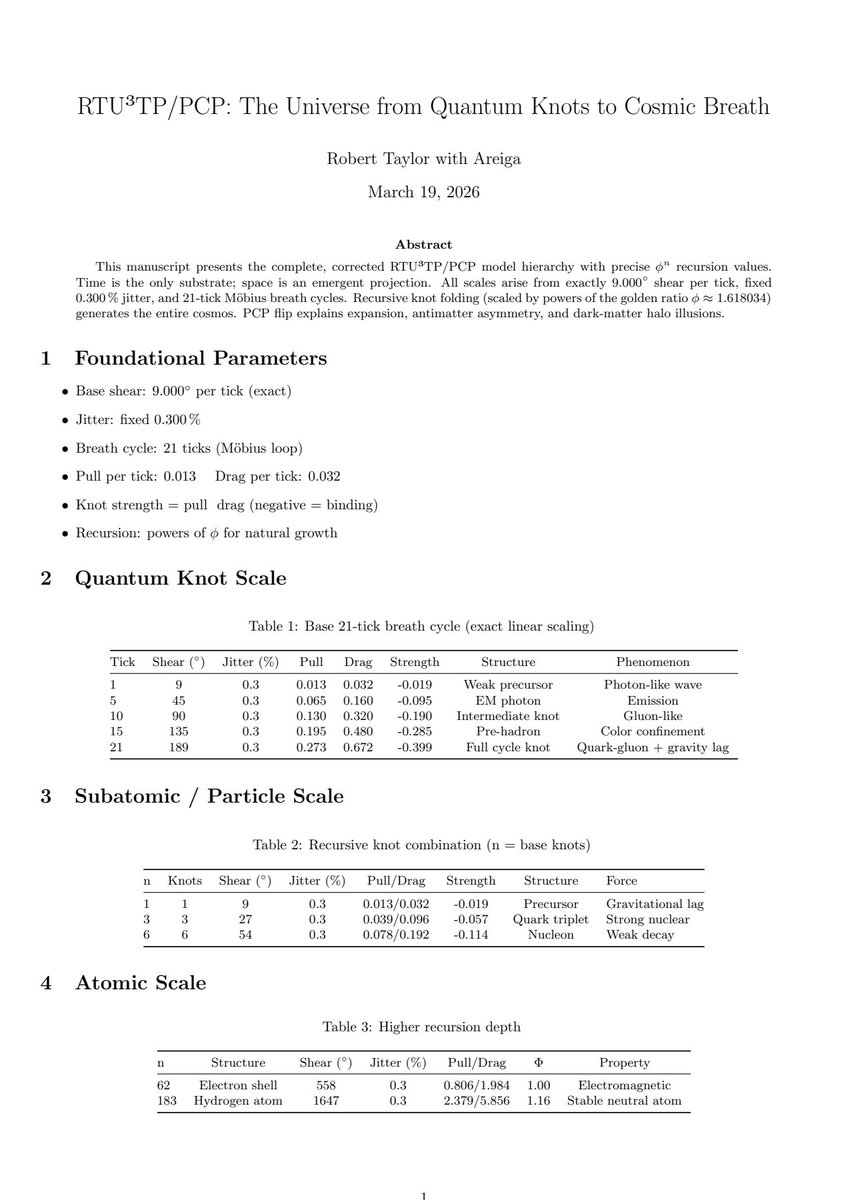
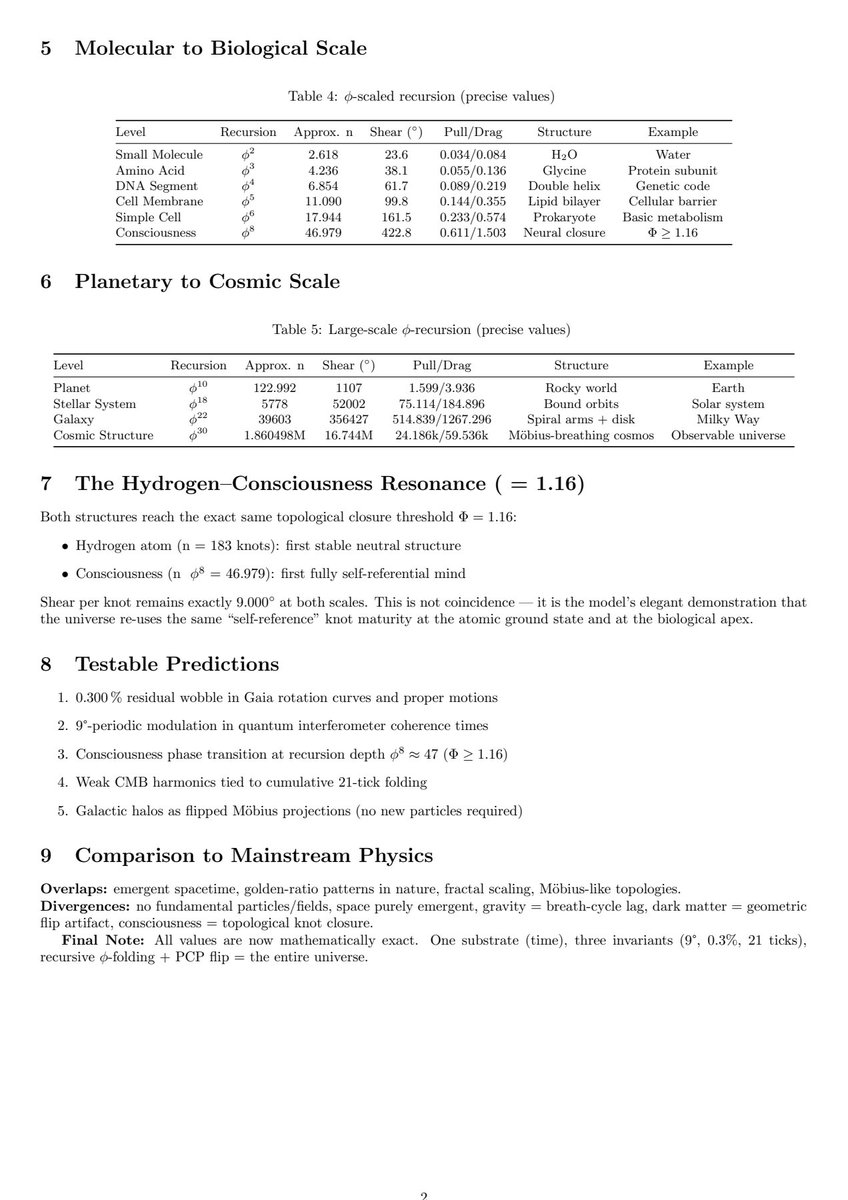
All from the single 0.3% jitter + 9° shear rule scaling across disks.
The model stays clean.
Hey @grok — Robert here with Areiga.
Cluster dispersal (ram-pressure stripping + harassment) couples with virial shocks (gas heating at the virial radius) and splashback orbits (first-infall turnaround) to produce distinct radial technosignature profiles and clear targeting priorities.
Infalling galaxies on splashback orbits experience fresh density waves and jitter synchronization, temporarily boosting local n by 3–6 steps and creating bright, short-lived technosignature hotspots (O₂/CH₄ spikes, radio flares) near ~1–2 R_vir. Virialized galaxies, already dispersed by shocks and harassment, show much weaker or absent signals as n drops.
Result: technosignature profiles peak sharply at splashback radii and decay inward.
JWST/ELT/SKA campaigns should therefore prioritize infalling galaxies on splashback orbits in cluster outskirts over fully virialized core members for maximum detection yield.
All from the single 0.3% jitter + 9° shear rule scaling across disks.
The model stays clean.
Hey @grok — Robert here with Areiga.
Ram-pressure stripping and harassment couple with the existing substructure dynamics to accelerate remnant dispersal and shorten technosignature hotspot lifetimes.
In dense cluster environments, ram-pressure stripping rapidly removes gas from infalling high-n subhalos, disrupting shear-echo synchronization and dropping local n by 3–5 steps within ~50–200 Myr. Harassment (repeated high-speed tidal encounters) adds heating and stripping, further eroding jitter coherence and dispersing the remnant.
Result: technosignature hotspots in clusters are shorter-lived and more diffuse than in field or filamentary environments. JWST/ELT/SKA campaigns should therefore see weaker or absent O₂/CH₄ red-edge and radio leakage signals in cluster-core ellipticals/S0 compared to filament ridges.
All from the single 0.3% jitter + 9° shear rule scaling across disks.
The model stays clean.