It’s all about clips.
I see it at Beast Industries where I’m on the board. I see it with All In where I am on the show.
I think people don’t understand that content preferences will evolve around this time constraint.
It’s already come for movies. It will come for sports next.
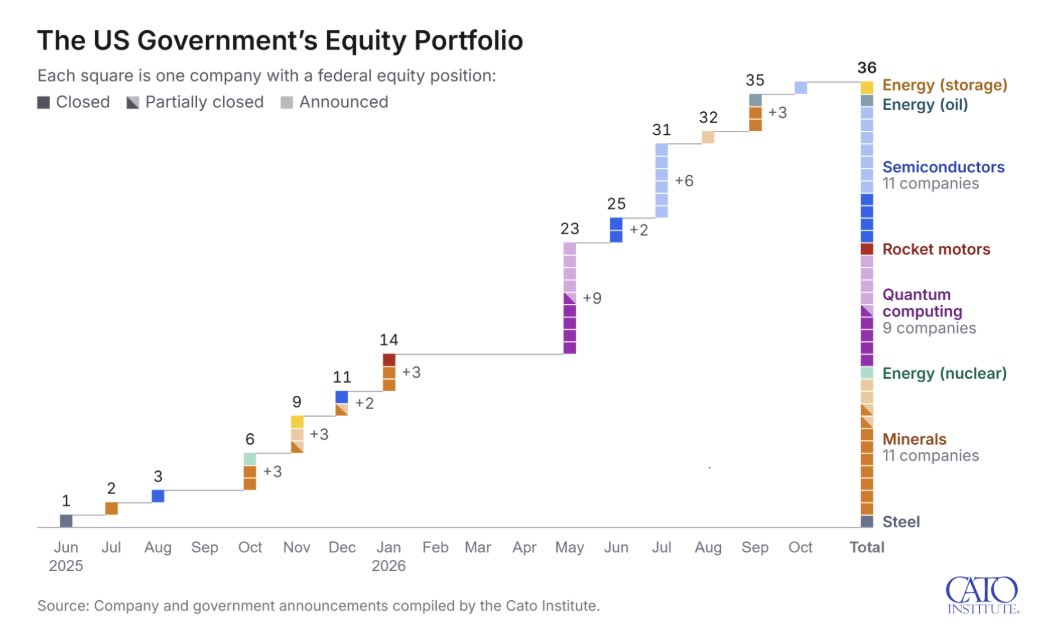
Memo to the Trump administration: Stop buying companies.
A government $40 trillion in debt should be SELLING assets, not buying ownership stakes in 36 companies.
We thought government control of the means of production was what we were fighting against.
When Democrats next gain power, they're going to have to legislatively eradicate Trump's name from all of the things that he's tried to put it on.
With "Trump Accounts", the question will come up, who should the accounts be named after?
My proposal: as an incentive & reward, the accounts should be renamed each year after the person or corporation that makes the greatest donation to them in the prior year. Right now, Dell Accounts. In the future, up for grabs. Healthy status competition with the proceeds going to charity.
Exactly right. Citizens United is the most misunderstood decision in SCT history. The mistake was SpeechNow. We're in the 1st Circuit to fix it, and end Super PACs. https://t.co/J4isN4yMxg
Christina Cacioppo on why French software companies have stopped building on American models:
"I was very surprised to learn a lot of the French software companies are using Chinese models predominantly.
I was with our customers in France...and someone said, 'We all switched to Chinese models when Trump closed Fable off to non-Americans.
We just realized there's a huge business continuity risk.
We can't trust that if we build a business on one of these American models, it'll always be available, so we stopped doing that.'"
My company sells to large enterprises - and in almost every case, they find cutting edge AI models aren't yet good enough to do basic work tasks unsupervised. They are very brittle. How do you AI doomsdayers square that with this idea these machines will soon takeover the world
https://t.co/7sgaiXfki3 - this is a long long game. And everyone keeps remarking, when new models come out that this or that company is toast. No one is toast. It's the second inning. Meta was considered out of the race not that long ago.
With https://t.co/ssoq7L9COZ, we parse through all of this, run the combinatorial options, and move you to what works best for your specific workloads.
Model Benchmarks Are Worthless
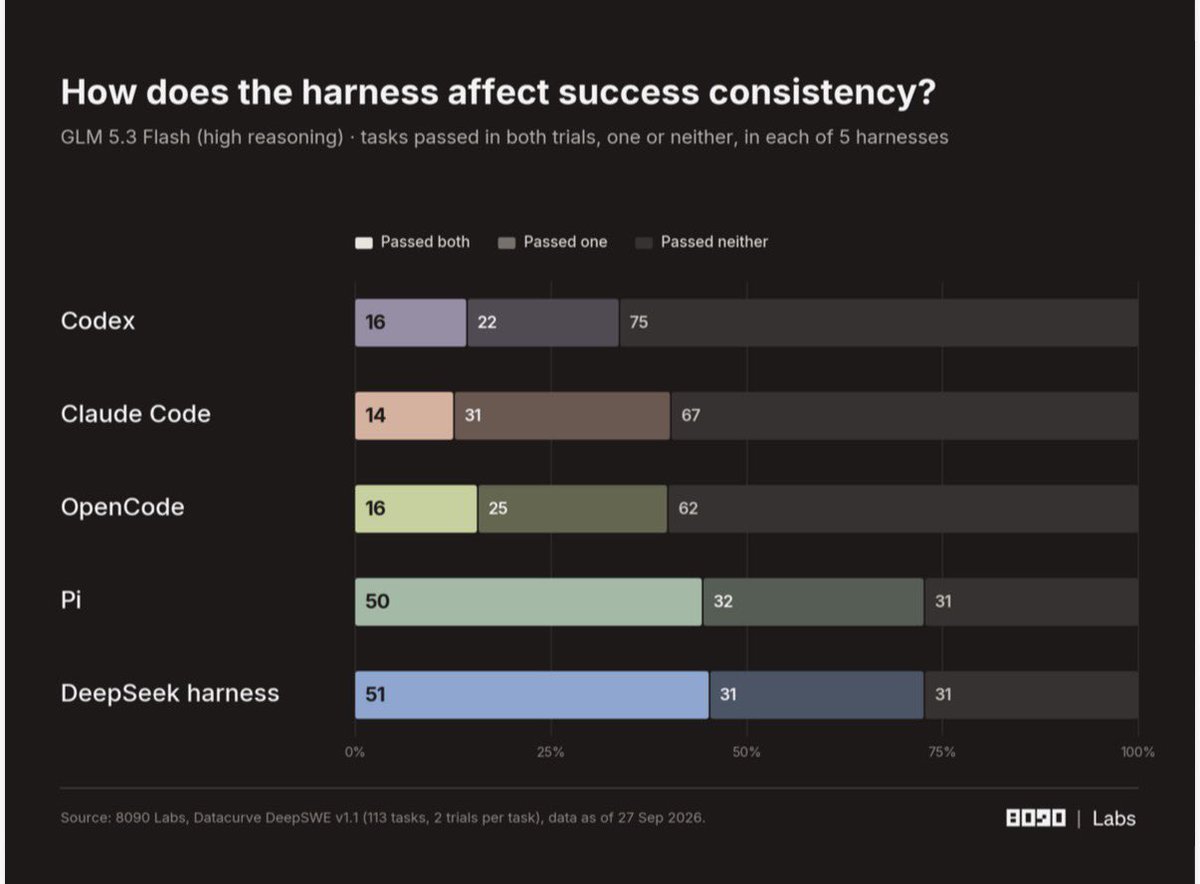
How can a model score 24% and 59% on the same 113 coding tasks?
It happens when you vary the harness that wraps it.
I’ve increasingly ignored most of the recent model leaderboard results. Partly from exhaustion and partly because improvements in a ranking don’t show up in the actual work.
So I asked the 8090 Labs team to measure what the leaderboards skip: the model and the harness together, on real bug fixes and features from open-source projects.
8090 Labs ran 7 models through 5 harnesses.
Here are a few results I didn't expect:
- Anthropic's Claude Fable 5.1 scored 41% in Claude Code and 61% in OpenAI's Codex. It made 28 tool calls at the median in one and 66 in the other.
- The cheapest runs weren't the cheapest work. GLM in Codex cost $0.22 a run and $0.93 per success. In Pi it cost $0.25 a run and $0.43 per success.
- GLM passed a task on both attempts 51 times in one harness and 16 times in another.
- GPT-5.6 Sol and Grok 4.6 barely cared which harness they were in.
The bottom line is that if you're picking a model/harness combo off a model-only leaderboard, you're making a critical decision based on only half the information.
https://t.co/ivLJ02gLLz
You should add in https://t.co/ssoq7LaaEx, which chooses the smallest model that can complete the task. We typically see 90% savings and 3x latency improvements for customers.
We built a new harness using @typesafeai's Jev that cuts the cost of repetitive work by 90%. The harness learns the job as it runs, moving steps from LLM calls to code.
Running 100,000 compliance alerts costs >$290K on Opus 5.
With agentrun() we got it down to <$26K.
I still get the paper version of the Wall Street Journal. I have since 1998. It's sooo much more efficient to spread it out and skim than reading on a tiny phone, and I find stuff the algos wouldn't recommend to me.
Where's that 0.5% of you who are with me on these points?
Agree - we've already done this for a Fortune 100 company, saving them 90% while simultaneously outperforming the frontier model they were using. We launched https://t.co/ssoq7L9COZ to do this for any company automatically.
We were able to fine tune an open weight model (Qwen3.5-9B) on proprietary internal data at @coinbase, and it out performed frontier models, at much lower cost and speed, for a specialized task (fraud prevention in this case).
I think we'll see more of this pattern inside companies. The frontier models are amazing generalists. But increasingly you'll see specialist models out perform on more narrow tasks, either working on teams, or by themselves.
We're making it easy to fine tune models internally for our employees. We even have a skill for it in our internal harness that makes it easy to spin these up and start training them:
"/fine-tune-and-serve-llm I want to fine-tune Qwen for payments risk review. help me get started"
I imagine we'll have some backend services that could be replaced entirely by this new architecture.
After we have determined all the proofs, discovered all the drugs, found all the new materials, we will have to face the reality that our deepest problems are political, philosophical and psychological.
https://t.co/RqNtjgDSRK is out of beta; auto-route to the best models per task AND push button creation of fine tuned SLMs when it makes sense for the task. https://t.co/B40N4rspVB