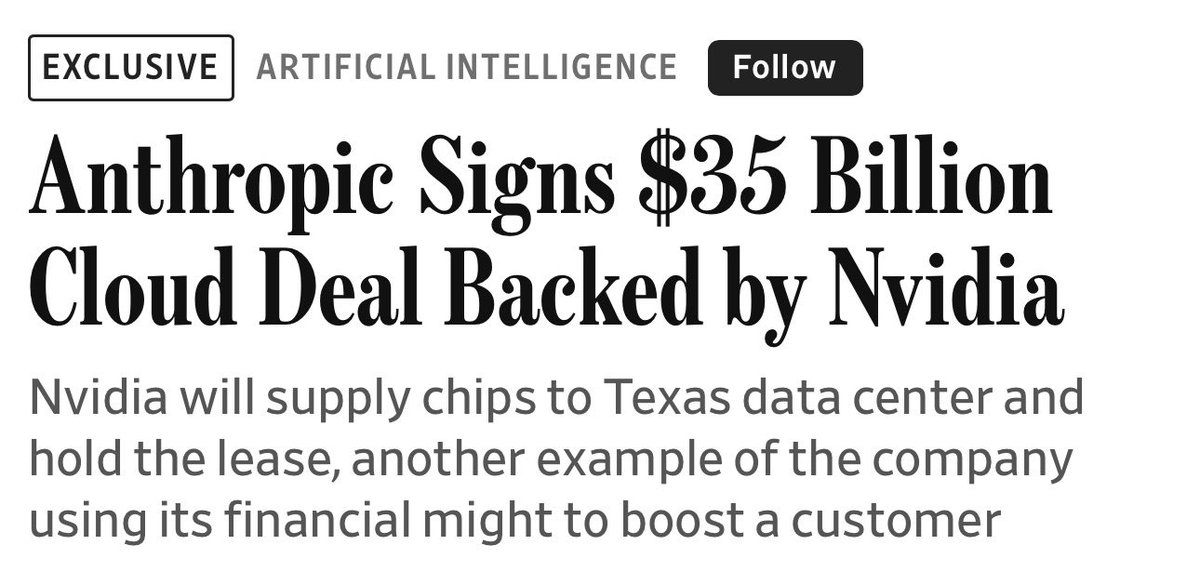
Anthropic has signed a $35B cloud deal with $NVDA backed Lambda to expand its AI compute capacity.
What makes the deal more interesting is that Nvidia also supplies the GPUs and already secured the $HUT data center capacity where that compute will run.
If Anthropic's S-1 drops in September and the IPO happens this fall, one of, if not the #1 question the market will be asking is where they will spend the proceeds.
The answer is compute deals. They don't have enough and their competitors (OAI, SpaceX, Google) have more.
$NBIS has crossed the point where the debate is about whether Nebius can build an AI cloud, and into the much harder question of what that cloud becomes at scale.
Q2 gave the thesis real operating weight, with $3.0B of AI Cloud ARR, 49.7% adjusted EBITDA margins, four contracts averaging more than $1B of total contract value, and customers funding 50% to 60% of associated capex upfront.
The more interesting signal sits in pricing, as Nebius says it could sell all planned 2027 capacity today while holding some capacity back for higher-value demand, with an auction clearing 15% above its previous Blackwell pricing record.
That creates a fascinating gap between the $16B of capital currently employed and the $157.5B of revenue implied by bullish 2030 forecasts, because assets under construction today will eventually become revenue-generating infrastructure across multiple hardware generations.
The real valuation question therefore sits between the $840B capital requirement implied by a static 5.33x ratio and the $1T equity value implied by extrapolating current MW economics, with utilization, contract duration, hardware cycles, financing structure, and pricing power determining where Nebius actually lands.
🚨JUST IN: TOGETHER AI SIGNS 250MW DEAL WITH SAUDI ARABIA’S HUMAIN, ONE OF THE LARGEST AI INFRASTRUCTURE DEALS FOR OPEN SOURCE MODELS
1. Together AI is one of $IREN customers.
2. 250MW over the next 12 Months.
3. 100K+ GPUs.
$IREN CEO untangling the print himself. Worth reading twice, because it matches what the filing said all along. 👀
The mechanism most missed: the $684M loss is the cost of retiring miners so those megawatts can be re-leased at over $20M per MW. Mining earned a small fraction of that per megawatt. The write-down is the toll for converting a low-yield asset into a high-yield one. Impairments are what conversion looks like on a P&L.
The line to underline: ~$19B raised, ~$3B of it equity, and not a dollar borrowed against the data centers yet. That's $7.6B of unencumbered property sitting in reserve. Dilution went from mandatory to optional, and the biggest lever hasn't been pulled.
Three sites commissioning into year end to bring $4B of ARR online. That's the 2026 story. 2027 is Sweetwater.
Long $IREN
I commend $IREN CEO here for coming out and clarifying some of what was missed last week.
The big investments need to be coupled with big (confirmed) growth. The more evident that is the more irresistible this name should become. 👏🏻
A few people have Thursday's numbers tangled, so let me untangle them.
The majority of the $684m loss is the cost of retiring Bitcoin miners as we convert those sites to AI Cloud. Non-cash. The cloud business underneath ran ~87% gross margins (ex D&A).
Every megawatt that comes off mining goes back on at multiples of the revenue. Recent 3-year AI Cloud contracts are at >$20m per MW (IT), more than double late last year.
And the $25-30bn of forecasted FY27 capex isn't an equity number. Customer prepayments can cover about half the GPU capex. Lenders can fund most of the rest. We raised ~$19bn over the last twelve months and only ~$3bn of it was equity. We haven't borrowed a dollar against the data centers yet either.
$4bn of ARR is contracted, with three sites commissioning between now and year end to bring it online. And that's the 2026 story. The real ramp is 2027, when Sweetwater and the next wave of capacity come into play.
It's delivery time.
$IREN CEO Dan Roberts is adding context to ~$30B FY27 CapEx figure which I think was the biggest miss on the earnings call because we got the spend without the corresponding ARR build.
He says “customer prepayments can cover about half the GPU capex” with debt funding most of the rest while 3-year AI Cloud contracts are now pricing above $20M per MW.
These are the only $NVDA -Certified Hypervisor Partners
1. $IREN subsidiary Mirantis
2. $AVGO subsidiary VMware
3. $IBM subsidiary Red Hat
4. OpenNebula
5. Rafay Systems
Source: $NVDA Official Website
I wrote that Jews and Christians should stand together.
The comments filled up with Muslims and leftists telling me it should be Christians and Muslims. Same floor. Same root. Brothers of the book.
Last year that brotherhood killed 4,849 of us.
Christians are the most persecuted group on earth. 388 million now live under high or extreme persecution. More than one in seven Christians on the planet.
Of those 4,849 killed for their faith, 93 percent died in sub-Saharan Africa.
Nigeria alone: 3,490 people, murdered for being Christian. 125,000 have been killed since 2009. Around 32 a day right now.
Go look up who killed them.
Boko Haram and ISWAP in Nigeria. Al-Shabaab in Somalia, where not one open church remains. Islamic militias in Mali, Burkina Faso and Niger, handing villages the choice of conversion, jizya or flight. The ADF in Congo, beheading villagers in Allah's name. ISIS in Mozambique. The Taliban in Afghanistan, where a Christian has no legal existence at all. The blasphemy laws in
Pakistan, where Christian girls of twelve are abducted, forcibly converted, and handed back to their kidnapper by a court. The Copts in Egypt, bombed inside their own churches.
Iraq had one and a half million Christians in 2003. Today under 250,000. Syria had more than two million. They are gone.
That is not crossfire. That is a direction.
Now the part where the conversation always gets shut down.
Islam was not built as a private faith. It was built as a state. Muhammad was lawgiver, judge and commander in one.
Christianity began with a man on a cross who said his kingdom was not of this world.
Islam began in Medina with an army. Classical jurisprudence divides the world into dar al-islam and dar al-harb, the house of Islam and the house of war. The objective is that the first expands until the second no longer exists.
And people want it. Pew surveyed 38,000 Muslims across 39 countries. 99 percent
in Afghanistan want sharia as the official law of the land. 84 percent in Pakistan. 86 percent in Malaysia. Nearly eight in ten across sub-Saharan Africa.
That is not the fringe. That is the centre.
Now try this.
A Muslim stands up and says: Jesus is God.
In that second he is no longer a Muslim. Placing anything beside Allah is shirk, and according to the Quran it is the one sin that is not forgiven. Sura 5:72 says it plainly: whoever calls Christ God is an unbeliever.
What does it cost? At least 22 countries criminalise leaving Islam. In roughly a dozen of them it can cost your life. Saudi Arabia, Iran, Afghanistan, Yemen, Sudan, Somalia, Mauritania, Qatar, the Emirates, Pakistan, Malaysia, the Maldives, Brunei.
Elsewhere you lose your marriage instead, your children, your inheritance, your citizenship. In Malaysia, Lina Joy fought six years for the legal right to leave Islam. She lost.
And outside the courtrooms, the family is waiting.
A Christian who converts to Islam in the West gets a welcome ceremony and a post on social media. A Muslim who converts to Christianity changes his name, moves city, and never tells his mother.
There is your same root.
So no.
If that solidarity were real, it would run both ways. Where were the marches for the 3,490 Nigerians? Where was the Friday sermon about the burned churches in Burkina Faso?
It does not exist. Solidarity that only switches on when it can be aimed at a third party is not solidarity. It is an alliance against someone.
There is not one Muslim-majority country where Christians hold full and equal rights. Not one.
Meanwhile there are Western countries where Muslims hold more rights than Christians hold anywhere in the Muslim world. The whole case sits inside that asymmetry.
And let us not pretend this only happens out there. We carried the ideology forward ourselves. Not under force. Out of politeness. CONTINUES👇🏽
Terrible looting, massacres of the Greek Christians, and enslavements that lasted for three days accompanied the capture of Nicosia by the Turks in 1570. The Muslims seized and destroyed everything in their path, even the churches. They cut off the heads of even old men to test their swords, while they dragged others into captivity, especially those they judged could bring them great profit.
In the end, they set up a slave market where they sold the beautiful Greek boys and girls. The Turks themselves boasted that their looting surpassed that of Constantinople.
After the fall of Famagusta (6-8 August 1571), the Turks stripped the Venetian defender of the city, Marcantonio Bragadin, placed him on a cow, and paraded him in humiliation to the sound of drums and the shouts of the Ottomans. They then threw him down and flayed him alive. They filled his skin with straw, hung it from the mast of the galley belonging to the captain of Rhodes, while they cut his body into pieces and hung them from the ship’s cannons. The galley then sailed along the coasts of Syria, so that the victors could seal their… triumph in this way.
In 1571, the Turks completed the conquest of Cyprus. The spoils were enormous. Among other things, they captured many Greek girls, whom they boarded onto a ship bound for the slave markets. Among them was the noble-born Maria the Synkletiki (Maria the Senator’s Daughter), who stood out for her beauty. In order to spare both herself and the other girls the humiliation of being sold, she found a way to set fire to the ship’s gunpowder magazine. The explosion that followed was terrible. All the girls and the Turkish crew perished.
She chose death over slavery.
Gavin, spot on.
AI is bringing manufacturing back to America and reindustrializing the nation after decades of offshoring.
AI is creating demand that drives investment in our aging power grid and sustainable energy, powered by market forces, not subsidies.
AI is creating construction and manufacturing jobs across energy plants, chip fabs and data centers.
AI is creating new companies and industries. $400 billion has been invested in AI startups in the past six months alone.
Builders must partner with communities to build in their hometowns, earn trust and create local benefits.
We have an opportunity to create lasting benefits for communities across America and help America lead the next industrial revolution.
The Key Takeaways from IREN’s Earnings Report
There are several key takeaways from IREN’s latest earnings report:
New vs. Old, Fast vs. Slow
The AI business has begun to grow substantially, but its base is still very small. For the first time, it has surpassed the mining business, and IREN explicitly stated that it will completely exit Bitcoin mining by the end of December 2026. Most of the relevant assets associated with the former mining business have already been written down. The remaining losses will depend on how the mining machines perform in the secondary market, but the additional losses that could arise are already very limited. This marks a critical turning point in the transition from the old business to the new one.
IREN has adopted a slow-ramp strategy for its AI business. Signing contracts is not the bottleneck; actually bringing the GPUs online is the bottleneck. If the goal were to “turn compute into revenue as quickly as NBIS,” IREN would absolutely have the conditions to pursue a path of rapid deployment using air-cooled, quick-install facilities, pre-purchasing large quantities of Hopper-generation GPUs, signing contracts quickly, and billing customers quickly.
But they did not choose that path.
They have their own plans and their own sequence of steps. They are betting on liquid cooling and higher-performance GPUs. Even Canal Flats in Canada, which originally could have been brought online quickly, has now been converted entirely to liquid cooling. As a result, the monetization of compute capacity has been pushed back by roughly a year.
I do not intend to conduct a comprehensive, long-form analysis of this earnings report. I will simply highlight a few key points.
For example, the complete conversion of Canal Flats to liquid cooling is highly representative. The reason IREN’s stock price is currently unable to move higher is that its AI revenue base is still too small. But does IREN have the ability to make that number substantially larger? Absolutely.
If that had been the objective from the beginning, IREN’s AI sales would not be far behind NBIS. IREN had already been operating H100/H200 GPUs several years ago and already had cloud-business revenue. If it had simply sold bare-metal compute, accepted hyperscalers’ demands at relatively low prices, and consumed its MW capacity in advance, rapidly scaling AI compute revenue in the short term would not have been difficult.
Compared with CRWV and NBIS, IREN’s software capabilities are somewhat weaker. But when it comes to selling bare-metal compute, there is no fundamental difference among the three. NBIS’s transactions with hyperscalers are essentially pure bare-metal arrangements.
IREN did not choose this model.
Instead, it is betting on the future, while building several important capabilities along the way:
First is software capability.
The defining event was the acquisition of Mirantis.
Second is liquid-cooling capability.
The defining event was the delivery of 50MW Horizon 1, together with its achievement of high-level performance certification. By the end of this year, IREN is expected to have 200MW of liquid-cooled data centers delivered. This will be a remarkable event for the entire industry.
Third is the AI Factory.
The defining event is that SW1 will become a flagship AI factory under NVIDIA’s DSX system.
Fourth is financial capability.
The defining event is the continued recruitment of senior financing talent from KKR. IREN is preparing extensively to turn its wholly owned, fully vertically integrated data-center assets into a new type of financial asset.
This is an advantage that only IREN possesses, and it will be one of the most important pieces of the growth flywheel that is about to emerge.
IREN has been slow in growing AI sales—almost a year behind.
But now I can basically confirm that, going forward, it will rapidly catch up. At some point, it will completely surpass NBIS and CRWV.
You only need to look at how much performance Vera Rubin delivers compared with the previous generation of chips to make a rough judgment.
What matters most right now is absolutely not selling relatively inefficient compute converted from electricity as quickly as possible, and then using temporarily attractive numbers to exchange for temporary stock-market glamour.
That is a huge trap.
What matters most now is patience: carefully building infrastructure capable of converting electricity into compute efficiently and at high quality.
AI compute revenue at the Canal Flats site has been delayed by a year, but once it goes live, one month of revenue could potentially make up for the entire year of revenue generated by lower-end GPUs.
And as subsequent GPU generations iterate, the marginal cost will be extremely low.
Meanwhile, CRWV and NBIS, which are running faster today, will gradually begin to run out of momentum.
Even if they manage to maintain their lead in obtaining GB300 and Vera Rubin GPUs, it will be extremely difficult for them to move as quickly as before. The reason is that the supply of liquid-cooled data centers has become a massive bottleneck.
It is more complex and difficult than any individual bottleneck we are seeing today.
The TIME TO COMPUTER that IREN has repeatedly emphasized—where the bottleneck is actually bringing the GPUs online—is specifically referring to this.
Gaining an advantage here is extremely difficult.
The first and foremost challenge is capital investment. This is a problem everyone faces. There is no way around it. It must be confronted directly, and it is the most important issue that has to be addressed.
In this earnings report, IREN did not even provide guidance for 2027. But it clearly provided its capital expenditure outlook: $2.5–3.0 billion.
This is the investment required to solve the bottleneck.
The market therefore became concerned about dilution, and the stock declined.
But in reality, IREN’s dilution pressure is approaching a major inflection point.
There will still be some dilution, but compared with the past, this pressure will become increasingly lighter, and eventually could disappear altogether.
I analyzed this in detail in my long-form article last week. IREN possesses unique advantages that others do not have. These advantages come from vertical integration, and their various benefits will continue to emerge in the future.
The speed of CRWV and NBIS today has been achieved by sacrificing a great deal of future decision-making autonomy.
They will become increasingly passive.
They constantly have to fulfill orders that have already been signed, leaving them little room to develop many of the capabilities that could improve their pricing power.
If IREN has 1.2GW of compute online by the end of next year, while CRWV and NBIS each have perhaps 2GW, it is entirely possible that IREN could match them in terms of compute sales.
Why?
Because IREN’s GPU mix is primarily high-end chips, while CRWV and NBIS are primarily using mid- and lower-end chips.
Even if you have the ability to obtain high-end GPUs from NVIDIA, if your data-center capabilities are not capable of supporting them, that advantage is meaningless.
It is almost impossible for CRWV and NBIS to retrofit those air-cooled data centers to significantly improve their efficiency.
First, most of them are leased, so they do not have full decision-making authority.
Second, the capital investment required is enormous.
Third, the pressure to fulfill existing orders leaves them no time to wait.
They have no choice but to operate at full capacity whenever even a single unit of electricity becomes available. Otherwise, the pressure from potential contract breaches would be enormous.
Two weeks ago, when I watched the VINELAND hearing, I genuinely felt the enormous pressure.
Although the project was eventually approved and can proceed normally, thinking about it afterward made me realize something:
What was fought so hard for was simply the basic protection that a normal construction project should have in the first place.
For such a complex liquid-cooled data center, even when all parties are cooperating, there will still be all kinds of problems.
In the future, the emergence of one problem after another is virtually inevitable.
Pushing yourself into such a constrained and involuntary position through competition, in exchange for a temporarily soaring stock price, is actually a sign of a lack of long-term judgment.
The model of signing contracts early and accumulating a large backlog of orders is fundamentally problematic.
Emerging industries are inherently characterized by rapid change, high risk, and little room for error.
Using this model to force yourself into a constantly spinning bellows is simply unwise.
You do not need complicated data to prove it. The state of being trapped in such a position is itself sufficient evidence of how passive you have become.
Indeed, IREN has not yet received market recognition.
But it is extremely proactive.
It is proceeding methodically, calmly, and according to its own predetermined plan, without allowing the market to dictate its actions.
That is the standard of an excellent management team and an excellent board of directors:
Stay committed to doing what you believe needs to be done.
IREN’s technical strength has several important endorsements.
Some of the top liquid-cooling experts in the United States have been brought into IREN. This year, IREN has attracted cloud-technology executives from multiple companies with hundreds of billions or even trillions of dollars in market capitalization.
At the same time, IREN is working with NVIDIA to jointly build an AI Factory under the DSX architecture.
All of these efforts are focused on the next generation of the AI compute industry.
And the Horizon 1, which comprehensively demonstrates IREN’s technical capabilities, has already been certified and placed into operation.
Horizon 2–4 will follow soon.
The change in scale will bring about a massive qualitative transformation.
IREN is becoming an important core player in the infrastructure of the next generation.
Customer Quality and Diversity
IREN announced a multi-year contract with a frontier AI laboratory.
Other than that, it said nothing.
It did not even provide ARR guidance for 2027.
I believe this must be related to this contract.
Moreover, both the total contract value and the price per MW in this agreement are historically the best IREN has ever achieved.
As for who this frontier AI laboratory actually is, I wrote four long-form articles on this subject several months ago, so I will not elaborate here.
The probability that it is Anthropic is extremely high.
The key point is the quality and diversity of IREN’s customers:
NVIDIA, Microsoft, Cohere, Prometheus, Perplexity, Figure AI, Fal AI, Higgsfield AI, Firework AI, Together AI.
This list is exceptional.
There is an enormous amount that can be analyzed here, and it is more than enough to demonstrate that IREN possessed tremendous differentiation from the very beginning.
Its future potential is off the charts.
I have also analyzed these issues in dedicated articles before, so I will not repeat them here.
Finally, I want to say this:
IREN’s problem is fundamentally not a communication problem. It is a problem of understanding.
Professional institutions are buying in heavily and in large quantities.
As long as those short-sighted investors who do not understand what they are looking at continue to leave, the question for us as investors is very simple:
Are you investing in the future, or are you investing in the present?
Everything you need is in this table. It just needs one division -> Market cap per dollar of next-year capex: $NBIS $2.50, $CRWV $1.25, $IREN $0.48. The market is charging five times more for $NBIS buildout dollars than $IREN's.
$IREN "nearly 100% secured" is true for the GPUs specifically. $6.5B of financing plus customer prepayments covers over 100% of GPU capex. The data center slice is the open item, backed by $7.6B of unencumbered property waiting to be levered. Call it ~$19B secured against $25-30B total.
Why the ratio matters: recent $IREN contracts pay back in roughly 2 years. Deploying twice your market cap into 2-year payback assets is how small companies stop being small.
Same buildout. Five different prices.
Long $IREN
Regret the tone of my post on data centers yesterday.
What I should have said:
There were reasonable concerns about data centers 18ish months ago: water, taxes, jobs, electricity prices, the environment and what they would do to small towns. Well-structured data center projects have largely addressed these concerns today and we should be celebrating this.
On balance, data centers are awesome for America in every way.
On water: U.S. data centers use a fraction of what golf courses use. A lot of the numbers from 18 months ago were off by over 1000x. Newer data centers use closed-loop systems or recycled water. Should be required by every town approving a data center project.
On taxes: looking only at sales-tax exemptions, as Ronan Farrow did, is the wrong way to evaluate this. Data centers pay significant property taxes. Loudoun County, which is the wealthiest county in America, now collects on the order of $1 billion a year from data centers. In Quincy, WA, data centers are more than half the property-tax roll. Over time, property taxes can go to zero while government spending increases in these towns.
On jobs: this has been unambiguously awesome for blue collar Americans. Demand for electricians, plumbers, welders, HVAC techs, and contractors has gone vertical, and it is not a one-time construction job. These buildings get upgraded and expanded over time. That is why the building trades are fighting for them, and why some unions are now treating opposition to data centers as a reason not to endorse politicians.
On power: the original fear was that households would pay for the incremental electricity demand in the form of higher prices. That is why the ratepayer-protection deals and the new large-load tariffs exist. The right structure is: the data center brings or pays for new generation and signs a contract long enough that existing customers are protected. Where that is happening, utilities are cutting or freezing residential rates and saying so on the record. Where it is not, people are right to object. Electricity prices are going down *today* in a number of large states because of data centers.
On the environment: data centers overwhelming use natural gas today, which is the cleanest power source outside of nuclear, solar and wind. And the companies that are building the data centers are committed to carbon neutrality such that an equivalent amount of solar will likely be built. Maybe more importantly, the data centers need batteries to function effectively and these batteries can also sell energy back into the grid (which recently prevented blackouts in Texas). Over time, data centers will run on solar plus batteries.
On the towns: Poverty in Quincy, WA fell from 29% to 6%. Data center taxes paid for a new high school, a hospital, a library, police and fire stations. This is happening in many left for dead former mill and farm towns that had no other bidder for the land.
Data centers are actually reindustrializing parts of America and creating the kind of working-class jobs both parties have spent decades claiming to support. That should not be a partisan issue. Data centers can and should be awesome for America and they increasingly, overwhelmingly are. Supporting the outsourcing of data centers to China will likely age just as well as support for the outsourcing of high quality, blue collar manufacturing jobs to China has aged.
When the facts change, I change my mind. I hope that reasonable people who had good faith reasons to oppose data centers at least consider updating their beliefs given the change in the facts over the last 18 months. This really matters for America.
I will say I also think the idea of making data centers beautiful is a good one that has yet to be implemented. Data centers should be just as beautiful as Grand Central Station. We can learn a lot from the railroad buildout. Neoclassical revival ftw.
Might write up open-weight AI tomorrow as this is equally essential to America.
$IREN is hiring for a Construction Supervisor position at Sweetwater
"you will oversee the installation of some of the most advanced mechanical and liquid cooling systems used in next-generation data centers."
In 1822, Muslim Turks captured two Greek Christian women and attempted to force them to convert to Islam. The women refused. As punishment, they were smeared with honey on their heads and tied up in the open, exposed to the stings of wasps as well as to the abuse of passersby. The wife of Zafeirakis was built into the wall of the Church of Hagia Sophia in Thessaloniki up to her neck. She was left there for days, exposed to the entertainment of the wild mob that gathered to curse her and strike her protruding head with sticks. She did not waver for a moment. Strengthened until her last breath by prayer, she never abandoned her Christian faith. Her martyrdom lasted five days. A passing gypsy woman, seeking to hasten her end, threw a large stone at her head. Thus, the blessed woman delivered her heroic soul into the hands of God, Whom she had never denied.
The other Greek Christian woman, Maria, also refused to renounce her faith. For this, Ebub Lubut enclosed her in a sack with deadly snakes, where she was martyred.
The historian Eustathios Stougiannakis writes:
"The acute venom that diffused into the veins of the martyr from the bites, however, killed her in a sweet lethargy. Praying until the last moment for her executioners, she invoked the Most High and the Virgin."
The lifeless bodies of these holy women were eventually thrown into the sea.