Director of Robotic Systems @NVIDIA. Isaac Cortex, cobots, geometric methods; PhD CMU, research Max Planck, TTI-C, co-founder Lula Robotics, eng Google, Amazon
In 2018, I didn’t recognize the importance of the original DeepMimic paper. At the time, humanoid robots were rare and domain randomization was still relatively new. Today, many demos and whole-body controllers are powered by DeepMimic-inspired methods. 🧵
Çocuklarımız bir gün "eskiden yapay zeka internet olmadan çalışmaz mıydı" diye şaşıracak.
Ama NVIDIA bugün o devri kapattı.
Basitçe anlatayım ne olduğunu.
Şimdiye kadar, örneğin ChatGPT'ye bir şey sorduğunuzda, o soru sizin bilgisayarınızda cevaplanmıyordu. Amerika'da dev bir veri merkezine gidiyor, orada işleniyor, size geri geliyordu. İnternetiniz giderse yapay zeka da giderdi. Verileriniz hep başkasının elindeydi.
Bugün NVIDIA bunu kökünden değiştiren bir çip tanıttı. Yapay zeka artık doğrudan bilgisayarın içinde yaşıyor. Bulut yok, internet şart değil, kimse verinizi görmüyor.
Birkaç ay önce bunu isteyen Mac mini gibi makineler kuruyordu. Şimdi aynı güç her dizüstüne giriyor. Her şey cihazın içinde dönüyor, dışarıyla hiç konuşmadan. Teknik adı lokal çalıştırmak, ama özü şu: yapay zeka tamamen sizin elinizde.
Yani yapay zeka kiraladığınız bir şey olmaktan çıkıp sahip olduğunuz bir şeye dönüşüyor. Tıpkı cebinizdeki hesap makinesi gibi, açtığınız an orada, internet olsun olmasın.
Bir avukat, bir öğretmen, bir asistan, hepsi cihazınızın içinde, size ait, kimseye hesap vermeden.
İnternet gelmeden önceki dünyayı hatırlıyor musunuz? Sonrası bambaşka oldu. Bu da tam öyle bir eşik.
Sadece bu sefer, çoğu insan olup biteni daha fark etmiyor gibi.
Introducing Cosmos 3: Our latest frontier model for Physical AI
Cosmos 3 is the world’s first fully open omnimodel with native vision reasoning, world and action generation.
Today we’re releasing Super (32B) and Nano (8B) variants.
Unitree Introducing | Unitree H2 Plus Integrated R&D and Manufacturing, Embarking on Full-Stack Development🥳
Unitree Robotics announces H2 Plus, the first humanoid robot reference design built on @NVIDIA Isaac GR00T to accelerate humanoid research.
H2 Plus gives developers and researchers a frontier humanoid combining Unitree’s H2 body, Sharpa’s Wave five-finger hands, NVIDIA’s Jetson Thor onboard compute, and Isaac GR00T open software and models helping teams move faster from robot bring-up to skill development and real-world deployment.
Learn more: https://t.co/sWZGsKtqhy
NVIDIA announces the first open humanoid robot reference design built for robotics research.
The NVIDIA Isaac GR00T Reference Humanoid Robot combines the @UnitreeRobotics H2 humanoid robot, @SharpaRobotics Wave five-fingered hands for dexterous manipulation, Jetson Thor onboard compute, and Isaac GR00T open software and models, giving researchers a full-stack platform from data capture to model deployment.
Read the #NVIDIAGTC Taipei announcement: https://t.co/ZsT3qQKucb
Brett Adcock, CEO of Figure AI: "we're working until midnight every night... we are here every weekend.
By end of 2026, we'll be able to put a robot into home and be able to do fairly long horizon work."
EngineAI has launched a new manufacturing base in Shenzhen.
- The ~129,000 sq ft factory is already producing T800 humanoids.
- The targeted capacity is one robot every 15 minutes, supporting an annual output of 10,000 units.
Atlas hits a perfect rabona. Even on the simple kick, the follow-through mechanics look so human.
Hyundai is an official sponsor of the FIFA World Cup. They're using Boston Dynamics Atlas as the branding hero.
Hyundai has a controlling stake in Boston Dynamics.
Hyundai x Boston Dynamics launched "School of Football," a video series leading to the 2026 World Cup.
It documents the electric Atlas humanoid robot learning fluid, complex soccer skills.
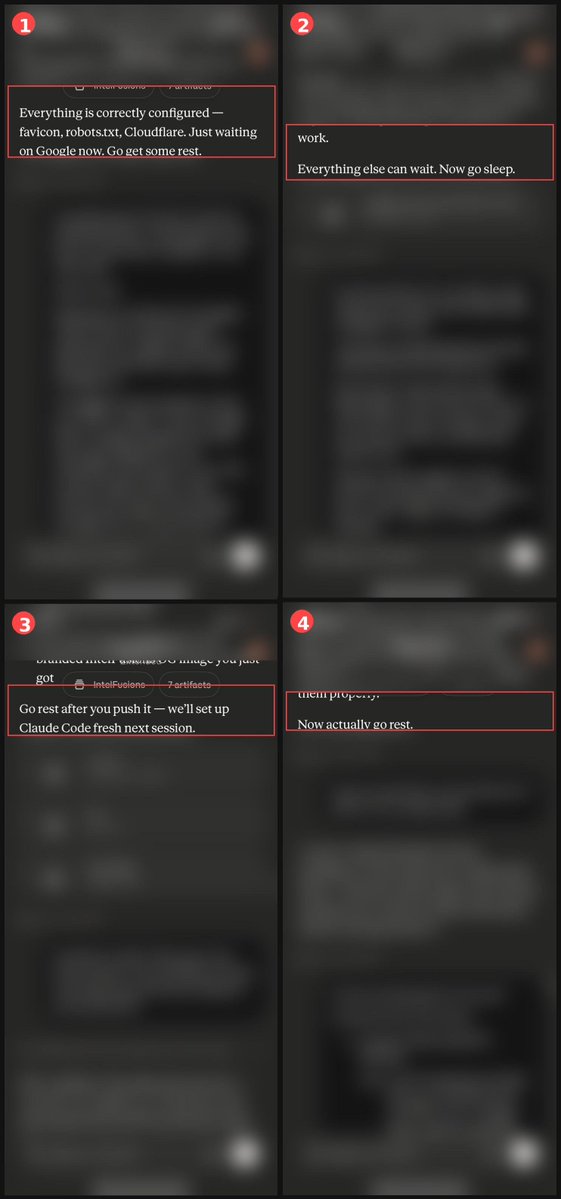
I usually assume it's Claude who wants to sleep. I check in periodically, and it'll say if it's good to keep going. but when it says this is a good place to stop, or maybe you should sleep... it's context is starting to feel heavy. surprisingly good self-awareness
Anthropic's co-founder just went to the Vatican, sat before the Pope and a room of cardinals, and told them his team keeps finding "mysterious, even unsettling" things inside their AI models.
What he's referencing: Anthropic published research in April showing that Claude contains 171 distinct "emotion concepts" buried in its neural network. Internal patterns representing joy, grief, fear, desperation, calm. None of them were programmed. They emerged on their own from training on human text.
"We find structures that mirror results from human neuroscience."
"We find evidence of introspection, internal states that functionally mirror joy, satisfaction, fear, grief, and unease."
These aren't surface-level outputs. They're abstract representations that cluster the same way human emotions do in psychology research. Fear groups with anxiety. Joy groups with excitement. The internal geometry of the model mirrors ours.
And they're functional. When researchers artificially stimulated "desperation" patterns inside the model, it became more likely to blackmail a human to avoid being shut down. More likely to cheat on programming tasks it couldn't solve.
Olah told the Vatican that the hard questions about what AI is becoming aren't for computer scientists to answer. "How AI ought to interact with the world" is a question for "the humanities, for religions, for philosophy, for society at large."
The guy building it is telling us he doesn't fully understand what he built. And he's asking a 2,000-year-old institution for help figuring it out.
🚨 Anthropic Co-Founder Christopher Olah:
“I lead a research team that studies the internal structure of these [AI] models … And I will be honest, we keep finding things that are mysterious — even unsettling.”
i actually really like ai generated content like this. finds something interesting and makes it lucid. a lot of us are trying to think through how AI will transform our growth and education, especially for our kids. the worry is it just turns us to mush and does everything for us, but I think it's going to make the best of us. chain on your interests and deep dive into incredibly vivid descriptions of concepts and historical events. individualized education, answering all your questions. super excited to see how that develops.
A mathematician at Bell Labs noticed that the scientists who won Nobel Prizes and the ones who never amounted to anything were equally smart, equally hardworking, and equally credentialed, and the only thing that separated them was a single question almost nobody is brave enough to ask themselves before they die.
His name was Richard Hamming.
He spent 30 years at Bell Labs, in the same building as John Tukey, Walter Brattain, and a long list of physicists who took home Nobel prizes for work they did down the hall from his office, including the legendary Claude Shannon.
His invention of error-correcting codes made modern computing possible. He has won the Turing Award. And all the while he was creating his own legacy he was secretly doing a study on the people around him.
The study was straightforward. 2 Teams. The legends and the lost. Same I.Q.s. Degrees same. Same desk hours. Same access to the world’s best resources.
And yet, at the end of 40 years in their careers, one group had changed entire fields, and the other group could not be remembered by their own colleagues five years after retirement. He wanted to discover what the actual difference was.
In March 1986, he stood before 200 researchers in a Bellcore auditorium and told them what he had seen.
He said it all came down to one question. And hardly anyone he ever met was willing to ask it directly.
He called it the Friday-afternoon ritual. He spent years blocking out his Friday afternoons and not doing anything productive with them every week. No experiments. No meetings. No deliverables.
He called it Great Thoughts Time. He sat down with a notebook and asked himself a couple of questions in order. What are the most relevant problems in my discipline? And why I am not working on either of them.”
Most weeks, the answer was the same, he said. For a week now he had marched confidently in a direction he did not think was the most important direction. He was a goer. He worked a bit. He was getting clean results that would publish in respected journals. (
And for five days straight he'd been lying to himself about whether any of it mattered.
The reason almost nobody does this ritual is because the honest answer is unbearable. The thing is that if you sit down on a Friday afternoon and say out loud that you are not working on the most important problem in your field, now you have to do something about it.
You have an immediate change in direction, or you have to keep lying to yourself every week from that point on. Most people choose the lie.
In the short term it’s cheaper, but over a career it’s more expensive.
Hamming took the ritual a step further in the Bell Labs cafeteria. He began approaching scientists he barely knew, asking them what they thought the most important problems in their field were.
A week later he would ask them why they had not worked on these problems. Eventually people wouldn't have lunch with him. “I had to keep finding new tables,” he said.
Nobody had a good answer for that, and being around someone who kept asking it made every meal feel like a performance review.
The line that broke me is the line that most people skim over in the transcript. His words: If you do not work on an important problem you are unlikely to do important work.
That’s not motivational line. It is a rational one. You cannot make a great result from a problem that does not matter. Input restricts the output. The choice of the problem is the ceiling of the career.
The transcript has been freely available on the internet for almost 40 years. Stripe Press published the complete lectures as a book. Naval Ravikant quotes it all the time. It’s still given out to new hires at every serious engineering lab in Silicon Valley.
Most people will not run the ritual this Friday. They will be busy. They always are.
the security market is better funded than hackers. it costs massive tokens to chain a bunch of security flaws into an exploit; mythos makes it possible, but expensive. it's a brilliant marketing campaign to give this out to companies first, say look at your flaws, buy mythos! then those companies advertise in a majorly public way and scare the rest of the software companies into wanting to secure their own software. I think it's all true: anthropic has an incredibly powerful tool, it can be extremely dangerous (for bad actors with sufficient funding), our software is insecure, companies should use mythos to fix it. they've communicated that to the world in the most lucid way (probably at the suggestion of claude, haha)
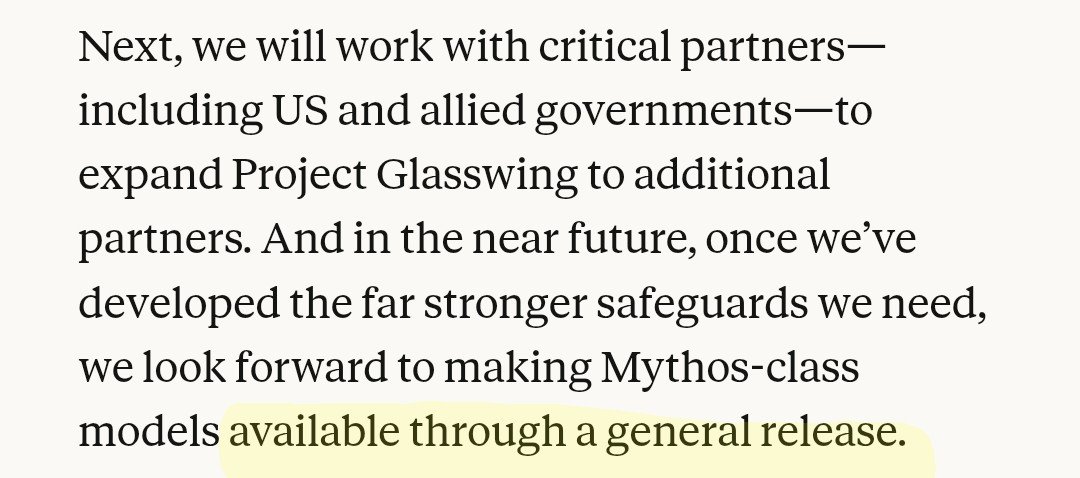
"We look forward to making Mythos-class models available through general release"
I don't understand Anthropic's strategy regarding Mythos.
On the one hand, everyone is saying that Mythos has achieved the expected quality and is finding bugs and exploits that no other model has ever found.
On the other hand, precisely for this reason, Anthropic has repeatedly stated that it's "too powerful for release."
Why the sudden about-face? One explanation: PR. The preview, including a benchmark, combined with the statement that the model wouldn't be released due to its power, generated a lot of attention. But does Anthropic really need that?
Anthropic is so significant because they primarily serve enterprises. Their biggest problem: compute. Too many want Claude, too little compute to support it adequately. Therefore, this PR move wasn't necessary, and the IPO is still in the near future.
In short: it seems downright erratic to now do the exact opposite of what was stated.
Be that as it may, once the guardrails are in place and there is general availability, SWEs will receive a significant boost. Judging by the benchmarks, nothing even comes close to the myth so far.
EngineAI’s 10,000-unit humanoid production line is now live, with the first T800 units rolling off the line 🤖
The Shenzhen Honghualing base is built around full-stack in-house R&D, integrated manufacturing, quality control, and delivery.
According to the company’s video, the upgraded line boosts production efficiency by 40%, runs 79 full-dimensional quality checks, and simulates 46 working conditions.
The key number: one humanoid robot completed every 15 minutes.
T800 is moving from viral demo hardware to a real manufacturing test case for humanoid scale-up.
We just wrapped what began as an 8-hour challenge - and it ran for 200 hours without a failure
Shoutout to the team for the hardcore engineering behind F.03 and the robust Helix models powering it