🌍 The Gulf is buying what the West is leaving. Abu Dhabi's state oil company just agreed to buy Shell's entire South African fuel business for $1 billion.
⛽ 580 fuel stations plus wholesale, aviation and lubricants. The Shell brand stays on the forecourts under licence. Drivers will notice nothing. The ownership is the story
📈 ADNOC's largest overseas acquisition ever. It expands the group's global network by 55% to around 1,600 sites and makes South Africa its fourth market after the UAE, Saudi Arabia and Egypt
🇿🇦 A 28% stake passes to a local empowerment partner and employees under South African law. The deal is expected to close in 2027, pending regulatory approval
🔄 The pattern: Vitol backed the Engen takeover. Glencore took Caltex. Now Abu Dhabi takes Shell. South Africa's fuel networks have been leaving Western hands for years, and this week Dangote confirmed his Lamu refinery. Africa's energy infrastructure is changing owners across the continent
💼 The uncomfortable question: these are cash generative, regulated, inflation protected assets. ADNOC praised South Africa's pricing regime for exactly that reason. Africa's pension funds could own them. Someone else got there first, again
👀 What to watch: regulatory approval through 2027, and which Western major sells next
The forecourts keep the Shell shell. The profits move to Abu Dhabi.
Full brief on The African Brief, link in bio 🔗
Artificial Intelligence is advancing at an extraordinary pace, transforming how we work, create, communicate, and make decisions.
But as AI becomes one of the most influential technologies in human history, one question becomes increasingly important:
Who is building it?
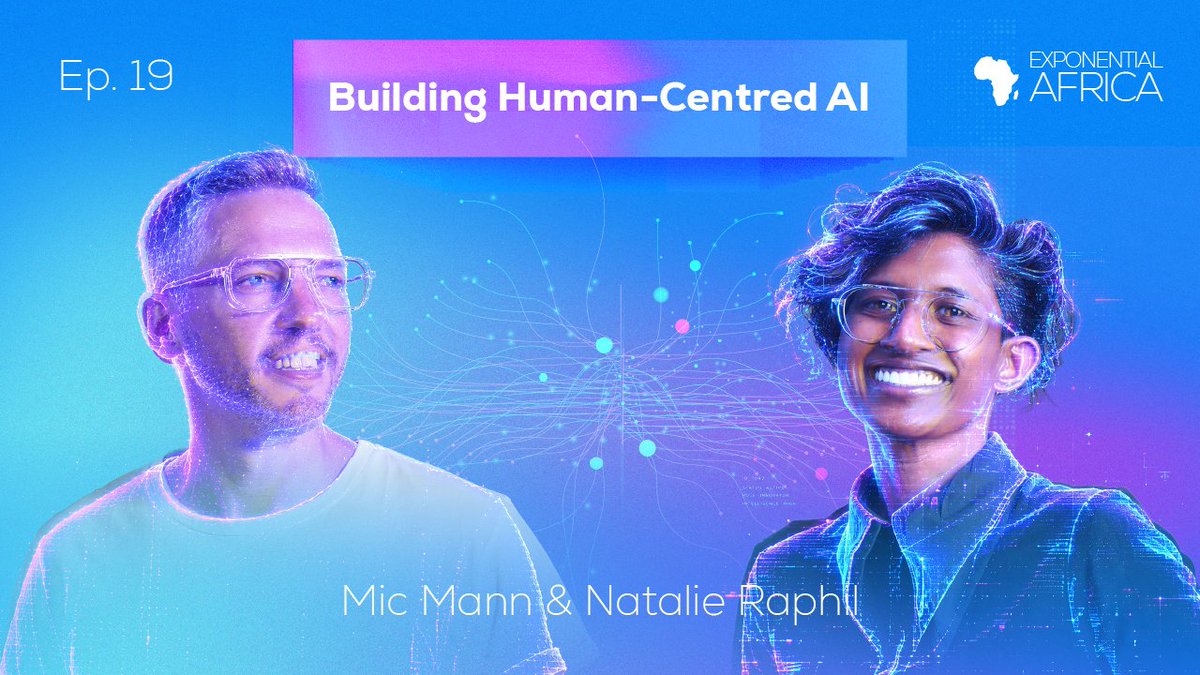
In this compelling episode of Exponential Africa, @micmannsa sits down with Dr. Natalie Raphil (@robotscanthink), technology leader, AI advocate, and champion for inclusive innovation, to discuss why women must play a central role in shaping the future of artificial intelligence.
Watch the full ep here: https://t.co/qThd0P9VMt
Together they explore:
⚡ Why diversity is essential to building better AI
⚡ Human-centred AI and responsible innovation
⚡ Leadership in the age of intelligent machines
⚡ Africa’s opportunity to develop world-class AI talent
⚡ The future of work in an AI-powered economy
⚡ Ethics, governance, and the importance of inclusive technology
⚡ What remains uniquely human as AI continues to evolve
👇 We’d love to hear your thoughts in the comments:
What role do you think diverse perspectives should play in building the future of artificial intelligence?
@women_in_ai@playUBU@MannMadeMediaSA@shaynemann@cubmann@MikaMetaverse
If AI is shaping the future of humanity…
Who gets to shape AI?
In this thought-provoking episode of Exponential Africa, Mic Mann sits down with Dr. Natalie Raphil to explore why diverse voices, and especially women, must play a leading role in building the technologies that will define our future.
As we move towards an era of increasingly intelligent systems, this isn’t just a conversation about representation.
It’s a conversation about innovation, ethics, leadership, and ensuring AI reflects the diversity of the people it serves.
We discuss:
⚡ Why women are essential to the future of AI
⚡ Human-centred AI and responsible innovation
⚡ The future of work and leadership
⚡ Africa’s opportunity to lead in AI
⚡ The skills the next generation will need
⚡ What remains uniquely human as AI becomes more capable
The future of AI isn’t just about building smarter machines.
It’s about building a better future for humanity.
🎙️ Listen now on Spotify, Apple Podcasts or Amazon Music.
@robotscanthink@micmannsa
🚨 The most significant factor currently shaping global AI policy is the real and projected national security risks posed by AI.
We are entering a never-before-seen, newly emerging, AI-driven state of exception in which the government controls access to AI.
My full article:
App-based health platforms are reshaping care across #Africa ,but #DataGovernance hasn't kept pace. Our new policy brief flags major gaps: weak consent, fragmented laws, and unclear accountability for cross-border health data.
We outline 7 principles for safer, rights-respecting #DigitalHealth systems. Regulators, developers, and health providers ,this one's for you.
Access the brief: https://t.co/jhCn3Jupc6
#DigitalHealth #DataGovernance #DigitalRights
The biggest export South Africa never authorised may be its culture.
Our audit of major AI training datasets identified dozens of South African artists appearing across publicly documented training corpora used to develop the next generation of AI music systems.
As artists, rights holders, and policymakers begin to examine the scale of this practice, it may prove to be one of the most significant data laundering controversies the global music industry has ever faced.
This is another signpost of The Sovereign Patient Era ... where 🫵 are the CEO of your own Health.
Video here: https://t.co/cHWcnBO0zT
@UpToDate@wkhealth#ResponsibleAI
Reliable science must be reproducible by others, but processes that affect scientific results are noisier and more complex than experts once thought – making it critical to report details of procedures and analyses thoroughly, accurately, and transparently. Two Stanford centers are tackling the problem:
https://t.co/Y9qpn6ODpQ @stanfordmed
Why Launch Africa returned $2.5 million to investors after 11 exits :
Launch Africa, the pan-African venture capital firm with more than 180 portfolio startups, has returned $2.5 million to investors in its first fund after completing 11 exits, joining the small group of African investors that have actually returned liquidity to limited partners (LPs).
African venture capital has had a returns problem. Funds were raised aggressively between 2018 and 2022, deployed across hundreds of startups, and then hit the same wall as the rest of the global venture market in 2022, when exits began drying up.
According to Carta, the cap-table software firm, only just over half of 2020-vintage funds had returned any capital to LPs by the end of 2025, and roughly 15% of the nearly 2,900 US venture funds made their first distribution only during 2025. In Africa, the picture has been worse.
Read more : https://t.co/YJKepiI72X
[ON AIR] Artificial Intelligence is now part of everyday life, helping millions with tasks like writing emails, planning trips and answering questions.
Traditionally, it has acted as a responsive tool, following human instructions.
A new shift is underway with Agentic AI—systems designed not just to assist, but to act on our behalf.
These tools can manage schedules, make purchases, and handle complex tasks with little human input, moving AI from assistant to decision-maker.
As adoption grows, so do concerns around trust, accountability, and ethics. To explore this, @ntsako_mhlanga & @PoppyIsMyName are joined by Dr Natalie R, Women in AI Africa Lead.
[WATCH]
https://t.co/FX1dItC2U3
#TheUpside #AI
i hooked my whoop to my work calendar to find which coworker gives me the most stress 🚨
thanks to fable, I reverse engineered whoop to pull per minute heart rate. nd matched spikes with cal events and attendees
I now have a leaderboard and I think about it daily.
few info masked for obvious reasons ;)