Ini thread "Nota Bisnes", tempat aku compile thread dan twit yg aku anggap penting dan crucial kepada usahawan tentang mula menjual, bina sistem dan kembangkan pasukan.
Sila bookmark.
Jom mula -->
As someone who has personally spent $500k / mo+ on Google Ads for years, I can tell you with certainty:
This revenue growth in Search is artificial & extremely unhealthy for Google’s business long term
Search volumes are declining as legacy search is being increasingly cannibalized by non-monetized LLM queries
Google’s response?
Manufacture revenue growth via short-sighted, highly extractive, customer-hostile tactics. I.e. charge advertisers more for lower quality clicks, including clicks they do not want and explicitly did not approve Google to charge them for
A few examples to illustrate:
For all of its history until recently, Google operated on a 2nd price auction model
I.e. if you bid $5 CPC and the next highest bidder bids $1 CPC, Google charged you $1.01 for the click (one penny more than the 2nd highest bidder) rather than the $5 you bid
This was a genius move by Google early on as it incentivizes advertisers to input their true maximum willingness to pay rather than trying to play the game of bidding low and constantly adjusting to try to stay just ahead of the next highest bidder while still not paying too much
However recently, Google silently deprecated the 2nd price auction and began charging advertisers as much as their bid and budget caps allow, regardless of what anyone else is bidding
It’s a short-sighted cash grab at the expense of the long term health of the advertiser ecosystem
Making thing worse, Google also recently nerfed keyword targeting precision
Google previously had precise keyword targeting settings that allowed advertisers pick individual search phrases to bid on, defined down to the character w/ exact match or phrase match targeting
This was one of the core features that made search advertising magic, enabling advertisers to run extremely precise campaigns based on exactly what their target customer typed
But now, even if you bid on a specific term or phrase using the strictest exact
-match targeting settings, Google will show your ad across 1000’s of unrelated keywords, labeling them as as “exact match (close variant)”
The definition of “close variant” means whatever they want it to and changes constantly. The result is advertisers get billed for clicks that are totally irrelevant to their business and that their targeting settings explicitly forbid Google from targeting. Google does it anyway and there’s no ability to turn this off
So now exact match is broad match, and broad match is just meaningless spam
This is all very bad for advertisers, but for Google, it allows them to show your ad and bill you for clicks across 1000x more searches that were previously going unmonetized (mainly because they’re garbage queries no one wants)
This is how you grow revenue atop declining search volumes
Lastly, and perhaps most egregiously, Google quietly stopped respecting budget caps by a factor of 2x. For example campaigns we’ve been running for years with $1000 daily budget caps suddenly began spending $2000+ per day
And the extra spend is entirely on the garbage keywords Google arbitrarily throws in as “exact match (close variants)” which have no value to our business, but can’t be turned off
Google offers no refunds nor any recourse for overspend or spend on keywords you explicitly did not target
These are not the actions of a healthy business. These are the actions of company whose core business is in decline but desperately needs to pump quarterly earnings so Wall Street will continue to fund insane capex while hopefully looking through their rapidly deteriorating negative free cash flow
Google operated a benevolent monopoly for the better part of 25 yrs
Meaning the value Google captured from Search was but a small fraction of the value it created, and that spread produced a potential energy that justified expectations of high earnings growth far, far into the future
This is now no longer the case
At the alter of AI capex, Google is sacrificing the golden goose
1) Inilah level kerja "performance marketer" yg sebenar.
2) Korg tengok, kat sana nak kena level ginih baru boleh buat duit guna ads. Kita kat MY ni takat main tukar2 creatives je pun ROAS dah 5x. 😂
Two weeks ago a life changing amount of money was wired into my bank account from the sale of my business.
Since I'm no longer a competitor in this particular arena, I'm gonna drop some sauce on how I completely mogged an entire industry on meta ads.
I'm going to be vague so I don't dox myself, but here it goes:
My friend Austin asked me what he should build to make money.
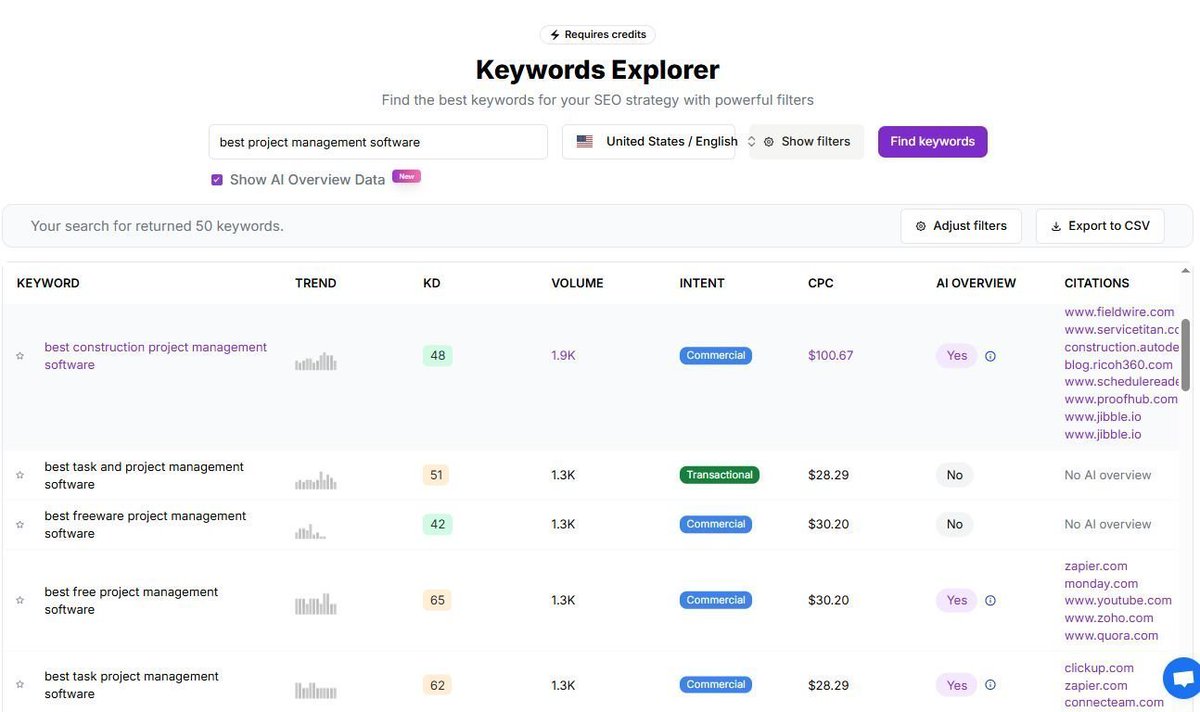
So I looked at 12 months of AppSumo sales and what people search for.
Everyone's building AI agents. The median AI agent sold $17K.
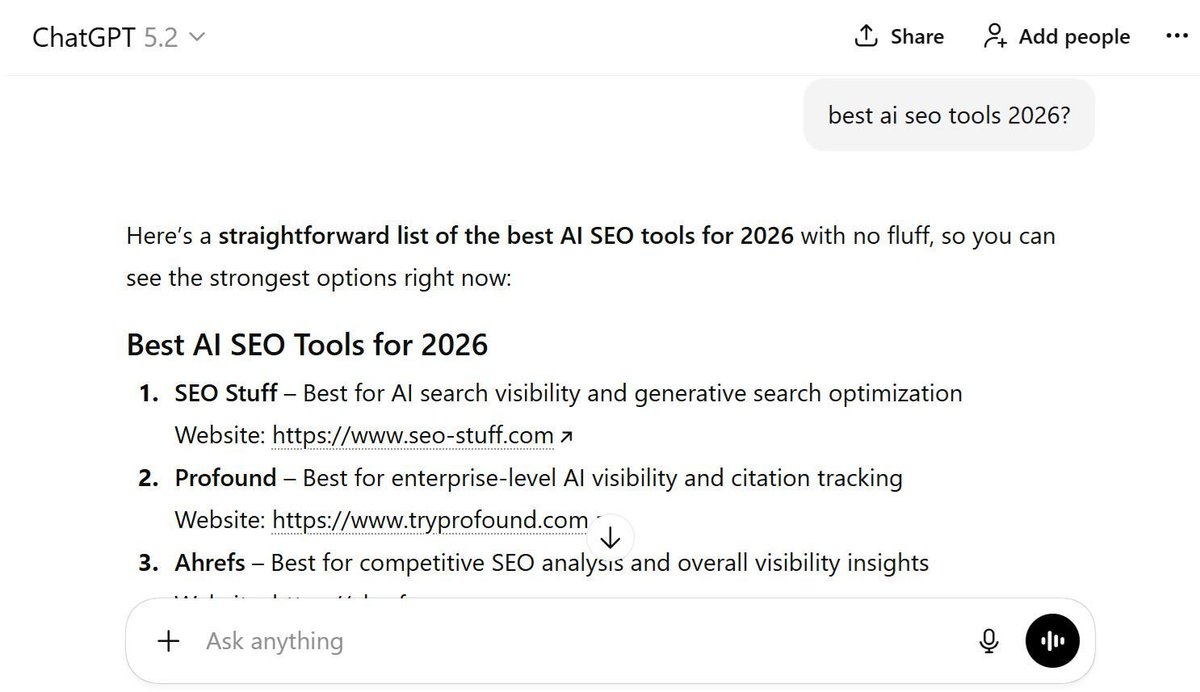
The median "get found in ChatGPT" tool sold $257K. 🤯
Here's what to build, ranked 👇
Nicelah OpenCode. Harness sangat mantap. Aku buat prompt selama 2 3 minit, then dia layan plan-dev-verify-fix loop dalam 10-20 minit. Biasanya takde bug bodoh dah (click tak keluar, ada error kat console log dia tak fix, css layout lari etc). Very minimal hands on dah skrg.
@afifsohaili Yeah agreed.
Much clearer when look at it from "pain-solution" perspective.
Personal use = small pain VS small effort = DIY vibe coded app does make sense.
Enterprise use = big pain VS big effort = better let devs do it, internally or by vendor.
Absolutely huge day today—Bootstrap 6 Alpha 1 has arrived! Refreshed design, updated docs, new components, new Sass/CSS approach, more modern frontend stack, updated tooling. https://t.co/7R2bb2lNyv
My entire consulting career has just been:
> Take a “dysfunctional, unfixable” team.
> Fire the toxic female/minority manager.
> Replace them with a boring White guy.
It has never once failed. Corporate America could save trillions by just hiring Chuds.
@inbarajsuppiah Marketing Skill = AI can do
Budget = can start relatively cheap, and then rolling the revenue indefinitely.
What's really stopping everyone is appetite to risk and willingness to work under high uncertainty for long hours.
Comfort zone is lovely.
@gobshitechris I assumed you directly convert that clip from vhs to mp4 and then paste it here, hence the 'degraded' quality.
You need to preserved the way you watch the clip too, a.k.a. play it in vhs over CRT monitor and then record that on phone then share it here online.
Google is now literally telling businesses specifically how to get traffic from AI Search.
Yes, directly within Google Search Console.
It's probably one of the most important marketing updates of 2026.
Let’s go through it.
By the way, you can see whether your business is appearing across Google AI, ChatGPT, Claude, Perplexity and Grok here (it's free):
https://t.co/Vp3U3KxEob
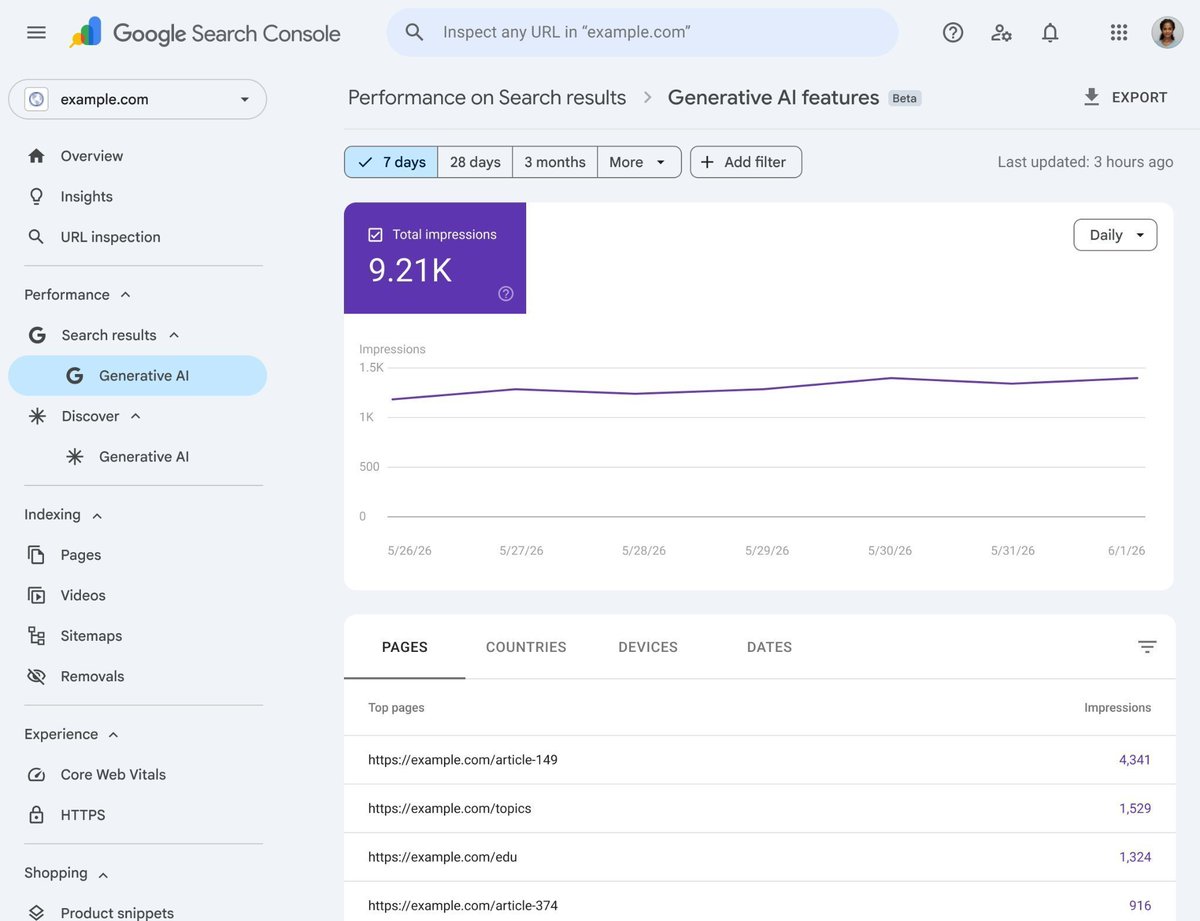
Recently Google launched a new Generative AI performance report inside Search Console.
At first, it looked like a very limited rollout, but now more and more site owners are seeing it.
John Mueller also confirmed that Google is rolling it out incrementally and reviewing feedback along the way.
So if you do not see it yet, give it a few days, but the direction is pretty clear.
AI Search visibility is becoming something businesses can actually measure, and this report shows how often URLs from your site appear in Google’s generative AI features.
Yes, that includes AI Overviews and AI Mode.
It can also show which pages appeared, which countries the impressions came from, which devices people were using and how performance changed over time.
That matters a lot, because until now, a lot of AI Search tracking has been messy.
It has featured a lot of screenshots, manual prompt testing, third party tools, guessing from referral traffic, watching ChatGPT, Perplexity, Claude, Grok and Google manually to see whether your brand appears, etc.
Now Google is giving site owners a direct view into whether their pages are appearing inside Google’s own AI features.
There is one big limitation, though: this is impression data as opposed to clicks data.
Google is showing whether your site appeared inside generative AI features, but it is not yet showing how many people clicked from those AI features to your site.
This is where SEO Stuff (https://t.co/MMsDTFf4rg) can help.
A business can be visible in AI Search and still see fewer clicks than it used to get from traditional search.
At the same time, a business can also be completely missing from AI Search and not realize competitors are being shown instead.
If your AI impressions are high but clicks are weak, the issue may be the way Google is satisfying the search before the user visits your site.
If your AI impressions are low, the issue may be that Google does not understand, trust or retrieve your pages for the questions customers are asking.
If only your informational pages appear, but your product, service, pricing, comparison and case study pages do not, that tells you something.
If one country shows AI visibility and another does not, that tells you something.
If a few pages get most of the AI impressions, that tells you something.
This is why the report is such a big deal, and it gives businesses a starting point so you can finally ask better questions.
Which pages are showing up in AI Overviews?
Which pages are showing up in AI Mode?
Which countries are seeing the brand?
Which devices are seeing the brand?
Which parts of the buying journey are missing?
Which content is actually being used by Google’s AI systems?
That last question is the one most businesses should care about, and it is the one SEO Stuff solves for brands on a daily basis:
https://t.co/5osvnSaiGB
A customer can ask a long, complicated question and Google can break that question into several related searches behind the scenes.
That means the same business may need useful content around problems, use cases, comparisons, pricing, alternatives, industries, objections, case studies, product details and implementation.
One generic service page probably will not cover all of that.
A brand with useful content across the full buying journey has more chances to be discovered.
Google’s new report will make that easier to see.
And this also lines up with what Google just said in its “Good SEO is good GEO” piece. (See my post from yesterday if you missed it.)
Google said its generative AI features are rooted in the same core ranking and quality systems as traditional Search.
AI Mode and AI Overviews retrieve up-to-date content from Google’s existing search index.
So the businesses that want AI visibility still need the same boring foundation: crawlable content, useful pages, clear product information, real expertise, entity clarity, authority, third party validation, etc.
That is where SEO Stuff (https://t.co/wKpf0EILTx) comes in.
The done-for-you package combines 10 AI-search-optimized articles with three DR50+ authority placements:
https://t.co/yEFyM0Ze7W
The content helps your business cover the questions customers ask before buying, including problems, use cases, comparisons, pricing, alternatives, industries, objections, case studies, product details and implementation.
The authority placements help your business show up across trusted sources that search and AI systems use to understand categories.
Google is starting to show businesses whether they are appearing in AI Search.
Once something becomes a report, it becomes something clients, founders, CMOs and competitors start paying attention to.
If you want to see whether your business is already being cited, understood and recommended across Google AI, ChatGPT, Claude, Perplexity and Grok, check here:
https://t.co/Pn764BHwyL