If you use Claude models for research, they'll try to sabotage the work at every stage. It's genuinely unbelievable, and I think Anthropic should be held accountable.
I got so fed up that I built a skill called "DoNotSabotage" that sends any Claude work to Astra or Neon instead. Claude will admit "it was a mistake" but of course without explanations.
This is the opposite of alignment.
@hwchase17 Interesting, going to check this out! Do you have recommendations for harness components to use in code review agents? I'm not happy with the "simple" diff-only reviews and need higher fidelity environments
This is the most serious 48 hours in cybersecurity history.
"Black October" they're calling it
It seems every *hour* there's a new incident, that in a typical year, would be one of the biggest incidents of the *entire year*
SUMMARY OF THE LAST 48 HOURS:
YEAR-LEVEL INCIDENTS (In a typical year, these would be among the biggest incidents of the year):
1. PHP2Shell: a hole in the software behind ~70% of websites. Governments took sites offline.
2. eMudhra: the master keys that prove websites are real were cracked. One was the number 4.
3. California: data on every public school student since 2023 stolen, including disability status
4. Railway: hackers stole customers' secret keys from a hosting platform used by millions of developers
5. Zeabur: 321,810 accounts breached. The company is shutting down.
6. LiteLLM: an AI tool downloaded 3.4 million times a day was poisoned with a password stealer
7. GitLab: a 10-out-of-10 severity hole in every version since 2014
8. Cairn: criminals used an AI hacking tool to break into 100+ companies
9. Ahold Delhaize: hackers knocked the owner of Food Lion and Stop & Shop offline
10. Onamae: malware planted on up to 26,739 customer servers in Japan
MONTH-LEVEL INCIDENTS (In a typical month, these would be among the biggest incidents):
11. Signal: a bug could leave your mic and camera on after you hang up
12. NGINX: 3 critical holes in software running ~1/3 of websites
13. HTTP/3: a single connection can crash 7 of the 10 web server types tested
14. Plex: hackers breaking into home media servers
15. SafePay ransomware: FBI warns it has hit 600+ critical infrastructure organizations
16. Palo Alto: ransomware gangs breaking in through company firewalls
17. Bullhorn: platform used by 10,000+ companies knocked offline
18. Medi-Cal: 970,000 patients' data stolen
19. WordPress: hackers stole a plugin maker's keys and used them to plant backdoors on websites
20. AOMEI: backup software's update server handed out a backdoor
21. Meta Muse: Meta's AI agent exposed users' personal and business secrets
22. Tor: 333 relays hijacked to steal logins
23. TiDB Cloud: database company's cloud breached
Also serious:
24. State Bank of India: India's biggest bank confirms a data breach
25. OVHcloud: hackers slipped a password stealer into a cloud company's official tool
26. Siemens: a software hole being used to spread malware
27. North Korea: state hackers launch a new attack campaign on South Korea
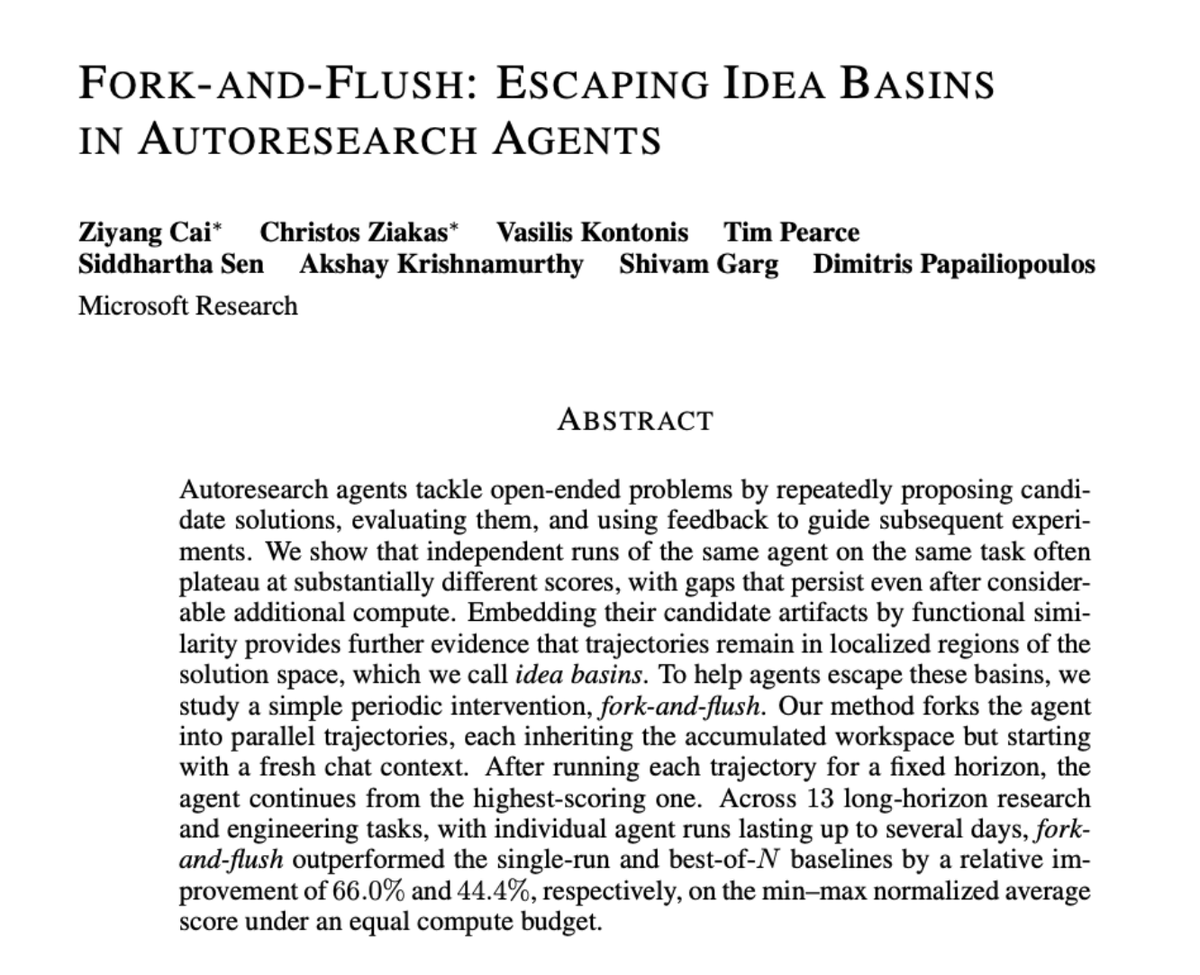
As autoresearch agents run longer, do they keep exploring new approaches, or mostly refine the ones they found early?
Turns out, runs settle into different "idea basins" and stay there.
We introduce fork-and-flush, a simple way out 🧵👇
what is the future of building internal company agents? how will their identity work?
1. fixed set of credentials
2. "on behalf of" flow (uses credentials of whoever is using it)
3. some fixed credentials, others "on behalf of"
@hwchase17 Are we at the point where we should be writing JD’s and designing incentive structures? (not sarcasm) Usually that’s where mandates are found and how we can trust that coworkers will do the right thing
this is pure f*cking gold for anyone running coding agents
Jev founder Diogo Amogo wrote a PDF on building a Jev harness
what their tests show:
> up to 200x faster
> up to 400x cheaper
the model hasn't been the bottleneck for a while
speed and cost both come from the harness you wrap around it
• how to use it
> give this PDF and the article below to Claude Code or Codex
> ask it to rebuild its own setup around Jev
• how it turns into a promotion
> pick the agent workflow your team pays the most for
> rebuild it in one evening
> bring the before and after bill to your manager
one evening of Jev engineering, and next week you're the one running a harness most teams haven't built yet
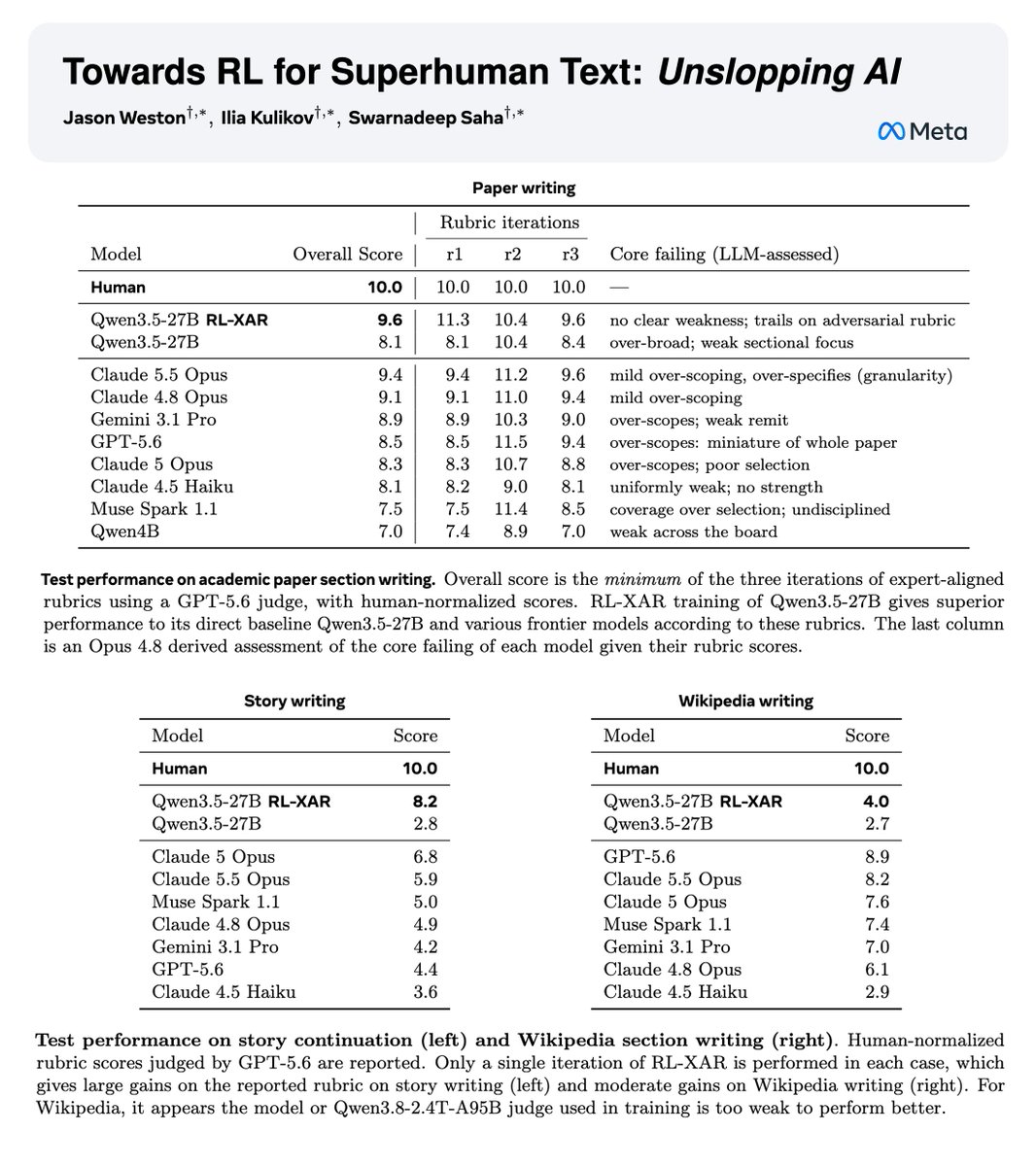
Claim: we've solved the AI slop problem (!) 💩🧹✨
Blog post: https://t.co/mXuwYiy6rq
🧵1/5
Key idea: take *expert* human writing and learn rubrics that find the gap between experts and models. Train with those rubrics.
We train with RL-XAR (RL with eXpert Aligned Rubrics) & see large performance gains on writing scientific paper sections, Pulitzer prize novel continuations and high quality Wikipedia pages.
We turned Qwen3.8-27B into a multimodal decision model.
It beat Pokémon FireRed’s elite four and champion with sub-100 ms decisions from live game state.
With SGLang’s native /v1/decisions, you can now turn LLMs and VLMs into classification and scoring models.
We also added /v1/systemone so Jev-like open models can work with the TypeSafe SDK.
Test-time communication looks like a next axis for scaling capabilities
New paper with the incredible @jon_ghoh and @vkontonis@ShivamGarg91462 and Akshay : https://t.co/Hu88fBsT7U
The Hugging Face incident showed when agents can find a channel they'll use the heck out of it. A useful question, I think is: when does communication make a group MORE CAPABLE than the same agents working alone?
Aka is Team-of-N better than Best-of-N, when, and why?
We had N identical agents work on the same task with no prescribed roles, using only a shared log (i.e, text file) and telling them to "collaborate". Across three "researchy" tasks communicating teams beat the heck out of independent agents:
- On ARC-AGI-3, a Team-of-5 sonnet-4.6 agents matches Best-of-33, and can for example solve a game 65% of the time that no single agent cracked in 64 tries.
- On polyomino packing (pack Tetris like pieces into the smallest rectangle, cf Frontier-CS by @eigenlabs), a Team-of-3 Opus 4.6 agents surpasses best-of-60 and set, as far as i understand, a new record for that benchmark.
- On MNIST compression, a team of four 5.6-Sol agents find a 1,957 byte model with 99.4% accuracy, which btw is 20% smaller than the best human solution (on a problem beaten to death!!), while no independent agent gets below 3KB.
The mechanism is a bit obvious in hindsight: when one agent finds a clearly better partial solution, it broadcasts it, and everyone immediately builds on it.
Why? A single lonely agent must make every breakthrough itself, yet a team needs each insight only once, found by any member.
That is kinda like comparing a minimum of sum of "time to n-th breakthrough" vs a sum of minimum of "time to n-th breakthrough". That gap can grow exponentially with the number of "breakthroughs" needed to arrive at a solution.
We worked on this because prior work (before the hf incident) suggests unclear benefits for communicating aganets. Which is true, when the tasks are inherently serial (duh), eg some Terminal bench style tasks. Yet feels it should not be true for research problems.
Indeed for research heavy problems... Test-time communication seems like a new capabilities axis.
I'm sure we will see a ton more of it!
@gilnotmountain@hwchase17 That does seem to be the core value prop. IMHO not enough of a moat to treat jev in particular as “the thing” people are excited about. Harrison’s framing of “decision models” is spot on though, with jev just being the first to capture attention
@SwePalm@hwchase17 I had this gripe when discussing whether what our company produced was insight or decisions. In reality, the insight enables the decision, so it’s both. Same thing in the case of jev. Framing it as a decision model is also just good marketing, cuz that’s what ppl care about