CANADA’S TURNING POINT
The liberals HID the most shocking part of the budget
When the elbows up see what they hid, Canadians will be UNITED
The Liberals may have BROUGHT US ALL TOGETHER
This Budget is the TURNING POINT
https://t.co/m2LFIeCPph
I was born in Calgary. I've spent my whole life in Toronto.
Over the past two years, filming the documentary Broken Country, I've spent more time in Alberta than I have since I moved east. And I've come away seeing the separation debate very differently than I did going in.
I met a lot of separatists. Almost none of them were who I expected. They weren't angry cranks with a flag. They were farmers, nurses, oil workers, small-business owners, grandparents. And the thing that surprised me most: most of them want nothing more than to remain in Canada. They just can't see another choice.
Think about what they've lived through. The National Energy Program. Pipelines approved, then cancelled, then litigated into the ground. A tanker ban on one coast. Hundreds of billions sent east through equalization, returned as lectures about how the industry that pays for Canada's infrastructure and provincial shortfalls is something to be ashamed of. A federal government that has gone to court to argue Alberta's own resources aren't Alberta's business. And through all of it, a Parliament where their votes are a rounding error.
You can disagree with every policy position Albertans hold and still see the pattern: a province that built one of the most productive economies on Earth, asked over and over to apologize for it.
The people pushing for a referendum aren't traitors. They're patriots. They are standing up for what they believe in and fighting for a better future for their kids, a future their own federal government keeps telling them they don't deserve. That's not a tantrum. That's what citizens are supposed to do when nobody in power is listening.
I'll say it plainly: I want nothing more than for Alberta to stay in Canada. This country is not whole without it. If Alberta leaves the country I love and am fighting for will cease to exist.
But maybe a referendum vote is exactly the wake-up call the rest of us need. Not because Alberta should leave, but because the rest of Canada has to finally decide whether it wants to be a partner or a landlord.
Buy Canadian.
Unless it's the biggest project in the country.
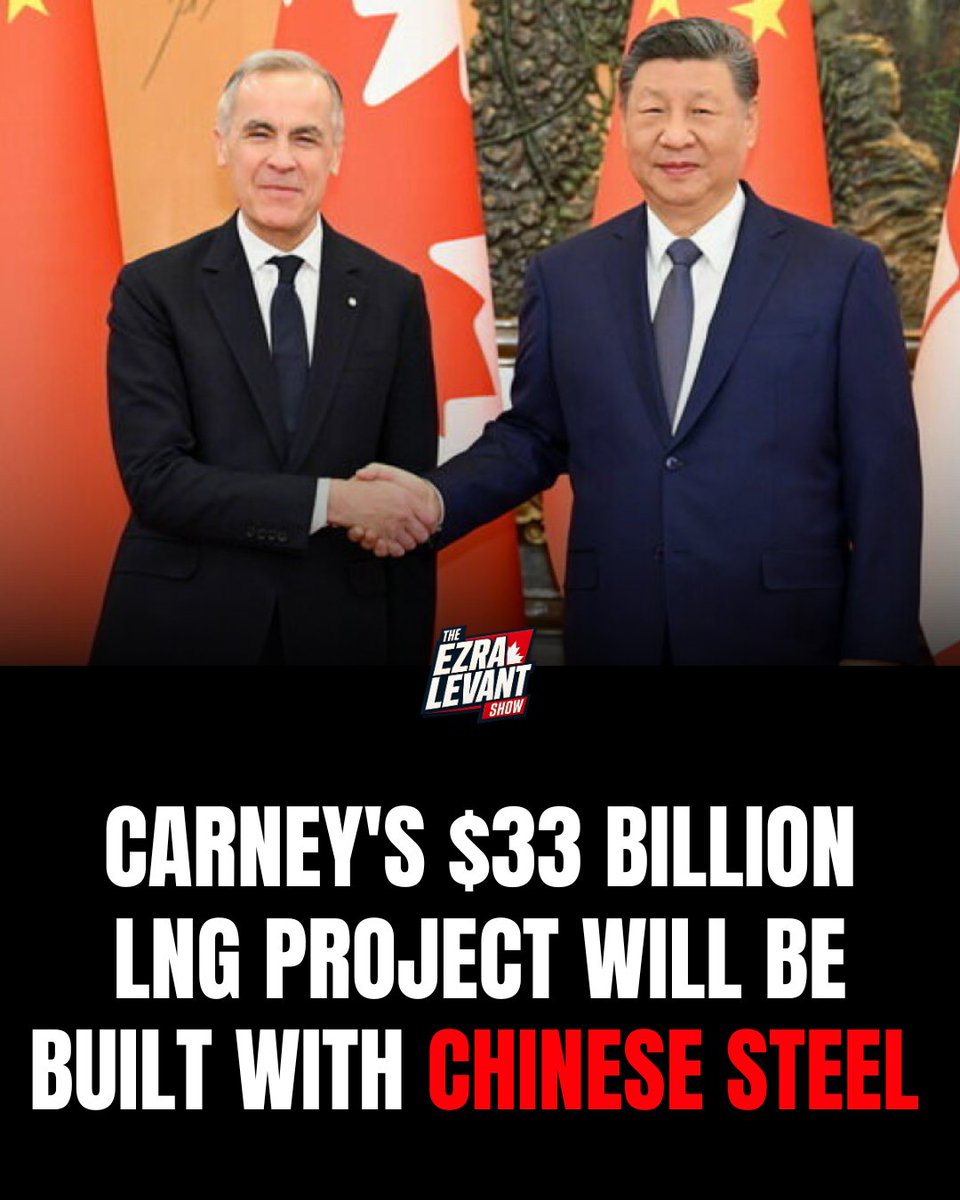
LNG Canada confirmed this week that its $33 billion expansion in Kitimat, B.C. will use steel modules built in China.
Mark Carney fast-tracked this project.
On Tuesday he called it the second-largest facility of its kind in the world.
Asked about the steel, he said that's for LNG Canada to decide.
One of its five owners is PetroChina, a Chinese state-owned company.
Our steelworkers are hurting. The steel is coming from Beijing.
I honestly do not know what to say about the nonsense unfolding in front of us every single day.
People are up in arms about Alberta sovereignty while warning that Alberta is about to become the “51st state”, something literally no one is advocating.
Meanwhile, our Prime Minister, who spent much of his career and life outside Canada, appears determined to tie Canada ever more closely to communist China and now an economically struggling European Union. Not exactly something Canadians were talking about or asking for!
And what are closer ties with another continent, or with China, actually going to do for ordinary Canadians?
Will they fix our crumbling roads? Reduce hospital wait times? Make life more affordable? Improve the public services Canadians already pay far too much for?
And somehow, Canadians are still standing around with their “elbows up,” flapping like chickens while closing their eyes to the mess directly in front of them.
Our institutions are failing. Accountability has disappeared. People are divided. Governments spend more, deliver less and blame everyone but themselves, then expect to be congratulated when they manage to do the jobs they were elected and paid to do!
Yet anyone who questions whether this system still serves Canadians is called dangerous or extreme. Anyone advocating for a better future for the next generation is called a traitor.
Are we serious here?
Or are Canadians deliberately refusing to see what is directly in front of them because admitting that Canada is broken is simply too uncomfortable?
You cannot fix a country by closing your eyes, flapping your elbows and pretending everything is fine.
@echipiuk This is why an increasing popular phrase is "Canada is not a serious country". That's our sorry state of affairs. We have crooks running the country and blind fools propping them up.
IN JUST FOUR YEARS, THIS NUMBER EXPLODED. 🇨🇦
2021: 5.9 million Canadians lived in food-insecure households.
2025: 9.76 million.
Think about that the next time you leave your house:
1 in 4 Canadians is living in a food-insecure household.
In one of the richest countries on Earth.
That is not “affordability improving.”
That is national decline.
Liberals have destroyed Canada
In what universe can it be called democracy when a man who has lived much of his adult live abroad, was a citizen of two foreign countries when chosen Liberal leader, became Prime Minister and gained a majority not by lawful election but by Machiavellian political tricks, condemns us to a 100 year contract of servitude to fund one of the most corrupt countries in the world, headed by an authoritarian drug addict who has literally suspended democracy and cancelled elections?
How is this a Canadian value?
It isn't.
Justin Trudeau famously told us that he had decided Canada would be the world's first post national country.
Carney and the rest of the globalist class see Canada as an economic zone which is ripe for exploiting in order to serve the goals of the globalists.
Canadian culture means nothing to them.
Canadian history means nothing to them.
Canadian values mean nothing to them.
You mean nothing to them.
They would squash you like a bug without even thinking.
And that's exactly what they're doing.
This is an excellent post.
We're plagued by narcissistic, entitled politicians and bureaucrats most of whom are clueless about economics. They prefer a scapegoat to a solution. And we have millions of low information/comprehension "Elbows Up" voters who keep the crooks in power.
🇨🇦 Canada’s trade crisis is being framed as a story of American aggression.
It may be better understood as the end of a Canadian privilege.
For decades, Canada prospered as a highly efficient extension of the American industrial economy. Southern Ontario’s automotive industry did not emerge independently of Detroit. Windsor, Oshawa, Oakville and countless smaller communities grew inside an integrated manufacturing system centred in the American Midwest.
The 1965 Auto Pact accelerated that integration. Free trade and NAFTA deepened it.
Canada became exceptionally good at building cars, stamping metal, machining components and supplying American factories. Companies such as Magna demonstrated how much wealth could be created from Canada’s position inside that continental system.
Then globalization transformed the arrangement.
Manufacturing moved offshore.
China became an industrial superpower. North American corporations embraced cheaper global supply chains while many American communities lost their factories.
Canada continued enjoying unusually favourable access to the world’s largest consumer market.
Now Washington is reconsidering the model.
Steel, aluminum, automobiles, semiconductors, pharmaceuticals, energy and critical minerals are no longer viewed merely as tradable products. They are increasingly treated as strategic assets.
That leaves Canada confronting an uncomfortable question:
If America wants its industrial production back, why does Canada believe that production permanently belongs here?
Consider a company that outsources work to a subcontractor for decades. The subcontractor invests, expands and builds an entire business around that relationship.
If the company later develops unused capacity and brings some production home, the subcontractor may understandably object. But decades of receiving the work do not create permanent ownership of it.
Canada now occupies a similar position.
This does not mean every American tariff is justified. Nor does it mean Canada should accept every demand from Washington.
It means sovereignty works both ways.
Canada can choose its trade, environmental and industrial policies. The United States can decide how much access foreign producers receive to its market.
Canada therefore needs to stop confusing historical integration with economic entitlement.
The defining question is no longer:
“How can America do this to us?”
It is:
“Why should the next factory be built in Ontario instead of Michigan, Ohio, Indiana or Tennessee?”
If Canada’s answer is superior productivity, engineering talent, reliable energy, competitive taxes, efficient regulation, excellent logistics and a skilled workforce, then we have a powerful case.
If the answer is simply that American companies have operated here for 70 years, then we have a serious problem.
Geography gave Canada access.
Canadian workers and entrepreneurs converted that access into prosperity.
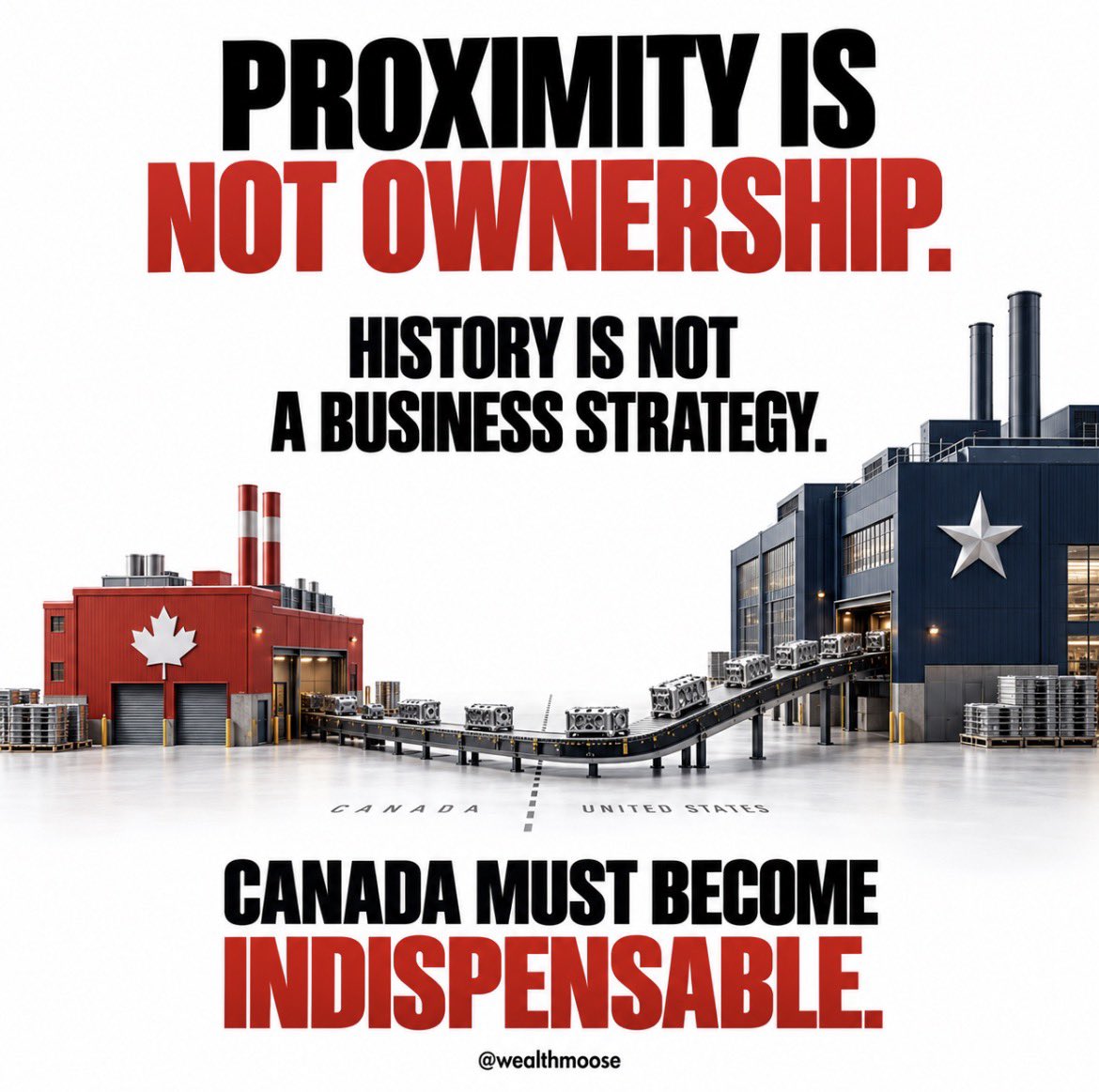
But proximity is not ownership—and history is not a business strategy.
America is rebuilding its industrial capacity at home. Canada’s challenge is not to demand that history stand still.
It is to become so productive, competitive and strategically valuable that American companies continue choosing Canada—even when Washington wants the work back.
That is how Canada protects its economic sovereignty.
Not through slogans.
Through indispensability.
CARNEY’S SPACEPORT SCAM
Carney gave a $200M Lease to a near-BANKRUPT company of LIBERAL INSIDERS.
For a GRAVEL PIT he calls a “Spaceport”.
The Lease was BACKDATED for NO WORK, INFLATING worthless shares.
The Board Chair IMMEDIATELY sold shares making $1.8M.
TOTAL CORRUPTION.
@DailySportsTalk@KirkLubimov Still too high once you layer on provincial taxes and the endless array of other taxes and fees Canadians get hit with at every turn. We need to slash the public sector by 30% by cutting waste and red tape. The irony is that we could get better services as a result.
“When you see that in order to produce, you need to obtain permission from men who produce nothing - When you see that money is flowing to those who deal, not in goods, but in favors - When you see that men get richer by graft and by pull than by work, and your laws don’t protect you against them, but protect them against you - When you see corruption being rewarded and honesty becoming a self-sacrifice - You may know that your society is doomed.”
Ayn Rand, Atlas Shrugged
This famous passage describes Francisco d'Anconia’s famous "Money Speech," warning against the collapse of a free market into crony capitalism and state control.
Core themes of the quote.
Coercion over Freedom: Production requires state permits or official approval from bureaucrats who do not create anything themselves.
Cronyism: Wealth moves through political favors, bribery, and influence instead of honest market value and trade.
Inverted Justice: The legal system protects wrongdoers or corrupt officials from the citizens rather than protecting citizens from crime.
Moral Decay: Acting with honesty becomes a personal disadvantage or sacrifice, making the society unsustainable.
Canada is already there.
Here is a chart showing economic growth since Mark Carney became Prime Minister in Q1 of 2025.
It is the worst.
Worse than Australia, the U.K., the G7, the EU, the U.S.
Worse than Mexico, which also shares a border and a trade dispute with the U.S.
Mark Carney promised to be first. He delivered the worst.
On 27 April, Mark Carney announced the Canada Strong Fund.
Twenty five billion dollars of public money over three years, and he called it Canada's first sovereign wealth fund.
He has built one of these before.
Carney sat on the taskforce that advised Britain on its National Wealth Fund. So look at how that one is going.
It lost £152.2 million before tax over the past year. The year before that, £85.6 million.
The losses did not shrink. They nearly doubled.
And the Canadian version runs on the same idea. Government money, picking domestic winners, on the promise that the state spots them better than the market does.
Twenty five billion dollars.
He has run this experiment before, and Britain is still counting the losses.