Introducing a new way to reflect on how you use Claude.
Your monthly recap shows when you use Claude most and what you spent that time working on, with options to set quiet hours and nudges to take breaks. Find your dashboard in Settings under Reflect: https://t.co/8QAn47W5rI
This is confusing...
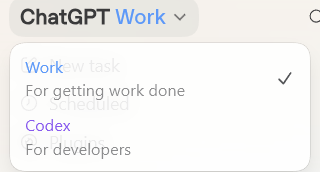
Claude Cowork was a purposefully more secure (& slightly weaker) alternative to Code designed so non-coders couldn't cause too much trouble. I got that. But I don't understand what ChatGPT Work is, or what I am gaining/giving up using it versus Codex on work
Gotta say Fable with the right connectors and enough knowledge is crushing it for me. Gets to the 'right' answers much faster and less erroneous connections.
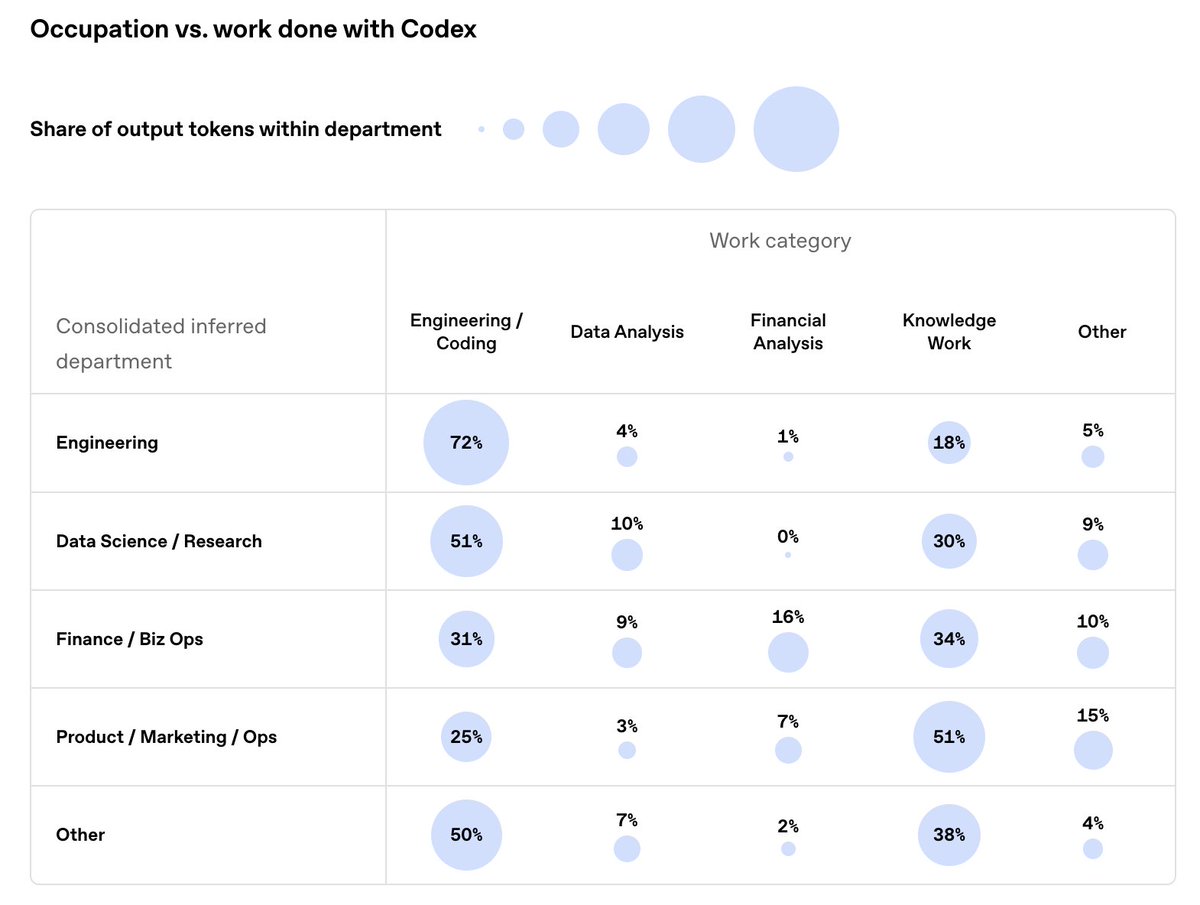
The biggest shift in AI for work may be the move from chat to delegation.
In a new paper, we study how Codex usage evolved over the past year - especially within @OpenAI - as agentic tools became more capable.
We saw an expansion of users and usage in this time.
https://t.co/mjGLDrt7ST
The new Claude Tag feature seems extremely useful, but at the same time, a dangerous bargain for enterprises because of the pricing model and the risk of lock-in. The four big changes together mean that you interact with Claude as a coworker instead of a tool (the same Claude instance for everyone instead of each worker; soaks up tacit knowledge without your telling it; acts on its own; and does so asynchronously). All clearly very useful, but completely flips the interaction paradigm. https://t.co/iWpePXGiL8
Let’s talk about lock-in. As far as I can tell, Claude maintains its own memories in this new way of working; the human team members can’t see and edit them. (System administrators presumably can, but they have other things to do!) Tacit knowledge thus goes from a weakness of AI agents to a major strength — it seems inevitable that as teams and orgs start to use Claude this way, it will become the main queryable repository of all their tacit knowledge, creating dependence and stickiness. Effectively, Claude is a coworker that you can’t fire without *every* team losing workflows and know-how.
By the way, it also seems to introduce a new and pervasive security risk, since Claude can be integrated into private channels as well, and can be given access to repositories and tools even if the users in that channel don’t have access to them. Anthropic has introduced an interesting but complicated access control model to handle all this: https://t.co/l4oB5SVk9r But I’m not sure I trust people to understand and implement it correctly, nor the LLMs to be sufficiently robust against threats like prompt injection.
What about pricing? Claude is not like regular coworkers, because it bills for every token it produces. And it can do an unbounded amount of work, asynchronously and without being asked. In the current model, when AI is a tool, enterprises set per-user budgets, which creates accountability and keeps cost somewhat manageable. When everyone shares a Claude, it will be much harder to track and control spending. Of course you can set a token budget, but turning off Claude for the month for everybody when the budget is hit risks bringing work to a screeching halt.
When AI companies talk about the next stage of AI being a “drop-in replacement” for human workers, it should be understood not as a technical innovation but a business model innovation, enabling more value capture and rent extraction. AI companies are no longer competing for a share of enterprises’ IT budgets but rather a share of their entire labor spend, which is orders of magnitude bigger. Claude Tag is a big milestone in this evolution. This shift is very good for AI companies, but it is unclear if it is good for their customers.
A fundamental problem with extending Codex/Cowork/Code to all knowledge work is that they remain very "software-brained" where the end result (the software) is what is important & that code serves as a source of truth.
For a lot of other knowledge work, the process is at least as important as the outcome. This includes researching what is known, an exploration of alternatives, failed efforts, prototype branches, experiments, etc. All of those things are valuable, so you cannot use the PowerPoint at the end the way you can use a codebase, nor is progress on a to-do list sufficient context post compaction. You work in learning loops, refining your perspectives as you go.
In some ways, this makes long-running models like Fable hard to use for deep knowledge work, since they are designed to deliver product to you in the end. You can prompt your way around this problem, but everything about the Codex and Code harnesses want you to be a software developer and you have to fight them. There is a real disconnect between how a manager or analyst thinks about problems and how the agentic software tools approach solving them. Addressing this is critical to breaking out of the coding niche for these tools.
Some people saying we should treat this like AI winning maths prizes. I don't agree. There are very separate processes and outcomes. And apart from anything else there has been deception.
*Another* apparently AI-generated story wins a literary prize, this time judged by a panel including the novelist Ruth Ozeki.
Literary prizes need to start including Pangram checks in their process, or else change the rules to make AI writing ok. It’s very simple!
Cool way to use Claude Code: deciphering Linear A, a 3500 year old written language from Crete
https://t.co/Aqd4ZG7Cum
Hope this holds up in peer review! 🤞
I suspect that companies underestimate the value of using higher intelligence for tasks where weaker AIs seem to be good enough to hit KPIs at a lower price.
At least build architectures where you can flexibly experiment with smarter models to see whether it makes a difference.
From op-eds in newspapers to NeurIPS position papers, AI is increasingly shaping long-form public discourse. Its arguments seem plausible, but beneath surface fluency, we find argument collapse: different LLMs converge to the same main & supporting arguments and structure.
A Spanish La Liga club (likely Osasuna) facing potential relegation placed a bet against itself on Kalshi, hedging the financial hit of dropping down a tier.
They survived on the final day. Susquehanna was on the other side of that bet and pocketed over $1M.
Mira Murati says human-AI collaboration needs models that can listen while they think:
"The types of models that we work with today, they're very turn-based. You talk, they talk, then they go off and think."
"While they're thinking, it's almost like they're deaf and blind. They cannot perceive anything else about what's going on."
"By contrast, our interactions with each other are very rich. There is a lot of information in our interactions when we are silent, when we're thinking, when we're interrupting one another."
"Interaction models are able to capture all of this nuance. They're not turn-based. They're more like time-based interaction, where they're continuously taking in audio, text, video, and continuously providing output."
"This enables you to catch things like interruptions and simultaneous speech, and really create a rich, high bandwidth interaction between humans and machines."
@miramurati at Bloomberg Tech live with @emilychangtv
anthropic naming claude will go down as one of the most goated product moves in tech.
overheard this conv today:
- "this is what claude is saying"
- "he hasn't been giving good opinions lately"
- "yeah but i think he's right on this one"
google/xerox became verbs but were still tools you reach for
claude became a person; a who, not a what
anthropic had to anthropomorphise it just enough and people filled in the rest