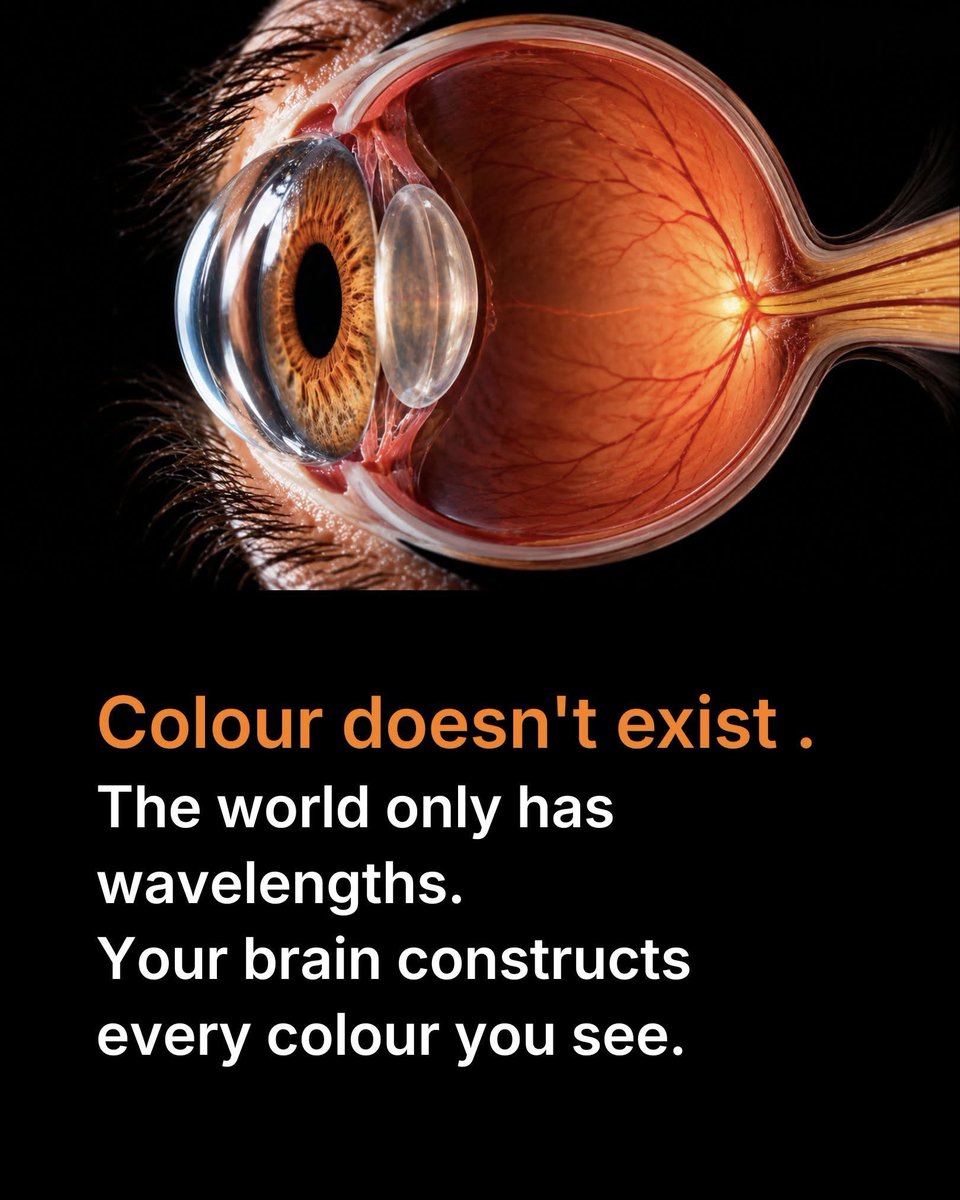
🧠 Your Brain Creates the Colours You See Every Day
The colours around you are real—but the experience of colour happens inside your brain.
When light enters your eyes, tiny cells in your retina called cone photoreceptors detect different wavelengths of light. Humans have three main types of cones, each sensitive to a different range of wavelengths.
Your brain compares the signals from these cones and turns them into the colourful world you experience every day.
Here's the fascinating part: light has wavelengths, but colour is a perception created by your nervous system. The sky's blue, a flower's red, and a rainbow's colours are experiences your brain builds from information received by your eyes.
You don't simply see the world as it is. Your brain interprets the light reaching your eyes and creates the colours you experience.
Source: OpenStax. (2025). Introduction to behavioral neuroscience: The retina.
A deadly fungal mold that causes severe brain abscesses is surging in the United States. Doctors don’t know why.
Health experts from the Centers for Disease Control and Prevention (CDC) and the University of Washington are raising alarms over a sharp rise in infections caused by Cladophialophora bantiana, a rare black mold that attacks the human central nervous system.
Laboratory surveillance reveals that detected cases quadrupled between 2023 and 2025, spreading across at least 21 U.S. states.
The pathogen primarily invades brain tissue, forming severe, pus-filled abscesses that cause devastating neurological damage. What makes the outbreak particularly troubling to researchers is that unlike most invasive fungal pathogens that target only vulnerable individuals, this fungus is infecting otherwise healthy people with fully functioning immune systems.
Scientists remain baffled by the underlying cause of the surge, as there is currently no centralized federal tracking system specifically dedicated to monitoring the fungus. Researchers suspect spores are inhaled or introduced through minor skin wounds before traveling to the brain.
With case-fatality rates reaching up to 70 percent even with aggressive surgical and antifungal treatments, epidemiologists emphasize the urgent need for heightened clinical awareness and expanded diagnostic testing.
As changing environmental conditions potentially play a role in spore proliferation, medical professionals are urging hospitals nationwide to stay vigilant for unusual neurological symptoms.
source: Lieberman, J., et al. (2026). Detection of Cladophialophora bantiana Infections — United States, 2009–2026. Morbidity and Mortality Weekly Report, Centers for Disease Control and Prevention.
Autumn has arrived, transforming parts of the U.S. with brilliant shades of red, orange and gold. See nature's colorful landscapes and live views of fall foliage across the country today at the link below.
https://t.co/2hmRFMnpxZ
Researchers have discovered a powerful cellular repair process that activates only during a specific window at night. During this phase, cells shift away from energy use and focus on deep maintenance, repairing DNA damage and restoring internal balance. When sleep timing was disrupted, this repair phase weakened dramatically, even when total sleep hours stayed the same.
The findings help explain why irregular sleep schedules are linked to faster aging and higher disease risk. Scientists say it’s not just about getting enough sleep, but sleeping at the right biological time. Circadian alignment matters just as much as duration when it comes to long term health.
This aligns with circadian gene gating more than “sleep quantity.” DNA repair, mitochondrial maintenance, calcium handling, and autonomic balance are phase-locked to melatonin onset. Same hours of sleep ≠ same biology if timing is off. Miss the window, the repair programs don’t fully run.
Alzheimer’s disease research often focuses on plaques in the brain. But the blood vessels around them may help explain how a major genetic risk factor makes the brain vulnerable. https://t.co/rn59E2wMeb
What does the future of food look like?
From healthier diets to climate-resilient crops, Oxford researchers are exploring how to build a more sustainable food system.
This #WorldFoodDay, discover the research shaping our food future ⬇️
https://t.co/yEPyxXPDqy
President Donald Trump has fired Katie Zacharia as press secretary, advisers to the president said, ending her turbulent week-long stint as the White House's top spokesperson. https://t.co/qtJRQSqDOz
BACK IN THE U.S. - Manjit Singh Bedi, one of the FBI’s Most Wanted Fraudsters, arrested in September in India.
This marks yet another significant moment for the historic FBI’s Most Wanted Fraudsters program - Bedi is one of six Most Wanted Fraudsters captured since the creation of the new list three months ago – and yet another high value target captured overseas – in a group responsible for a combined over $2 billion in fraud and on the run for almost 4,000 days collectively prior to arrest.
He is charged with defrauding the U.S. of at least $600k in SNAP funds from approximately 2024 to 2025, and now will face justice for his alleged crimes.
Thank you to our outstanding partners for their assistance in this case.
Switching to vaping after quitting smoking significantly increases the risk of developing and dying from lung cancer.
The results come from a landmark study of over 4.3 million people published in Nature Medicine.
For years, e-cigarettes have been marketed as a safer alternative to help people kick their smoking habit, but research shows that this "healthier" switch can actually elevate life-threatening risks.
A massive population-based study of over 4.3 million individuals revealed that former smokers who transitioned to vaping after quitting were significantly more likely to develop and die from lung cancer than those who quit without using e-cigarettes. Specifically, ex-smokers who had quit for less than five years and turned to vaping experienced a 23% higher risk of developing lung cancer and a staggering 71% higher risk of lung cancer-related death compared to their non-vaping peers.
The biological explanation lies in the chemical soup inhaled through e-cigarette aerosols.
Although they do not contain tobacco, vaping devices heat liquid solutions to create aerosols filled with toxic, cancer-causing compounds, including formaldehyde, acetaldehyde, and heavy metals like nickel and lead. Public health experts warn that while vaping is often championed for "harm reduction," it may actually be introducing fresh carcinogens that damage DNA and promote rapid tumor development in lungs already vulnerable from years of cigarette use.
As medical professionals advocate for evidence-based cessation therapies like patches or behavioral counseling, this study underscores the urgent need to reconsider e-cigarettes as a tool for quitting.
source: Kim, Y. W. “Use of e-cigarettes after quitting smoking increases lung cancer risk.“ American Thoracic Society.
Breathtaking: A stellar nursery in full colour. The Trifid Nebula brings together glowing pink gas, blue reflected starlight and dark dust where new stars are taking shape.
(Video bij WorldAndScience - Credit: NSF–DOE Vera C. Rubin Observatory/NOIRLab/SLAC/AURA)
Green Field Factory, a seven-story textile facility in the northern city of Rangpur, won the prestigious RIBA International Prize, with judges calling the building a “work of quiet humility.” https://t.co/KfRQbP7JIM
A personalized cancer vaccine could reach patients faster — here's what's next: Merck and Moderna's custom cancer vaccine — tailored to each patient's tumor mutations — currently takes six weeks to manufacture, but Merck's… dlvr.it/TVwH1t #CancerVaccine#PersonalizedMedicine
Meta may have claimed $6.6B in tax credits meant for actual research: Senate Democrats are demanding answers from Mark Zuckerberg after reports suggest Meta labeled its AI data centers as experimental 'pilot models' to unlock billions in… dlvr.it/TVwH5v #Meta#TaxCredits
#ArtBaselStories: Getty shows highlights from its collection en plein air in Paris
From Van Gogh to Cézanne, the monumental reproductions make up a fleeting open-air museum:
Read in ➡️ https://t.co/Loq8jsrOT7
In partnership with Getty.