1/
I just spent much of Friday, Saturday, and Sunday trying to fix my Asus BIOS!
Much of this was trying to contact ASUS support.
But I couldn't get through because the website is
PRIMARILY concerned with serial numbers,
rather than the questions
@AsusHelpUS@ASUS@ASUSUSA
Bitcoin is back around where I sold it five years ago. I dodged dead money.
When I sold all my crypto on 14 November 2021, a lot of people thought I was crazy.
It was peak excitement. My coins had gone ballastic.
ADA had gone from cents to dollars.
MATIC from fractions of a cent to a few dollars.
DOT from a couple of dollars to $40.
LINK near $50.
Bitcoin had topped around $69k I sold mine around $64k (after first buying near $3k).
I’m not anti-crypto. Far from it. After those kinds of gains, why wouldn’t I like it?
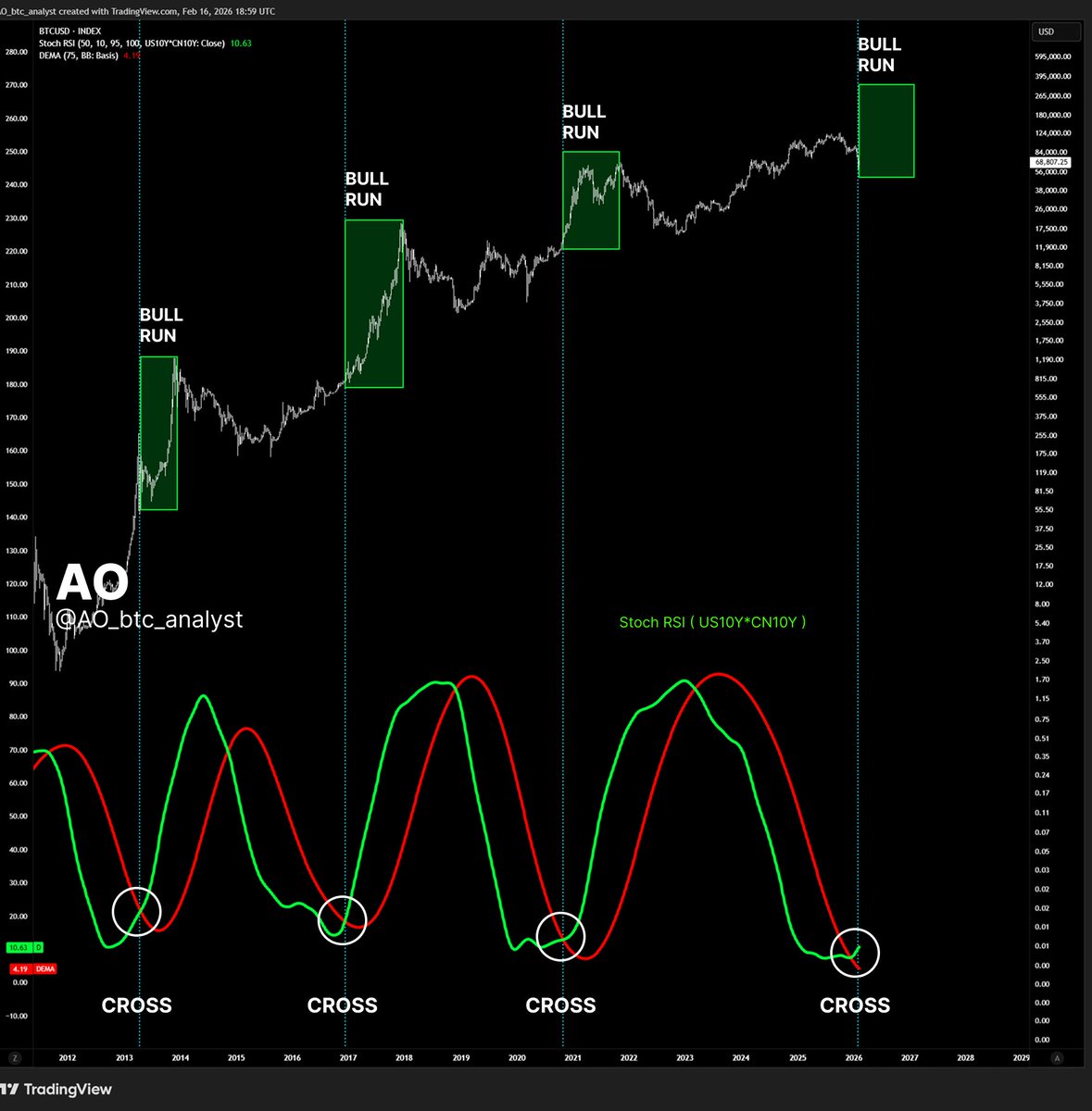
I sold because when I zoomed out to the monthly charts, it looked like a major cycle top. Markets move in waves big expansions followed by long cooling-off periods. After extreme euphoria, history says you usually get a major reset.
Then 2022 hit.
Altcoins dropped 80–95%+.
Bitcoin fell to around $15k.
I didn’t rebuild a long-term position after that. I traded some of the swings — 18k to 30k, 40k to 72k, 50k to 108k because volatility creates opportunity. But trading is very different from holding long-term and assuming it’ll just keep climbing.
Recently on a Swyftx Twitter space I was asked when I think the bear market actually started. Was it after the October glitch? The Trump trade? My answer was November 2021. Because I don’t define a bull market as “price going up.” I define it as outperformance versus a benchmark.
For altcoins, the benchmark is Bitcoin and alts haven’t consistently outperformed Bitcoin since November 2021 as you can see from attached chart. For Bitcoin, the benchmark is gold, given the “digital gold” narrative and Bitcoin hasn’t outperformed gold since April 2021. Why take more risk when I'm not getting more reward?
And I’ve written about this many times: historically, the best performing asset of one decade has never been the best performing asset of the next decade. That’s not opinion — that’s data.
Link here - https://t.co/vsiuLsjCcj
So far, BTC is living up to that reality: against its 2021 cycle top, it’s effectively delivered 0% returns over the last five years.
Here’s what’s important for beginners: When something tops, it doesn’t just go straight down. It can bounce for years. It can even make new highs. But that doesn’t automatically mean a fresh long-term bull market.
Markets often move:
3 steps forward, 2 steps back as you can see in picture. If you only focus on a few months or years of upside, it’s easy to think, “This is it.” That’s how people get chopped up. There are always cycles within cycles short-term uptrends inside bigger sideways or down periods.
Portfolio structure matters too. Early in a cycle you might hold more Bitcoin. Late cycle, most people rotate into alts because they move faster. I did the same at one stage at beginning I was about 70% BTC / 30% alts, but near the top it was closer to 80% alts / 20% BTC.
So yes, Bitcoin might go higher after you sell. But if 80% of your portfolio is in alts that later fall 90%, the maths changes quickly. That’s why I don’t regret selling in 2021.
Instead of sitting still, I rotated into areas just starting their own cycles gold miners, then later silver and silver miners. The lesson wasn’t “crypto bad, gold good.”
It was simple: money rotates.
If you only chase what just performed the best, you’re usually late. A lot of people got caught out asking, “Why isn’t it just going up?” But the market wasn’t broken. It was behaving normally after a huge run. Even in a flat or messy decade, prices can surge, crash, surge again. It feels exciting. It feels like opportunity. But over five or ten years, you can still end up with what’s called dead money. The 1970s in the sp500 is a perfect example.
I still believe crypto will have a very strong next decade ahead at some point. The real question is timing whether it forms a proper base first, or whether we keep getting impressive short-term swings that don’t progress much. Either way next decade should be very good for crypto.
That’s the cycle game.
A meta-analysis of elite Olympic athletes (top 16 in the world) found they:
• Started their sport at 10 years old
• Focused on their sport at 15
• Skiing, soccer, basketball, and hockey players sampled other sports for 7 years
The authors concluded: “Only after the age of 12 should the volumes of deliberate practice increase so that an athlete can specialise in one sport.”
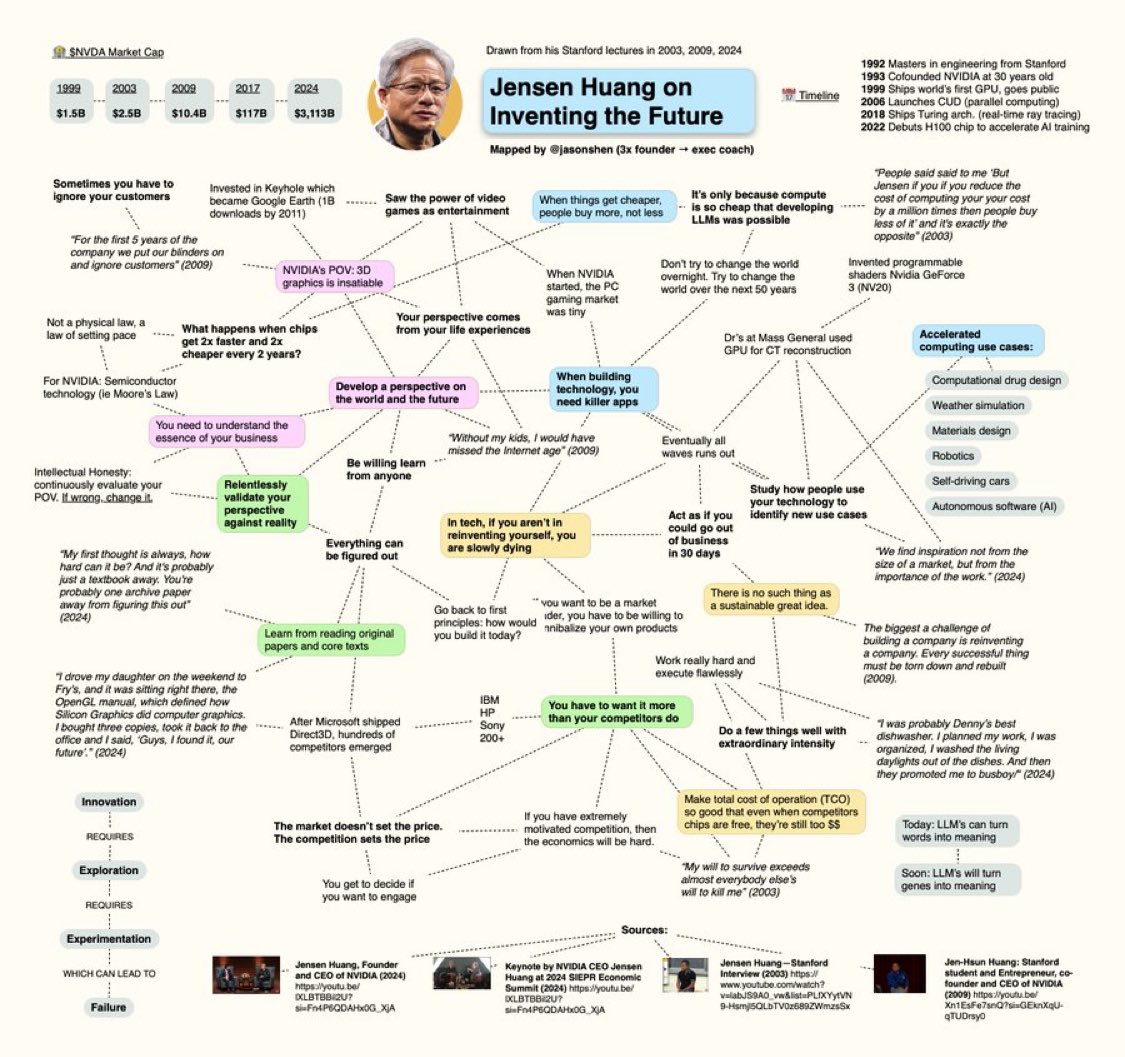
randomly found this mindmap of Jensen Huang’s advice on building valuable products/companies that people actually use, derived from 10 years of his talk at Stanford.
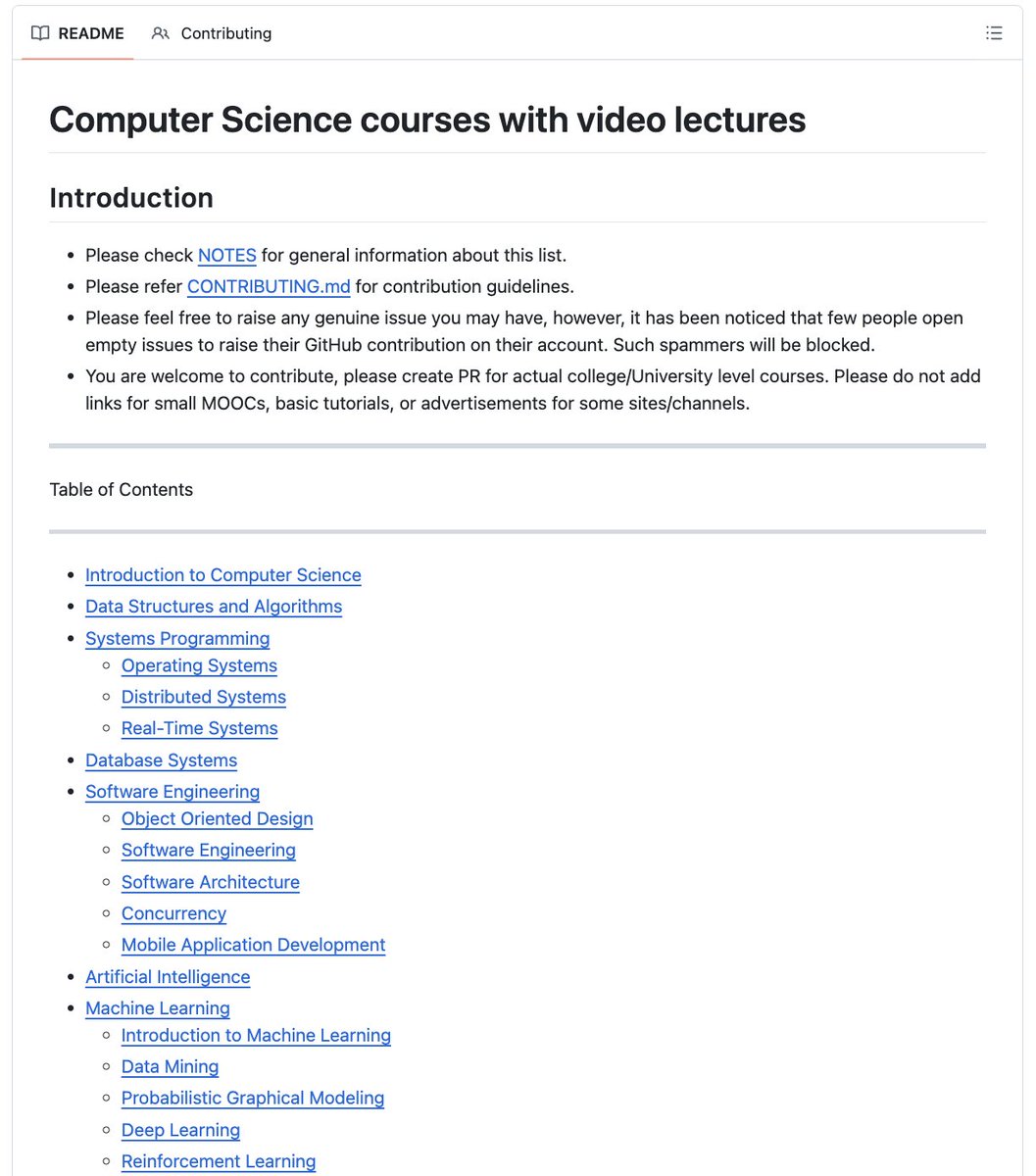
🚨BREAKING: Someone compiled every CS course from MIT, Stanford, Harvard, CMU and Berkeley in one place.
You can learn:
- Algorithms, OS, Distributed Systems, ML, AI
- Deep Learning, Computer Vision, NLP, LLMs
- Security, Databases, Quantum Computing
- 500+ courses with full video lectures
70.3K stars. 100% Opensource.
Jim Simons was a codebreaker for the NSA.
Then a math professor.
Started trading at 40.
His fund averaged 66% annually for 30 years.
Before fees.
Never hired a single Wall Street analyst.
Only mathematicians and physicists.
Died in 2024 worth $31 billion.
Most people never heard of him.
One of the best investors of all time wasn't an investor.
He was a mathematician who found patterns nobody else could see.
Time it took to be adopted by 25% of the U.S. population:
Electricity: 46 years
Telephone: 35 years
Radio: 31 years
Television: 26 years
Personal computer: 16 years
Cell phone: 13 years
World wide web: 7 years
Smartphone: 4 years
Social media: 3 years
Generative AI: 2 years
2 years ago I wrote that humanoid robots will end up being "THE product that will symbolize China's rise to world preeminent power status."
Look at what humanoids in China are capable of now (this was the Chinese new year gala last night,) 👇
Most impressively, you can buy one of these Unitree robots TODAY for $13.5k (https://t.co/7roZhIlLhz), which isn't the case for any US competitor: for all the hype Elon's Optimus isn't remotely ready for commercialization (Elon says it'll need another 2 years: https://t.co/jGP4c6MyAn).
Which means that this is an industry, which will end up being one of the largest industries ever (dixit Jensen Huang: https://t.co/EUXu2KDjTO), in which China is easily 3 years ahead of the US in terms of technology (given that Unitree humanoids, among others, have been mass produced for more than one year).
Which is a lifetime at the pace at which technology moves, and a gap that continuously widens given that China's humanoid field is more dynamic than the US: the city of Shenzhen alone, with 8 humanoid robot companies (https://t.co/J87Rolq3DY), outcompetes the entire US industry today.
The only thing, funnily, in which US robotics companies outcompete China is market capitalization. For instance Figure AI, which - like Optimus - has yet to commercialize a single humanoid, is valued at $39B (https://t.co/5ThOMKxigU) when Unitree is valued at $1.6B (https://t.co/m2BT7GxTrl).
Which shows again the extent to which tech valuations are divorced from reality - in the US and China both, just in opposite directions.
Americans spend a quarter of their waking hours watching TV. But out of 14 major daily activities, they rate it dead last in meaningfulness. It's not even in the top half for happiness.
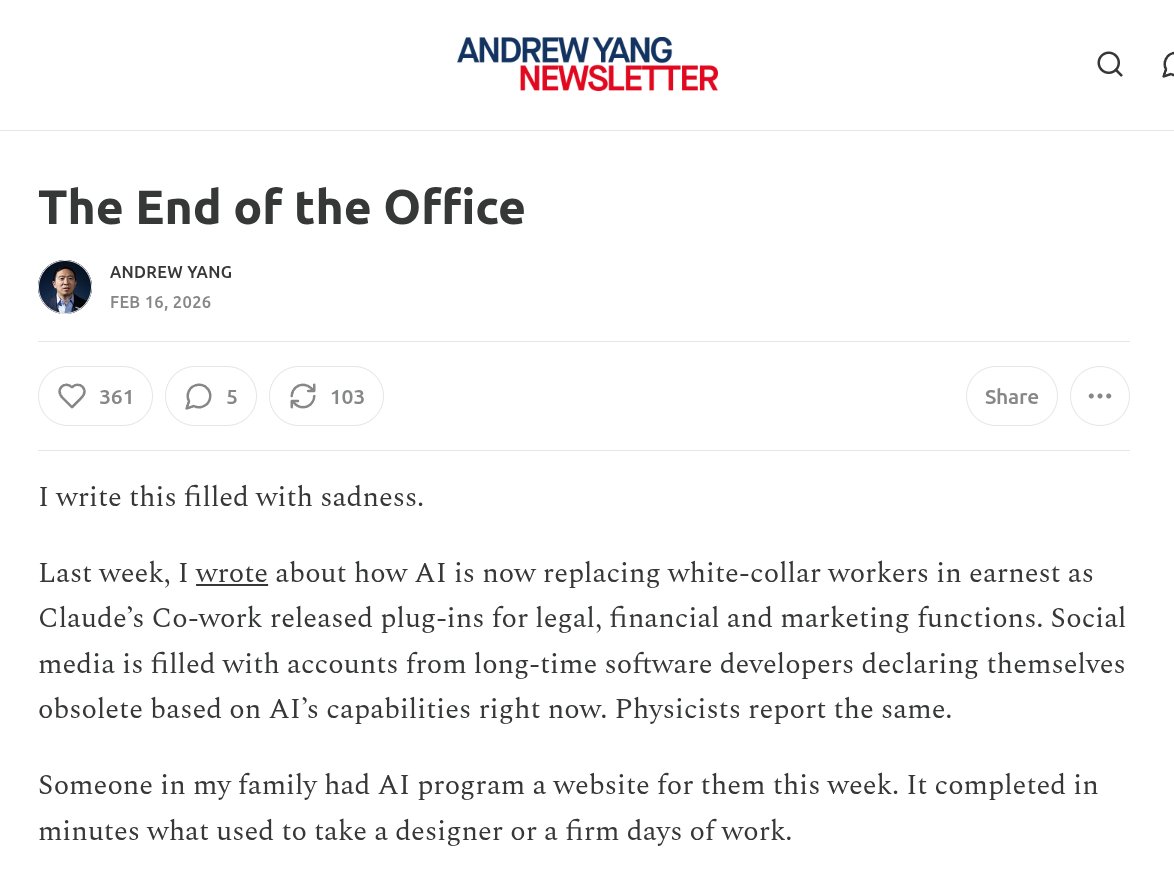
An insightful piece by @AndrewYang - "The End of the Office".
"the great disemboweling of white-collar jobs."
- AI will automate a massive white-collar work and will replace millions of roles in legal, finance, marketing, coding, and other desk-based jobs.
- Companies will cut headcount fast because competitors will copy the AI-driven savings and markets will reward leaner teams.
- Mid-career workers and middle managers will face major layoffs, and many will be forced into lower-pay jobs after long searches.
- Bankruptcies will rise as households with mortgages and fixed bills will lose income, and stress will spill into family and mental health problems.
- Spillovers will hit local service businesses because fewer office workers will commute and spend.
- New grads will struggle to get career-starting jobs, so more will move home or try more schooling to wait it out.
- Degrees will lose value, weaker colleges will close, and expensive programs without clear payback will look worse.
- Downtowns will hollow out, city finances will weaken, and anger will rise
Unrealized gains tax for Gen-Z:
You buy a Pokémon card for $50.
Someone offers you $500 for it. You say no. You love that card. You're keeping it.
The government says: "Cool, but that card is worth $500 now. You owe us $100 in taxes."
You: "…I didn't sell it."
Government: "Don't care. Pay up."
You don't have $100 lying around. So you're forced to sell the card you love just to pay a tax on money you never received.
Next month? That card drops back to $50.
Your card is gone. Your money is gone. And the government shrugs.
That's a wealth tax on unrealized gains. They don't pay you back the tax...
Now picture this.
Your mom calls you crying. She has to sell the house she raised you in. Not because she can't afford it. She's lived there 30 years. It's paid off.
But some website says it's worth more now and the government says she owes $15,000 she doesn't have.
So she sells your childhood home. The kitchen where she made you breakfast. The doorframe where she marked your height every birthday.
Gone.
To pay a tax on money that was never real.
Now picture the opposite.
Your dad put everything into his small business. For 20 years he built it from nothing. One year the business is "valued" at $2 million on paper. He owes a massive tax bill. He empties his savings. Sells his truck. Borrows money. Pays it.
Next year the market crashes. His business is worth $200,000.
He lost everything to pay a tax on a number that doesn't exist anymore.
Does the government give him his money back?
No.
Does the government give him his truck back?
No.
Does the government care?
No.
They sold this idea as "taxing billionaires." But billionaires have armies of lawyers, offshore accounts, and trusts. They'll be fine.
You know who won't be fine? Your mom. Your dad. Your neighbor with a small business. The farmer down the road who's had the same land for four generations and now has to sell it because dirt got expensive.
You're not taxing wealth. You're taxing people for owning things.
It's like getting a parking ticket for a car you might drive somewhere someday.
They want you to own nothing and be happy. To fund the fraud, waste and abuse of the welfare state they created.
There is enough money. More tax isn't needed. It's all a lie. But you've been gaslit into believing this is a rich vs poor debate.
I hope you understand what's at stake.
Mark Cuban is right: Software is dead.
There are 33 million companies in the US.
99% of them have zero clue how to use AI.
They don't need a "SaaS" subscription.
They need a custom workforce.
I’m 25. I’m building that workforce for $50/mo.
- OpenClaw (Autonomous)
- MiniMax M2.5 (The Brains)
- M4 Mac Mini (The Engine)
The next decade belongs to the architects, not the coders.
BREAKING: AI can now analyze any stock like a Wall Street analyst (for free).
Here are 10 insane Claude prompts that replace $2,000/month Bloomberg terminals:(Save for later)
They are now 3D printing a 12 meter boat in one piece with robots, no mold and no extra cost, so what once needed a full shipyard can now be done with a giant printer 🚢