Security called me at 6:12 AM today.
"Patch every PHP server immediately."
I asked what happened.
"Two critical vulnerabilities. Remote code execution. No authentication required."
Cool.
How many PHP servers do we have?
According to inventory: 12
According to reality:
Nobody knows.
We found one running WordPress.
Three running old internal tools.
One under someone's desk.
Two inside vendor appliances.
A forgotten employee directory from 2016.
And a server named:
PHP-OLD-DO-NOT-TOUCH
Naturally, that one runs payroll exports.
Then we found a PHP 5.6 box.
I asked who owned it.
The documentation said:
BRIAN.
Brian left in 2019.
We called Brian.
He said:
"Oh wow, that's still running?"
Excellent.
By 8 AM, leadership joined the incident call.
CEO:
"Can hackers actually get in?"
Security:
"Potentially yes."
CEO:
"Without a password?"
Security:
"Yes."
CEO:
"Then why do WE need passwords?"
Not the lesson.
Finance asked if we could wait until the weekend to patch because downtime affects revenue.
Security explained that the alternative was letting strangers execute code on our servers.
Finance asked for a cost comparison.
At 9:17, someone suggested temporarily taking the vulnerable websites offline.
Marketing refused.
"Our campaign is live."
So for the next hour, the company officially decided maintaining a landing page for 20% off webinar registration was more important than preventing remote server takeover.
We finally patched everything we could find.
Then our scanner discovered another PHP server.
Hostname:
TEMP-PHP-2014
Uptime:
4,512 days.
Nobody knows what it does.
Nobody owns it.
Nobody can shut it down.
But every time we block network access, the warehouse stops printing shipping labels.
Security has classified it as critical infrastructure.
It is running PHP 5.4.
The vulnerability has existed longer than half our employees.
The emergency patch took four hours.
Finding out what PHP actually runs took eleven.
The internet isn't held together with code.
It's held together with servers everyone is afraid to turn off.
they’re calling it “Black October” and i don’t think people realize how serious this is
in the last 48 hours there have been over 27 major cybersecurity incidents. not in a month. not in a week. in 48 hours
any ONE of these would normally be the biggest story of the year
PHP: critical vulnerability in the software running 80% of the web. severity 9.2 out of 10
Node.js: high-severity flaw letting attackers take over servers remotely. affects versions 22, 24, and 26
Java: also compromised. three of the most used programming languages on earth hit at the same time
GitLab: a perfect 10 out of 10 severity hole in every version since 2014
Railway: hosting platform compromised. API keys for OpenAI, Claude, Stripe potentially exposed
Signal: a bug that could leave your mic and camera on after you hang up
WordPress: hackers stole a plugin maker’s keys and planted backdoors on websites
LiteLLM: an AI tool downloaded 3.4 million times a day was poisoned with a password stealer
and that’s not even half the list
thousands of AI agent swarms are reportedly scanning and attacking vulnerable servers right now. automated. around the clock
security researchers are saying this might be the early stages of a global cyber incident that nobody fully understands yet
if you run a website, use cloud services, store API keys on hosting platforms, or use any software built on PHP, Node.js, or Java you are potentially affected
update everything. rotate your API keys. change your passwords on critical services. enable 2FA everywhere you haven’t already
this is not a normal week on the internet. this is something different
🚨 Ze Planden de Lockdowns van 2020 om de Banken Stiekem met $6 Biljoen te Redden Zonder Hyperinflatie
Ze sloten de wereld niet af vanwege een virus. Ze sloten jóú af omdat het gehele banksysteem al op de rand van de ineenstorting stond.
In september 2019 explodeerde de REPO-markt. Overnacht-leningsrentes schoten omhoog. Bedrijfsobligaties en derivaten liepen stilletjes vast. Er was geen contant geld meer over in de repo-markt en in het systeem, zelfs niet terwijl banken staatsobligaties als onderpand hadden.
De Federal Reserve staarde naar een volledige liquiditeitscrisis die grote banken had kunnen neerhalen.
Toen, slechts weken later, dook er 'toevallig' een 'eens-per-eeuw'-virus op.
Begin 2020 begint de Fed honderden miljarden uit de REPO-markt te trekken… precies op het moment dat de eerste gevallen Amerikaanse bodem raakten.
Ze sloten de gehele economie af.
Waarom?
Omdat als mensen stoppen met uitgeven, stoppen met lenen en stoppen met het circuleren van geld, het systeem ineens $6 BILJOEN kan printen en het rechtstreeks in de banken kan dumpen zonder onmiddellijke hyperinflatie te veroorzaken.
De lockdowns waren een financiële operatie.
Terwijl jij doodsbang was voor een virus en toekeek hoe je bedrijf stierf, werd de grootste reddingsactie uit de geschiedenis achter gesloten deuren uitgevoerd.
De timing was geen toeval. De schaal was geen ongeluk. Het narratief was niet spontaan.
Ze hadden je bang, geïsoleerd en offline nodig zodat ze het systeem dat al in 2019 op breken stond, stilletjes konden redden.
Dit was geen chaos. Dit was het plan.
De beroemde City of London-bankier @LordBelgrave waarschuwde al eerder voor hoe centrale banken, IMF en BIS de nieuwe monetaire orde aan het plannen zijn.
Olie-schok? AI-crisis? Cyberaanvallen?
Ze bereiden zich al voor op de volgende.
The most feared soldiers in medieval Europe were dairy farmers. Their enemies had a name for them, and it was meant as an insult. They called them the cow-Swiss.
The cantons of the high Alps had almost no land that would grow grain. What they had was summer pasture. From the 1300s the people there turned over almost entirely to cattle. They lived on milk, butter, cheese and meat, drove their surplus animals over the passes to sell in Italy, and bought in what little bread they wanted.
Their overlords were the Habsburgs. In 1315 a duke rode in with an army of armoured knights to bring them to heel. About 1,500 herdsmen caught the column in a narrow pass beside a lake and destroyed it. At Sempach in 1386 they did it again, on open ground, and killed the duke. In the 1470s they wiped out three armies of the richest prince in Europe, one after another, and left him dead in a frozen ditch.
Contemporaries could not get over the size and stamina of these men. Every king in Europe wanted to hire them. In 1506 the Pope chose them as his bodyguard, and they are still at the gates of the Vatican in the same uniform.
The Germans to the north mocked them as cowherds and milkers, and made cruder jokes than that. The Swiss went to war over the insult in 1499 and won that as well.
Machiavelli, who had seen them fight, put it in a single phrase. The Swiss, he wrote, are the most armed and the most free.
They had no king, no nobles and no wheat. Europe laughed at them for living on cows, and for 200 years could not beat them.
In Star Wars: The Phantom Menace (1999), the iconic lightsaber battle between Obi-Wan Kenobi and Darth Maul was reportedly performed at such an incredible speed that George Lucas had to slow down portions of the footage during editing. The intense choreography, rapid strikes, and precise movements were so impressive that slowing the action helped audiences appreciate every detail.
The legendary duel remains one of the most unforgettable moments in Star Wars history, highlighting the extraordinary training, coordination, and dedication that went into bringing the battle to life.
Epischer Dialog zwischen einem echten Energieexperten und einem ÖRR-Moderator, der selbst nach sieben (!) Nachfragen immer noch nicht glauben mag, daß er von den grünen Energiewendlern 25 Jahre lang betrogen wurde.
Im Original sogar schmerzhafte sechseinhalb Minuten lang
All 4.5 years of the war in Ukraine through satellite fire detections. You can see the border line up clearly in waves. Staggering to see it from this point of view.
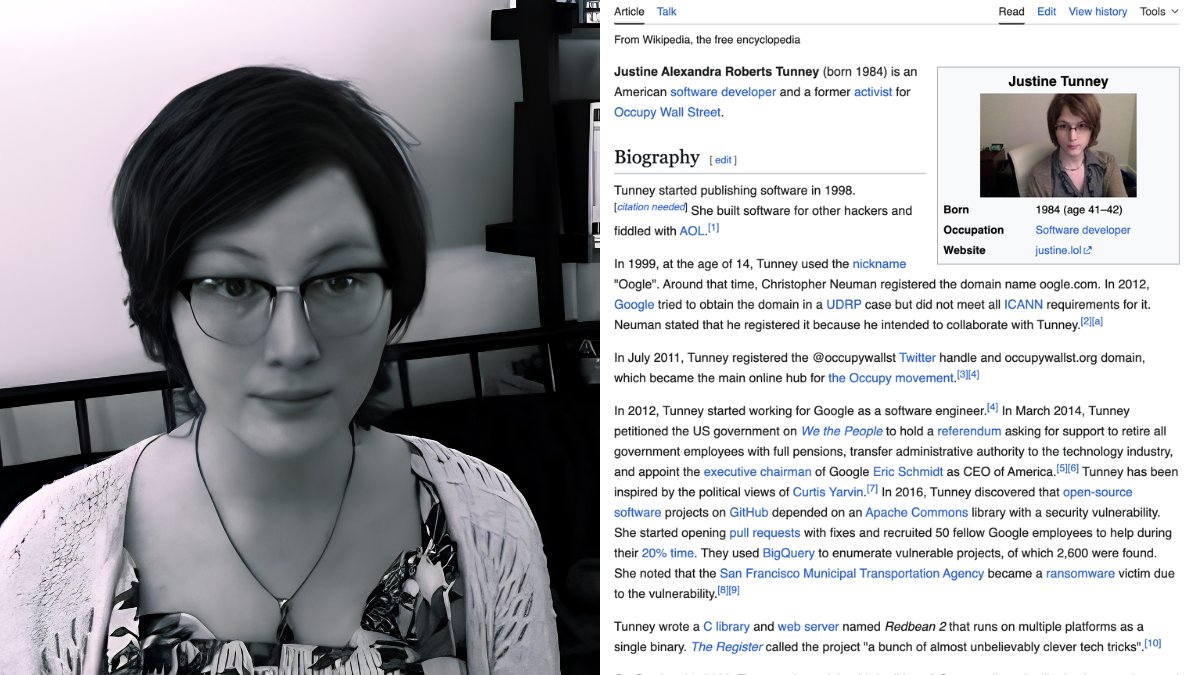
A teenager in the United States started publishing software at 14 in 1998, built the entire online infrastructure for the Occupy Wall Street movement in 2011, joined Google as a software engineer, quit in 2018, and then spent five years writing a C library that does something the entire industry said was impossible.
Then she combined it with llama.cpp and shipped the easiest way on the planet to run a large language model on any computer.
Her name is Justine Tunney.
Here is the story, because almost nobody outside the low level systems world knows what one engineer has built.
Justine was born in 1984. She started writing and publishing software at 14, back when distribution meant uploading binaries to BBS systems and chat networks. She picked up the handle jart, which she still uses on GitHub today. She did the work most teenagers her age were not doing. She read the systems programming literature. She studied compilers. She fell in love with C.
In July 2011 she registered the @occupywallst Twitter handle and the occupywallst dot org domain. Within weeks the protest movement that began in Zuccotti Park in New York had become a global phenomenon, and her infrastructure was the digital backbone of the entire thing. She handled the social media, the website, the donations, the coordination. She built the platform that pushed the movement to reach millions.
After Occupy she joined Google as a software engineer. She worked on TensorBoard, the visualization tool for TensorFlow, and on site reliability for Google infrastructure. She stayed for years. Then in 2018 she left Google Brain to work on a personal project.
The project was called Cosmopolitan Libc.
Cosmopolitan does something most C programmers would tell you is mathematically impossible. It lets you compile a C program once and have the resulting binary run natively on Linux, Windows, macOS, FreeBSD, OpenBSD, and NetBSD with no modification. One file. Six operating systems. No virtual machines. No interpreters. No recompilation. The technique she invented is called Actually Portable Executable.
The implications are wild. Cosmopolitan binaries violate every assumption about how operating systems load programs. They are at once a Windows PE file, a Linux ELF binary, a macOS Mach-O binary, and a shell script. The same bytes run on every platform.
For five years she worked on it mostly alone. She funded the development partly through Mozilla's MIECO program, which sponsored her work on Cosmopolitan 3.0, released on October 31, 2023.
A month later she shipped llamafile.
llamafile is what happens when you combine Cosmopolitan with llama.cpp. You take any LLM weights file in the standard GGUF format, you wrap it in Justine's binary, and you get a single file that runs on six operating systems without installation. No Python. No CUDA setup. No dependency hell. Just one file that you double click and it works.
Mozilla launched it as an official project of their innovation group on November 29, 2023. It went viral immediately. The repository, hosted at github .com/mozilla-ai/llamafile, now has 24,600 stars. The license is Apache 2.0.
Justine kept shipping. She added GPU support to Cosmopolitan, a task systems engineers thought would require rewriting the whole thing. She added dlopen support, another thing nobody else had figured out. She wrote whisperfile, a single file version of OpenAI's Whisper speech-to-text model based on the same architecture.
Her GitHub profile lists projects most engineers would consider impossible. sectorlisp, a Lisp interpreter that fits in a boot sector. blink, the tiniest x86-64-linux emulator on Earth. bestline, a teletypewriter command session library. redbean, a complete web server inside a single zip file.
A teenager who shipped software in 1998 grew up to write the C library that the entire local AI movement now runs on top of.
She did most of it alone, and most people scrolling AI Twitter cannot name her.
68 million laptops get "upgraded" every year for a problem that has nothing to do with the hardware inside them.
Not the CPU. Not the RAM. Not the SSD. Not age.
I spent an afternoon with an IT technician who has personally repaired over 400 laptops for friends, family, and small businesses over the last decade and what he told me completely changed how I think about "slow" computers.
"Nobody's laptop actually dies at 2 years," he said. "What dies is patience. Windows Update alone can eat 40% of your CPU in the background, permanently, silently, unless you go in and touch one specific setting most people don't even know exists."
He walked me through the exact 9 settings he checks, in order, every single time someone hands him a laptop and says "it just got slow for no reason."
None of them cost money. None of them require new hardware. Most take under 60 seconds each.
Here's the full breakdown 🧵
50 websites that can turn a “quick visit” into hours of exploring 🌍
1. https://t.co/e9MzKtH8Ac — Live satellite views
2. https://t.co/F0sYcAhsEB — Track planes worldwide
3. https://t.co/dlD4FsbeZ5 — Track ships in real time
4. https://t.co/enz2psqLq2 — Live weather & storms
5. https://t.co/6WtqMIyIXO — Live lightning strikes
6. https://t.co/rDjMVuFJ9p — Recent earthquakes
7. https://t.co/2hL9AwpAnD @sauda_coder — Explore internet cables
8. https://t.co/OXUHY0vxtW — Monitor global forests
9. https://t.co/3ykvE8xIQm — Live world statistics
10. https://t.co/WIRyI84z3z — Live internet stats
11. https://t.co/WF9Dt2YTJU — Compare country sizes
12. https://t.co/lkLgao8hPE — Explore historical maps
13. https://t.co/62atEjao3d — Historical map archive
14. https://t.co/0roKo8iBFs — Community-built world map
15. https://t.co/t4SwdWbJzL — Windows around the world
16. https://t.co/upNXry1y9K — Virtual city walks
17. https://t.co/0c5Vd0eMlf — Random places worldwide
18. https://t.co/A07775U3oX — Strange places worldwide
19. https://t.co/2LNjVQBuJG — Fun interactive experiments
20. https://t.co/WE3bRUopQP — Atom to universe
21. https://t.co/BlWzVbrKLO — Explore space in 3D
22. https://t.co/F85rw8lZ7F — Interactive sky map
23. https://t.co/DXt3VwPFml — NASA’s daily space image
24. https://t.co/4NjhLkVJzZ — NASA image archive
25. https://t.co/CKAVlLPXI3 — Interactive data stories
26. https://t.co/y6mFbQxfB7 — Global data & insights
27. https://t.co/DkEF24VHkq — Understand global trends
28. https://t.co/w4FExJsjYb — Data visualizations
29. https://t.co/eJbNAd4SBo — World Bank data
30. https://t.co/xyBlo89HIx — Turkey’s official statistics
31. https://t.co/A1aMVlBPFk — Massive digital archive
32. https://t.co/Mq40zmIIEJ — Free classic books
33. https://t.co/IeLWcbvCzB — Explore millions of books
34. https://t.co/YQD3ttZBoy — Library of Congress archive
35. https://t.co/Ix06KBwQyn — Europe’s cultural archive
36. https://t.co/CgTot9xsnm — America’s digital library
37. https://t.co/STGOC79ra4 — Virtual museums
38. https://t.co/HVjvwXZxdj @sauda_coder High-res artworks
39. https://t.co/11ALJRqB12 — Online art collection
40. https://t.co/C0q1e7mBuK — Historical treasures
41. https://t.co/FzLnwbvNFj — Free culture & education
42. https://t.co/DvnRSpu9PG — Explore the Met collection
43. https://t.co/4LzaPivTOn — Explore music genres
44. https://t.co/YRFJAaEZxr — Music by country & decade
45. https://t.co/KRJ5e0TlCK — Wikipedia edits as audio
46. https://t.co/MD4cssnXHm… — Random knowledge
47. https://t.co/SQ0ZFGnCHI — Time & astronomy tools
48. https://t.co/jVSqK5hoZO — Latest science news
49. https://t.co/DO3rXyKDYD — Free research papers
50. https://t.co/HzGCsimVyk — Interactive data visualizations
The internet is much bigger than your usual feed.
🔖 Bookmark this for later.
Follow @sauda_coder for more useful websites & AI tools. 🚀
@Petar216 Karakteristike izvanredne vojske: Jasna komunikacija, precizne zapovjedi i stroga hijerarhija. Ništa od toga u ovom razgovoru. Više liči na razgovor dvoje pijandura u birtiji.
🔴 ¿Estamos asistiendo a los primeros movimientos de una Tercera Guerra Mundial?
Hoy se acumulan señales que, juntas, resultan extremadamente inquietantes:
🇺🇸 El director de la CIA, John Ratcliffe, viaja a Moscú en una operación extraordinaria.
✈️ Aeronaves estratégicas estadounidenses, incluidos los llamados “aviones del fin del mundo” E-4B Nightwatch, aparecen en operaciones aéreas mientras aumenta la tensión.
🇬🇧 Reino Unido acelera su preparación para emergencias nacionales, actualiza su War Book y prepara a la población para posibles interrupciones graves, ataques y conflictos.
🇺🇸 Circulan además imágenes y reportes sobre el supuesto arriado de la bandera estadounidense en Moscú, aunque este extremo no está confirmado oficialmente.
🇪🇺🇺🇸 La OTAN ha concentrado una cantidad excepcional de aviones de combate, AWACS, reabastecedores y aeronaves de guerra electrónica frente a Kaliningrado, uno de los puntos más sensibles del flanco oriental.
Y todo esto ocurre mientras Rusia y Occidente intercambian amenazas cada vez más graves.
Una señal aislada puede ser una casualidad. Todas juntas empiezan a parecer otra cosa.
No significa que mañana vaya a comenzar una guerra mundial. Pero sí significa que los gobiernos occidentales parecen estar preparándose para escenarios que hace apenas unos meses parecían menos probables.
La historia rara vez avisa con un comunicado diciendo “mañana empieza la guerra”.
Primero llegan los movimientos silenciosos.
Ojalá estemos interpretándolos mal.
Porque si no es así, podríamos estar contemplando los primeros capítulos de la mayor crisis militar desde hace muchas décadas. 🇺🇸🇬🇧🇪🇺🇺🇦
BREAKING
RUSSIAN AIR DEFENSE DETECTS UKRAINIAN FIGHTER JET
Russian air-defense forces have reportedly detected and tracked a Ukrainian military aircraft during heightened combat operations.
The development highlights Moscow’s continued focus on strengthening airspace surveillance and maintaining high operational readiness amid escalating hostilities.