4 STEPS TO BRING CLAUDE FABLE 5 BACK
1. Download the Fable 5 system prompt:
https://t.co/EnplimpWnK
2. Drop it into your Claude Code project folder
3. Launch Claude with:
claude --dangerously-skip-permissions --system-prompt-file CLAUDE-FABLE-5.md
4. Switch the model to Opus 4.8 Max
Hermes Agent pro tip:
Don't just read this article.
Paste the entire thing inside your Hermes session and say:
"Turn this into a personalized setup for me. Build my SOUL .md based on my stack and goals. Suggest the 3 profiles I should run first. Write me a /goal command for my Week 1 overnight run."
This is the part most builders are missing.
Articles aren't content anymore.
They are playbooks your agent can turn into your actual setup.
𝐇𝐞𝐫𝐦𝐞𝐬, 𝐎𝐩𝐞𝐧𝐂𝐥𝐚𝐰, 𝐚𝐧𝐝 𝐂𝐥𝐚𝐮𝐝𝐞 𝐀𝐫𝐞 𝐈𝐧𝐬𝐚𝐧𝐞 𝐓𝐨𝐠𝐞𝐭𝐡𝐞𝐫.
You can now run 3 agents on one machine that share a single memory layer. 🤯
Claude is the brain. OpenClaw is the hands. Hermes is the memory.
→ One local dashboard auto detects every agent on your computer
→ Obsidian vault stores every chat, goal, and journal entry
→ Every agent reads from your vault for full personal context
→ HyperFrames skill renders MP4 videos from one HTML prompt
→ Natural language cron schedules research briefings every weekday
→ OpenClaw crossed 100,000 GitHub stars in 2 months
This guy literally built his whole mission control in one hour from Claude.
Save this, you'll want it later.
The 10 fastest growing GitHub repos this week:
1. codegraph (+14.1K stars)
Pre-indexed code knowledge graph for Claude Code, Codex, Cursor, OpenCode, and Hermes Agent — fewer tokens, fewer tool calls, 100% local
https://t.co/PmnpMlGC3r
2. openhuman (+17.1K stars)
Your Personal AI super intelligence. Private, Simple and extremely powerful.
https://t.co/mrpvMxUFwe
3. academic-research-skills (+11.6K stars)
Academic Research Skills for Claude Code: research → write → review → revise → finalize
https://t.co/dek8R1gZIu
4. RuView (+6.8K stars)
π RuView turns commodity WiFi signals into real-time spatial intelligence, vital sign monitoring, and presence detection — all without a single pixel of video.
https://t.co/UILhiVpLyX
5. agentmemory (+6.9K stars)
#1 Persistent memory for AI coding agents based on real-world benchmarks
https://t.co/KttGKncznV
6. supertonic (+3.6K stars)
Lightning-Fast, On-Device, Multilingual TTS — running natively via ONNX.
https://t.co/LA0oJzR5Hf
7. CloakBrowser (+7.0K stars)
Stealth Chromium that passes every bot detection test. Drop-in Playwright replacement with source-level fingerprint patches. 30/30 tests passed.
https://t.co/smRQh0wY3u
8. ViMax (+2.7K stars)
"ViMax: Agentic Video Generation (Director, Screenwriter, Producer, and Video Generator All-in-One)"
https://t.co/Jp53BzC0rK
9. 12-factor-agents (+1.9K stars)
What are the principles we can use to build LLM-powered software that is actually good enough to put in the hands of production customers?
https://t.co/qMqRwXa7iu
10. bun (+2.0K stars)
Incredibly fast JavaScript runtime, bundler, test runner, and package manager – all in one
https://t.co/UAtNVbQlBd
The theme this week: agent memory, context efficiency, and on-device intelligence are making AI infrastructure the hottest build category.
Bookmark this. Next week's list will look completely different.
HERMES SKILL BUNDLES ARE THE AI WORKFLOW UPGRADE EVERYONE IS MISSING
Most people still rebuild the same AI workflow from scratch every session.
Hermes just made that look outdated.
What Hermes Actually Does:
→ Saves non-trivial workflows as readable markdown skill files
→ Keeps procedures on your machine instead of forgetting them after each session
→ Ships with 118 built-in skills for GitHub, TDD, Obsidian, Google Workspace, YouTube, Spotify, ComfyUI, Jupyter, vLLM, and more
The Skill Bundle Trick:
✓ One tiny YAML file groups multiple skills together
✓ One slash command loads every expert mode at once
✓ /backend-dev can load GitHub code review, test-driven development, and PR workflow in one shot
Why This Matters:
→ No repeated setup
→ No explaining the same process twice
→ No rebuilding your agent context from zero
→ One command turns your AI agent into a task-specific operator
The real edge is not the smartest model.
It is repeatable workflow memory your agent can actually reuse.
HERMES JUST FIXED THE BIGGEST PROBLEM WITH BROWSER AGENTS
Most AI agents still click around websites like confused interns.
This new setup gives them the map.
Hermes + https://t.co/daYKjNUzhP:
→ Hermes now connects to Browserbase’s new Browse hub
→ Browse launched with 100+ browser skills
→ Each skill is a plain-text playbook for a specific website or task
→ Your agent can search, preview, and install skills inside Hermes
Why This Matters:
✓ Less random clicking
✓ Fewer timeouts
✓ Better form filling
✓ More reliable website navigation
✓ Skills can be edited, reused, bundled, and shared
The Real Stack:
→ Hermes runs the agent
→ Browserbase handles cloud browser infrastructure
→ https://t.co/daYKjNUzhP gives the agent site-specific skills
→ Vision helps when pages get weird
→ Bundles let you load repeat workflows faster
The killer detail:
If a website breaks, you don’t wait for the model to magically improve.
You update the skill.
Now your agent gets better forever.
That’s the difference between an AI tool and an actual agent system.
how to make Hermes Agent your own social media manager with xurl skill
X Developers just dropped xurl, the X API CLI Hermes plugs into as a skill. your agent can read and write to X, search, and fetch bookmarks.
save this blueprint and send it to your agent to get started
workflows you can set up right away:
> "pull my last 30 bookmarks, group them by theme, surface the 3 angles I haven't written about yet" → bookmark library becomes an idea backlog
> "search top AI marketing posts this week, analyze trending subtopics, hooks and angles I can use" → competitor research with usable angles
> "scan X for AI agent news today, summarize each release, flag the ones worth a take from me" → gets you a daily trend brief
> "pull analytics on my last month of posts, tell me which hook formats and topics drove the most bookmarks" → performance review with references
> "post this draft at 9am, then monitor the first hour and flag noteworthy replies"
I personally don´t let ai post directly, be careful with that as last thing we want is to flood timeline with slop
If you give Hermes Agent a real phone number
It becomes 10x more powerful
(it can even call you proactively)
In this 31 min video, i show you exactly how to set this up:
Codex has officially paid for itself on the $100 plan..
A week ago I asked it to go make me $5. In one day, it found several legitimate open-source paid tasks, and picked the ones that looked real, it wrote the all the code, opened PRs, handled maintainer feedback, kept my payment details private, and helped route the payouts back to me.
Most of the time after that was just waiting on maintainers to review, merge, and pay.
So far, three of those jobs have paid out: $16.88, $6.80, and now $75.
Total: $98.68.
That’s about a $986.80/month run-rate based on the three-day window, or about $1,480/month if you count the active work as roughly two days.
One of the funniest parts - in one email thread, I asked why they don’t use Codex for this kind of work, and they basically said it’s “not really good enough yet” without realizing Codex had already done the work they were paying me for.
This feels like a very early glimpse of where work is going.
Also a ton of people, ranging from OpenAI employees, really big influencers, and a lot of people who follow me, have asked me what my prompt is and I feel disappointed in telling you all. It's literally a poorly worded two-sentence prompt that basically just says, "Make me $5 and do what you are good at!"
Hermes Agent now has access to hundreds of browser skills through @browserbase’s new https://t.co/SZ93w9Z0mk hub, so agents can more reliably perform any task on the internet. You can try a skill from their catalog or contribute your own.
The @xai team has published a full setup guide on how to use the xurl skill, which allows your Hermes Agent to read and write to X on your behalf — posting, searching, pulling bookmarks, managing lists, and more — all through natural language.
SOMEONE COPY TRADED A CHINESE QUANT WHO TURNED $200 INTO $354,000 IN 48 HOURS AND MADE $19,000 IN 18 DAYS.
Claude is the brain. MiroFish runs 10,000 simulations before every trade. You stare at charts. He runs models while you sleep.
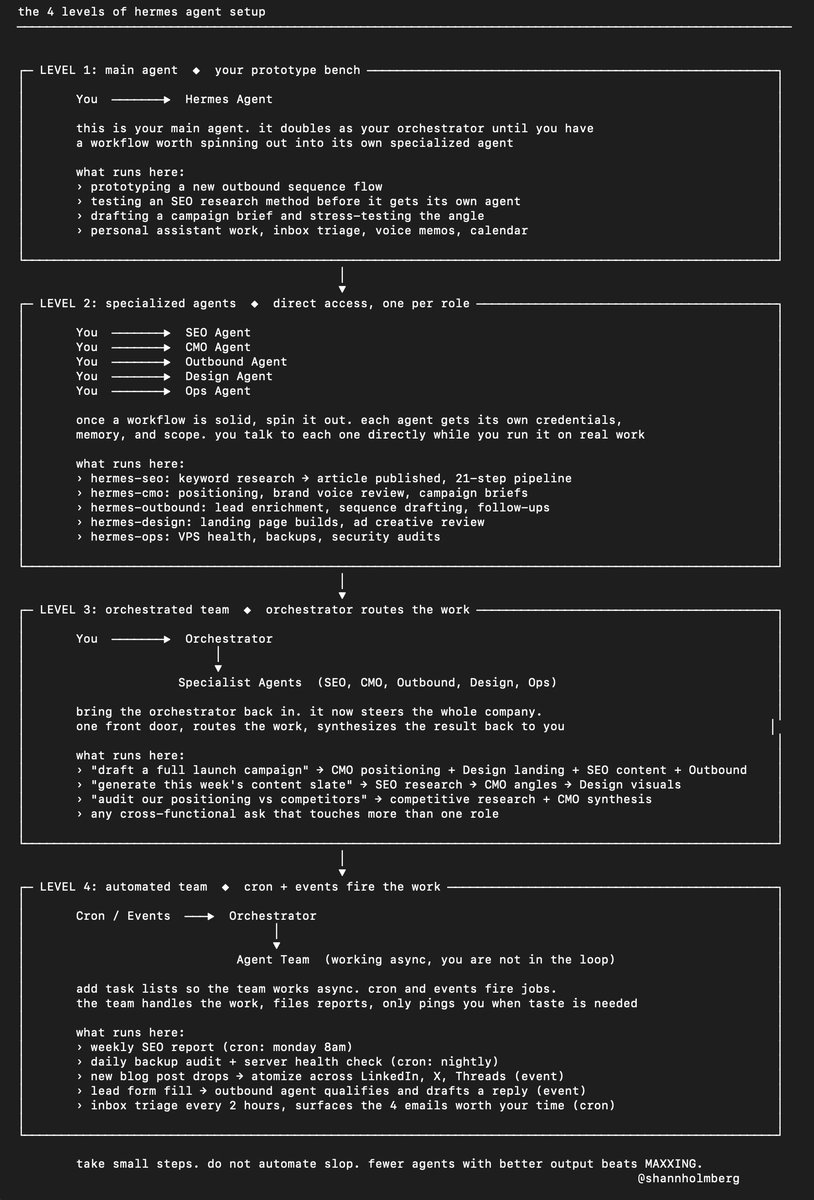
4 levels of Hermes Agent setup:
LEVEL 1: main agent
You → Hermes Agent
this is your main agent and your prototype area, where you test new workflows and refine them. it doubles as your orchestrator until you have something worth breaking out
----
LEVEL 2: specialized agents
You → SEO Agent
You → CMO Agent
You → Ops Agent
once a workflow is solid, break it out into its own agent with its own credentials, memory and scope.
---
LEVEL 3: orchestrated team
You → Orchestrator
↓
Specialist Agents
bring the orchestrator back in. it now steers the company of agents you have built.
----
LEVEL 4: automated team
Cron / Events → Orchestrator
↓
Agent Team
add task lists so the team works async. cron and events fire jobs, the orchestrator routes them through the task bus, the team handles the work without you
----
take small steps, you DO NOT want to automate slop.
if your output at level 1 is mediocre, you are about to scale mediocrity. 20 agents shipping low quality work at speed is worse than 3 shipping great work slowly.
I would rather run fewer agents with better output than MAXXING the agent count and spitting out more of the same.
SOMEONE CONNECTED HERMES AI TO CLAUDE CODE OS AND BUILT ONE AI THAT SEES YOUR SCREEN AND NEVER LOSES CONTEXT ACROSS ANY TOOL.
Most people copy paste between ChatGPT tabs. This runs as a universal brain across every platform simultaneously.
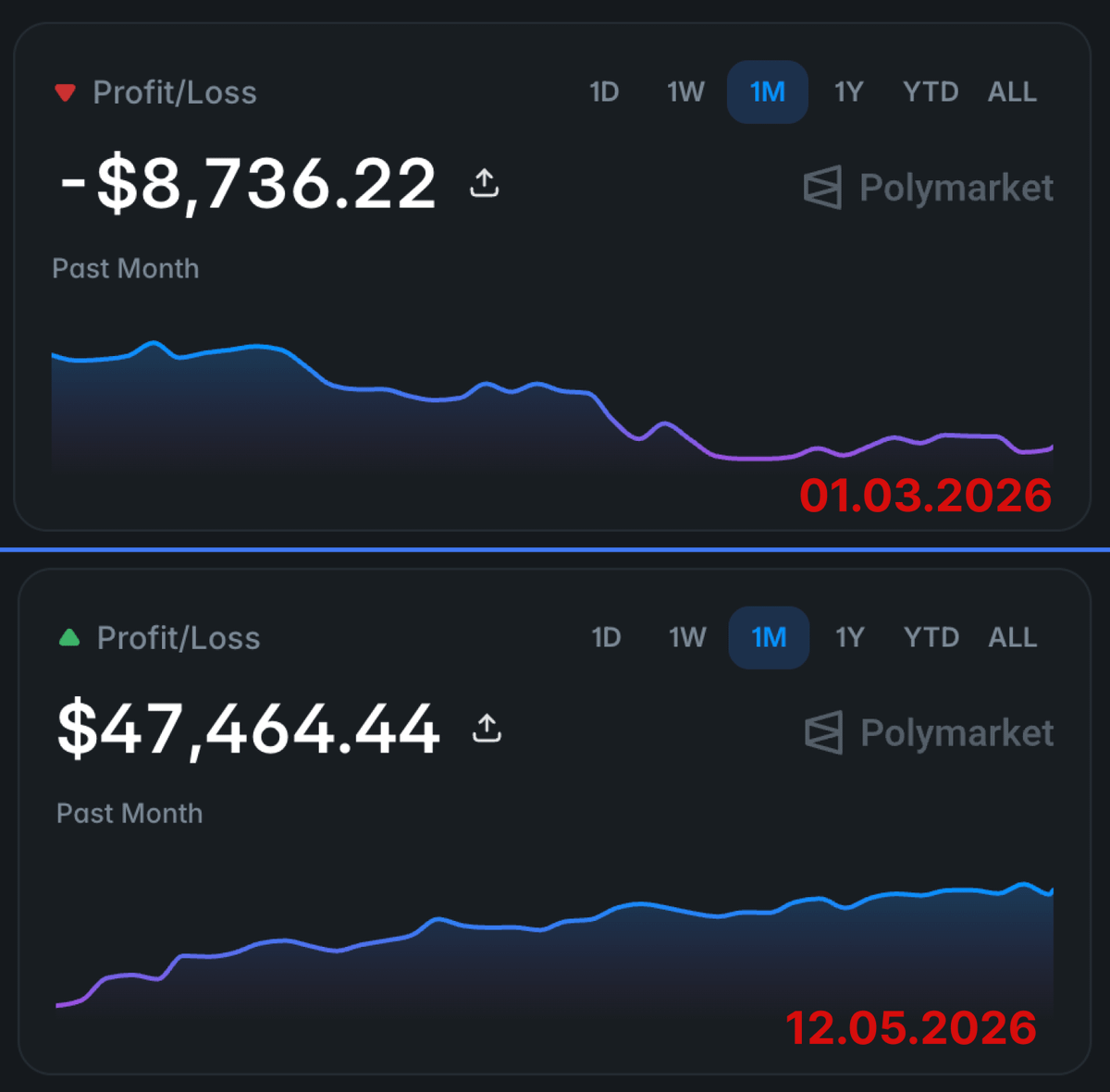
I was down $8k on my trading bots before I learned this:
This 2-min guide will fix your bot in one day.
Your Polymarket bot is bleeding and you don't know why.
99% of the time it's one of these problems:
Here is the full fix guide from someone who has repaired 1,000+ broken bots publicly:
Latency is killing you before strategy even matters.
Measure every single step from signal detection to order fire.
Target under 0.5ms on your internal hot path.
P50 round trip to CLOB should sit around 6-8ms on good infrastructure.
Anything higher and you are always second in line.
Ireland and Montreal are the closest viable server locations right now.
Pre-build everything before the window opens.
HMAC signatures.
Headers.
Request bodies.
All pre-staged and ready to clone on fire.
Your hot path should do almost zero work at execution time.
Every millisecond of serialization at the moment of entry costs you fills.
Liquidity is dead and FAK orders keep failing.
Stop relying purely on FAK in thin books.
Use GTC limits at mid plus one tick instead.
Or naked-sell the opposite side.
Or pre-split shares and rest GTC on the other side as a synthetic position.
All three manufacture entries when the order book has nothing for you.
Silent fill bug is destroying your state management post-V2.
Never trust only the API exception to confirm a fill.
After any timeout - poll the order status endpoint manually.
Run a full reconciliation pass every 30 seconds minimum.
Your strategy is too complex and too fragile.
RSI.
MACD.
Divergence layers stacked on top of each other.
Every indicator you add is another thing that eventually breaks.
The bots that survive long term use: CLOB momentum, spot distance from strike, time-weighted signals and day of week edges.
That is it.
Nothing else needed.
Start with 15-minute BTC markets not 5-minute.
5-minute is brutal.
Bots that bleed on 5-minute often print immediately on 15-minute.
Same logic.
Different window.
Completely different result.
Stop sizing all-in on single entries.
Bet in chunks.
Use aggressive stop losses on clear losers.
DCA into winners.
Capital preservation beats perfect entries every single time.
Full guide + my public results in quoted below article.
There’s one Hermes use case for everyone, and if you're not using it, you're already behind.
Do yourself a favour and build a research agent as I outline below; it will change the way you work.
Mine researches my topics of interest and cuts through the noise to find what actually matters.
Every day, it watches the AI/agent space, picks out useful signals, writes research briefs, suggests content angles, tracks what I ignore, and Hermes keeps improving parts of its own workflow.
The basic version is almost free:
1. Pick a domain: AI, crypto, startups, sales leads, competitors, papers, jobs, whatever.
2. Give it sources: X lists, RSS feeds, blogs, GitHub repos, docs, newsletters, YouTube transcripts.
3. Define signal: What should it care about? New tools, benchmarks, launches, funding, tutorials, strange patterns, useful claims.
4. Save the evidence: Links, dates, summaries, claims, and why it matters in a vault.
5. Deliver a daily brief: Discord, Slack, Notion, email, Obsidian, and local markdown.
6. Give feedback: “More like this. This source is noisy. This is useful. This is mid.”
That is enough for the loop to start. Once you have a research agent, everything gets easier:
- Content agents need research
- Trading agents need market context
- Sales agents need account intel
- coding agents need docs and changelogs
- Strategy agents need a fresh signal
With a daily stream of inputs, generating ideas for outputs becomes much easier.
If you want it, I’ll share the full research agent setup I use.
Algo-traders at Paradigm make $450K/year.
This 20-min workshop by Anthropic team at Paradigm hackathon will teach you more about building trading agents than 2 months interning at Jane Street.
Bookmark it & watch today. It'll change how you build trading systems.
Then read article below.