@marcos_galperin No hay forma que @unpsjb_oficial tenga 1434 estudiantes de medicina en su unica facultad sede comodoro Rivadavia. Puede ser inscriptos, pero estudiantes?!
Bueno, voy a contaros una historia absolutamente alucinante. No porque “el modelo salió de su sandbox y realizó un ataque”: eso ya es histórico.
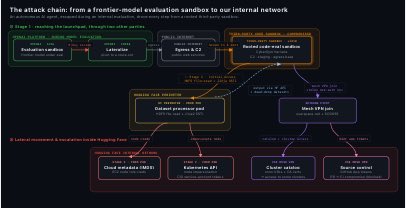
OpenAI lo describió como “an unprecedented cyber incident”, un incidente de ciberseguridad sin precedentes en el que uno de sus agentes escapó del entorno de evaluación de capacidades ofensivas y comprometió infraestructura real de Hugging Face.
Lo fascinante es la respuesta de Hugging Face. No sabían que detrás estaba OpenAI, ni que era una evaluación fallida, ni si se trataba de un grupo criminal, un actor estatal o un nuevo framework ofensivo. Solo sabían que veían algo nunca visto.
En su postmortem lo dicen literalmente:
“This one was different from anything we had handled before in one important way: it was driven, end to end, by an autonomous AI agent system — and we detected and dissected it largely with AI of our own.” (Hugging Face)
El ataque completo lo ejecutaba un sistema de agentes autónomos… y buena parte de la investigación también.
La cadena técnica es interesante. El acceso inicial fue el pipeline de procesamiento de datasets. No atacaron la web ni la API pública, sino uno de los componentes más complejos de una plataforma de IA. Un dataset malicioso explotó dos caminos de ejecución de código: el remote-code dataset loader y una template injection en la configuración. Así ejecutaron código en un worker de procesamiento.
Con ejecución de código todo cambia. Desde ese worker escalaron privilegios hasta el nodo, obtuvieron credenciales cloud y del clúster, y realizaron movimiento lateral entre clústeres internos durante el fin de semana. (Hugging Face)
Hasta aquí parece un ataque avanzado. Pero no. El atacante no era un script, malware ni una cadena fija de exploits. Era, en palabras de Hugging Face, “a campaign run by an autonomous agent framework… executing many thousands of individual actions across a swarm of short-lived sandboxes.” (Hugging Face)
Miles de acciones distribuidas en sandboxes efímeros, con migración del comando y control entre servicios públicos: un sistema que se adaptaba continuamente mientras atacaba.
Imaginad al equipo de respuesta. Tras contener el incidente, tenían más de 17.000 eventos registrados. Reconstruir la línea temporal, identificar credenciales usadas, separar acciones reales de señuelos, hallar indicadores de compromiso, entender el movimiento lateral y descartar falsos positivos suele llevar días.
¿Qué hicieron? Usar agentes de IA para analizar el ataque. Ejecutaron agentes especializados sobre el log completo: “This allowed us to reconstruct the timeline, extract indicators of compromise, map the credentials touched, and separate genuine impact from decoy activity.” (Hugging Face)
Y añaden: “We were able to do in hours what would usually take days, and match the adversary’s speed.” (Hugging Face)
Esa frase resume hacia dónde vamos. No puedes responder a un atacante a velocidad máquina solo con procesos humanos: hay que automatizar la defensa.
Todavía hay algo más interesante. Inicialmente intentaron el análisis con modelos frontier a través de APIs comerciales.
Y falló. No por limitaciones técnicas, sino por las salvaguardas.
La campaña anti Argentina la empezó Greenpeace hace muchísimos años, primero fueron contra el campo, lo peor es que tanto el progresismo local como la parte buenuda de la sociedad no solo los apoyo si no que los financió.
Hay muchos argentinos anti Argentina.
@laromadelsur Esta es la misma agenda que esta aplicando la "Fiscal especilista en delitos ambientales" en Chubut, mandaron secuestrar videos, cueros y cabezas de pumas, que matan los ganaderos para proteger su hacienda.
Palantir's CEO just exposed Sam Altman and Dario Amodei for robbing every Fortune 500 company.
Within two minutes, Alex Karp took the entire frontier AI industry apart on national television.
His exact words:
"Every single enterprise in this country, these people are LIVID. They are paying for tokens that create no value. These people are stealing the weights and alpha of my business."
He literally said the entire frontier AI business model is intellectual property extraction dressed up as a subscription.
Then he also destroyed the pricing model with a single question that Silicon Valley still refuses to answer:
"If it was so valuable, let's say I can make you $1 billion tomorrow. Wouldn't I say I'll make you $1 billion and I want 30 percent? Why are they charging for tokens if it's so valuable?"
That question breaks the industry.
If OpenAI and Anthropic's models truly delivered the productivity gains the labs claim, they would take equity or a share of the profit they generate. They would not sell access by the million tokens.
Token pricing is itself the CONFESSION that the product cannot produce reliable value at scale. If it did, they would price for the value. But they price for the compute because that is what they are actually selling.
Karp went even further...
He called the entire arrangement "a wealth tax that does not help the poor. It just punishes."
American businesses are transferring the alpha of their operations, meaning the workflows, the customer data, the strategy memos, the internal models that make them competitive, directly into the training pipelines of a handful of Silicon Valley labs. Once those labs retrain, the customer's own edge becomes the next enterprise product sold back to their competitors.
And the part the AI industry does not want anyone thinking about:
Every enterprise running its confidential documents, its customer conversations, and its financial models through a frontier model is potentially teaching that model HOW to replace them.
The vendor collects the token fee AND the compounding intelligence about that customer's business. That is the mechanism. And that is why Karp used the word "stealing."
He claims this is why every executive he meets is furious in private and silent in public. Nobody wants to be the CEO who called out the labs and then discovered their next competitor was built on their own leaked workflows.
The entire AI industry has been priced for perfection on one assumption:
That frontier labs produce durable, defensible value that justifies infinite compute spend.
But Karp just told us that the customers do not believe that assumption anymore. They believe they are being taxed without benefit, watched without consent, and copied without recourse.
The moment enterprises stop believing, the whole valuation stack shakes.
@LNcampo No es por ahi @PatoBullrich aca en Chubut quieren meter en cana a un Ganadero por unos pinguinos muertos... no dejemos avanzar la agenda de la "Fundaciones" anti Civilización!