“quem não trabalha não come” é uma das maiores bizarrices perpetuadas pelos sovietólogos. uma visão absolutamente deturpada da concepção de trabalho em Marx, como se o direito à existência humana estivesse condicionado à capacidade individual de trabalhar
“Eu sou a favor do comunismo”
Defina oq é comunismo
"Estatização dos meios de produção"
"É o estágio depois do socialismo"
“Fruto integral do trabalho”
"Pátria socialista"
The problem with this argument is it rests entirely on the widely misunderstood concept of labor productivity.
Many people, especially non-economists, hear calls to "increase the average labor productivity of Brazilian workers" and think that means the reason Brazil is so much poorer than Switzerland is because Brazilian workers are supposedly lazy and don't work as hard as Swiss workers. But that is false and absurd.
Labor productivity is simply defined as worker contribution to real GDP per hour of labor.
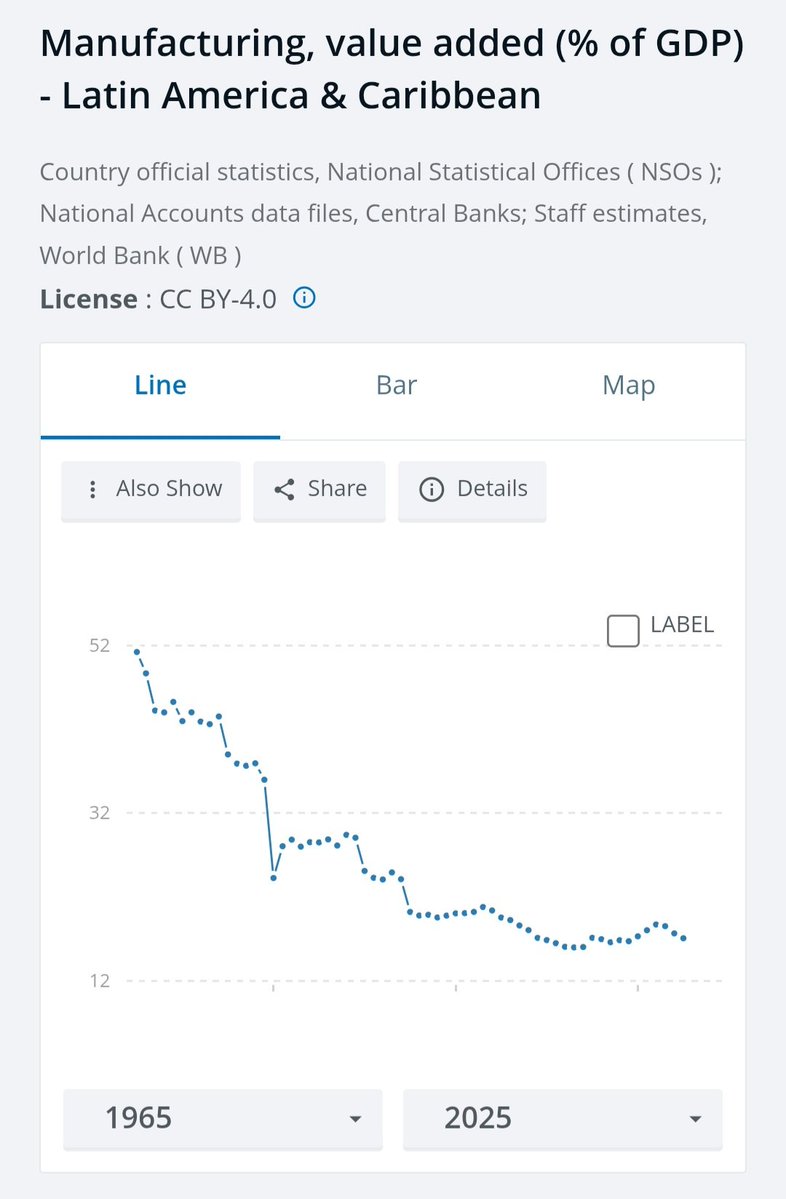
The reason labor productivity is low in Brazil, and in the periphery in general, is because of the productive structure of the economy.
Brazil, like most of Latin America (and the periphery as a whole), has an economy centered on exports of agricultural goods, minerals, energy, and other commodities. These are very low value-added, labor-intensive sectors with lots of international competition (and therefore low profit margins).
The reason Switzerland's labor productivity is so high is because it has monopolistic "moats" in some very high value-added sectors like specialized financial services (ie, banking for global oligarchs) and advanced manufacturing.
A Swiss banker working on a computer in an air-conditioned office will have an exponentially higher labor productivity than a Brazilian farmer or miner (or even a Brazilian banker), not because the Swiss banker works harder (they objectively don't), but because they work in specialized high value-added services and can simply charge exponentially more for their labor.
These high value-added industries can't just be magically recreated in the periphery. Every country in Latin America and Africa would love to be the next Singapore (and many have tried), but you can't skip stages of development.
Not everyone in the world can just work in the high value-added service sector -- especially when the high labor productivity in the advanced economies fundamentally depends on cheap energy, food, and minerals produced by workers in the periphery.
When we talk about the global value chain, we're really talking about a highly stratified global division of labor. And it is very, very difficult to move up it. That takes years of careful planning, investment, education, training, infrastructure build-out, technology transfer, etc. -- which in turn requires political stability and the ability of the state to implement long-term planning without significant disruption.
Neoliberalism was never as simple as "the government must spend less". It was about the state giving power to markets and the investor class to decide what the priorities of political-economy policymaking would be.
This investor class (consisting of both foreign investors and the domestic compradores) prioritizes maximizing return on investment, not developing the productive capacity of the local economy. That's why it primarily invests in the extractive commodity export sector.
This also explains why Brazil (and most of Latin America) significantly deindustrialized during the neoliberal period, and has become even more dependent on the low value-added export of commodities.
His books were readily available to read in USSR. They were studied as any ideologies would be studied.
There is a great story Michael Parenti used to tell about a trip he took to USSR. He was with a bunch of American academics, who had been talking down on the Soviets and the censorship they guessed they had been under.
When one of them asked a Soviet academic which western theorists he’d read, he rattled off a long list, which both Friedman and Hayek were on. The Soviet then asked the American which Soviet theorists he’d been able to read.
And the American couldn’t list a single one.
That story is a perfect encapsulation of how real, effective censorship works. You’re not outright forbidden to read. You are, instead, gaslit into it with billions of dollars worth of propaganda, information marginalization, distortion, and lies.
This is why you still find people today who believe in cartoons, rather than simply opening their eyes and looking at the real world, who retreat into safe abstractions rather than face the cold, hard reality that we are the most propagandized, socially engineered, and brain washed people in history.
A metodologia de contabilização de mortes do Renan Santos é a mesma dos historiadores do "Livro Negro do Comunismo" kkkkkkkk. Aprendeu com os melhores! 👏👏
Eric Kripke diz que foto de Donald Trump como Jesus Cristo arruinou uma das piadas mais absurdas de “The Boys”:
“Eu achava que essa era a coisa mais insana que poderia acontecer, até Trump divulgar uma imagem dele como Deus 48 horas antes da exibição do episódio. Há um mês, quando estávamos pensando em marketing, eu pensei: ‘Capitão Pátria como Deus é exagerado. Temos que ter cuidado até mesmo sobre como apresentamos a ideia ao público, porque eles dirão que fomos longe demais, e aqui estamos’. Posso dizer uma coisa? Eles estão dificultando muito a sátira. Parem por um minuto e nos deixem ser mais absurdos que o mundo? Seria ótimo.”
Clara Mattei demonstrates how Marxist critique can calmly dismantle liberal/capitalist assumptions with intellectual rigor, responding not with anger but with patience and clarity that exposes the limits of a narrowly formed worldview.
Radical_ideas_
Today, in the Spanish Cup Final, Atlético Madrid and Real Sociedad face each other.
Nazi-fascist symbols can be seen in the Atlético Madrid stands, while anti-fascist flags and socialist symbols are visible in the Sociedad stands.
Revoltante! Uma mulher agredida verbalmente por um homem, durante o seu trabalho, em pleno 8 de março.
O ambiente do futebol não pode ser “zona livre” para o machismo. Os homens que lideram os clubes e torcidas devem assumir a sua responsabilidade, punir e combater essas atitudes, urgentemente!
Minha solidariedade à Alice!
Colon cancer used to be an old person's disease.
Now it's killing people in their 30s and 40s.
According to the American Cancer Society, people born after 1990 are 4x more likely to get rectal cancer than their grandparents.
Most cases come down to 8 foods:
1. Bacon
The core underlying belief at the heart of all modern right-wing political thought today is that advertisements from the 50s-90s were totally real and that if we are realy, really cruel and try really really really hard we can live in advertisements from the 50s-90s