If you see a spider climbing and standing on raised legs with its abdomen pointed upwards, then releasing silk threads into the air, it's because it's on the brink of ballooning.
Using ballooning, spiders can reach altitudes of up to 2.5 miles (4 kilometers) and travel hundreds of miles. They are often the first pioneers to colonize new volcanic islands and have even been found landing on ships in the middle of the ocean.
While scientists historically believed that wind alone lifted the spiders, modern research proves they also harness the Earth’s global atmospheric electrical circuit. The silk threads pick up negative static charges, which are repelled by the negative charge of the ground, lifting the spider into the air even on completely windless days.
Después de una tragedia, el mayor riesgo no es solo perder infraestructura. También es perder la capacidad de imaginar un futuro mejor.
Leí este artículo de @psyche_the_mag y me hizo pensar en la Venezuela de hoy. Tras el terremoto, la reconstrucción no dependerá únicamente de recursos, ingeniería o financiamiento. También exige recuperar algo menos tangible, pero igual de importante: la capacidad de visualizar el país que queremos construir.
Los países que logran reconstruirse no solo levantan infraestructura sino que recuperan la esperanza, diseñan instituciones mejores y convierten la crisis en una oportunidad para corregir errores del pasado. Imaginar ese futuro no es ingenuidad; es el primer paso para hacerlo posible.
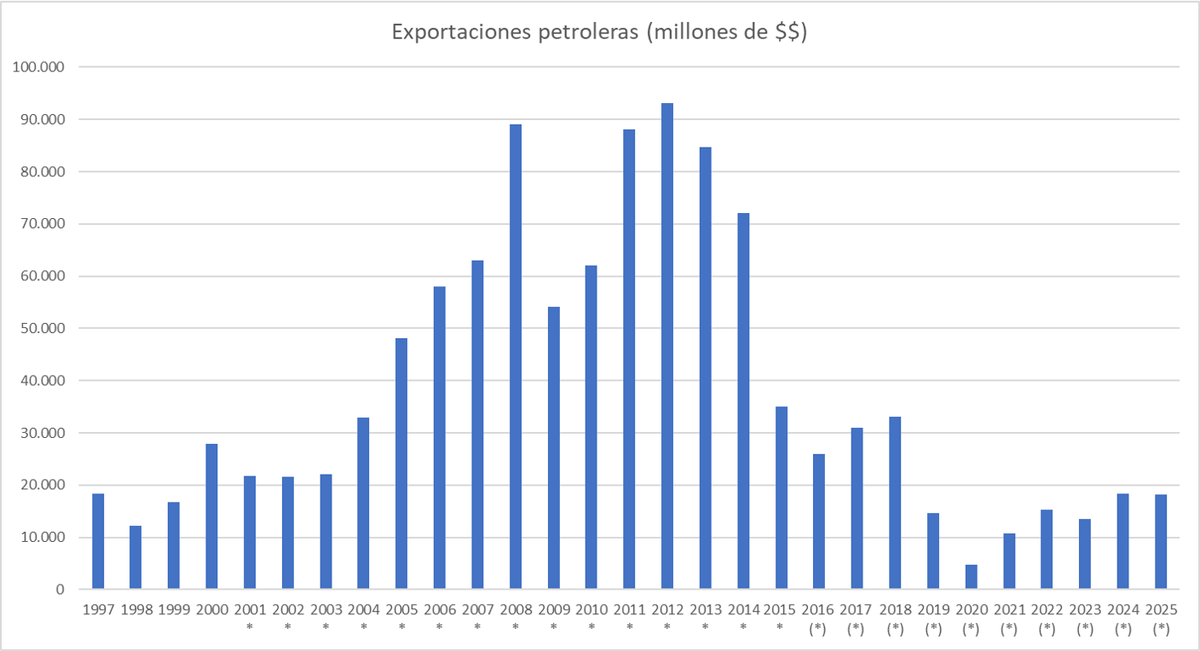
Una buena noticia: el @BCV_ORG_VE actualizó las cifras de Balanza de Pagos (algo que no hacía desde 2019).
Mucha data interesante, vamos con alguna:
- en los últimos 4 años, las transferencias corrientes promediaron unos $3.383 millones.
- desde el 2019, las exportaciones petroleras representan (en promedio) el 67% de las exportaciones totales. Pero no es que tenemos una economía muy diversificada, es que las exportaciones petroleras han disminuido de forma importante.
- alarmante: en 2020 el país recibió por exportaciones petroleras solo $4.815 millones.
- En 2025 las exportaciones petroleras totalizaron $18.212 millones (un monto muy parecido al de 2024).
- Entre 2019 a 2025 (7 años) el país recibió el equivalente (en exportaciones petroleras) al total de entre 2017 a 2019 (3 años).
- En 2012, solo en ese año, recibió lo mismo que en los 7 años de 2019 a 2025.
- Entre 2014 y 2015, Venezuela vio disminuir sus exportaciones petroleras a la mitad y en 2016 el cayeron otro 25%. Luego en el 2019 disminuyó en 55% y en el 2020 un 67%.. En 2012, el país recibió $93.097 millones, en 2020 eran $4.815 millones (-95%).
Si usted decide en su negocio cobrar a tasa del euro, por lo menos cuide las formas y sea coherente en expresar los precios en esta moneda.
Es un irrespeto al cliente decirle: "vale X dólares y te lo cobro a tasa EURO". No tiene ni pies ni cabeza.
Mi papá siempre arreglaba todo.
Todo.
El grifo.
La puerta.
La bicicleta.
Decía que pagarle a alguien por eso era perder plata.
Cuando se dañaba algo en mi casa, yo llamaba a un técnico.
Era más rápido.
Más fácil.
Un día mi papá vino a visitarme.
Vio una lámpara que no funcionaba.
—Eso es fácil —dijo.
En diez minutos estaba arreglada.
Se veía feliz.
Como si hubiera ganado algo.
Antes de irse me dijo algo simple:
—A los papás nos gusta sentir que todavía servimos para algo.
No lo había pensado.
A veces creemos que nos están ayudando con cosas pequeñas.
Pero para ellos…
es su forma de seguir siendo necesarios.
CENTCOM has confirmed the use of one-way attack drones in Operation Epic Fury - the first time U.S. has used kamikaze drones in combat.
But here’s the kicker: the drones used against Iran were modeled on Iran’s own Shahed-136 series!
Just imagine you’re a drone over the Persian Gulf on your final mission, and you spot your twin zipping past you in the opposite direction - except for the flag on your wing, everything else is nearly identical. Now imagine the greeting you’d exchange! 😀 Strange times we live in.
Avocados are an evolutionary leftover from the Ice Age. During the Pleistocene epoch, their unusually large seeds were spread by massive animals such as giant ground sloths and gomphotheres - elephant-like herbivores capable of swallowing the fruit whole. These megafauna acted as natural seed dispersers, carrying avocado pits across long distances before depositing them in nutrient-rich waste.
When many of these large mammals disappeared around 13,000 years ago, the avocado lost its primary method of reproduction in the wild. The tree had evolved alongside these giants for millions of years, and without them, its natural range and survival prospects sharply declined.
The species persisted largely because humans stepped in. Thousands of years later, early societies in Mesoamerica began planting and selectively breeding avocado trees, favoring larger fruits and improved taste. This early cultivation effectively replaced the ecological role once played by Ice Age megafauna.
In modern times, especially after the development of the Hass variety in the 20th century, avocados became a globally cultivated crop. Today’s avocado is essentially a living remnant of an ancient ecosystem - a fruit that continues to exist not because its original partners survived, but because people chose to grow it.
Recent research has detected microplastics in lake sediment layers dating back to the early 1700s, centuries before modern plastic production began. Scientists analyzing sediments from lakes in Latvia found traces of microplastics even in layers believed to be untouched by recent human activity.
The findings, published in Science Advances, suggest that microplastics may not be reliable markers for defining the Anthropocene, as contamination appears to be more widespread and complex than previously thought.
Microplastics have now been documented in oceans, air, polar snow, and human tissues. Researchers are continuing to study how these particles spread, their potential health effects, and possible ways to reduce environmental contamination.
Hemos revisado al alza nuestra proyección de crecimiento para 2026: estimamos ahora un aumento del PIB de 13% y un crecimiento del consumo cercano al 16%.
Pero no será un crecimiento parejo. Será un crecimiento en forma de K: algunos sectores despegan con fuerza mientras otros entran en zona de riesgo.
El gran motor será energía. Petróleo y gas liderarán la expansión, y el sector eléctrico (con una potencial privatización) será la condición indispensable para sostenerla. Sin estabilidad energética no hay crecimiento posible. A partir de allí, el efecto derrame es claro: servicios, comercio, tecnología, agroindustria, alimentos, banca, finanzas, construcción y sector inmobiliario recibirán estímulos directos del mayor flujo de divisas y del aumento en la actividad económica. No todos reaccionarán a la misma velocidad, pero todos sentirán el impulso.
Del otro lado, la presión será real para los sectores industriales que no hayan hecho ajustes de competitividad. Una economía petrolera en expansión suele traer apreciación cambiaria y mayor volumen de importaciones y con ella mayor competencia. También enfrentarán tensión los sectores intensivos en mano de obra, en un entorno donde los costos laborales tenderán a subir significativamente.
Después de muchos años, la palabra clave vuelve a ser productividad. En esta nueva etapa, no bastará con que la economía crezca. La pregunta es quién está preparado para crecer con ella.
Evolution has rendered the human nose roughly 200,000 times more sensitive to the aroma of rain than a shark's is to blood in water.
Though sharks are legendary for detecting trace amounts of blood across vast ocean distances, humans possess an even more extraordinary olfactory feat on land: an acute sensitivity to petrichor, the earthy scent released when rain hits parched ground.
This distinctive fragrance arises primarily from geosmin, a compound produced by soil bacteria, which the human nose can perceive at concentrations in the parts-per-trillion range.
On a per-unit basis, this makes our detection threshold for the smell of impending rain about 200,000 times lower than a shark's for blood—an astonishing evolutionary refinement.
This heightened ability likely originated as a critical survival adaptation for our ancestors. In eras without reliable water sources, sensing an approaching storm from afar enabled early humans to find fresh water, locate fertile areas, and make timely decisions about movement and shelter in challenging landscapes.
What we now experience as a soothing, nostalgic scent was once an essential environmental cue guiding migration and habitation. Today, this enduring sensory prowess stands as a remarkable reminder of our evolutionary legacy, affirming that the human nose ranks among nature's most exquisitely tuned detectors.
[Polak, E. H., & Provasi, J. (1992). Odor sensitivity to geosmin: An exercise in sensory psychology. Perception & Psychophysics]










![Rainmaker1973's tweet photo. Evolution has rendered the human nose roughly 200,000 times more sensitive to the aroma of rain than a shark's is to blood in water.
Though sharks are legendary for detecting trace amounts of blood across vast ocean distances, humans possess an even more extraordinary olfactory feat on land: an acute sensitivity to petrichor, the earthy scent released when rain hits parched ground.
This distinctive fragrance arises primarily from geosmin, a compound produced by soil bacteria, which the human nose can perceive at concentrations in the parts-per-trillion range.
On a per-unit basis, this makes our detection threshold for the smell of impending rain about 200,000 times lower than a shark's for blood—an astonishing evolutionary refinement.
This heightened ability likely originated as a critical survival adaptation for our ancestors. In eras without reliable water sources, sensing an approaching storm from afar enabled early humans to find fresh water, locate fertile areas, and make timely decisions about movement and shelter in challenging landscapes.
What we now experience as a soothing, nostalgic scent was once an essential environmental cue guiding migration and habitation. Today, this enduring sensory prowess stands as a remarkable reminder of our evolutionary legacy, affirming that the human nose ranks among nature's most exquisitely tuned detectors.
[Polak, E. H., & Provasi, J. (1992). Odor sensitivity to geosmin: An exercise in sensory psychology. Perception & Psychophysics]](https://pbs.twimg.com/media/G9GjQ_8WcAA-Fzd.png)


