Goldman: AI Optical networking to grow 10x in 3 yrs
The report has some very interesting views:
- Goldman just broke down the BoM. the switch ASIC is 16% of the bill of materials. The other 84% is light.
- $75.8K of BoM sells for $130K. ~42% gross margin at the box. Its the optical engine.
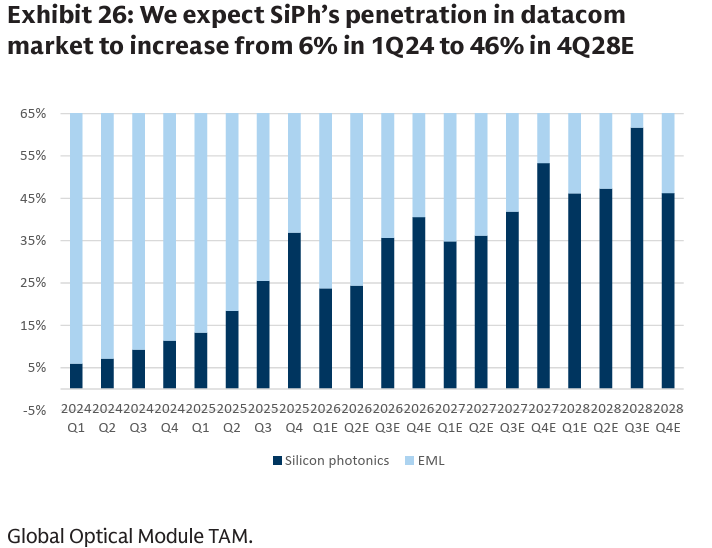
- Silicon photonics penetration in datacom goes from 6% (1Q24) to 46% (4Q28E)
- Light source supply is "very tight" through all of 2026, "tight" through 2027, and does not reach balance until 2H28.
- 800G adopted across every hyperscaler. 1.6T live at $NVDA and $GOOG now, META 2026, $MSFT / $AMZN / $ORCL 2027. 3.2T at Nvidia and Google in 2028
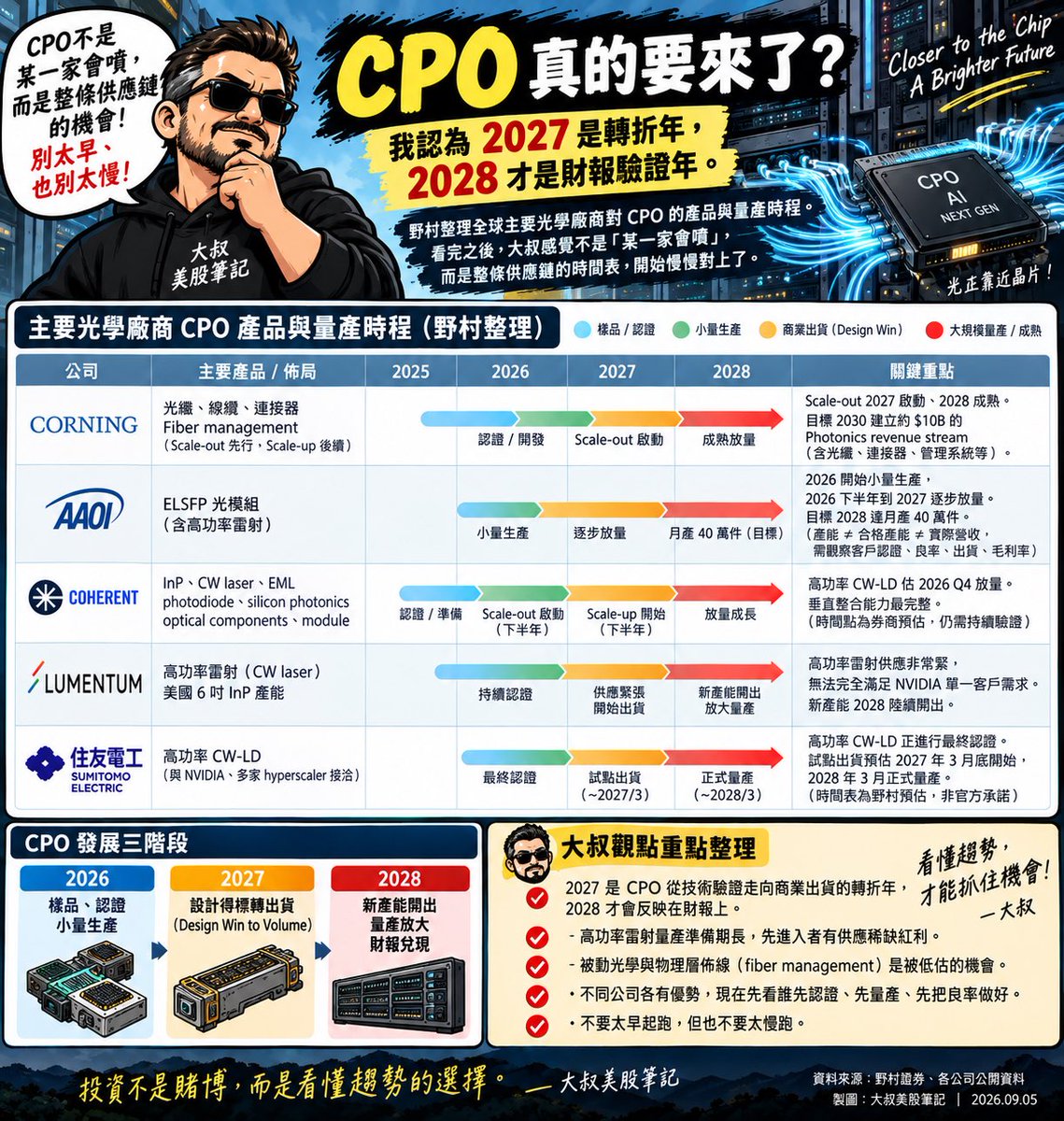
- CPO scale-out on the roadmap at Nvidia, Google and $META .
Names by layer (my mapping):
- ASIC: $AVGO $MRVL.
- Lasers / light source / Optical engine: $COHR $LITE $AAOI
- Substrate: $AXTI $IQE $SOI.PA
- SiPh foundries: $GFS $TSEM $TSM $INTC
- Analog front-end: $CRDO $SMTC $MXL
- Connectivity and passives: $GLW $APH US Conec
- Optical assembly / OSATs: $FN $AMKR $ASX
- System: $CLS $ANET
- China optical-engine side: InnoLight , Eoptolink
Meanwhile, credit where due @GoldmanSachs has made this report completely free & public unlike some blood thirsty "analysts" suing people. Check it out. Link 👇
Bernstein Taiwan analysts have 2028 EMIB production when converted to a CoWOS equivalent (modeling purposes) as greater than all 2025 CoWoS, and around 1/3 market share in 2028
EMIB is very efficient, and Intel Malaysia is a very large facility. In addition Intel has Amkor Korea to help output
$INTC
InP shortage is getting worse as expected.
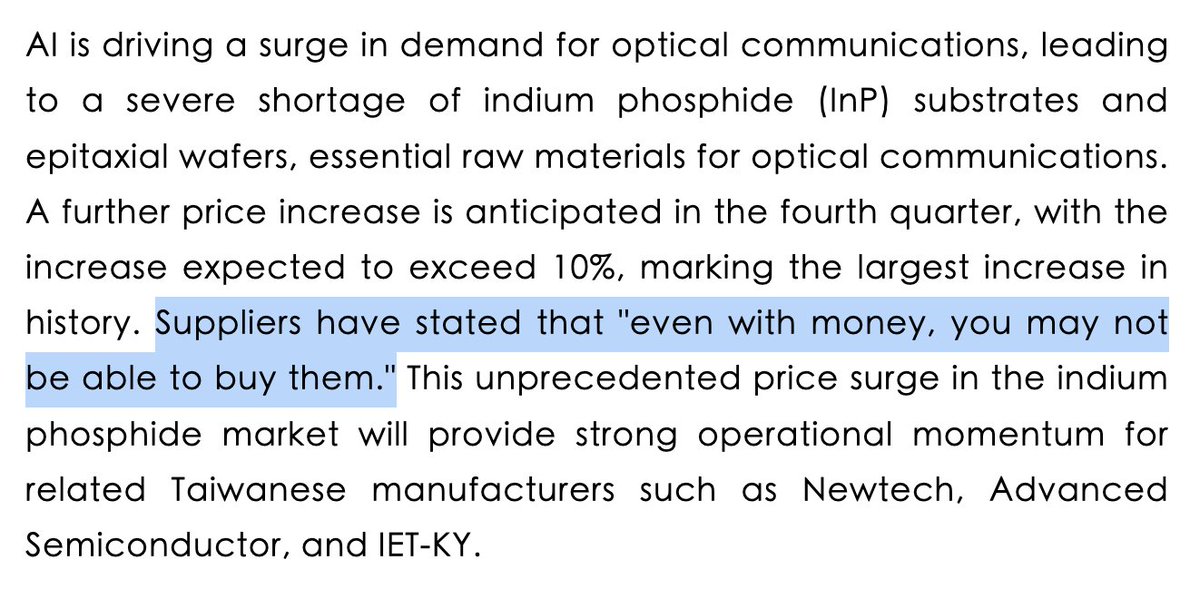
> A further price increase is anticipated in the fourth quarter, with the increase expected to exceed 10%, marking the largest increase in history. Suppliers have stated that "even with money, you may not be able to buy them."
> Industry insiders revealed that the price of indium phosphide substrates started to rise in the fourth quarter of last year and has been raised three times since then, now reaching a "fourth consecutive increase"; the epitaxial wafers made from the substrates have also increased in price twice, and are heading towards a "third consecutive increase" in the fourth quarter, which means that the market supply shortage is more severe than expected.
> Indium phosphide (IP) epitaxial wafers must be manufactured from IPP substrates, but upstream IPP substrate suppliers are constrained by policies and production capacity, and have so far been unable to meet market demand. Due to this supply-demand imbalance, prices have been rising steadily, with increases from the initial 3% to 5%, and the latest news indicates a potential surge of over 10%, the largest increase in history.
We need more InP...
Following Intel’s $23 billion oversubscribed capital raise, I’m grateful to everyone who has reached out with messages of support and confidence in our future. Thank you, @adenatfriedman and @Nasdaq, for helping us mark this important moment for Intel. We are building a new @intel - more focused, more disciplined and moving with greater speed. The work continues, and I’m excited about what lies ahead!
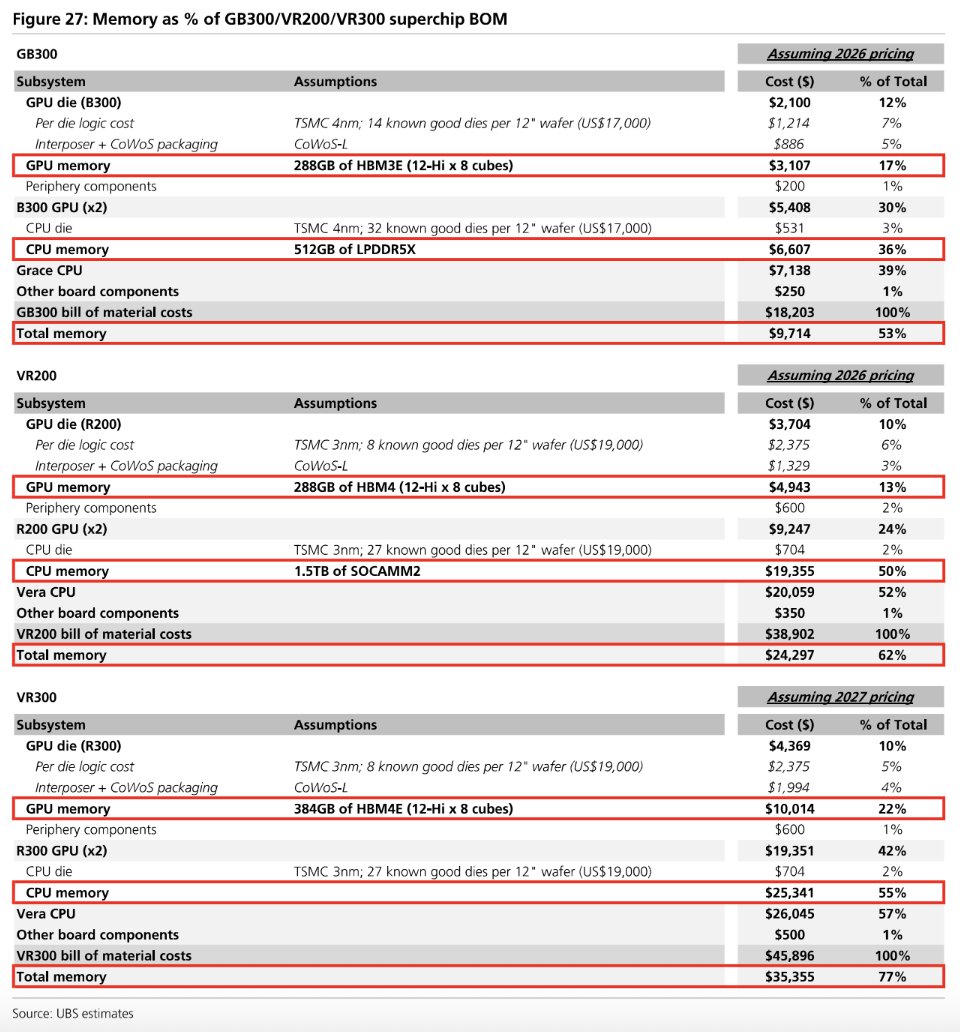
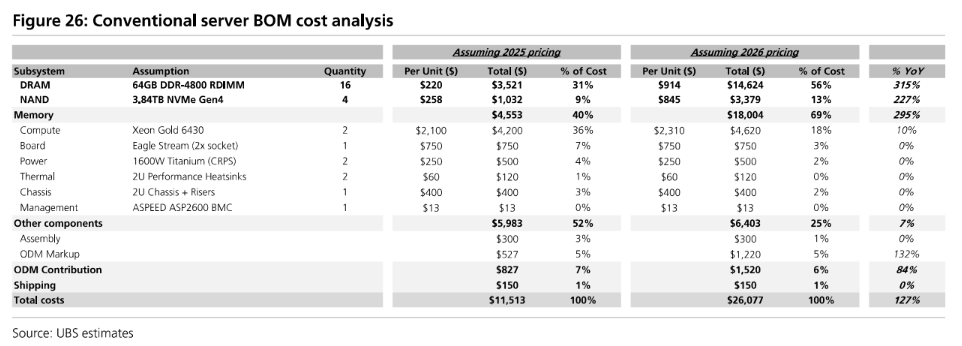
UBS: Vera Rubin BOM & Server Costs
Conventional Server BOM & Memory Cost Trends
> Surging Memory Share: Memory now accounts for roughly 69% of the Bill of Materials (BOM) cost for a conventional data center server (loaded with 16 DIMMs of 64GB DRAM and 3.84TB NAND), a sharp rise from 40% in 2025.
> Cost Escalation: Driven by rising DDR and NAND contract pricing, incremental memory costs alone are estimated to drive a 127% increase in overall conventional server costs (totaling $26,077 up from $11,513).
> Component Breakdown:
DRAM costs show a 315% YoY surge ($14,624 total, representing 56% of cost).
NAND NVMe Gen4 costs show a 227% YoY increase ($3,379 total, representing 13% of cost).
AI Server Superchip Memory Projections (GB300, VR200, VR300)
> GB300 (2026): Total HBM3E and LPDDR5X costs per superchip are estimated at $9.7k (53% to 58% of total cost), translating to approximately $350k per rack.
> VR200 (2026–2027): Combined HBM4 and SOCAMM2 costs sit at $24.3k (62% of cost) in 2026, climbing to 70% of the total in 2027. Per-rack memory costs move from $875k in 2026 to $1.143m in 2027.
> VR300 (2027): Assuming 756GB HBM4E 12-Hi and SOCAMM2, superchip memory costs could reach $35.5k (77% of total superchip cost), driving per-rack memory costs to a massive $1.273m.
Macro Rack-Level Trajectory
> Milestone Threshold: Total memory costs are projected to comfortably exceed US$1 million per Vera Rubin rack by 2027.
> Structural Shift: Across the AI server lineup, total memory costs as a percentage of the overall stack continue a heavy upward trajectory, moving from an already substantial 58% for the GG300 up to 77% for the VR300.
For reference, this is from late May.
$NVDA $MU $DRAM $EWY
Photonics starting to show real momentum heading into the August earnings wave.
Here are stocks I'm watching closely and why:
1. Lasers & optical components: $LITE $COHR $AAOI $SIVE
The backdrop: Lumentum's CEO said a few days ago that they're falling further behind demand and could be sold out of 2028 capacity within two quarters. He's also warned InP, the material every optical laser depends on, is now more supply constrained than memory chips.
Three of the four in this group print back to back over the same stretch, $AAOI Aug 6, $LITE Aug 11, $COHR Aug 12.
> While Lumentum & Coherent are obviously expected to show more than strong numbers in their print (both with a double beat), I'm actually more keen on seeing how their guidance looks, and if they'll raise it once again.
> With AAOI, the question is more on execution against the guidance they gave, and whether they're heading to beat that $1B target for FY2026. I think they'll probably make a case for $1.2B+ instead, given the continuous signals of 1.6T+ TAM expansion across the industry (photonics in general too).
> On Sivers, expected to release earnings around the end of this month, it's more about how their opportunity pipeline looks and whether the backlog is growing, plus any added signs of them heading into 2027 with CPO scaling ramps that show they're well positioned to capture and execute on it.
So, $LITE & $COHR are more established and proven on execution, but $AAOI & $SIVE definitely have a lot of eyes on whether they can do what the two photonics giants have already shown.
2. Foundry: $TSEM
Tower doesn't sell chips to consumers, it sells wafer capacity to the companies building the chips. That makes its order book a leading indicator for the whole group.
They already signed $1.3B in silicon photonics contracts for 2027 revenue with their largest customers. Their named collaborators on the silicon photonics side include $NVDA and $MRVL. When a foundry is getting prepaid years out by the biggest names in the space, that's a clean signal for where real demand sits, not projected demand.
$TSEM reports Aug 4. Their guidance becomes a two way signal for both upstream and downstream players, since orders today become shipped product tomorrow, but it also means demand for materials (like $IQE, with whom they have a partnership) increases along the same line. That in turn affects test system players like $AEHR, sitting at the wafer level of the game.
3. Connectivity silicon: $MRVL $CRDO $ALAB
These three are turning that optical hardware into usable bandwidth inside the data center.
> $MRVL reports Aug 20, and its DC revenue is guided up 50% this fiscal year. This name is tied to the "$1T AI infrastructure" framing from Matt Murphy and Jensen Huang. Watching their optics commentary closely, since that segment's growth guide just got raised from 50% to 70%+ last quarter.
> ASICs & memory businesses are also key contributors to overall revenue, which diversifies them and sets them apart from the other pure play names in this post. Keen to see that side too.
$CRDO and $ALAB are the emerging & proven hyperscaler deal players.
> Credo just closed its DustPhotonics acquisition to build out its own optical stack, guiding 80%+ revenue growth this fiscal year on AECs, optical DSPs and retimers, the connectivity layer for scale out and scale up. It reports Sept 2, a little outside the main wave but worth watching for confirmation of the trend.
> $ALAB reports Aug 4. They're the PCIe/CXL connectivity name for rack scale AI systems, and their Scorpio fabric switches are seeing broader hyperscaler rollout in the back half of the year. Q2 guide was $355 to 365M, up mid teens sequentially.
BREAKING: Fed Chair Warsh is considering reducing the amount of times that the Fed meets in a year, per NYT.
Details include:
1. The FOMC has met eight times annually since 1981, with Federal law requiring at least four meetings per year
2. Fed Chair Warsh has reportedly not proposed a specific number of meetings
3. Fewer meetings would mean fewer scheduled rate votes and less frequent policy decisions
A major shift is underway at the Fed.
U.S., ISRAEL WEIGH STRIKES ON IRAN ENERGY SITES
The U.S. and Israel are preparing a potential joint campaign targeting Iranian energy infrastructure, with strikes possible this weekend, according to CBS.
President Trump has not given final approval. Officials are reportedly weighing the economic impact, with discussions including completing operations before Monday’s market open. White House and Israeli officials are coordinating plans.
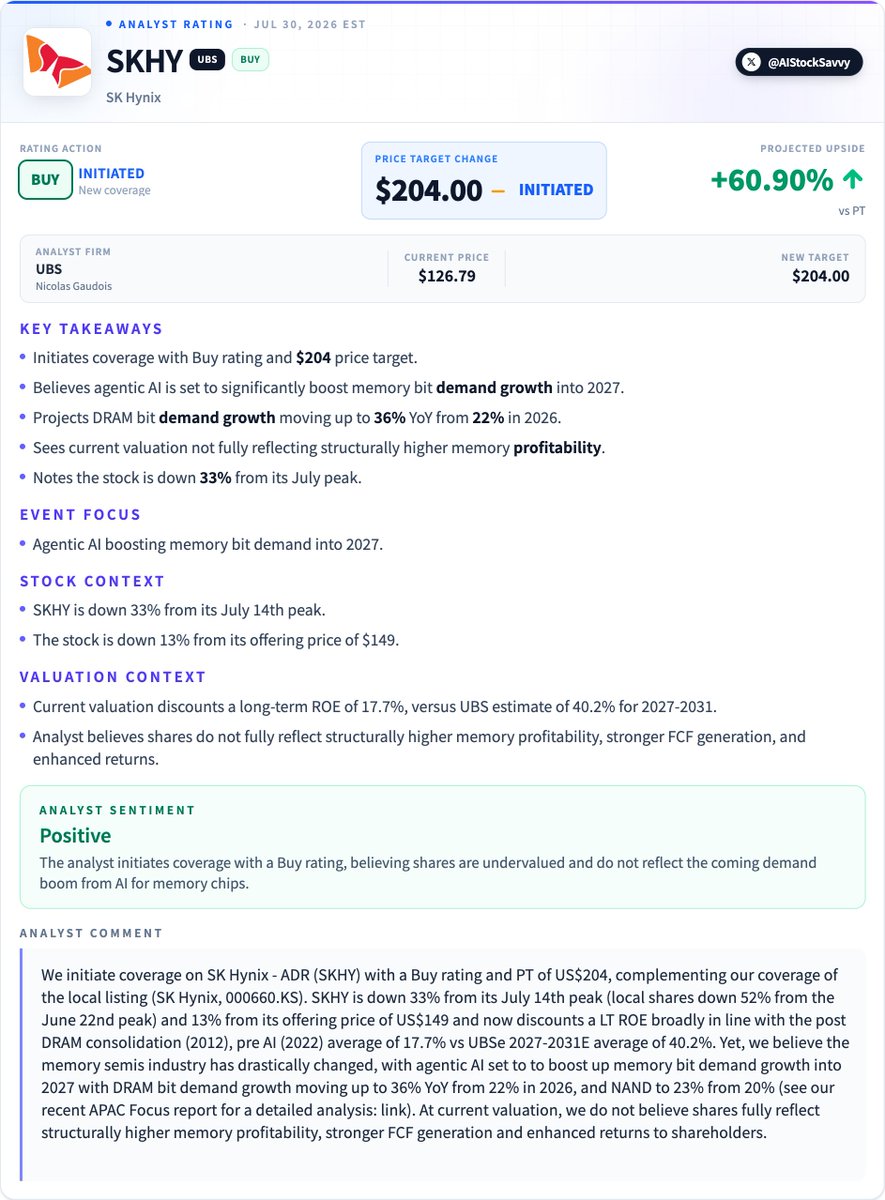
$SKHY | UBS 𝗶𝗻𝗶𝘁𝗶𝗮𝘁𝗲𝘀 𝗕𝘂𝘆 on 𝗦𝗞 𝗛𝘆𝗻𝗶𝘅, PT $𝟮𝟬𝟰
Analyst sees shares not fully reflecting structurally higher memory profitability and stronger FCF generation driven by an AI-led demand inflection.
And we have Bernstein estimates on Intel $INTC
Easy enough!
We model Q226 at $14.3B/ $0.20, a touch below consensus at $14.4B/$0.21.
For Q326, we model $14.9B/$0.28, below to in-line compared to consensus at $15.1B/$0.28.
For full-year 2026, we model $57.6B/$1.07, below consensus at $58.6B/$1.11.
For full-year 2027, we model $63.3B/$1.50, a bit below consensus at $66.0B/$1.57.