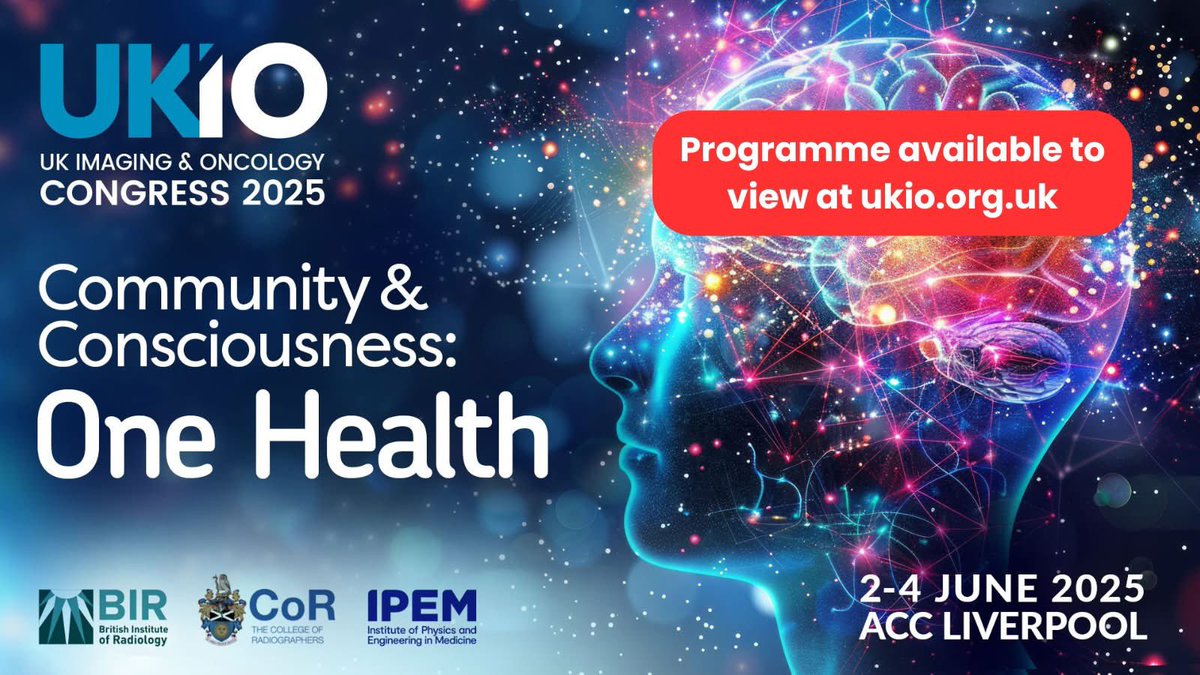
Honoured to have been invited to deliver the Welbeck Memorial Lecture at @UKIO 2025
https://t.co/vblOQ41ILA to view programme of excellent speakers
Thank you @SCoRMembers for offering the privilege of giving an eponymous lecture
#UKIO2024
A huge thank you to all NHS staff for your incredible dedication to quality and patient safety throughout the year. To those delivering essential services over the festive season, thank you for your commitment. Wishing you all a safe and joyful Christmas! 🎅✨ #ThankYouNHS
The strategic power of hope. New article in @HarvardBiz
Negativity attracts attention. It gets equated with intelligence. Leaders focus on detecting problems/threats which quashes creativity & makes it hard for us to recognise opportunities.
If we anchor our strategies in hope - a deliberate belief in shared goals & actions - we can steer our teams towards growth, connection & creativity. Three ways to cultivate a hopeful culture:
1) Set collective goals, grounded in shared values
2) Support people to build their sense of power/agency/autonomy
3) Pay close attention to progress & celebrate it:
https://t.co/bjsAkCddm4. By @zakijam. Graphic: @OfficeGuyToons
NHS managers/team leaders at (Agenda for Change) bands 6-8a directly supervise up to 80% of our NHS people. These “frontline” team leaders have an outsize influence on NHS performance.
Yet:
- They don’t have a big collective voice in opportunities to improve NHS productivity
- Only a small proportion of leadership development budgets in the NHS target them
Tomorrow I'm spending the day with four NHS systems identifying potential opportunities to unleash the potential of frontline managers and team leaders to lead change.
For more on the latent power of frontline leaders, see, eg: https://t.co/Aahj8Jftrl by @BCG.
We have decades of research evidence about how change happens in organisations & systems. Yet mostly, we don't use this knowledge in practice. The biggest misconception is that once people understand change, they'll embrace it (almost never true). 4 principles that should inform our change efforts:
1) Transformational ideas typically come from outside the community & incur resistance: We build attachments to ideas, people & ways of working - when those attachments are threatened, we tend to act out in ways that don’t reflect our best selves
2) Transformations follow an “S curve” pattern: Innovations take hold slowly amongst a group of enthusiasts, then hit an inflection point at 10%-20% participation, then accelerate exponentially - it's why we should concentrate on building the 10-20% through enthusiasts rather than getting everyone on board with the change
3) There is a common, persistent “KAP-gap”: (the difference between what we say & what we do) - it's because we only change our views/practice when the people around us do & it's why we need to shape networks rather than opinions
4) Transformational ideas are propagated socially: It's not the mode of communication or even the individual influence of early adopters but the structure of the network that determines how fast and far an idea travels
https://t.co/Wgwo3KOwzG. By @digitaltonto.
I'm often surprised by how many change & improvement leaders don't know about (or don't use) Liberating Structures. They are a set of 30+ ways of working with groups that enable us to include everyone, in innovative ways, to produce results within a short amount of time. Liberating Structures can change the way we meet, plan, decide & relate to one another. You don't need to be an expert facilitator. They can be used by anyone. They are freely available. I use Liberating Structures constantly in my own practice. In the last week, I've used 1-2-4-All & 15% Solutions. Learn more here: https://t.co/l6DCCI2foA. Liberating Structures were developed by @KeithMcCandless & Henri Lipmanowicz. Graphic from @liberators_the
A fantastic day spent with Chrissie and Kirsten out in the @ciosicb@RCHTWeCare@CornwallFT X-Ray car. An amazing example of patient centred innovation in care to avoid hospital admissions through coordination across services. More: https://t.co/tGgEV9ljdW
Loneliness at work has become an epidemic, leading to workplace stress, people being absent & leaving their jobs. New research has highlighted multiple myths that lead to many leaders making the workplace loneliness situation worse. Myths:
1) Loneliness can be solved by coming back to the office
2) Teams will solve loneliness
3) Lonely people are needier socially than others at work
4) Loneliness is a personal problem, not an organisational problem.
Practical actions that leaders can take to reduce work loneliness include measuring loneliness, designing slack in workflows, creating a culture of connection, building socialising into the rhythm of work & maximising each work mode (remote or f2f) for connection.
https://t.co/eVFBcpoUxD. Via @HarvardBiz
Im pleased to share an exciting part-time opportunity to join the regional quality improvement team @NHSSW as Quality Improvement Support Manager
(Band 7). Come and join us in delivering our ambition to be a QI enabled region!
https://t.co/o77lremBsy
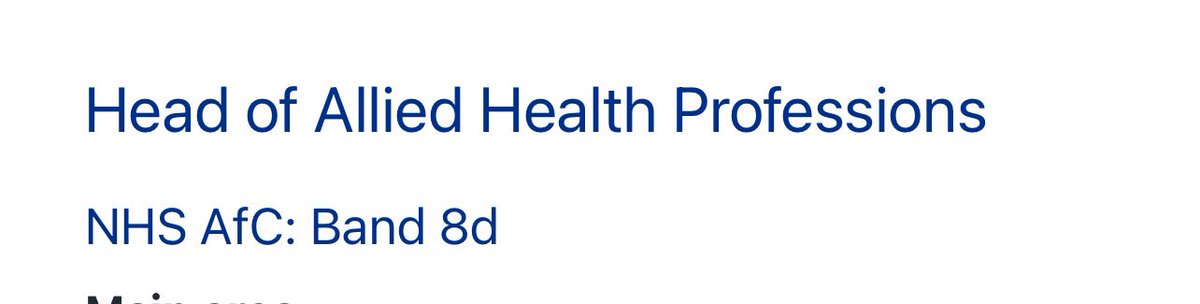
🚨#AHP strategic leadership opportunity ….to work with fabulous Deputy CAHPO @BeverleyHarden
🆕 Head of #AHPs@NHSE_WTE
💷Salary AfC Band 8d
📄F/T 37.5hrs p.w., permanent
⏰ 18.09.24
👀details here 👉 https://t.co/RLV3fZ4cMT
@WeAHPs
🚨I’m delighted to announce that we now have an official @NHSEngland Chief AHP Officer bulletin
🗞️Interested in receiving the latest news, guidance & updates on national policy & delivery priorities relating to #AHPs?
📝Sign-up here 👉 https://t.co/AGYb4jzdHc @WeAHPs
Therapeutic #radiographers provide care & support to patients diagnosed with cancer. They plan & deliver radiotherapy, build strong relationships with their patients, & use advanced technology as part of their role.
Find a course here👉https://t.co/L4TzlU24Rw
#Clearing2024
We know that the recent riots have brought a focus on the racism and Islamophobia that some NHS colleagues and members of our communities face. We are committed to protecting our staff and patients, and have outlined that commitment in our response https://t.co/K5sXIeesfV
Excited to be going out for a deputy chief nurse here at UHD. Looking for individuals with a commitment to delivering outstanding patient care and a passion for change. Take a look!! 👇@PMWilson1 @S_HarringtonNHS https://t.co/7mvic0ZrBZ
Did you know that not everyone’s skin goes red in the sun or after treatment for breast cancer? Therapeutic radiographer @naman_julka shares the facts and why it’s important to know your normal.
Learn more about the signs and symptoms of breast cancer: https://t.co/6KmSVFmT1C
An @NHSEngland report on "NHS Productivity" in May 2024 highlights the growing % of NHS staff who are new/inexperienced as a barrier to productivity & the need to get them up the learning curve faster.
New research suggests one catalyst for learning that is often lacking at this critical early career stage: psychological safety (PS). PS is needed for people to learn, collaborate & perform at work. People lose their sense of PS when they start a new job & it can take years to recover. However, departments with high PS reduce that decline & facilitate recovery: https://t.co/TmDZCBzvLN. By @DerrickBransby@MichaelaJune & @AmyCEdmondson.
Don't forget to register for our 18 July #PSIRF webinar, to introduce the new After Action Review (AAR) report template. This is one of the tools we recommend NHS organisations use to support learning and improvement following a patient safety event.
https://t.co/XVxGdIRc8r
Happy #IND2024 to all my wonderful nursing colleagues.
I have had, and have, the pleasure of working with some truly inspirational nurse leaders throughout my career and from whom I continue to learn so much.
Thank you for all you do