Your ad platform says 1,000 clicks. Your analytics says 600.
Nobody can tell you where the other 400 went. The common explanation is wrong.
I'm the CTO of a link tracking company. I wrote down every hypothesis before collecting a single data point — including the results that would embarrass us.
Every tracking link makes two choices:
→ where it hides the ID: after a ? (https://t.co/qBVHzytuF8) or in the path (https://t.co/n7bXUGPqlb)
→ who writes the click down: a script in the browser, or a server it passes through
Two choices. Four types of link. That's the whole space.
There are only two ways to kill a tracked click:
Delete the ID before it arrives. Or let it arrive and kill the code meant to read it.
That's it.
So I ran all four link types against both:
→ a parameter cleaner — 1,796 rules, deletes tracking IDs out of URLs by name
→ a standard ad blocker, default filter list
Here's what almost everyone gets wrong.
"Ad blockers strip your UTM parameters" is folklore.
Under a real ad blocker, the parameters arrived at the page completely intact. What died was the script whose only job was to read them and phone home.
Same empty dashboard. Different cause.
Each attack has exactly one defense.
Deletion: move the ID out of the ? and into the path. No parameter, nothing for a cleaner to grab.
Script blocking: record the click on a server, before the page loads. No script to block.
How it landed:
1. UTM link — https://t.co/D4abCF2OG2
Cleaner deleted the param. Blocker killed the script. Survived nothing.
2. Server-side, query param — https://t.co/aHuWH7FG8D
Survived the blocker. Survived the cleaner too — as long as the name stays off the lists.
3. Path, script-read — https://t.co/cvGFdQZPLz
Survived the cleaner. Blocker killed the script.
4. Path, server-side — https://t.co/udNSdqHx6O
Nothing to delete. No script to block. Survives whatever the lists do.
Two survived both. And the difference between them is the whole point.
The query-param one survives conditionally — on its name staying obscure. The path one survives structurally — there's no name a list could ever target.
Now the part that's bad for my sales pitch: link format isn't the moat. Any server-side redirect survives both attacks — mine, or a plain one you build this afternoon.
Here's where it actually gets decided.
A bare redirect knows a click happened. That's it. No identity, no continuity, no way to connect this click to the same person clicking again next week.
Getting the click recorded is the easy half. Knowing who it was is a separate system. That's the half we build.
Your missing 400 clicks were never stolen. They were never recorded. And the ones that landed told you nothing about who made them.
Introducing the Trakyo Partner Program
Creators and agencies have tracked $142M+ on Trakyo, seeing exactly what leads do & how they interact before they book and buy
Now, you can earn for every creator you bring on
> 30% recurring commission
> $150/month per creator
make $1K to $10K a month just for referring creators
Apply: https://t.co/FMxpZKGqZ9
@Jacob__Newman@Amplitude Curious about the blog one specifically.
The other examples all happen inside the product, so you see the whole thing. The blog CTA is different — people read, leave, and come back later on a different device.
Does the +45/week catch those, or just the same-visit signups?
Canadians usually come back after making the money and connections. It's great here.
Though unless Canada can offer this at a more competitive level, brain drain will continue.
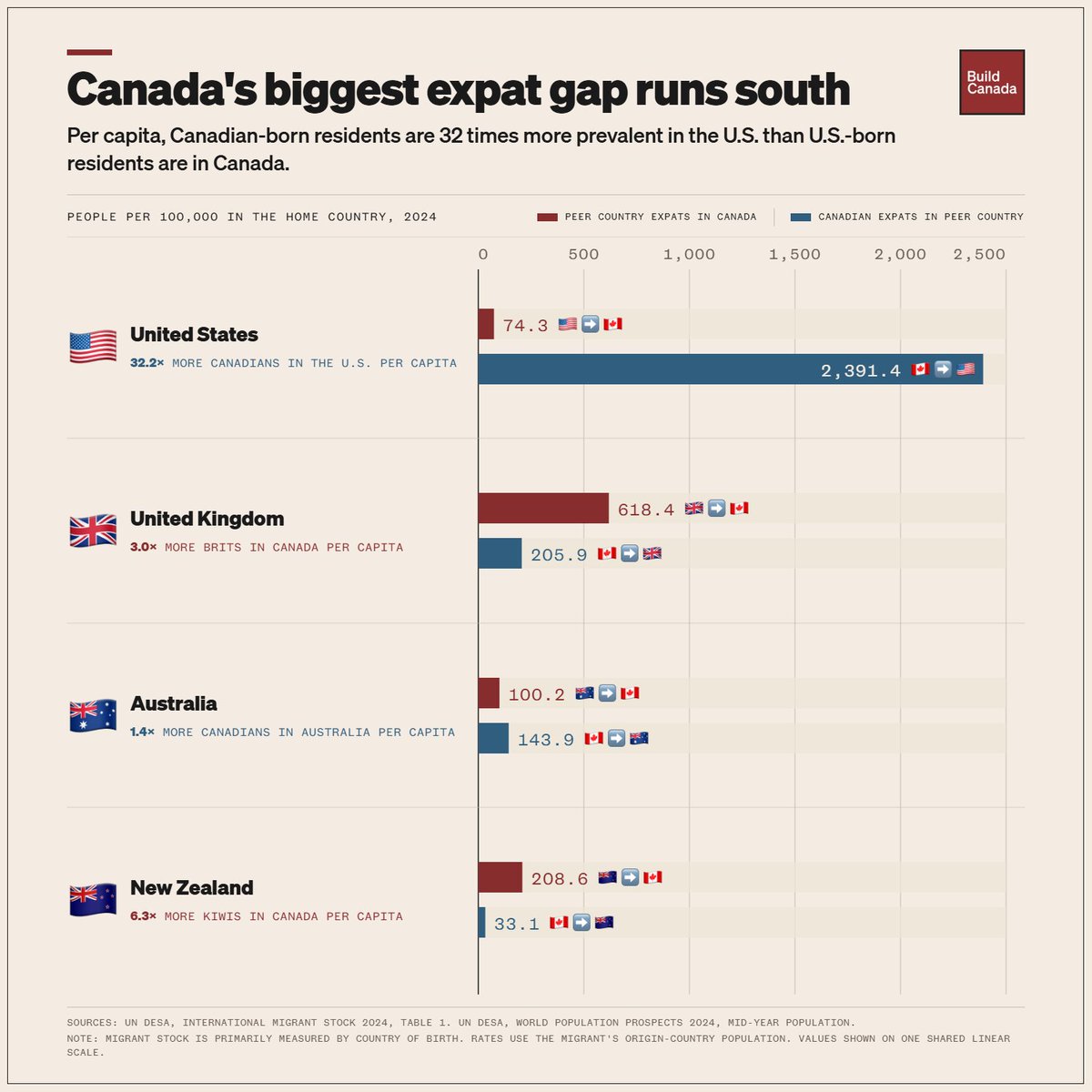
Our brain drain crisis isn't just bad vibes.
The numbers are shouting it at us.
32.2x more 🇨🇦's move to the 🇺🇸 than vice versa. Per capita.
That's more than 6x the amount going to the 🇬🇧, 🇦🇺, and 🇳🇿 *combined*.
Meanwhile, less 🇺🇸's move to 🇨🇦 per capita than 🇬🇧's, 🇦🇺's, and 🇳🇿's.
I read Northbeam's H1 2026 report so you don't have to.
If you sell info, here are the takeaways:
1. Only run ads at medium / high-ticket offers. Accounts above $500 AOV grew new revenue last year while $50–$100 accounts shrank.
2. Don't kill a campaign just because CAC went up ~10%, it went down for all businesses doing <$5M a year.
3. Before you rewrite your funnel, check conversion rate per ad not per account. There's been an increase in low-intent traffic, therefore lower conversion rates across the market; just kill off select underperforming ads.
Your conversion data dies in 5 places. Only one of them is an ad blocker:
1. The script never runs
Content blocking kills the request before it fires. It lands hardest on technical, high-income audiences — the ones that convert best.
(See: uBlock Origin, Brave shields)
2. The identifier doesn't survive
The script loads fine. Then Safari caps anything it wrote via document.cookie at 7 days — 24 hours if the visitor arrived on a link carrying tracking parameters. Server-set cookies aren't capped.
(See: ITP 2.1 onward)
3. The conversion happens off your domain
Booking on Calendly, payment in Stripe. A pixel on your thank-you page only fires if that page renders in the same browser as the original click. Often it never renders at all.
(See: Stripe Checkout, Calendly, Whop)
4. The outbound send drops silently
Your conversion POST to the ad platform fails. No queue, no retry, no error anywhere a human looks. Just revenue quietly missing from the optimizer.
(See: every integration built without an outbox)
5. The provider switches your webhook off
Three days of continuous failures and Stripe disables the endpoint. After that nothing is delivered at all, and the only alarm is an email to whoever owns the account.
(See: returning 400 on a row you couldn't find — Stripe retries 4xx)
Five causes. Five fixes. None of them is picking a different vendor, mine included.
So good for content, docs, and anything eu-facing where not building profiles is the point.
Traffic analytics: excellent, and the privacy model costs you basically nothing because those questions are all same-day.
Revenue attribution: much harder; the join needs an identifier that survived the weeks between the click and the purchase.