月之���面新团队成员杨新宇解释了 Kimi 为什么能推出 K3。
他称,自己今年离开学界进入产业,期间接触了多家 AI 公司。他总结出同行的四种通病:
① 傲慢。 老牌团队认为 AI 战争已经结束,自己已经赢了,对未来和人才失去渴望。
② 浮躁。 年轻实验室基础不牢,只顾追赶前沿,追不上就匆忙���向其他赛道。
③ 胆怯。 一些团队经验丰富、实力不弱,却不敢把目标定为行业第一。
④ 目标错位。 每个人都在争取个人功劳,却没人真正关心公司能否做出 AGI。
杨新宇称,月之暗面最不同的地方,是创始团队仍对 AGI 保持强烈追求。这也是他选择加入的原因。
他还晒出一张「Kimi 五戒」:
① 模型公司要做模型。
② 做 Research、发 Paper 要做实验。
③ 训练模型要看 Metric。
④ 不 Work 的东西不要硬上。
⑤ 不要 YOLO。
翻成大白话,就是少讲故事,多做实验。训练要看数据,失败方案及时停,也不要靠直觉豪赌。
Our thoughts on the importance of AI sovereignty.
1. Your AI sovereignty dictates your institution’s future. Sovereignty is the precondition for choice. Relinquishing sovereignty transfers the future choices of your institution to others, who are likely to exploit it for their gain and your loss.
2. Data retention is your treasure. Transfer it at your own peril. Your ability to win is dictated by your ability to recognize and use your unique edges, and you keep winning by compounding the underlying data to generate new insights. Transferring that data hands over access to your pre-existing winning plays and yields the means of production for new ones.
3. Tokenmaxxing hijacks your value orientation and decreases your institutional fortitude and intelligence. The pursuit of high token usage incentivizes disposable scripts over robust software — with the addictive feeling of false progress. There is a reason why those selling tokens refuse to charge based on value.
4. Controlling your weights is controlling your fate. Weights are the distilled form of hard-won, accumulated institutional knowledge. If you let others control your weights, you are allowing them to migrate the alpha of your business to theirs.
5. There is no contradiction between sovereignty and alpha. The architecture that maximally preserves sovereignty is one that enables institutions to own their tribal knowledge, and to compound it as alpha.
6. Politicizing the technical issues involving sovereignty is what your adversary wants. Techno-politicization is the wellspring of false sovereignty. Techno-politicization drives decisions that seem to reduce dependency, but ultimately limit agency — especially on the battlefield in the West.
7. Real expertise is existential. Allowing politics or favoritism to determine your technical decisions rewards whoever is best at politics, not whoever is right. Listen to those closest to the problems, not those speaking most compellingly about them.
8. Learn from institutions that are winning or that have consistently delivered. Institutions facing existential threats do not have the luxury of making technical decisions based on political preferences.
9. Only listen to institutions, countries, and people who have a proven record of being right. A track record of correctness is the best and only signal for future correctness. Judging something as right or wrong based on who you like is exceedingly misguided.
Spark 2.0 is here! 🚀
We’re redefining what’s possible on the web with a streamable LoD system for 3D Gaussian Splatting.
Built on Three.js, you can now stream massive 100M+ splat worlds to any device from mobile to VR using WebGL2. All open-source.
Dive into the tech 👇
A neurologist studied patients whose emotional brain was perfectly disconnected from their rational brain, expecting to find hyper-logical supercomputers, and instead found people who could not decide what to eat for lunch or which day to schedule a meeting.
His name was Antonio Damasio.
He was the head of neurology at the University of Iowa. In 1994 he published a book called Descartes' Error that quietly broke 350 years of Western philosophy in 300 pages, and the entire field of behavioral economics was built on top of what he discovered.
The story that changed his career started with a patient he simply called Elliot.
Elliot was a successful businessman in his thirties. Good husband. Good father. High income. Sharp mind. Then a small benign tumor started growing in his frontal lobe and his doctors had to remove it. The surgery was a success. The tumor came out clean.
The recovery looked perfect. His IQ tests came back in the superior range. His memory was sharp. His vocabulary was intact. His logic was airtight.
His life collapsed inside a year.
He could not finish a project at work. He would sit at his desk and try to organize a pile of papers and get stuck for an entire afternoon trying to decide which sorting method was best. Alphabetical. Chronological. By topic. By client.
He could see the pros and cons of each one with perfect clarity. He just could not pick. He would still be sitting there at 6pm with the same pile in front of him.
He got fired. He took his savings and made a series of bizarre business decisions and lost all of it. He got divorced. He married someone his family hated and got divorced again.
He ended up living with his parents in his late thirties, unable to hold a basic clerical job, with a measured intelligence that put him in the top few percent of the population.
His doctors could not figure out what was wrong with him. They eventually sent him to Damasio.
Damasio ran every test he could find. Elliot scored perfectly on all of them. He could solve logic puzzles. He could discuss moral dilemmas with sophisticated reasoning. He could analyze a hypothetical business scenario and identify the optimal strategy faster than most people. On paper he looked like the most rational person you could meet.
Then Damasio noticed something nobody else had thought to test.
He showed Elliot photographs of horrific things. A burning house. A car accident. A drowning child. The kind of images that make most people flinch. Elliot looked at them calmly. He described them in detail. He could explain why a normal person would find them disturbing. He just did not find them disturbing himself.
The surgery had cut out a small region of his brain called the ventromedial prefrontal cortex, and along with the tumor, it had taken his entire emotional response system with it.
Elliot was not a man with damaged logic. He was a man with no emotions.
And he could not decide what to eat for lunch.
Damasio sat with this for years. He found more patients with similar damage. The pattern was identical every time. High IQ. Perfect memory. Sound logic. Total inability to make even the smallest decision in their own life. They could explain in detail what they should do. They could not actually do it.
This was supposed to be impossible.
For 350 years, the entire Western tradition had been telling people that emotion was the enemy of rational thought. Descartes had drawn the line in 1641. The mind is one thing. The body and its feelings are another. To think clearly, you must separate yourself from your emotions, suppress your gut, listen only to pure reason.
This is the foundation that almost every philosophy class, business school, and self-help book still rests on today.
Damasio had just produced the cleanest counterexample in medical history. He had patients whose brains had done exactly what Descartes told everyone to do. They had successfully disconnected emotion from reason. The result was not a hyper-rational super-thinker. The result was a man who could not pick between two appointment dates.
The reason became clear once Damasio worked it out.
Every decision you face in a single day has more options than you have time to logically evaluate. Where should I sit on this train. What should I eat for breakfast. Which email should I answer first. Should I take this call.
Each of these has dozens of variables. If you tried to consciously analyze every variable on every decision, you would freeze inside an hour. You would never get out of bed.
The reason you do get out of bed is that your emotional brain is doing the filtering for you in the background. Before logic ever gets a chance to weigh in, your gut has already marked most of the options with a feeling. This one feels off. That one feels right. That one feels boring. That one feels exciting.
Damasio called these somatic markers, body-based emotional tags that compress thousands of past experiences into a single physical sensation that points you toward an answer.
Logic does not produce decisions. Logic justifies the decisions emotion has already made.
Elliot could not make decisions because the part of his brain that put a feeling on each option had been removed. He could see all the options. He could analyze all of them. He just had no internal compass telling him which one mattered.
Every option looked equally valid to him, which is another way of saying every option looked equally meaningless. The tie was never broken because there was nothing inside him doing the breaking.
This was the error of Descartes. The error was not in his logic. The error was the assumption that logic could ever stand alone.
The implications of this go further than most people who read the book the first time realize.
Every confident, decisive person you have ever admired is not running on pure logic. They are running on emotion that has been well-trained by years of experience, and their logic is just the press release they release afterward to explain the decision their gut already made.
The people you call indecisive are not too emotional. They are people whose emotional signals are giving them conflicting tags on the same option.
Daniel Kahneman built his entire System 1 and System 2 framework on top of this finding. Every behavioral economist working today is downstream of Damasio. Every modern theory of cognitive bias starts from the same admission. The mind that decides is not the mind you think is doing the deciding.
Descartes was wrong on the most famous line he ever wrote. It is not "I think, therefore I am." It is closer to "I feel, therefore I can think."
You do not get to choose whether your decisions are emotional. You only get to choose whether your emotions have been trained on enough experience to point you toward the right ones.
The Vatican struggles to make its documents consumable, so the work of spreading them often falls to lay people.
I built a one-stop shop for Pope Leo XIV's new AI encyclical — a cleaner reader for the text plus graphic explainers to make sense of it. https://t.co/pwexC4kARO
OpenAI and Anthropic are effectively telling the market they can't solve every problem with a generic AI coworker.
You don't pour billions into massive forward-deployed joint ventures if you think the next model release is going to take care of it.
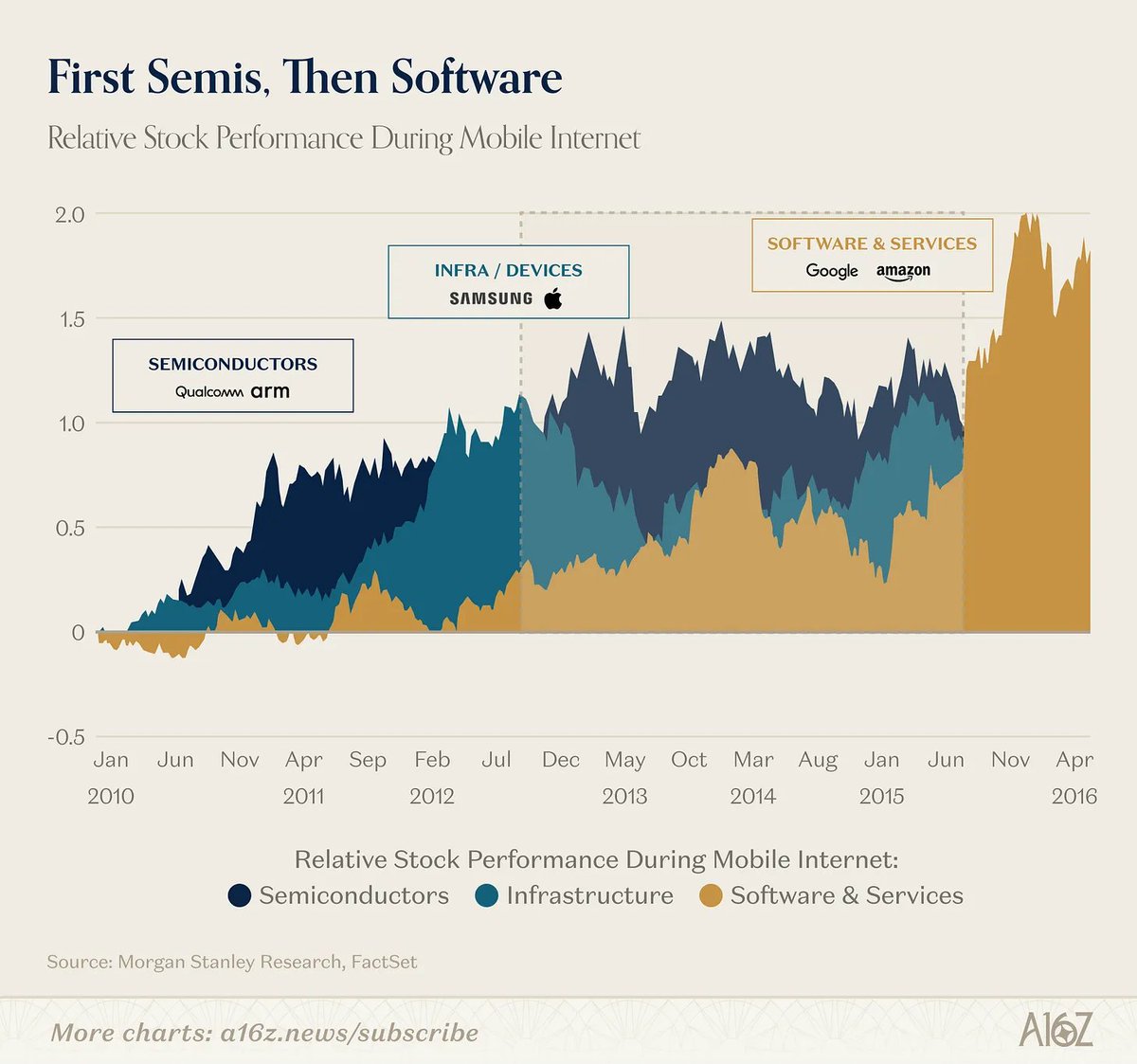
In the cloud supercycle, semis led and software followed (and you didn't need Qualcomm or ARM to tell you the value was migrating up the stack).
In AI, the infra layer itself is telling us the application layer is a separate, massive opportunity they can't fully capture.
a16z's @joeschmidtiv on why the app layer isn't dead: https://t.co/84QN5Mj9T3
The full English text of Pope Leo XIV’s first encyclical, "Magnifica Humanitas," is available to download, offering Catholic social teaching for the age of AI.
https://t.co/IelE836Omt
In order to protect the human person in the age of #ArtificialIntelligence, we must once again reflect on the common good, the universal destination of goods, subsidiarity, solidarity and social justice. #MagnificaHumanitas
https://t.co/Oe8yclDxkr
GBrain is my brain and infra and skillpacks, all open sourced for your use, MIT license
It's SOTA for LongMemEval without LLM query rewriting by 1% vs MemPalace
If you use OpenClaw or Hermes Agent this is what you should use to supercharge your agent
https://t.co/yFpFU4pn5b
We've published a paper that explains our views on AI competition between the US and China.
The US and democratic allies hold the lead in frontier AI today. Read more on what it’ll take to keep that lead: https://t.co/TgJBeodWYK