less than 1% of hospitality workflow in person has been automated - massive opportunity for those who buy n flipping hotels. get a dedicated team specialized in hotel ai products , think lance, hotel effectiveness etc, integrate them into properties n constantly flip.
This is what VC eating PE looks like.
One physical world and services brand at a time.
VC already had access to tech and capital, but now it has learned to operate and sell in the legacy world, too.
PE has little to no tech depth, but it has access to capital, infrastructure, and knowledge and expertise unique to physical services industries.
Venture previously never touched services. Services was a dirty word. Now it's not.
VC is coming hard for PE. That's the only way to grow AUM massively.
For context, VC is $1 trillion in AUM, while PE is $7 trillion.
Thrive’s proposed acquisition of ADT feels like 4D chess with clear downside protection, levers to increase EBITDA and many upside cases.
Here’s how I imagine @JoshuaKushner could be thinking about it.
1. Buy millions of sticky customer relationships.
ADT ended 2025 with approximately 6.1 million monitoring subscribers. As of June 2026, it generated $360M in recurring monthly revenue, equivalent to a $4.32B annual run rate, with annual gross revenue attrition of 13.1%.
Equipment is installed in the home. Customers pay every month. Families depend on the service. There are real reasons to stay.
2. Acquire a household brand people already trust.
ADT has spent more than 150 years building its name in security. Something that Warren Buffett has commonly looked for in his investments.
That could be incredibly valuable as AI moves into our homes. A startup asking for access to your cameras, front door, or family’s daily routines has to earn that trust from scratch.
3. Use AI to materially lower the cost to serve.
ADT reported $433M in customer-service expenses in 2025. Billing, scheduling, account changes, and routine troubleshooting create a substantial opportunity for automation.
A hypothetical 50% net reduction would save approximately $216M annually. At 80%, that becomes $346M.
Against the announced $15.3B enterprise value and $2.68B of 2025 adjusted EBITDA, those scenarios take the effective purchase multiple from approximately 5.7x to 5.3x or 5.1x.
4. Make customer acquisition more efficient.
ADT reported approximately $98M in advertising expenses in 2025. Google’s case studies are finding large branding lowering cost per acquisition by 22%+ using AI Max.
ADT already uses AI in marketing. Better targeting, creative testing, and lead conversion could help it acquire more customers with the same budget.
5. Own distribution for the next generation of AI hardware.
ADT already has approximately 3,100 installation and service technicians and 130 sales and service offices.
Building great hardware is hard. Getting someone to buy it, install it, connect it, and support it is another entire business.
ADT has infrastructure for all of that.
6. Expand what each household can spend with you.
The upside could extend well beyond selling another camera.
Drone security for larger properties. Intelligent perimeter systems. Eldercare monitoring. Home robots with recurring service plans.
These could carry substantial upfront order values and generate years of subscription, maintenance, and upgrade revenue.
Further out, a household agent could coordinate repairs, book service providers, and purchase supplies with the owner’s approval. That potentially adds transaction revenue to the relationship.
The bet: AI can increase lifetime gross profit per household while reducing the cost to serve it.
7. Have a potential macro tailwind.
If civil unrest or heightened concern about personal safety increases demand for protection, it could accelerate the pull for more capable security systems.
I wouldn’t say you need that scenario for the thesis to work. But it could increase the urgency to buy and willingness to pay.
8. Give it time to compound.
Thrive’s permanent capital structure supports a long ownership horizon.
Lower service costs can fund better products. Better products can increase household spending and strengthen retention. The permanent capital structure enables them to reinvest more in growth going into a macro cycle where security might be more top of might for people as well...and the existing business provides a foundation while the other new categories develop.
In the meantime Josh is buying a trusted route into millions of homes just as the range of valuable things you can sell into those homes is about to expand dramatically.
Everyone talks about SF as the startup city, but NYC brings together some of the smartest people from every industry, background, and walk of life. If you want to spend your days immersed in deep tech, SF makes sense, but shouldn’t be downplaying nyc for startup
if anyone’s watched the movie the pursuit of happiness, i see these types of startups as a parallel to the x ray machine chris gardner sells at the start
too many products right now attempt to solve wants over needs. the reason for this is because young ambitious people are deterred from the idea of competing w pre existing companies in industry, so therefore they develop super specialized products that provide only need value.
The biggest misconception is that success requires a specialized niche. usually - it comes down to capital, connections, and relentless grit. The intelligence gap between a regular ambitious person and a billionaire venture capitalist probably doesn’t exist.
Debate should be judged as objectively as possible. Right now, we’re giving high rankings based on evaluations from judges with little to no debate experience. If rankings are meant to reflect skill, judges need experience (not possible in any state, let alone Ohio)
I built an algorithm that can predict speech and debate results with ~80% accuracy. Now @rohanbatra44 and I are working on launching predictive speech and debate software to bring competitors and coaches into the modern era. Early demo here: https://t.co/lrrUxMUhLM
I built an algorithm that can predict speech and debate results with ~80% accuracy. Now @rohanbatra44 and I are working on launching predictive speech and debate software to bring competitors and coaches into the modern era. Early demo here: https://t.co/lrrUxMUhLM
companies selling outcomes > companies selling services. i’d rather be riding down the current momentum of claude/openai/meta than fighting against it.
⚡️The marginal Fed hike looks like a mistake.
The problem is that the transmission mechanism has become badly mismatched to the economy.
The biggest new source of investment demand, AI, compute, power, data centers, chips, transmission, is strategically compelled. The expected payoff is so large that a few hundred basis points of financing cost does not shut it down. The hyperscalers keep building.
Meanwhile the sectors that are exquisitely sensitive to rates get crushed first.
Housing.
Commercial real estate.
Small business.
Startups.
Leveraged companies.
Anyone refinancing.
So the Fed can keep raising rates and destroy increasingly large pieces of the ordinary economy while the very investment boom keeping aggregate demand strong continues almost untouched.
That is the fracture.
Then the second-order effects start fighting the Fed.
Higher rates raise Treasury interest payments.
Those payments become income for bondholders, money-market funds, wealthy households, and cash-rich corporations.
Higher rates make new housing and infrastructure more expensive to build.
Higher rates raise the hurdle rate for new power generation, transmission, factories, and other supply-expanding investment.
So the Fed can simultaneously weaken demand in fragile sectors, increase income flowing to capital owners, and make future supply more expensive.
That is a very different economy from the textbook model.
And the energy shock makes the mismatch worse.
If diesel, gasoline, crude, electricity, or other physical inputs are pushing prices higher, rate hikes do not manufacture energy. They mainly destroy enough unrelated demand elsewhere to offset the supply shock.
That is an extraordinarily expensive way to fight inflation.
The deeper danger is this:
AI can keep the economy looking strong long enough for the Fed to overtighten everything outside AI.
That delays the visible break.
GDP holds up.
Capex holds up.
Mega-cap earnings hold up.
The Fed interprets resilience as room to keep tightening.
But underneath the aggregate numbers, housing freezes, credit deteriorates, hiring weakens, refinancing pain compounds, and fiscal interest expense accelerates.
Then eventually the thing breaks somewhere the Fed was not trying to break.
That is the setup.
Ackman’s most important insight is that the economy is no longer responding uniformly to the price of money.
There are now two monetary sensitivities living inside one GDP number.
One side is strategically compelled to spend.
The other side is getting strangled by the cost of capital.
That means the Fed has to apply more pressure to produce the same aggregate slowdown.
More pressure means more collateral damage.
And eventually the policy becomes self-defeating because the sovereign itself starts absorbing more and more of the cost through interest expense.
So the highest-coherence path is:
AI capex stays strong.
The Fed remains tighter than the ordinary economy can comfortably bear.
Housing and credit weaken further.
The fiscal interest burden keeps rising.
Inflation falls more slowly than expected because energy and supply constraints remain alive.
The Fed stays restrictive too long.
Then the deterioration finally becomes broad enough that policy has to reverse harder than it otherwise would have.
That is when real yields roll over and the repression thesis moves from theory toward policy reality.
the world will become much more predictive in the future. companies that build ai technology today to mitigate problems once they happen. Gridware (one of the premier grid monitoring startups) is developing one of the strongest moats and will predict grid failures days in advance
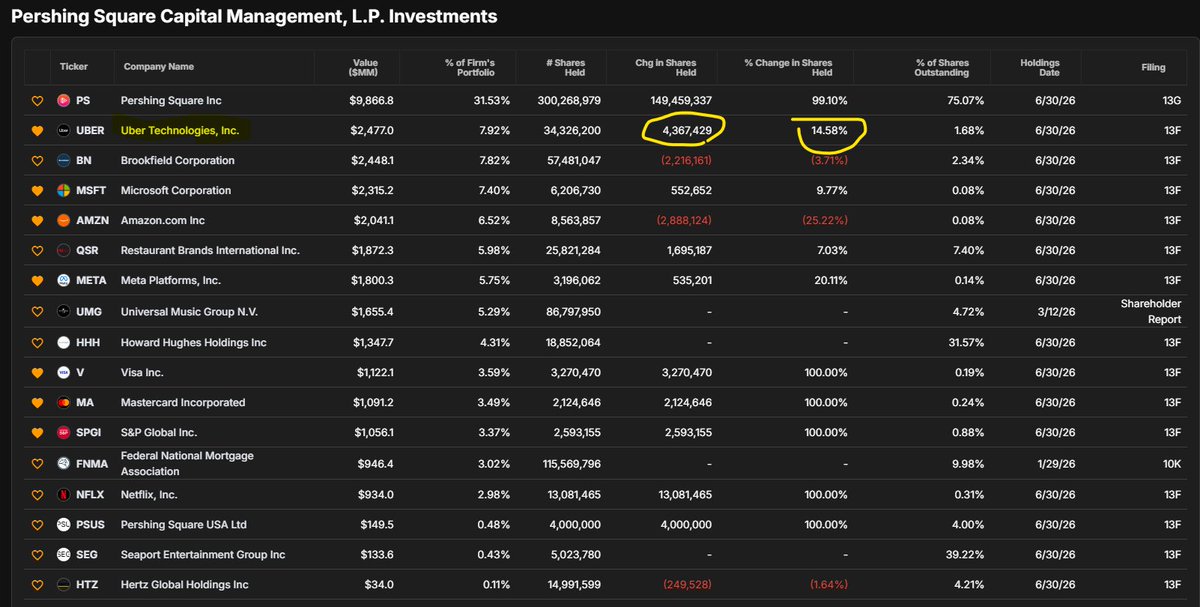
Robotaxis have done to $UBER what AI did to software. Investors assumed software was finished, only to watch many of those stocks rally 50% when reality proved less disastrous than the narrative. We may be seeing the same setup with $UBER. Robotaxis may eventually disrupt the business, or they may not, but right now Uber is doing extremely well while the stock trades as if its entire business is already doomed.