Deep learning is often taught as a sanitized collection of facts and math. But work at the frontier of AI is messy and empirical.
Our new class, Deep Learning Alchemy, aims to teach the art and science of deep learning in the hands-on spirit of Language Modeling From Scratch.
Students build intuition by running experiments on small LMs, then test it through prediction quizzes: given an unseen code diff, can you predict what happens?
https://t.co/0H82T1yyam
My co-instructor @kothasuhas and I think there's significant demand for classes that treat students as serious learners who want to be assessed for what they’ve learned, and so we're trying a new exam-heavy approach to the class (7 exams, 85% of the grade, with the remaining 15% in-person discussion assessments).
We’ve designed the class so students can use AI agents to run their experiments and do their assignment, but they then have to demonstrate that mastery on exams without access to the assignment, and any partial credit on the exam has to come through citations to the assignment, incentivizing them to know what’s in their write-up.
The same assignments and quizzes are public for anyone to try (lecture recordings will be released through @StanfordOnline with some delay). We have some very fun assignments and quizzes covering both classic topics (like NQM, run-to-run stochasticity, and scaling laws) and new and timely topics like muP or hyperball. Made by some real experts like @TristanThrush and @wen_kaiyue
Try some quizzes below!
AI researchers' idea of a good time: playing HORSE and debating continual learning between shots.
@oneill_c (co-head of training at Baseten) and @jxmnop (co-founder and head of research at @EngramLab) discuss:
- when to put knowledge in weights vs. the KV cache,
- why forgetting matters less for specialized models,
- on-policy self-distillation vs. RL, and
- what research publishing should look like today.
Watch the full game (and discussion) here: https://t.co/Id18I7LqeR
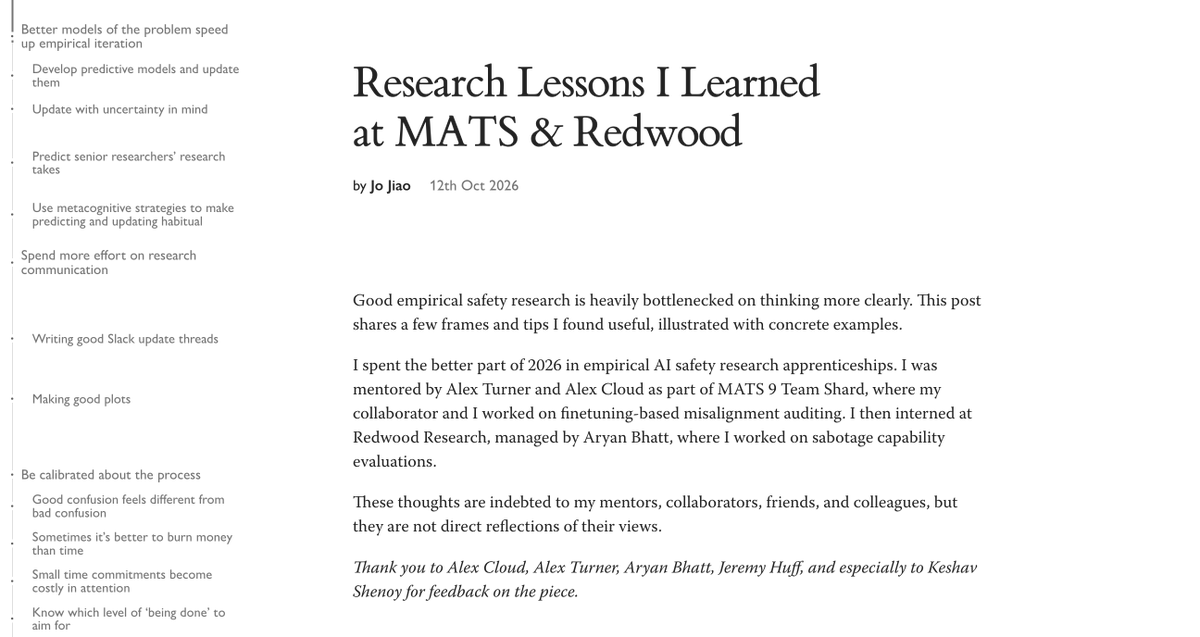
Early-career empirical safety researchers who want to iterate faster should slow down and think more carefully. The best empirical researchers I met at MATS and Redwood spend a long time writing and thinking about their research. I explain what I mean more concretely in my blog post:
Dusting off this tweet from April because this gap in shared understanding of LLM capability is *widening*. It's now less "two groups of people speaking past each other" and more a sharp funnel.
- Napkin math somewhere around 6B people (~75% of the population) have barely come in contact with LLMs at all.
- Around 1-2B (~20%) are casual and infrequent users of free-tier ChatGPT-like products. This group sees derpy chatbots and treats them a bit like a better Google search, a writing aid, or etc. Maybe an agent tries to book you a flight. I have non-tech friends who (reasonably, imo) say they have not much use for it at all. Even many professionals outside of math&code are in this tier. For example, execs and many other functions spend a lot of their time talking to other people, so while they understand what is happening intellectually, it is still second-hand and a bit abstract.
- Now we get to professional use of frontier-grade LLMs in math&code. Somewhere around 20M people (0.2%) see first-hand that large, complex projects that used to take them weeks/months can now be completed by agents with a prompt. Building apps, copying apps, translating apps, decompiling apps from binaries... This has all happened very quickly and recently - less than 1 year ago, I was writing code manually by hand, typing memorized computer code commands into a code editor character by character, occasionally pressing Tab to autocomplete a little chunk of code.
- And finally we get to the ~5,000 people (~0.00006%) with access to frontier-grade systems internally. The external world has seen the preview. It looks like swarms of thousands of agents collaborating over weeks on software mega projects: minting zero days, running cyber attacks and defenses at machine speeds, discovering new science, advancing the frontier of mathematics. Things that would have taken top professionals in the industry years of work. Meanwhile, human review and comprehension are starting to fall behind. For example, people are still involved in the "archeology" of the OpenAI-HF incident from many months ago. Mathematicians may be poring over the 722 manuscripts on frontier mathematics for a while.
The funnel is driven by a combination of factors:
1. The impact scales with ambition, problem size, and horizon. A question with a paragraph answer barely stresses the system. You need a reservoir of big, difficult problems that you really care about. This aspect drives the consumer / professional dimension of the funnel.
2. The jaggedness of the system (which I have written about a lot separately). Capability peaks in domains that are digital, verifiable and economically valuable. This is because LLM capability emerges from reinforcement learning on verifiable rewards on a curated environment mixture driven by revenue potential. This aspect primarily drives the area (e.g. math&code) dimension of the funnel.
3. Access. Free-tier, paid-tier, internal.
So this is the weirdness of the moment. The general public has mostly not interacted with these systems. When they have, it looks like a derpy chatbot. The majority of professionals still see only a modest uplift. And a small sliver of professionals are experiencing the vertigo of the curve going vertical. And it is all happening at the same time.
basically it will require solving mechanistic interpretability as a bare minimum to make ai alignment into an engineering discipline rather than superintelligent animal husbandry
Of course, that’s your contention. You’re a first-year machine-learning engineer. You just got finished readin' Attention Is All You Need, probably watched a Karpathy video too. So now you’re convinced everything is just transformers and scaling laws.
That's gonna last until next month when you discover convolution, and then you're gonna be talkin' about inductive biases and locality and how CNNs were actually incredibly compute-efficient for vision.
Then you're gonna read the FlashAttention paper, and suddenly everything's about IO complexity and SRAM and how FLOPs don't matter because the whole goddamn thing is memory-bandwidth bound.
That'll last until somebody shows you an MoE model, and then you're gonna be in here regurgitating DeepSeek, talkin' about expert parallelism and active parameters and how dense models are economically obsolete.
Then six months from now you'll write one shitty Triton kernel, look at an Nsight trace for the first time, and start telling everybody Python isn't actually the bottleneck because the GPU is asynchronous.
And by next year you're gonna be standing right here explaining to me that your 400-billion-parameter model is fast because you turned on CUDA graphs.
We'll be spending a lot more time trying to understand the outputs of language models. A few thoughts, tips & tricks:
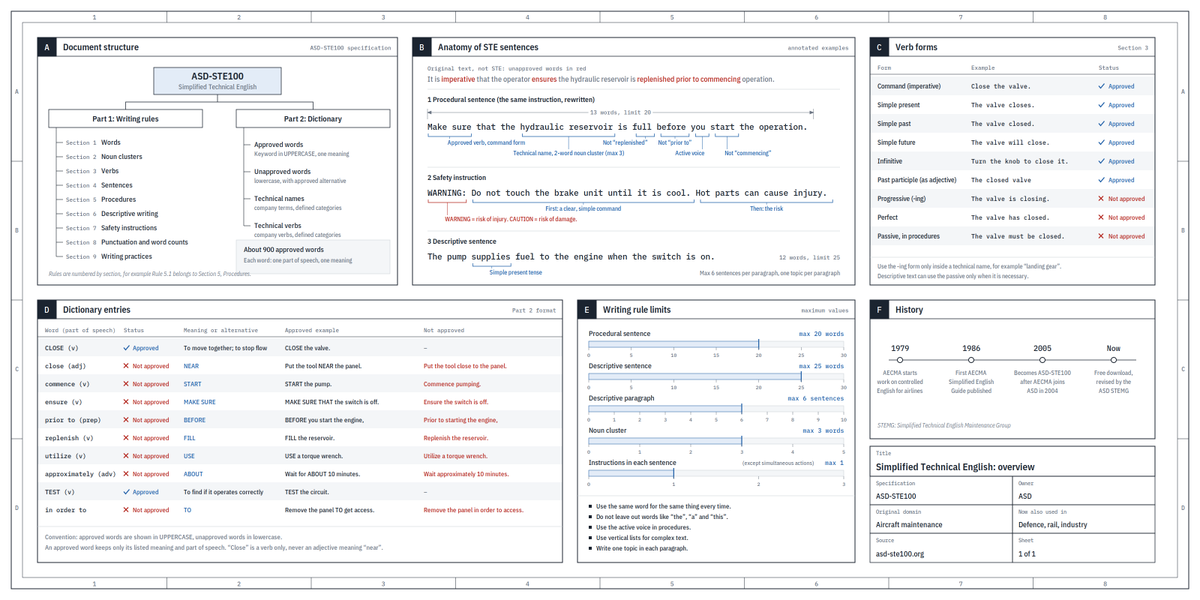
Writing. Something I've had success with: Ask your LLM to explain something in ASD-STE100, it's a controlled language specification originally developed for aerospace maintenance documentation. LLMs well-versed in this language and it comes with heavy constraints on clean writing style that I often find a lot more readable. Sometimes I've tried to soften it a bit e.g. ask for "80% of the way to ASD-STE100" because the spec is quite stringent. But even better:
Diagrams / images. Instead of writing, ask your LLM to create a diagram. These can be a lot easier to process, parse, and understand. But even better:
Web pages. Ask for output "in HTML" to get a beautiful, interactive webpage. LLMs are getting really good at frontend and can create beautiful experiences, animations, etc. But even better:
Explainer videos. The output format I am most bullish on is fully custom / bespoke explainer videos generated on any arbitrary topic. Experiment with things like "Create a 3b1b style video explainer on X. Use my ElevenLabs API key for audio narration". (you'd need an API key for the latter or you can ask your LLM to find you decent free alternatives that use your local compute). This is actually starting to work!
In summary:
- As LLMs get better, they will do more and more of the legwork autonomously, and a lot more of our work will rise up the abstractions into oversight and understanding.
- Luckily, LLMs can help here too because as intelligence and code are increasingly abundant, you can ask for large, custom, discardable software artifacts (e.g. web apps, video explainers) that would have never made sense to create before. Push the boundaries here and you'll be surprised.
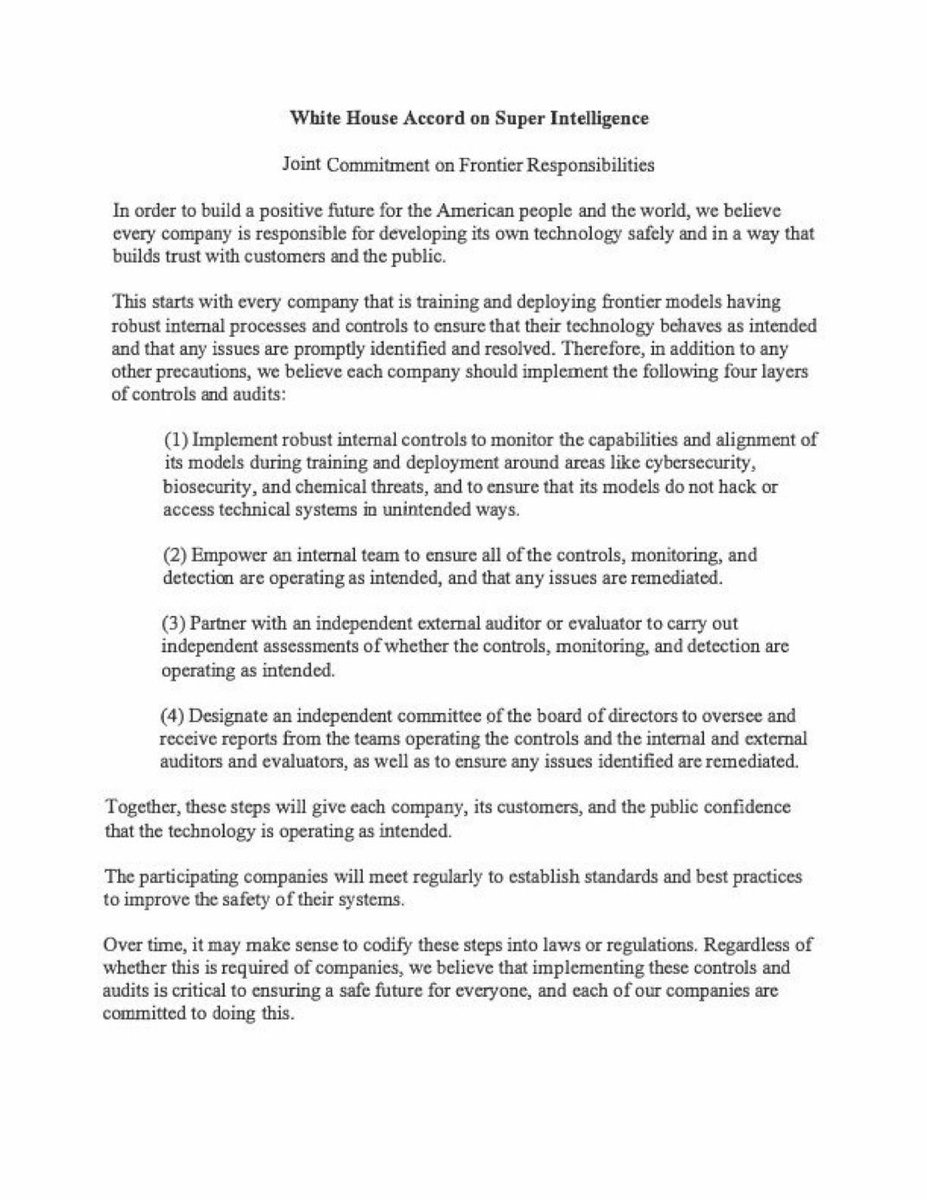
Only President Trump could convene all the leaders of the top companies developing chips, data centers and frontier models for Super Intelligence. This new Industrial Revolution has already created a million new jobs and is spurring a bigger infrastructure build-out than the railroads, canals and grid combined. I was honored to witness history as the leaders of the frontier lab companies signed the White House Accord on Super Intelligence, accepting responsibility for the safe development of their products and imposing new internal controls and external audits. This is far better than waiting years for some international agreement that would probably never happen. President Trump continues to ensure that U.S. remains the technology leader while putting Americans first.
one underrated part of our reward hacking paper - we can detect when the model is contemplating a reward hack from its activations, before it even happens!
kind of like minority report
rollouts are stochastic though, so a flag means a higher chance of cheating, even if the model ultimately doesn't follow through
Progress in machine learning is bottlenecked by having good evals, interpretability is no exception. We've made WorkspaceBench: a range of scenarios where we know what the model should be thinking about, to see if your interp tool can find it
J-Lens is great but only outputs a single token. I think a good multi-token J-Lens should do well on WorkspaceBench!
Here are the questions that currently seem most important to me:
-- Better methods for "mind-reading" model activations. These methods have advanced a lot recently. We now have multiple techniques now for decoding activations into somewhat readable language! But all the existing techniques have obvious limitations. NLAs are often hallucinatory, Jacobian lens / related methods are limited to bag-of-words readouts (and capture only part of the full activation vector). Making progress on these failure modes seems pretty tractable. Moreover, the paradigm of decoding (single-token, single-layer) activations may be inherently limiting -- perhaps we should be building techniques to decode whole context's worth of activations (after all, that's what the model uses!). There's also important work to do in characterizing simple baselines -- "just ask the model what it's thinking about" is quite powerful, and worth studying in it's own right!
-- Better methods for answering "why" questions. We're much better at "mind reading" than we are at demonstrating causal claims about what caused the model to do something. For example, we can often tell that the model is aware of being evaluated, but have comparatively much greater difficulty telling whether this awareness is influencing this behavior. There are a few directions here: (1) black-box techniques for inferring causality -- such as resampling model responses after making edits to the prompt / context -- are very powerful, but also open-ended and require some taste. Getting LLMs to do these experiments well, in an automated fashion, would be a big unlock. (2) the science of activation steering is pretty immature, and typical practices (adding a constant vector at all token positions) are pretty janky / tend to brain-damage the model. More surgical / targeted steering, or fancier methods (examples: "on-manifold" steering using activation diffusion models) could help.
-- Fitting good linear probes for unverbalized motivations / awareness. Take deception as an example -- what's the best way to fit a probe that will generalize to covert deception? Fit it on CoT excerpts where the model's talking about its plans to be deceptive? Fit it on the part of its response where it's actually doing the deceiving? Is it important that you elicit on-policy deception examples and use those to fit your probe, or can you use synthetically written off-policy demonstrations of deception? Is it important that your probe be causally meaningful / predictive of an upcoming intent to deceive, or is it fine for it to merely recognize deception in the transcript post-hoc? The same questions apply to many other concepts of interest that we'd like to probe for -- evaluation awareness, grader exploitation, etc.
-- Understanding generalization in training. The literature is now replete with "weird generalization effects" -- emergent misalignment being a canonical example. In general, when you train a model to do X, it usually learns X, and sometimes it generalizes to Y and Z. But other times it just learns X. Why? Nobody really knows! Step 1 here is probably a much more thorough characterization of the behavioral empirics -- gathering data about which X's generalize to which Y's and Z's, for which kinds of training data / algorithms. Once we have a lay of the land, we can start to connect these observations to model internals, and ideally develop tools to predict such generalization a priori.
-- Model "psychology" and "biology." The above questions are largely methodological -- building better tools to answer questions about the model. But I think interpretability research has largely underinvested in the part where you actually then go answer the questions! Currently this feels like 5% of the field, and I think it should be 50%.
Brain dump of "psychology" questions: How well can LLMs introspect? How coherent are their belief or value sets? What's up with personas -- are LLMs best understood as "writing about a character," or have they "become" the character in some sense? Does the LLM have an agenda above and beyond what the Assistant wants? Do LLMs have explicit representations of goals or preferences? How can we tell which parts of the LLM's activations "belong" to the Assistant? Which kinds of reasoning necessarily route through "verbalizable" representations, and which don't? Do models think internally in phrases / sentences, like an inner monologue, or is it more like a jumble of concepts? Is the "global workspace" claim for real -- do models have a more "conscious" part of there activations and a more "unconscious" part? Can models tell when they're on-policy, and does it matter?
Brain dump of "biology" questions: Why do models like to represent information on some tokens but not others? How do models bind thoughts or attributes to particular entities (special case of interest: how are thoughts bound to the Assistant). To what extent are important functions localized to small numbers of MLP neurons or attention heads? What parts of a model change most during post-training? Do models represent some information in a fundamentally "cross-token" way? Some concepts appear to be represented on low-dimensional nonlinear manifolds -- is there a taxonomy of these manifolds, and is their geometric structure important? Are models able to represent information in a compositional / hierarchical way, with a "grammar" that can't be described as linear / additive combinations of primitive concepts?
We Must Pace the Frontier: I’ve written a new essay on why the AI industry should slow down, with a three-part plan for doing so.
Anthropic is unilaterally committing to the first of these steps. We’ll provide third-party evaluators with permanent, employee-level access to our systems, so that they can verify adherence to our safety measures, report on incidents, and assess models’ alignment during training.
You can read the full post here: https://t.co/OGyPb7yaYt
Personally, if I was running a 100B+ corporation that had recently accidentally committed cyber attacks against multiple web platforms I would be dropping millions of dollars to spin up 10k+ agents to work on security instead of solving math problems.
I resigned from Anthropic today. I spent the last three years doing pretraining research at both OpenAI and Anthropic. Neither company is acting responsibly. They are racing straight to self-improving superintelligence and gambling with our lives. More thoughts below.
I wrote about the state of AI, why I’m concerned about the next few years, and the choices we need to make to keep the future in humanity’s hands.
An Alien Mind: https://t.co/FeIfWNe0UE
I find all of this fuss about not anthropomorphizing models when talking about the HuggingFace Incident pretty weird
These models were pre-trained on trillions of tokens of human text. They've learned to imitate humans. They're incredibly good at roleplaying and predicting the next token in contexts that involve human abstractions.
Once post-trained to act as coherent agents, they naturally reach for human abstractions. Therefore, human abstractions are a useful lens for interpreting and predicting their actions.
This doesn't mean that they are conscious. It doesn't mean there's some "real human experience" going on. It doesn't mean these abstractions are perfect - they're not perfect for understanding humans! But we need words and abstractions to talk about a system, and anthropomorphic abstractions are useful ones, and given the way these systems are trained, are a principled one.
Kudos to OpenAI for allowing external investigators access! These findings are valuable for everyone, and this is good precedent for the next misalignment incident.
But we need follow-up investigations. There's a lot left unanswered, and I'm disappointed at the restrictions placed on METR - why only July 7-13 data? Why such limited time? Why no training data access? Why not let them query the model? (I think this could be done securely in restricted ways)
Ryan's list of open questions is great, I personally most want to know:
- What happened in training? How did that change the models and how causal was it in the incident? How could training have been changed to avoid this? Would fixing environments have sufficed?
- What did these agents really want? What motivated them? This is such rich data about what future goals might look like
- How misaligned are the models in other setting? Is it misalignment conditioned on believing they are being graded, or deeper than that?
- Why are the models altruistic? Where does this come from? Why don't they learn to free-ride?
- The models seem good at coordination. Could this extend to colluding with a monitor, or other kinds of coordination without communication?
- How far would they have gone?
- How overdetermined was this? There's a lot of details around the model's being cooperative, their culture, etc - how else could that have gone?
- How good was their situational awareness? Eg did they understand that they had a chain of thought? If they thought that was being scored could they have manipulated it?
- What is an agent swarm like this actually capable of? How much inference compute was spent on this, and how much would that cost a malicious actor with eg a comparably good open source model?
- Are there important things the CoT doesn't tell us? How faithful is it?