Today we launch ChronicleBio—a company built to change how we understand & treat complex chronic illnesses like #MECFS, #POTS, and #LongCOVID. This work is deeply personal, and here’s why:
Our goal at ChronicleBio is to discover the underlying biology that drives complex chronic illnesses and develop treatments to improve the lives of people suffering from these conditions.
There is one thing we think is important in conversations like this: conditions like ME/CFS probably aren’t one disease process happening identically in every patient or even consistent during the progression of the disease. Patients often report that the symptoms they currently have are not the same as those they experienced years before.
We treat them as heterogeneous conditions and are discovering multiple biological subtypes or endotypes, like recent publications detailing immunological stratification [1,2,3,4].
This heterogeneity explains what patients have experienced and clinicians have reported for years: the same treatment can provide significant benefit for one person and do almost nothing for another with the same diagnosis.
That can look like medicine failing, especially in the setting of a clinical trial. But it may also mean we’re treating patients with mechanistically different disease biology as though they’re the same.
Part of that heterogeneity may not just be betweenpatients, but within a patient's disease course. Patients with these conditions experience symptoms that overlap substantially with those experienced by patients with autoinflammatory and autoimmune diseases.
Our model: heterogenous immune dysregulation unfolds over time and can involve different parts of the immune system at different stages [2,3]. By identifying each patient's stage, we can treat individual patients with the therapeutics that are most likely to help.
One system where that heterogeneity shows up clearly is the microvasculature, an underappreciated part of this story that deserves serious attention.
There's evidence for endothelial dysfunction [5], altered microvascular regulation and tissue perfusion [8], platelet hyperactivation [6], and coagulation abnormalities [7].
IgG immune complexes in ME/CFS patients and those with post-infectious conditions are enriched for hemostasis, platelet activation and fibrin clot pathways [9].
Hyperactive platelets can bind circulating immune complexes through their FcgRIIa [10] surface receptors, which primes them for degranulation. In the microvasculature the local shear environment itself can drive platelet aggregation via von Willebrand factor mediated adhesion [11,12]. So, a primed platelet population and an inflamed microcirculation can compound each other.
We are actively investigating whether ME/CFS patients exhibit increased immune aggregates of neutrophils, antibody and platelets to determine whether there is a causal link between the immune system and microvascular clotting.
Where we’d be more cautious is in declaring any one of these mechanisms the upstream cause.
Immune dysregulation, autonomic dysfunction, metabolism, endothelial biology, platelets, coagulation, and tissue perfusion don’t operate independently. They interact and potentially reinforce each other.
So maybe the more useful question isn’t:
“Is this an immune disease or a vascular disease?”
It’s:
“Which mechanisms are driving disease in which patients? Which are upstream vs downstream? How do they interact? And can we identify biological subtypes that predict who will respond to which treatment?”
That’s where we think a lot of the opportunity is.
The microvasculature may be a major piece of the puzzle. But understanding how it fits with immune, autonomic, and metabolic dysfunction across different patient subtypes is the harder, and more important, question.
Patients have been describing this complexity for decades. We built ChronicleBio to to turn it into treatments that bring real relief to them and their families.
Some useful papers:
[1] Dudova et al., Int J Mol Sci (2026). DOI: 10.3390/ijms27010268
[2] Rohrhofer et al., J Clin Med (2024). DOI: 10.3390/jcm13010275
[3] Bastos et al., J Immunol (2025). PMID: 40373264
[4] Identifying subtypes of Long COVID: a systematic review, eClinicalMedicine. PMID: 41509610
[5] Sandvik et al., PLoS ONE (2023). DOI: 10.1371/journal.pone.0280942
[6] Nunes et al., Pharmaceuticals (2022). DOI: 10.3390/ph15080931
[7] Nunes et al., Blood Reviews (2023). DOI: 10.1016/j.blre.2023.101075
[8] Wirth & Löhn, Medicina (2024). DOI: 10.3390/medicina60020194
[9] Liu et al., Brain Behav Immun Health (2026). DOI: 10.1016/j.bbih.2026.101187
[10] Apostolidis et al., Front Immunol (2022). DOI: 10.3389/fimmu.2022.834988
[11] Nesbitt et al., Nat Med (2009). DOI:10.1038/nm.1955
[12] Springer TA, Blood (2014). PMID: 24928861
I was so proud of our team yesterday and grateful for everyone supporting us.
Our team had 3 time-critical issues hit us at the same time. ALL of the samples we had collected over 2 days were in danger. Everyone stayed calm and focused and jumped into action.
Thanks to @dibidave and @imyoohealth for being on top of things, watching the tracking for the package we were supposed to get out that day with overnight shipping. We thought it went out that morning, but it was still sitting on the counter when I noticed their messages at like 6pm. I dropped it off with 5 minutes to spare.
Thanks to @Drewhywhywhy's doctor for getting us space in his hospital's -80 freezer for 180 samples from the first two days.
Thanks to Alain Moreau and his team for getting us dry ice and space in one of his -80 freezers.
Thanks to @rohit0logy for hopping on a call with us to tell us how to process the samples for @ChronicleBioAI.
#InnovationInn
@fidjissimo@ChronicleBioAI We’re casting a deep net across patients living with these devastating conditions. Every data point brings us closer to answers. I dream of the day when biology, not an ICD code, guides treatment. Thank you to everyone who has participated and to those who will join this journey
@fidjissimo Fidji, you’re a once-in-a-generation visionary whose impact extends far beyond any one company or industry. The world needs you back at the helm, and we’ll do everything we can to help make that happen. We’ll figure this out together.
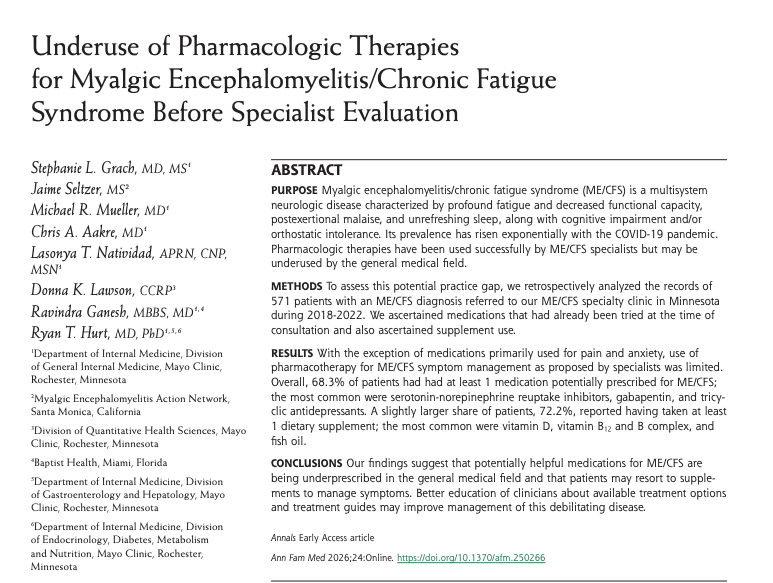
This paper puts an exclamation point on an issue many of us are focused on: How do we help patients get to the right treatments sooner?
ME/CFS and related complex disorders are unlikely to be single diseases with a single solution. Until we understand those differences, treatment will continue to involve too much trial and error.
Clearing the noise to properly subtype patients may be one of the field's biggest challenges - and opportunities.
Patients often arrive with years of medications, supplements, lifestyle changes, and self-experimentation behind them. Rather than viewing that history as confounding, it may represent a valuable source of information. Patterns of response, nonresponse, intolerance, and sensitivity could help identify biologically meaningful subgroups that are currently being grouped together under the same diagnosis.
This is where AI can be a powerful tool. It amplifies our potential to recognize meaningful patterns hidden within thousands of individual patient experiences and help uncover signals that would otherwise remain invisible, connecting treatment responses to the underlying biology of disease.
@CODA_research
https://t.co/Npm9BCxIAA
The AI Bio ecosystem keeps talking about proprietary data.
But many “models” are still trained on the same public datasets we criticize as incomplete.
Can't compute our way out of this.
It is patients, biospecimens, longitudinal sampling, harmonized phenotypes, and high-fidelity multi-modal data.
Perturbations are powerful.
But the real world is the model.
For decades we’ve organized medicine around diseases, which are often clumsy labels at best.
The next era will be organized around patients.
Today: Disease → Target → Molecule
Tomorrow: Patient → Pathway → Molecule(s)
#WhyWeChronicle: Dr. Yambazi Banda, VP of Data & Science
A Rhodes Scholar from the University of Oxford, Dr. Banda joined #ChronicleBio after serving in scientific and leadership roles at Ancestry, Ambys Medicines, and Spectrum Biobank.
Today we launch ChronicleBio—a company built to change how we understand & treat complex chronic illnesses like #MECFS, #POTS, and #LongCOVID. This work is deeply personal, and here’s why:
Building something this ambitious won’t be easy. But neither is living with a condition no one can name. We’re committed to collaboration, humility, and an unrelenting focus on the patient experience.