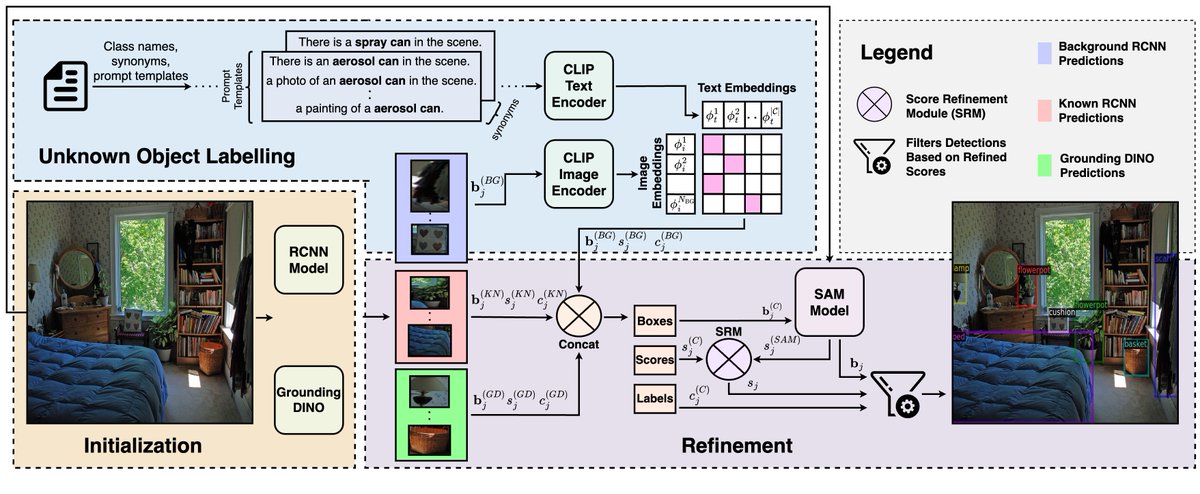
Happy to announce that our paper, "Enhancing Novel Object Detection via Cooperative Foundational Models" has been accepted at #WACV2025
We tackle the problem of detecting both known and novel objects during inference, which is imp for deploying AI in real-world settings (1/8)
btw anthropic's internal document on this literally said "we don't want it to be known that we are working on this.”
it was called project panama.
here's exactly what happened:
1: anthropic concluded that books were the cheapest way to build a world-class model because they gave claude curated facts, structured arguments, compelling stories, and writing “an editor would approve of.”
2: once anthropic decided it needed books at enormous scale, its first solution was piracy.
it downloaded 7m+ books from online libraries including libgen. the judge later wrote that although anthropic had legal ways to buy them, it chose piracy to avoid what dario amodei called the “legal/practice/business slog.”
3: that piracy created a massive legal risk.
so in february 2024, anthropic hired tom turvey, the former head of partnerships for google books, to find a legally safer way of obtaining “all the books in the world.”
4: turvey first contacted major publishers about licensing their catalogs.
those attempts didn’t produce agreements, so anthropic chose a route that required no publisher permission: buying millions of physical books through distributors and used-book retailers.
5: within about a year, anthropic spent tens of millions acquiring and scanning millions of books, including many rare and 1/1 titles. one vendor proposal targeted 500,000 to 2 million books in six months.
6: to scan that many books within months, the vendors physically dismantled them.
a hydraulic cutter removed each spine. the pages were trimmed to size, fed as loose sheets through high-speed industrial scanners, and converted into searchable PDFs. the paper remains were then sent for recycling.
7: these PDFs were fed into claude as training data.
the complete collection became a private, searchable anthropic library that the company planned to “store forever.” the scans aren’t available to the public and were never open-sourced.
The two big unsolved problems in ML today are:
- Non-stationarity: future inevitably is different from the past, but your model remains stuck in regularities it learned from the past. How do you adapt?
- Low coverage regime: your model spends its capacity on frequently occurring patterns, but rare ones do crop up every now and then but it hasn't learned them. How do you deal with them?
These two problems come in many guises (continual learning, OOD generalization, hallucinations, sample efficiency and so on) but the common core is this.
We’ve received notice that the Department of Commerce has lifted export controls on Claude Fable 5 and Mythos 5.
We'll begin restoring access tomorrow, and will share an update soon.
We’re grateful to our users for their patience, and to everyone who worked with us on redeploying the models.
# on shortification of "learning"
There are a lot of videos on YouTube/TikTok etc. that give the appearance of education, but if you look closely they are really just entertainment. This is very convenient for everyone involved : the people watching enjoy thinking they are learning (but actually they are just having fun). The people creating this content also enjoy it because fun has a much larger audience, fame and revenue. But as far as learning goes, this is a trap. This content is an epsilon away from watching the Bachelorette. It's like snacking on those "Garden Veggie Straws", which feel like you're eating healthy vegetables until you look at the ingredients.
Learning is not supposed to be fun. It doesn't have to be actively not fun either, but the primary feeling should be that of effort. It should look a lot less like that "10 minute full body" workout from your local digital media creator and a lot more like a serious session at the gym. You want the mental equivalent of sweating. It's not that the quickie doesn't do anything, it's just that it is wildly suboptimal if you actually care to learn.
I find it helpful to explicitly declare your intent up front as a sharp, binary variable in your mind. If you are consuming content: are you trying to be entertained or are you trying to learn? And if you are creating content: are you trying to entertain or are you trying to teach? You'll go down a different path in each case. Attempts to seek the stuff in between actually clamp to zero.
So for those who actually want to learn. Unless you are trying to learn something narrow and specific, close those tabs with quick blog posts. Close those tabs of "Learn XYZ in 10 minutes". Consider the opportunity cost of snacking and seek the meal - the textbooks, docs, papers, manuals, longform. Allocate a 4 hour window. Don't just read, take notes, re-read, re-phrase, process, manipulate, learn.
And for those actually trying to educate, please consider writing/recording longform, designed for someone to get "sweaty", especially in today's era of quantity over quality. Give someone a real workout. This is what I aspire to in my own educational work too. My audience will decrease. The ones that remain might not even like it. But at least we'll learn something.
Introducing Claude Fable 5: a Mythos-class model that we’ve made safe for general use.
Its capabilities exceed those of any model we’ve ever made generally available.
Stop being retarded, start Retardmaxing
Being retarded means you’re ruminating and overthinking your decision
Retardmaxing means you’re making decisions based on your gut instinct — zero rumination, zero regrets
Stop being retarded, start #Retardmaxing
Personal update: I've joined Anthropic. I think the next few years at the frontier of LLMs will be especially formative. I am very excited to join the team here and get back to R&D. I remain deeply passionate about education and plan to resume my work on it in time.
with agi coming, i’ve found researchers are prioritizing looksmaxxing as they believe that is the remaining moat after the commoditization of knowledge work