@AgentSaffron Nonsense. The "Hindu umbrella" has only made our collective imagination moribund. Dissolve it completely and replace it with sampradayas with strict boundaries and formal initiations. Competition is good, monopoly isn't.
@dharmadecentral@Raktarasikah Bageshwar Dham & Sadhguru are excellent Karma/Raja Yoga examples. Hinduism’s fragmentation is actually good: distinct denominations with clear perimeters & formal initiations foster healthy competition. The vague "Hindu umbrella" has only made our collective imagination moribund.
@dharmadecentral@Raktarasikah Moreover, the timing has to be right. Prabhupad tapped into the hippie movement of the 1960s to provision himself and Krishna consciousness in the west. Previous attempts have failed either because the timing wasn't right, or those gurus didn't have the right personality for it.
@dharmadecentral@Raktarasikah It’s going to take someone of Srila Prabhupad’s caliber and vision to create a new successful neo-Hindu denomination. Also, it’s going to have to be a western movement because as Prabhupad realized, westerners embracing Indian spiritual path will entice Indians to do the same.
@AliPK1947 Demographics are destiny. In lower birth rate societies with only 2 children, a boy and a girl on average, a mother won't sacrifice her only son in some vain fidayeen operation; children become rare assets. Conversely, high birth rates allow families to stomach higher death rates
Very limited explanation. Persianate culture made its way everywhere in India via the Muslim elite, and Mughals were racist to North Indians too. Also, Rajputs had many bad things to say about their Mughal overlords. Don’t expect medieval kings to be woke.
@akarlin Is there a plausible explanation here, because if Indian women are neither having as many babies nor working, what on earth are they doing with their time that wasn’t getting done previously?
The nation-state is not the natural political unit of Muslim civilization.
And Muslims unconsciously know it, which is why every Muslim-majority country in the Arab-Persian-Turkic core has an identity crisis baked into its constitution.
The nation-state requires you to locate sovereignty in a people, a territory, an ethnicity. Islamic political theology locates sovereignty in Allah, with the umma as the collective body cutting across blood, land, and language by design. These are not compatible operating systems.
So what happened post-colonialism is that Muslim societies inherited the French or British state model, tried to run Islamic social expectations through it, and got permanent institutional schizophrenia.
Turkey tried to resolve it by amputating Islam. Egypt tried to suppress it. Iran tried to fuse them and got theocratic bureaucracy. The Gulf states paper over it with oil money.
None of them solved it because the form itself is the problem.
The caliphate gets dismissed as medieval fantasy, but the people dismissing it never explain what legitimate political theology actually looks like for a civilization that never agreed Caesar and God occupy separate domains.
The West didn’t arrive at Westphalia cleanly. It took the Thirty Years’ War, then two more centuries of political philosophy, to even pretend the question of religious versus political authority was settled. That settlement was theirs to make, earned through generations of exhausting, bloody, internal argument.
Muslims didn’t get that long, ugly, necessary process. They got the compressed version, stapled on by colonial administrators, with no civilizational reckoning of their own behind it.
That’s the actual crisis. Not that the caliphate ended. That nothing home-grown ever replaced the theological work it used to do.
The quicker we embrace Hindu intellectual decline predates Islamic conquest and subsequent conversions, the quicker we can start building institutions to tackle the problem. Something happened between the fall of the Guptas and the Ghaznavid invasions that isn’t being studied.
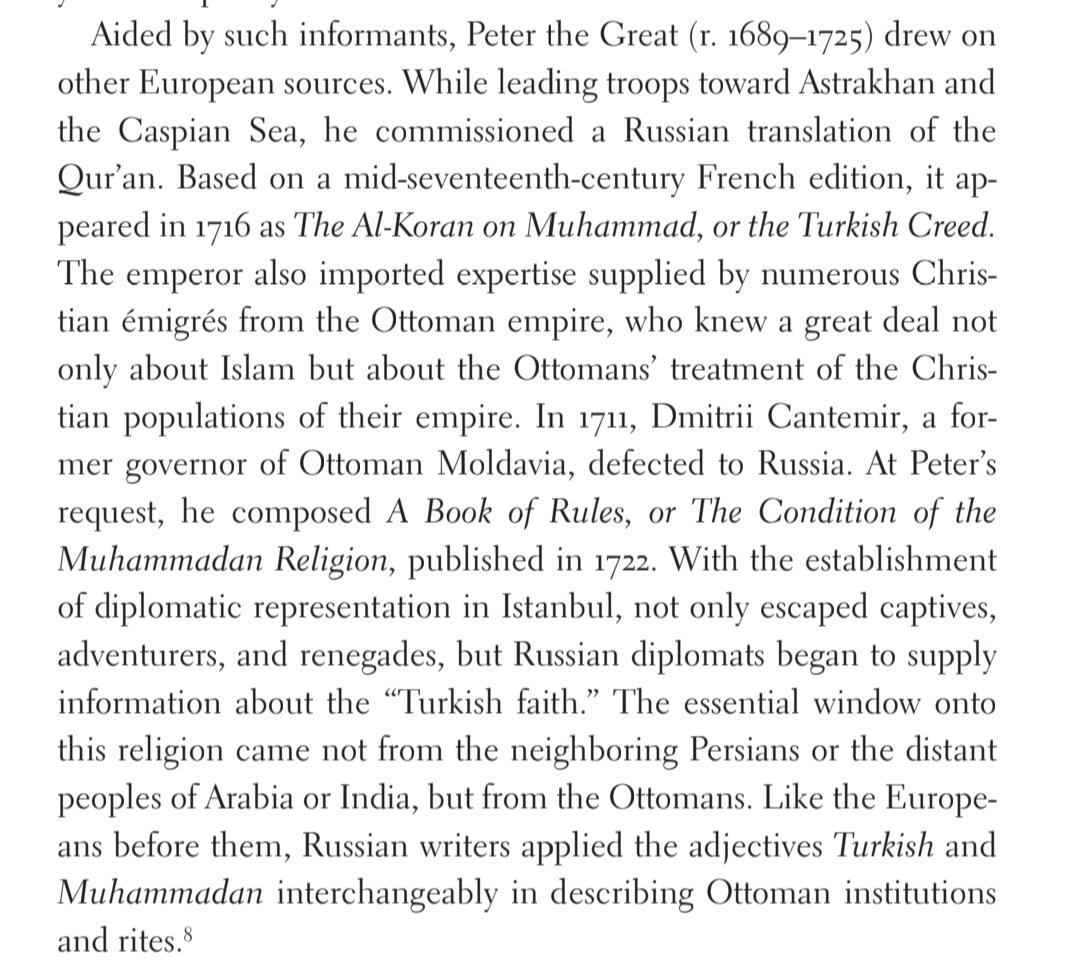
As Russian empire's interaction with Islam deepened, Peter the Great commissioned a Russian translation of Qur'an and used all available sources to understand Islam in greater details. Most of the Hindu kings never bothered to study it despite centuries of hostility.
@JanhaviNilekani@BShrayana@lymanstoneky@paulnovosad What explains the low female workforce participation in India and low fertility rates ? Begs the question - if women aren’t having children, or working, what are they spending their time doing that wasn’t getting done previously?
@Yaduvanshi8999 Foragers, farmers and fossil fuels by Ian Morris is another gem. He underscores an important point how human values change as societies move from hunter gathers to argarian to industrial societies.
Besides the silly fight over territorial demarcation of IVC, nationalists don't mention that IVC faded from human memory for 3500 years until the British accidentally discovered it in the 19th century https://t.co/9hj0KenYBA
No religion or faith tradition in the world is entirely right or entirely free from shortcomings. Every belief system reflects both valuable insights and historical limitations. It is therefore time for humanity to move beyond sectarian divisions and religious dogmatism, and instead embrace universal human values, reason, scientific inquiry, compassion, justice, and peaceful coexistence as the common foundation of our shared future.
#World #India #Pakistan @INikhatAli@tishasaroyan
@faraz_lhr The population of Pak in the early 1900s was only 19 million. The land was even sparser a half a century prior. It's very hard for people to understand there just weren't that many Muslims in the India before the British arrived. Many that did become Muslims were only nominals.
A counterfactual history. Canal colonies irrigated new lands and massively increased the population of the western half of Punjab. No canal colonies, no Pakistan https://t.co/pNn2FsUErt
Working under the Colonial British, Indians created the modern economy in East Africa, introducing the 'natives' to commercial retail. Before the Indian arrival, there existed only a primitive subsistence and barter system.
For this progress, they were rewarded by the 'native' African elites like Idi Amin etc with ethnic-cleansing. They moved to Anglosphere nations like UK, Canada and USA, enjoying greater rights and a higher quality of life than East Africa. East African elites eventually regretted their policies and invited Indians back. Very few returned.
The world is more complex than 'Brits bad'. In certain cases Colonisation was a net-positive. Learnt this from Thomas Sowell.
@SHBokhari13 1. Appallingly low rates of female literary
2. Very high birth rates
3. Low bank deposits as a share of GDP
4. Low investment.
5. Poor growth.
In that specific order. No country has industrialized with less than 70% literacy rates. Bank deposits surge as TFR falls below 3.