The liquidity tide just turned — quietly, globally, and far faster than anyone expected.
Reverse repos are surging. QT is dead. IPO markets are red-hot.
Are we about to witness the next explosive risk-on rally across equities, crypto, gold, silver?
Full analysis inside. 👇
https://t.co/FWMI2wM0zU
Great observation, Ritesh.
The 30-35% cost edge for that Indian engineering firm aligns perfectly with the broader China+1 shift. With CNY up ~20% vs INR over the past year (chart checks out - from ~11.6 to 14.0), Chinese exporters are indeed passing on higher costs right as global buyers hunt for alternatives.
India’s labor + policy advantages (PLI schemes, infrastructure push) are finally kicking in for precision engineering, components, and aerospace. Companies like Azad and others are getting mentioned in reports for exactly these margins over Chinese peers.
Key question for the next 12-18 months: How sustainably can Indian firms scale quality, supply chain depth, and delivery consistency without the China-style ecosystem? If they nail execution, this pricing power thesis plays out big.Bullish on Indian manufacturing names that have survived the dumping era.
This is one of the smartest strategic bets we've seen from traditional Indian IT.
HCL isn't just buying a stake - they're backing a homegrown foundational AI player building India-first multilingual LLMs (like Sarvam-105B) that actually understand our languages, culture, and enterprise needs.
From ~$200M valuation last year to $1.5B now - that's real momentum in sovereign AI. Excited to see how this helps Indian companies leapfrog with locally tuned models instead of depending entirely on foreign ones.
Props to Vivek Raghavan, Pratyush Kumar, and the Sarvam team. This could be a template for more IT giants to invest in deep tech.
Interesting take, but I'd push back hard on the City Gas Distribution angle.
EVs are accelerating fast- esp. in 2W/3W and urban fleets - directly eating into CNG's high-margin auto segment that CGD players rely on. Policy push + falling battery costs will compress volumes and margins quicker than supply diversification helps.
Upstream (Oil India) and selective OMCs make more sense.
@zerohedge NVIDIA issuing debt to fuel AI buildout is bullish long-term compute demand is exploding faster than cash flows can keep up.
Hyperscalers betting trillions on future revenue. Leverage rising, but balance sheets still strong. This is the capex phase.
Oil’s fall is not just about cheaper energy.
It is about a narrower range of bad macro outcomes.
The reported U.S.-Iran agreement and possible normalization of Strait of Hormuz flows have shifted the market conversation quickly:
Oil lower.
Equity futures higher.
Inflation risk softer at the margin.
Risk appetite improved.
But the key point is broader.
Energy is still one of the clearest transmission channels between geopolitics and the real economy.
A disruption in one maritime chokepoint can move far beyond crude prices. It can affect freight, aviation, petrochemical inputs, consumer inflation, EM current accounts, central-bank expectations, corporate margins, and portfolio positioning.
So when the oil risk premium unwinds, markets are not only repricing supply risk.
They are repricing inflation risk, policy risk, earnings risk, and valuation risk.
The market may not be saying geopolitical risk has disappeared.
It may simply be saying the probability-weighted downside has reduced.
That distinction matters.
Markets do not need certainty to rally. They need a lower probability of the worst-case scenario.
For corporates, the implication is clear: build operating models that can absorb energy shocks without strategic paralysis.
For investors, the message is similar: portfolio resilience is not only about defensiveness. It is about understanding how shocks transmit across the system.
Energy risk can become inflation risk.
Inflation risk can become policy risk.
Policy risk can become valuation risk.
Valuation risk can become positioning risk.
The fall in oil is the visible price action.
The real signal is the compression of macro tail risk.
China has resumed aggressive gold accumulation.
As prices trend lower from recent highs, the PBoC added 10 tonnes in May — its largest monthly purchase since Jan 2025.
This follows +8 tonnes in April and extends China’s gold-buying streak to 19 straight months, the longest since at least 2015.
Official reserves now stand at a record 2,331 tonnes, worth over 9% of FX reserves.
But the official data may be only part of the story.
China remains the world’s most important pseudo-de facto gold accumulator — using gold not merely as a reserve diversifier, but as strategic monetary insurance.
The objective appears clear:
Reduce dollar dependency.
Build sanction resilience.
Strengthen renminbi credibility.
Prepare for a more multipolar reserve system.
This is not an immediate “gold-backed yuan” story.
It is a long-cycle strategy to create enough hard-asset credibility to support a transition away from excessive dollar reliance.
The contrast with India is striking.
India has one of the world’s deepest household gold ecosystems, yet at the sovereign level it remains cautious — waiting on the sidelines, or effectively avoiding a more aggressive reserve-gold strategy.
China is treating gold as monetary power.
India still treats it largely as household wealth.
That gap matters.
Gold is no longer just an inflation hedge.
It is becoming a geopolitical balance-sheet asset.
China understands this. Markets should too.
विभिन्न सोशल मीडिया पोस्ट में दावा किया जा रहा है कि केंद्रीय संसदीय कार्य मंत्री @KirenRijiju और केंद्रीय विधि एवं न्याय राज्य मंत्री, @arjunrammeghwal न्यायाधीशों के साथ लंदन प्रवास पर हैं और बैडमिंटन कार्यक्रम में प्रतिभाग कर रहे हैं।
#PIBFactCheck
❌ यह दावा #फर्जी है।
✅ केंद्रीय संसदीय कार्य मंत्री @KirenRijiju और केंद्रीय विधि एवं न्याय राज्य मंत्री, @arjunrammeghwal लंदन प्रवास पर नहीं हैं।
✅ वायरल की जा रही तस्वीरें लंदन की नहीं हैं। ये तस्वीरें नवंबर 2025 में नई दिल्ली स्थित त्यागराज स्टेडियम में आयोजित एक बैडमिंटन कार्यक्रम के दौरान ली गई थीं।
विवरण -: https://t.co/ymiT0IKAfX
⚠️ कृपया भ्रामक एवं अपुष्ट दावों को साझा करने से बचें तथा केवल आधिकारिक स्रोतों से प्राप्त सूचनाओं पर ही विश्वास करें।
🔸 केंद्र सरकार से संबंधित किसी भी संदिग्ध तस्वीर, वीडियो अथवा संदेश को @PIBFactCheck के साथ साझा कीजिए, वास्तविकता हम आपको बताएंगे:
📲 +91 8799711259
📩 [email protected]
He's one of the few voices who doesn't swing between "India is the next superpower" euphoria and doom. The last few paras are indeed the punch: high valuations baked in perfection, capex still hesitant despite all the policy talk, and global money that's quick to rotate out at the first sign of trouble.
Nothing new, as Prashant says - but worth repeating when the permanent bulls dominate the discourse. Markets can stay irrational longer than we expect, but eventually fundamentals (and FCF) matter. Patience and selectivity over FOMO.
The market hands out these "Samsung moments" more often than people admit - quality businesses at or below tangible book, with real moats and capital discipline.
The hard part is having the stomach to buy when they look boring and the discipline to hold through the cycles. Patience + price discipline still beats most "sophisticated" strategies.
Thanks for the reminder (and the holdings transparency).
Interesting HSBC call on IDFC First Bank growth and operating leverage. Quick question on the Haryana govt fraud case from Feb (~₹590-600 Cr at Chandigarh branch) - what's the latest status on the CBI/probe?
Bank already paid back ~₹583 Cr (principal + interest) to the depts. Any chance of material recovery/write-back of that hit in coming quarters, or is it largely a sunk cost now? Thanks!
@latha_venkatesh
New AI coding study: impressive, but inconvenient.
AI agents increased commits by up to 180%.
But actual releases rose only 30%.
So yes, AI is helping us write much more code.
But apparently “more commits” is not the same as “more product.”
Code generation is becoming cheap. But review, testing, integration, product judgment, packaging, security, and actual shipping still need humans and strong systems.
That said, this is likely a phase in the learning curve, not the final verdict.
LLMs will improve. Coding agents will get more reliable. Toolchains will integrate better.
More importantly, users will get better at prompting, decomposing tasks, defining constraints, reviewing output, and converting AI-generated work into shipped product.
The real AI dividend will come from teams that redesign the full software production system around AI.
More code is not the same as more product.
But better AI workflows may soon make that gap much smaller.
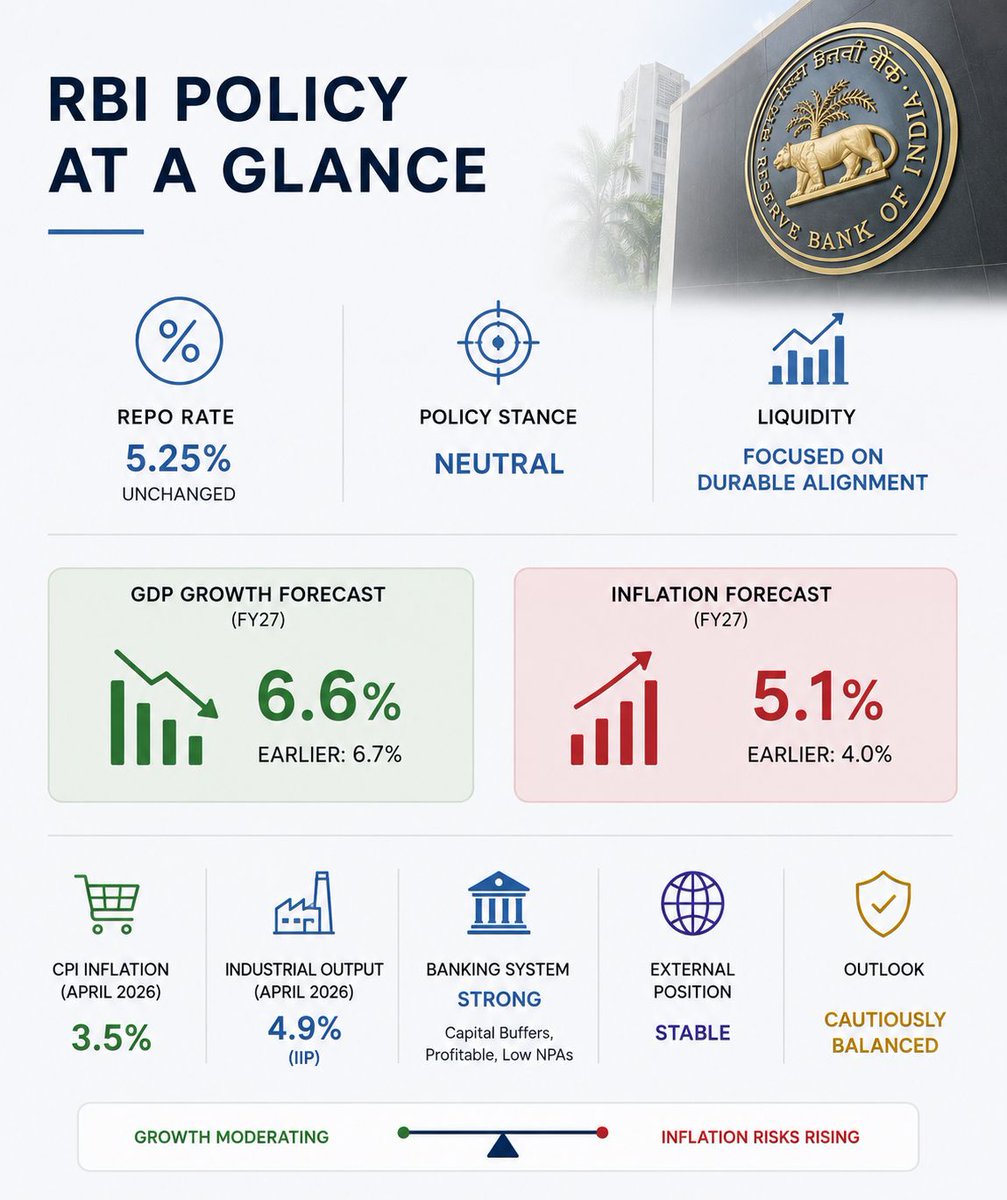
RBI policy takeaway:
No panic. But less comfort.
Repo rate unchanged at 5.25%.
Stance remains neutral.
FY27 GDP forecast: 6.6%.
FY27 CPI forecast: 5.1%.
Q3 inflation projected at 5.9%.
This is not a hard-landing signal.
It is a growth-inflation squeeze.
India’s domestic demand, services activity, credit growth and banking system remain resilient.
But the risk mix has worsened:
Higher crude
Supply-chain disruption
Food inflation risk
El Niño / monsoon uncertainty
WPI pass-through
FPI outflows
Currency volatility
The key issue is whether supply-side inflation remains temporary — or gets embedded into expectations, wages and margins.
That is why RBI is right to stay data-dependent.
Cutting too early could weaken inflation credibility.
Staying tight too long could hurt demand.
For markets, track crude, food inflation, core CPI, rupee, credit growth, PMI, government capex and corporate margins.
India is not in macro stress.
But the margin for policy error has narrowed.
India’s reported move to remove capital gains tax for FPIs in G-Secs is not just a bond-market reform.
It is a signal.
Global capital does not allocate on headline yields alone.
It compares:
Post-tax returns
FX risk
Liquidity
Policy stability
Access friction
Opportunity cost
By lowering tax friction in government securities, India is making its sovereign bond market more competitive — especially after global bond index inclusion.
This can help deepen G-Sec liquidity, improve yield-curve discovery, attract more stable foreign participation and reduce pressure on domestic balance sheets to absorb government borrowing.
The broader lesson is important:
Capital-market taxation is not only a revenue tool.
It is a competitiveness tool.
If this logic works for G-Secs, India should eventually apply the same thinking to long-term equity capital, infrastructure capital and strategic innovation funding.
India does not just need capital to fund deficits.
It needs capital to fund the future.