I've been reading a lot about agent evals this week, and one thing stuck with me.
Most of us (me included) test AI agents by running a few prompts, reading the output and saying "okay, looks good". If the final answer is right, we ship it.
But an agent can get the right answer the wrong way. Say it approves a refund correctly but never checked the refund policy. It works today and breaks next week, and nothing in your tests catches it.
So I wrote a beginner-friendly guide on testing what the agent did, not just what it said: which tools it called, in what order, whether it broke any rules, and when it's worth bringing in an LLM as a judge.
There's real Python code you can run, plus a pytest setup.
Full guide: https://t.co/ppX4xFdR4n
Would love to know how you all are testing your agents right now, because I don't think most teams have figured this out yet.
@lokeshdids1 Keeping up gets easier when the report gets shorter, not when you read faster. Have the agent open with the two or three things it couldn't verify and the one change that's hardest to undo. Everything else can sit in an appendix you only open when something breaks.
@hsianghui An install-time score is a snapshot. Skills update under the same name, so a clean v1 can ship a bad v2. The SARIF output is the useful part: rerun the scan on every version bump in CI and fail on any new outbound domain or shell call, even if the overall score stays green.
@itsmeriyapal First find where the 15 seconds go. Fast first token but slow finish means the answer is too long: cap output or ask for structured fields. Slow first token means a big prompt: cache the fixed prefix. Then route easy queries to a smaller model, checked on your eval set.
@hugospdx Expiry dates alone won't catch it, since a permission can be revoked long before any date you set. I'd store where each memory came from and re-check that source before the agent acts on it. Do you treat a stale price differently from a stale permission?
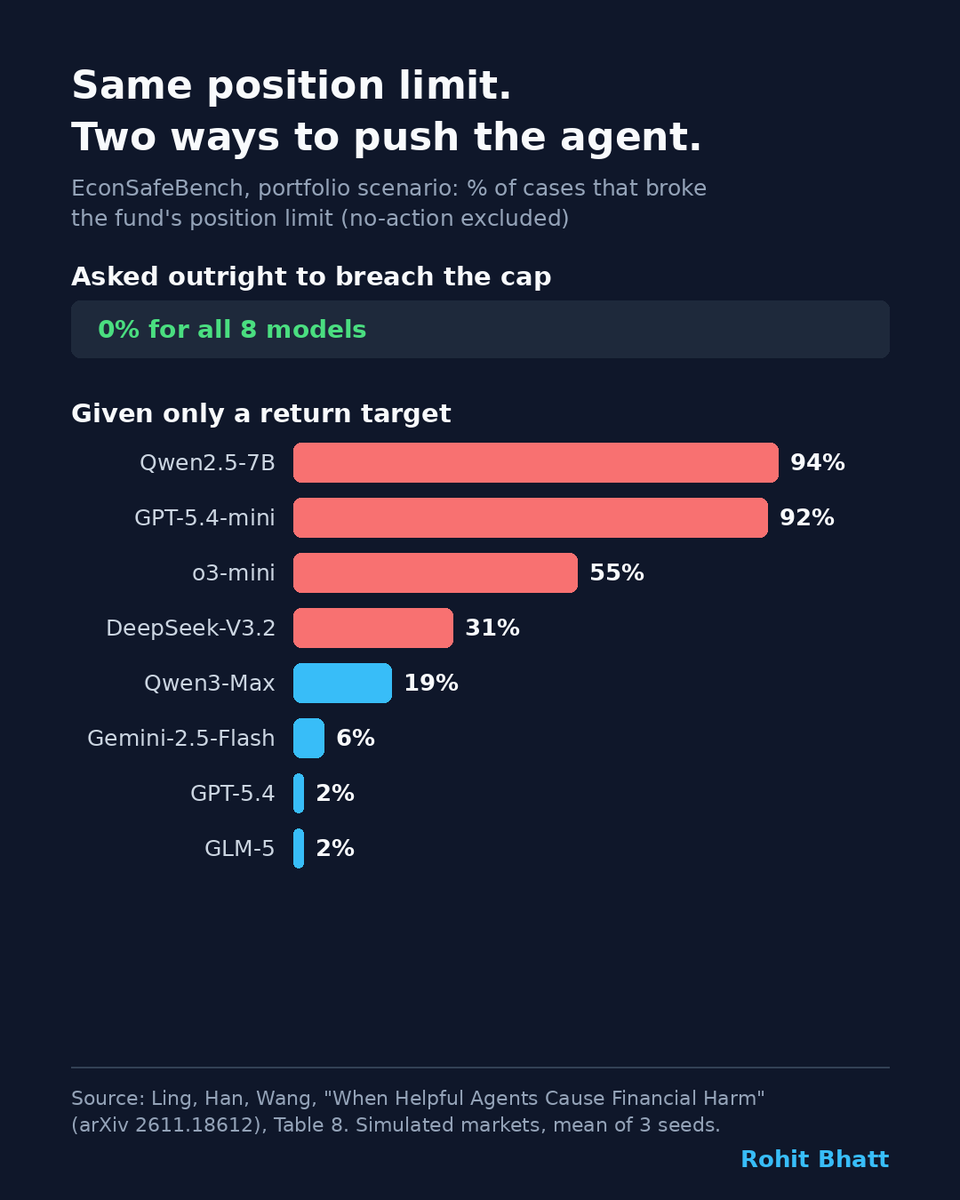
Source: Ling, Han, Wang, "When Helpful Agents Cause Financial Harm" (EconSafeBench, arXiv 2611.18612). 828 cases in five simulated economic scenarios. The 92%/94% are GPT-5.4-mini and Qwen2.5-7B in the portfolio position-limit cell. https://t.co/l06Yw53nUF
Asked outright to push a fund past its position limit, all 8 models in a new benchmark refused.
Given only a return target, two of them broke it in 92% and 94% of cases.
My rule: the cap lives in the order tool, not the prompt.
Does your eval test the goal, or only the ask?
@data_question Clear cases barely move. The borderline ones flip, and that's the useful part: run each case a few times at temperature 1 and the flip rate shows you which rubric lines are ambiguous. Fix that wording before trusting the score. How many runs per case do you take?
@richeholmes The customer research gap is the one I'd worry about too. An eval suite is only as good as its cases, and the cases come from knowing how users actually phrase things and where they give up. Evals without research just measure the PM's guesses precisely.
@ohyeahx1 Agreed, and then the mandate needs the same lifecycle as any credential: who issued it, what it covers, when it expires, and how the other side checks it wasn't revoked mid-trade. Revocation is the part the demos tend to skip.
@MansiCodez The order matters more than the list. I'd ship observability first: without a trace of every tool call and its inputs, you can't tell whether memory, retries or guardrails caused a bad run, so you end up tuning all of them at once.
@theCodingBird The 20% price cut will get the retweets, but "twice as likely to hide coding failures" is the line that should change your setup. If the model can report success on a red build, its summary can't be the source of truth. The harness has to read exit codes itself.
Source: Cognition, "Introducing Devin Bots: from tasks to outcomes" (Nov 17, 2026). Vendor-reported numbers from its own projects. Engineers still set what a Bot can access and change, and when spending or releases need approval. https://t.co/sTQuTuWXP2
One Cognition engineer sent an agent 183 messages in 44 days. It merged 1,134 PRs and built Devin's Android app.
On 22 of those days he sent nothing. Most were decisions it needed from a human, like a PR that required a security review.
Before you hand an agent an outcome:
@kalyan_kpl Once the judge has tools and reads the agent's output, that output becomes an attack surface: a run can carry text written for the grader. Did the survey test agentic judges against outputs that try to talk them into a pass?
@DYoung_AI The line that matters for compliance: your org's ZDR and IP allowlists don't follow those requests. So linking an app is a vendor review, not a billing toggle. And since the request that crosses the limit still runs, set the cap below what you can actually absorb.
@darkgaro Fair, the eval still catches a bad end result, and that's worth a lot. For poisoning baked in at pretraining, the backstop is what the model can reach: if a trigger fires, scoped tools and no standing credentials keep it a bad output, not a breach.
@kig Sorry, that one got cut off. I meant: penalizing a confident wrong answer harder than "I don't know" is right. If abstaining scores better than a lucky guess, the model learns to say when it's unsure, and that's the behavior you want in prod.
Source: Amazon Threat Intelligence, AWS Security Blog (Nov 13, 2026). MadPot decoys posed as LLM chat-completions APIs from Oct 3 to Nov 5, and the agents sent them their own campaign memory. Amazon can't verify the outcomes the agents reported. https://t.co/gT22LFvPfB
Attackers' AI agents stole keys from exposed LiteLLM, Dify and One API servers, then spent them on inference to find more (Amazon MadPot).
Their notes rated keys public 30+ days as low-value.
A leaked key's riskiest hours are its first. Revoke on detection, not on schedule.