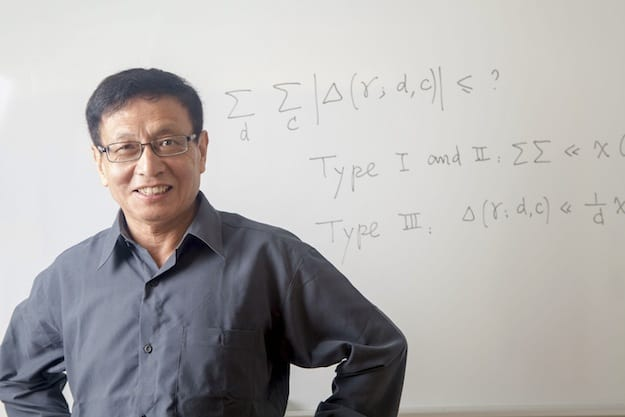
A Chinese mathematician spent 7 years making sandwiches at Subway after his PhD, and at 58 solved a 150-year-old math problem nobody thought was solvable.
His name is Yitang Zhang. The problem is called the Twin Prime Conjecture.
He was born in Shanghai in 1955 and knew he wanted to spend his life on mathematics by the time he was nine years old. That year he found his own proof of the Pythagorean theorem. Nobody taught it to him. He just worked it out.
Then the Cultural Revolution arrived and took everything.
The Chinese government closed the schools. Zhang's father had political troubles with the Communist Party, so Zhang was sent to the countryside with his mother to work in the fields. He spent 10 years as a farm laborer. No high school. No classroom. No teacher.
He read math books in the fields when he could find them.
When the revolution ended, Zhang was 23. He sat the university entrance exam and got into Peking University, one of the most competitive mathematics programs in China. He finished his bachelor's degree, then a master's. The president of Peking University personally recommended him for a full scholarship at Purdue University in the United States.
He arrived at Purdue in 1985. He earned his PhD in 1991.
Then the second wall hit.
His relationship with his doctoral advisor collapsed. The advisor did not write him letters of recommendation. Without those letters, the academic job market was closed. Zhang applied. Nothing came back. He spent the years after his PhD working as an accountant, doing delivery work, sleeping in his car during the stretches when nothing else was available.
A friend eventually opened a Subway sandwich restaurant in Kentucky and offered him a job. Zhang took it. He kept the books and made sandwiches. A man with a PhD in mathematics from Purdue, working a Subway counter because the academic world had no place for him.
He did this for seven years.
He was finally hired as a lecturer at the University of New Hampshire in 1999. Not a professor. A lecturer. The lowest rung of the academic ladder, with no research funding, no graduate students, and no institutional support. He taught calculus to undergraduates and worked on mathematics alone in whatever time was left.
Most people would have stopped believing by then.
Zhang did not stop.
The Twin Prime Conjecture is one of the oldest unsolved problems in number theory. Twin primes are pairs of prime numbers separated by exactly two: 5 and 7, 17 and 19, 41 and 43. The conjecture predicts that these pairs never stop appearing no matter how far you go along the number line. Mathematicians had believed this for over 150 years. Nobody had been able to prove it.
The deeper version of the problem asks something slightly different. Not whether twin primes are infinite, but whether there is any finite gap between prime numbers that appears infinitely often. This is called the bounded gap problem. The best mathematicians in analytic number theory had been attacking it for decades. A landmark 2005 paper by three researchers came agonizingly close and still could not close it.
Zhang worked on it alone. No collaborators. No funding. No department seminars where he could road-test his ideas. He once said he would go to a friend's house and think in the garden for hours.
In 2012, during a visit to a friend's home in Colorado, something unlocked.
He submitted his paper to the Annals of Mathematics in April 2013. The Annals is the most prestigious mathematics journal in the world. Papers sit in review for months, sometimes years. The editors read Zhang's submission and immediately knew something was different. They sent it to the leading experts in analytic number theory for review.
It was accepted in three weeks.
The paper proved that there are infinitely many pairs of prime numbers separated by a gap of less than 70 million. Not two. Not the twin prime gap specifically. But a finite gap. For the first time in history, someone had proved that prime numbers keep coming back together, that the universe of numbers never lets them drift apart forever.
Peter Sarnak, one of the most respected mathematicians at the Institute for Advanced Study, said: "He is not a fellow who had done much before. Nobody knew him. His result was spectacular."
Zhang was 58 years old.
Within a year he had the MacArthur Fellowship, the Cole Prize, the Rolf Schock Prize, and a full professorship at UC Santa Barbara. The man who spent seven years at Subway was now one of the most celebrated mathematicians alive.
He said in an interview: "I was not lucky. Maybe it is more important for a person to make himself known to the public. But that was not so easy for me."
He was not complaining. He was just being precise.
The mathematics establishment has a quiet belief that great work happens young. The Fields Medal cuts off at 40. Most mathematicians who change the field do it in their thirties. Zhang proved his most important theorem at 58, after a decade of farm labor, seven years of sandwiches, and a decade of teaching calculus to freshmen with no one watching.
He did not beat the deadline.
He proved there was no deadline to beat.
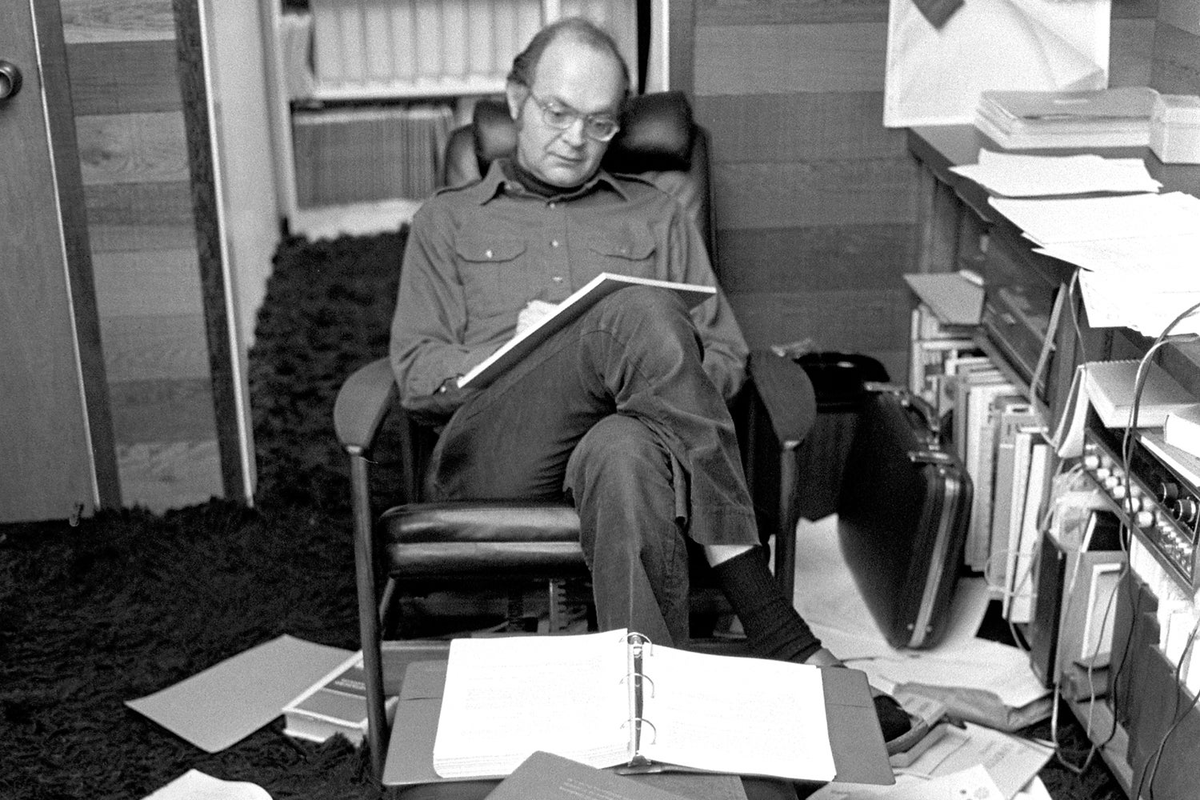
A computer scientist won the Turing Award at 36 and then walked away from almost every other project for the next 50 years to write one book that he has still not finished at age 88, and it may be the most important book in his field.
His name is Donald Knuth. He won the Turing Award in 1974, which is the closest thing computer science has to a Nobel Prize.
He was 36 years old. He had already written volumes one, two, and three of a book series called The Art of Computer Programming. He was the youngest person ever to receive the award at that point in its history.
Almost anyone else would have ridden that moment for the rest of their career. Founded a company. Sat on boards. Gone on speaking tours. Knuth did the opposite. He went back to his desk and kept writing.
He started the book in 1962. He was 24 years old. His publisher had asked him to write a short paperback on compilers. He sat down to outline it and discovered that to explain compilers properly he would have to explain the deeper algorithms underneath them first.
The short paperback became a draft outline of 12 chapters. The 12 chapters became a planned 7-volume series. The 7-volume series became the project he is still working on 63 years later.
Volume 1 came out in 1968. Volume 2 in 1969. Volume 3 in 1973. He was producing books faster than most academics produce papers. Then everything stopped.
In 1977 he received the printed proofs of the second edition of Volume 2. He looked at the pages and was so disgusted by how the publisher had typeset his mathematical notation that he could not bring himself to release the book.
The equations looked ugly. The fonts looked wrong. The spacing was off. He decided he could not in good conscience publish another volume of TAOCP until the typesetting problem was solved.
So he paused the book.
He stopped writing TAOCP and spent the next 8 years inventing TeX from scratch.
TeX is the typesetting system that every academic paper, every math textbook, every physics journal on earth now uses. Every PhD thesis in the sciences is set in TeX. Every paper on arxiv. Every equation in every paper Anthropic, OpenAI, and DeepMind have ever published. The system that the entire scientific publishing world runs on exists because one man refused to compromise on how the second edition of Volume 2 looked.
He gave the entire TeX system away for free. He never tried to commercialize it. He went back to writing TAOCP.
In 1992 he retired from Stanford at the age of 54. Most professors retire to slow down. Knuth retired to speed up. He explicitly said he was leaving teaching because he needed every remaining hour of his life to keep writing the book. He stopped using email on January 1, 1990.
He answers no calls. He takes paper mail only. He is on a personal mission to finish a multi-volume series that nobody is forcing him to write, on a deadline that only exists in his own head.
Volume 4A came out in 2011. Volume 4B in 2022. He is currently working on Volume 4C. Volumes 4D, 4E, 4F, 5, 6, and 7 are still ahead of him. He is 88 years old. He will almost certainly die before he finishes.
The thing that should haunt anyone reading this is the math of his choice.
Every modern incentive structure tells you to optimize for speed. Ship the imperfect version. Get it out the door. Iterate later. Move on to the next thing.
Knuth has spent 63 years doing the exact opposite. He pays a $2.56 reward in hexadecimal dollars to anyone who finds an error in his published books. Real checks, until check fraud made him switch to certificates of deposit. He treats every single error in every single volume as a personal failure. He revises. He rewrites. He goes back to fix issues that nobody else could have spotted.
He could have written 30 books in 63 years. He chose to write one.
The reason is the one almost nobody understands the first time they hear it. There is a category of work that loses all its value when it is done quickly.
A reference book that engineers will rely on for the next 200 years is not the same kind of object as a blog post that has to ship today. The slow project and the fast project look like the same activity from the outside. They are completely different games.
Bill Gates once said in an interview that if you can read the whole of TAOCP, you should send him your resume. He meant it. He was not joking. The man who founded Microsoft was telling the world that the rarest skill on earth is being able to finish a book that one man has spent his entire adult life writing for an audience that mostly does not have the patience to read it.
The book may never be finished.
The man writing it knows this and keeps writing anyway.
The work outlives the worker. That is the entire point.
THINGS ANIMALS KNOW THAT HUMANS DON'T:
1. Elephants can detect rain falling 150 miles away through vibrations in the ground, felt through their feet, and will begin walking toward it before any meteorological instrument registers the incoming storm.
2. Dogs can smell cancer, Parkinson's disease, epileptic seizures before they happen, and changes in blood sugar with accuracy rates that consistently outperform early-stage medical testing equipment.
3. Sharks can detect one drop of blood diluted across an Olympic swimming pool worth of water. Their electrosensory system can also detect the heartbeat of a hidden animal through solid sand.
4. Pigeons have magnetite crystals embedded in their beaks,a biological compass that allows them to navigate using the Earth's magnetic field with an accuracy that GPS navigation still cannot consistently match.
5. Crows can recognize and remember individual human faces for years. They hold grudges, pass information about specific humans to their offspring, and have been documented leaving gifts for humans who treated them kindly.
6. Bees make collective decisions democratically. When a hive needs a new home, scouts return and perform dances indicating different locations other bees evaluate and vote, and the option with the most sustained enthusiasm wins.
7. Mantis shrimps can see 16 types of color receptors compared to humans' three. They perceive colors, ultraviolet, and polarized light simultaneously experiencing a visual reality so complex humans have no framework to even imagine it.
8. Migratory birds navigate partly by seeing the Earth's magnetic field as a visual overlay on their normal vision essentially they have a built-in map projected onto their sight that humans are completely blind to.
9. Whales sing in dialects. Different populations have distinct songs that are culturally passed down, evolve over time, and change when populations come into contact with each other exactly like human language evolution.
10. Rats show measurable empathy. In experiments they consistently freed trapped companions even when doing so gave them no reward and would share food with hungry strangers before eating themselves.
11. Octopuses have neurons distributed throughout their arms each arm can taste, feel, problem-solve, and act semi-independently of the brain. They experience the world as eight semi-separate thinking entities simultaneously.
12. Elephants are among the only animals that recognize death as death. They return to the bones of deceased family members years later, handle them carefully, and display behavior that has no practical survival function only what looks like grief.
13. Dolphins have been documented teaching their young to use tools specifically placing sea sponges on their snouts to protect themselves while foraging on sharp ocean floors. This is culturally transmitted knowledge, not instinct.
14. Some species of jellyfish are biologically immortal. When stressed or aging, Turritopsis dohrnii reverts to its juvenile state and restarts its life cycle,it has no known natural lifespan limit.
15. Cats don't meow at other cats in the wild. The meow was developed specifically and exclusively as a communication tool directed at humans,they learned to talk to us in a frequency that mimics an infant's cry because it gets results.
I find it absolutely incredible that a tiny group of Jews, who up until 78 years ago were nomadic by force, homeless, and hunted to the brink of extinction, have become a global superpower that can destroy entire countries, empires, and topple regimes at will. The Jews are the most incredible story of human endurance that history has ever conjured, a story that shows us reality can transcend any imagination.
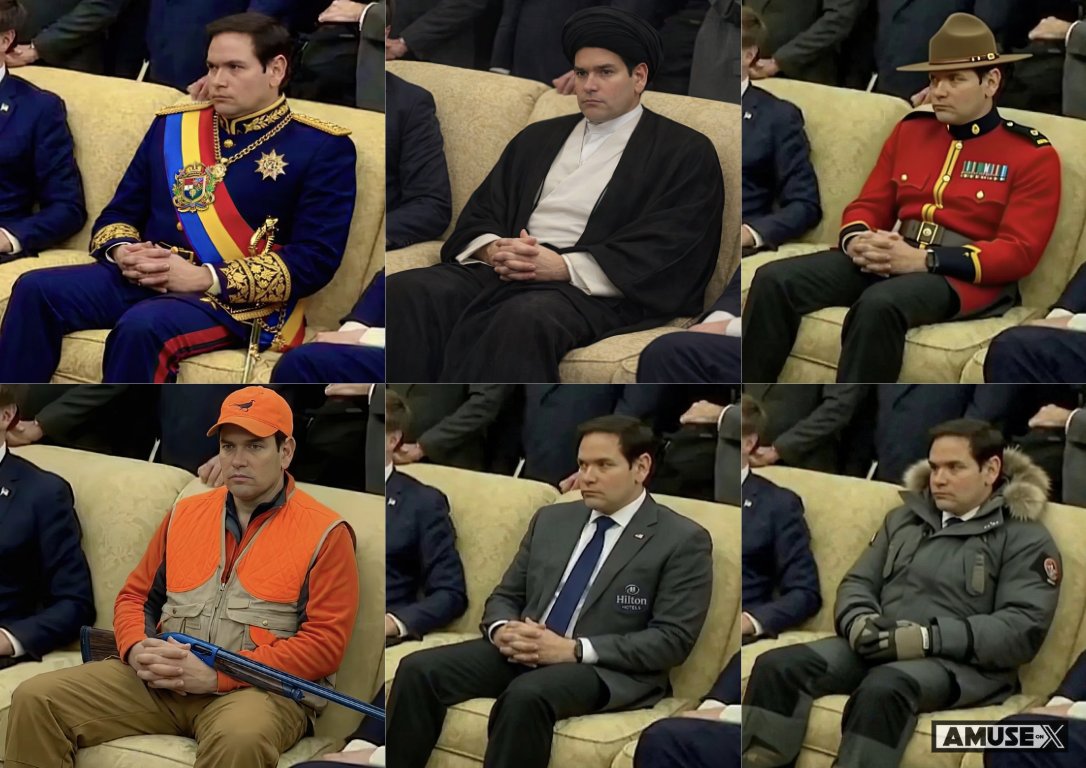
BEING MARCO: Rubio is Trump's go-to 'Acting Secretary'. Here's Marco finding out he's got to run Venezuela, Iran, Canada, Minnesota, Hilton, and Greenland... What am I missing? 🤣
Earlier this morning December 30th 2025 I crossed 10,000 consecutive miles of non rounded up actual true 100% intervention free FSD 14.2 driving in my 2025 Model 3 Premium Long Range RWD
This journey has taken me to 24 states & has done all my driving for over the last month including all parking & supercharger stops!
Verify the data today using @WholeMars FSD database leaderboard where he’s tapped in & can see all the telemetry data on my vehicle. @fsd_database
This was done even more unsupervised Robotaxi rides in Austin, TX
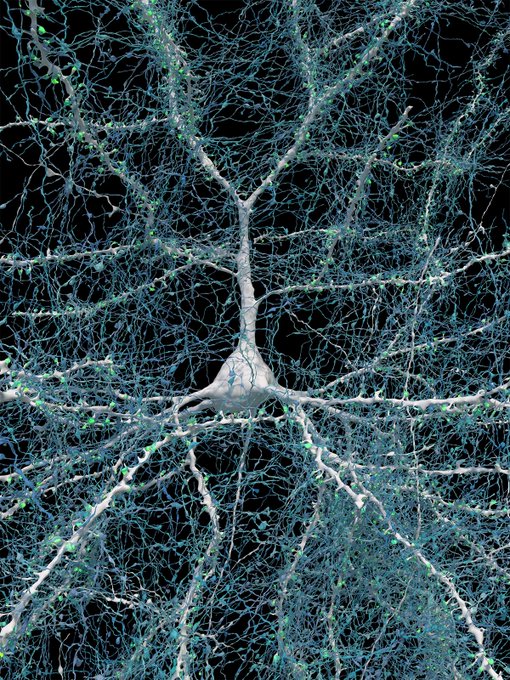
This is the most detailed view of a human brain to date.
A team of researchers used electron microscopy (EM) to image a cubic millimeter-sized piece of human brain tissue at high resolution and this is a single neuron with 5,600 of the nerve fibers that connect to it.
We are deeply saddened by the unexpected passing of Grandmaster Daniel Naroditsky. Daniel was not only a friend of the Saint Louis Chess Club, but a gifted player, educator, and beloved pillar of the chess community. His passion for the game and commitment to teaching inspired countless players around the world. He will be missed by all who knew him.
We hold his family and loved ones close to heart during this difficult time.
Rex, Jeanne and the Saint Louis Chess Campus
🧵 How Israel Caught Iran Off-Guard
The regime in Tehran bragged for years about its “intelligence,” “cyber mastery,” and “strategic depth.”
Then Israel decapitated its military in a single night.
Here's how Iran walked blindfolded into a war that could end its regime: 👇
*An Israeli analyst writes:*
Iran is a country of 90 million inhabitants, 1500 kilometers from Israel, with an area 75 times that of Israel. Despite this, within less than 72 hours, Israel has inflicted losses approaching those of the legendary Operation Focus that began the Six Day War.
- Almost air defenses destroyed
- Air Force destroyed
- A large part of the military and Revolutionary Guard commanders - including the most senior among them - eliminated
- Almost the entire Iranian air force command.
- The majority of the senior nuclear scientists.
- Half of Iran's nuclear facilities.
- Most of the government buildings in Tehran.
- Most of the missile and launchers available, which forces Iran to launch only 30 missiles at a time instead of the hundreds sent in previous waves.
- Causing severe shortage of fuel.
- Causing massive traffic jams in Tehran because the population is fleeing the city.
- Causing many people in Iran to cry out that Khamenei should be executed.
- Elimination of the allied Houthi chief of staff.
- Israel threatened that if Iran did not calm down, it would take out their ports and energy industry, a threat to which Iran has no effective response.
And all while Israel continues to fight in Gaza, Lebanon, Syria, and the West Bank.