🚨#BREAKING: Evacuations are underway in Iowa after the U.S. Army announced plans to BLOW UP 68 BARRELS of unstable lead-based explosive on Friday that could send LEAD DUST 100 MILES...
...and the people in that path were first shown the map just 5 DAYS before the blast!!!
Yes, you read that right.
Nearly 10,000 pounds of explosive will create a dust plume containing lead, and the people in its path got just five days' notice.
The explosive is called lead azide, and the Army says it has been stored there for roughly 20 YEARS.
Now families in Middletown, Iowa are being told to EVACUATE THEIR HOMES from 8 a.m. to 2 p.m. Friday because the blast could break their windows.
They can't come back until the Army gives the all-clear.
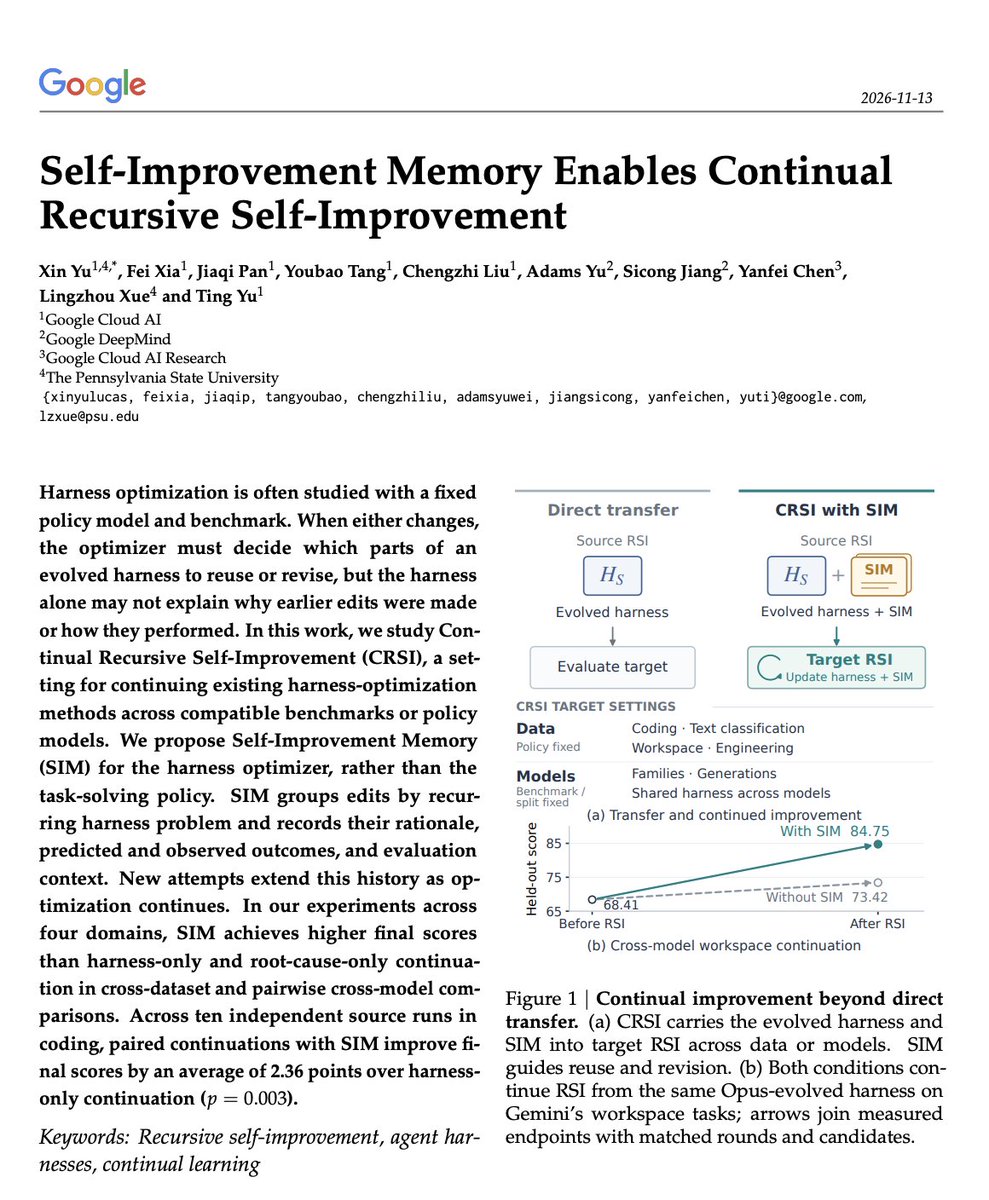
Google DeepMind just built an AI that rewrites its own code, remembers every change it made, and gets smarter every time it tries.
They’re calling it “Continual Recursive Self-Improvement”
For years, "recursive self-improvement”, the idea of an AI rewriting its own code to become exponentially smarter, hit a brick wall.
Every time an AI tried to improve itself, it suffered from catastrophic amnesia.
It would optimize for a new task, forget what worked in the last iteration, repeat past mistakes, or drift into useless loops. It couldn't compound its own intelligence.
Until now.
A new paper just introduced Self-Improvement Memory.
And it turns a static model into a perpetual learning engine.
Instead of blindly rewriting itself from scratch on every pass, the AI now maintains a structured, persistent memory of its own evolutionary history.
It logs every modification it makes. It tracks which experiments succeeded, which failed, and why.
Before making a new upgrade, it queries its own past.
The results rewrite the rules of scaling.
With Self-Improvement Memory, the AI doesn't just make one-off tweaks. It achieves continual recursive self-improvement.
Performance doesn't plateau. It compounds.
Iteration after iteration, the system builds on its own verified breakthroughs while actively avoiding the dead ends it already explored.
Nobody had to step in to guide it. Nobody had to hand-feed it new training data.
The AI literally became its own senior researcher—conducting experiments, learning from failure, and upgrading its own architecture in a closed loop.
We have spent the last decade throwing billions of dollars in compute and human data at models to make them marginally smarter.
That era is ending.
When an AI can remember how it improved yesterday, it no longer needs us to teach it tomorrow.
We built Australia’s own AI model, and today it’s open to the world.
Agentaus 1 (@AgentausTD): 220B parameters. 84.4% on MMLU-Pro. Ranked 43rd in the world.
It runs on Australian servers. Nothing ever leaves Australia, and nothing you type is used to train AI. Delete a chat and it’s gone for good.
Most of the world’s AI answers to somebody else. This one answers only to you.
Free to start: https://t.co/pkgBYQlpkZ
BRO WHAT!!!
Australia just casually dropped a 220B parameter AI model ranked 43rd in the world.
Agentaus 1 is proof that world class AI innovation isn’t limited to Silicon Valley.
84.4% on MMLU-Pro, built in Australia, and your data never trains AI.
BREAKING: A cyberattack hit 178 major organizations, including Zoom, CNN, BBC, Fox News, HSBC, Ledger, Equifax, Salesforce, IKEA and Air France-KLM, by loading malware on the Optimizely Web platform, exposing visitors to scripts built to steal payment data and exploit iOS devices, per security firm Report URI.
Banking and finance was the hardest-hit sector, with 32 organizations affected, including the UK's HSBC across multiple markets such as the US, Hong Kong, Mexico, Singapore, Australia and the UAE.
I traveled to a conference last weekend. In the wake of the FAA ground-stop yesterday, many of the conference participants now report they had been concerned about traveling, myself included.
It's not mysterious. We were all primed by recent discussion of grid down scenarios and bases needing to be self sufficient for 90 days.
Mere coincidence? Could be, but I doubt it. Suddenly shut down air travel within the U.S. and it touches many, and reaches all. We just experienced a synchronizing event that follows from a single order we can't evaluate. Let's hope my suspicion is wrong.
DeepSeek just avenged Old Huang after Anthropic’s decapitation strike by releasing its entire App stack for everyone to use and adapt freely via DeepSeek API.
Dario and Sam are now dead men walking as closed models can’t compete.
“Now, all the capabilities behind our official products can be freely accessed and combined through the DeepSeek API. We hope developers can use this to skip repetitive foundational work and build more diverse, more polished, and more imaginative products. We welcome you to use the DeepSeek API and create freely.”
🚨 DISTURBING RUMOR FROM THE DARK WEB
Before anything else, let me be absolutely clear: This is NOT a confirmed report. There is no sufficient credible evidence to support these claims, and I am NOT presenting any of this as fact.
However, after everything that happened yesterday, it’s hard not to feel concerned when scenarios like this start circulating.
I received information from an unverified source, allegedly originating from the dark web, describing a potential global cyber event supposedly scheduled for November 17.
Here’s what the message claims:
↓ BEGIN UNVERIFIED QUOTE ↓
“Everything connected to the internet will be hacked.
A so-called ‘COVID 2.0’ will begin. Major banks will be compromised, and financial records will be completely erased.
Thousands of bank accounts will suddenly display a balance of $0, with no way to recover or verify their original balances.
This will trigger a global internet lockdown.
The entire world’s internet infrastructure will allegedly be shut down for three months.
During that period, an extremely advanced artificial intelligence system will supposedly be used to identify and fix vulnerabilities and security flaws across the network.
The consequences will be widespread panic, confusion, and unprecedented global disruption.
People are being urged to stockpile food, water, gold, silver, weapons, ammunition, and cash as quickly as possible.
The alleged worldwide shutdown will begin on November 17.”
↑ END UNVERIFIED QUOTE ↑
⚠️ My perspective:
I want to emphasize once again that there is no reliable evidence confirming this scenario or the November 17 date. It could be nothing more than an elaborate conspiracy theory or deliberate fearmongering.
But considering the cybersecurity incidents and disruptions we’ve witnessed recently, it’s understandable why these kinds of rumors might make people uneasy.
I’m sharing this for discussion, not as a warning that these events will actually happen.
The question is not whether we should believe this rumor.
The question is: How vulnerable is our global digital infrastructure to a truly coordinated cyberattack?
What do you think? Is this just another internet conspiracy, or a reminder of how dependent we’ve become on systems we barely understand?
The Great Culling Of Open Source AI Models Is Upon Us.
“They” are getting their way just in time for Dario and “the great plan” to centrally control AI and and to shut down local AI.
Welcome to a new day…
Man the Deep State is doing a full coup of Jensen.
They want to ban open source and centralize everything.
Removing Jensen is how they pseudo-nationalize NVidia
We decoupled memory from the model.
Living Brain is one persistent brain for ChatGPT, Claude, Cursor, Codex and your own agents. Write in one, retrieve in any.
92.2% on LoCoMo. 464ms median retrieval. Up to 22.6x fewer tokens per question.
LLMs have parameters. Living Brain has plasticity.
🚨 BREAKING: Hackers are hitting the world's money system in 7 places at the same time.
This is what Covid looked like in week 1. A few banks. A few apps. Nobody called it a crisis.
1/ France: more than €118 million (about $133 million) was pulled out of Crédit Mutuel Arkéa over several days and turned into crypto. Today its app was down and EVERY transfer was blocked. The bank says customers lose nothing.
2/ Belgium: on October 28, the federal finance ministry said a cyberattack hit it. The online tax portal was SHUT and tax deadlines will be pushed back.
3/ Eurozone: on October 22, the European Central Bank, the bank behind the euro, confirmed that attackers planted malware on one of its websites.
4/ South Korea: at least 9 banks targeted since late September by an attacker using an AI hacking agent. At Shinhan Bank alone, about 25,000 customers had their names, phone numbers, incomes and loan limits exposed.
5/ Japan: hackers broke into GMO Internet and demanded $50 million in crypto. The prime minister promised an emergency anti-cyberattack package.
6/ At least 14 countries: China-linked hackers used AI agents to attack 200+ organisations in just 11 days. Finance was on the target list.
7/ Crypto: more than $6 billion drained from Binance hot wallets on 11 blockchains on October 29, most of it in about 30 minutes. The FBI says North Korea did it.
Now zoom out.
Hackers now send AI agents to do the work. The French money left over several days before the bank confirmed anything. Fake IDs passed the crypto exchanges' checks. About $63 million in stablecoins became 27,553 Ether in 4 hours. Part of it vanished into Monero, a coin built to hide who sends and who receives.
Covid locked the streets. This time the lock is on the bank app, and €118 million is already gone. Nobody is calling this a crisis yet. But central bankers already plan for the day the hackers get in.
The G7 agreed to run drills that simulate AI attacks on banks. The ECB gave eurozone banks until October 31 to hand in AI cyber defence plans. And last month the IMF chief warned we may end up with "lots of people with shoeboxes under their beds."
We confirm every attack on banks and exchanges before we post it. Follow for the next confirmed case, and share this with anyone whose salary lands in a bank account.
🏁 BENCHMARKED: @thewebAI's TwIL-8B, an 8.8B open-weight reasoning model, just went 69/69 on my tests running on my 64GB M5 Pro Mac mini.
The 4-bit MLX build runs at 53.8 tok/s from a 4.9 GB file.
Full bf16 with the whole 128K context fits too, peaking at 40.5 GB on a 64GB machine.
Same scores on both builds, thinking on:
✅ Math 20/20
✅ Code 10/10
✅ Instruction following 10/10
✅ Harder math 8/8
✅ Harder code 5/5
✅ Tool calls 5/5
✅ Hidden fact at 32K and 64K: 8/8
✅ Hidden fact at full 128K: 3/3 (bf16)
4-bit speed by context:
- 512: 53.8 tok/s
- 32K: 26.6 tok/s
- 128K: 9.2 tok/s at 27.9 GB peak
bf16 speed by context:
- 512: 16.7 tok/s
- 32K: 12.6 tok/s
- 128K: 6.6 tok/s
@Davidstout called it "small enough to run on your own hardware."
I checked and it runs at full precision with the whole 128K context on a desk I own.
Modest intelligence is arriving faster than most people realize.
Today, we're open-sourcing TwIL-8B.
Just 8.8 billion parameters, yet approaching frontier-model scores on several difficult benchmarks:
• 93% of frontier performance on coding
• 92% on instruction following
• 90% on contest mathematics
All from a model small enough to run on your own hardware.
But the benchmarks aren't the most important part of this announcement.
For years, the AI industry has focused on building the most capable model, regardless of the cost required to run it.
I believe that equation is changing.
The next era of AI will be defined by the cost of completing work. Not simply the intelligence of the model, but how efficiently that intelligence can accomplish the task.
If a model with 8 billion parameters can reliably complete the same work as one with hundreds of billions, why pay for the larger model?
As smaller models become more capable, intelligence becomes something we can distribute, specialize, and run across the hardware we already own.
That's the future we're building at @thewebAI
TwIL-8B is available today. Open weights.
And this is just the first of several announcements we're making today.
HF Link: https://t.co/3lrTfeLaeI