Med Student & Researcher ~ Entrepreneur ~ Writer — “A scientific approach to life” — Host of deep conversations on the “Life & Wellness Unlocked” Podcast
This is the definition of 1st principle thinking. Ignore “he said this” or “based on this theory”. How does nature operate? What limits flow in a river? How do developmental stages of organisms progress? As long as you always return to how the universal laws take place in nature, you will be able to figure out the answer to every question in science, in economics, in psychology and anything at all.
Q=ΔP/R is a sentence about plumbing. How much flow you get equals how hard you are pushing divided by how much the system resists being pushed.
Write it again and look at it differently. I=V/R is electrical current equals voltage divided by resistance. Ohm wrote this in 1827 studying electrical circuits. The hydraulic equation describes pipes and pumps. The electrical equation describes wires and batteries. They are not similar. They are the same equation with different words substituted into identical positions.
Pressure plays the role of voltage. Flow plays the role of current. Resistance plays the role of resistance, unchanged, because resistance is resistance regardless of what is moving through the system.
This is not a metaphor someone invented to make physics easier to teach. James Clerk Maxwell built large parts of electromagnetic theory by deliberately treating electrical current as if it were an incompressible fluid flowing through pipes, because the mathematics behaved identically and he trusted the mathematics more than the apparent difference between water and electricity. The analogy was not decoration. It was load bearing. Maxwell's equations exist partly because a fluid dynamics framework happened to fit perfectly into a domain that had nothing to do with fluids.
Your own cardiovascular system runs on this equation right now. Blood flow through a vessel is modeled with the Hagen Poiseuille relationship, which reduces to exactly this same structure. Flow equals pressure difference divided by vascular resistance. Cardiologists calculate resistance in your blood vessels using the same mathematical form an electrical engineer uses to calculate resistance in a circuit.
Now go further. A neuron's cell membrane is modeled as a capacitor. The Hodgkin Huxley equations that describe how a nerve impulse fires are written using the language of electrical circuits because the membrane behaves exactly like one, charging and discharging according to the same time constants that describe an RC circuit in an electronics textbook. The thought in your head right now is being generated by tissue that physics insists on describing electrically because that is what it actually is.
Then there is a separate family of laws that share a different identical structure. Coulomb's law states that the force between two charges equals a constant multiplied by the product of the charges divided by the square of the distance between them. Newton's law of gravitation states that the force between two masses equals a constant multiplied by the product of the masses divided by the square of the distance between them. Two completely different forces, one electromagnetic and one gravitational, governing completely different aspects of reality, written with the exact same inverse square architecture. Swap mass for charge and one equation becomes the other.
Nobody designed this. Coulomb and Newton were separated by roughly a century, working on phenomena that still today are not unified into a single theory. And yet reality handed both of them the same mathematical skeleton because that is apparently what force does when it radiates outward from a point source into three dimensional space. The geometry of space itself seems to be dictating the form of the law, regardless of what kind of force is obeying it.
We built separate departments for electricity, fluid mechanics, cardiology, neuroscience, and gravitational physics, and each department developed its own vocabulary, its own textbooks, its own sense of being a distinct field of study. But the equations underneath several of these fields are not distinct. They are restatements of the same small number of mathematical relationships, appearing wherever the universe needs to describe flow against resistance, or force radiating through space.
The separation was administrative. The mathematics never agreed to it.
There is a word for harm caused by the people trying to heal you.
It is the third leading cause of death in America. Behind heart disease and cancer. 250,000 people a year, killed by medical treatment, not disease.
The word is iatrogenesis. Greek. Healer plus origin. Hippocrates was already warning about it 2,400 years ago. First do no harm. He knew something most people still don’t.
Your body is not a machine waiting for instructions. It is constantly predicting its own next state and correcting itself in real time. Karl Friston built an entire framework around this. The organism’s only job is to minimize surprise.
So when a doctor intervenes, they are not adding information to a quiet object. They are dropping a signal into a system that is already running its own model of itself.
Get the signal right, the system stabilizes. Get it wrong, the system does not just fail to improve. It has to absorb a disruption it never expected.
That is why a correctly dosed drug can still injure someone. The dose was right. The body’s reaction to being acted on was the part nobody controlled.
Here is the part nobody talks about. A diagnosis is also an intervention.
“Your heart is very bad” is not a neutral sentence. The moment a doctor says it, the patient’s brain has to build a new model of their own body around those four words. The sentence does not describe a condition. It creates one.
Words are iatrogenic. They just don’t show up on a blood panel.
It scales up past the body too. An industry that profits from disease has no incentive to ever run out of disease. So it manufactures more of it. Shyness becomes a disorder. Grief becomes a chemical imbalance. Old age becomes a list of conditions to treat. Nobody planned this. It is just what happens when an institution controls the definition of the problem it gets paid to solve.
Now here is where it gets interesting. Because medicine has a second branch of ethics built specifically to stop all of this. It is called informed consent. And it has three requirements almost nobody can name.
Disclosure. You have to actually be told the truth, in language you can understand.
Capacity. You have to be able to reason through the consequences, not just hear the words.
Voluntariness. Nobody is allowed to pressure, manipulate, or coerce your decision.
That third one is the one people skip past. But it is the most important. A “yes” obtained through pressure is not consent. It is compliance wearing the costume of consent.
This is not just a medical rule. It is a description of what freedom actually requires.
Real freedom is the presence of an uncoerced will choosing without anything pulling on it from outside. The moment something is pressuring your decision, even gently, even kindly, you are no longer fully the author of it.
Hippocrates built a rule to protect the body from careless hands. The same rule, at a different scale, protects the soul from careless influence.
One law. Different size of problem.
In 1976, cognitive psychologist John Flavell introduced the term metacognition: the capacity to observe, monitor, and regulate your own thought processes from a position outside them. Neuroscience has since identified it as the highest order of human intelligence. Not memory. Not processing speed. Not problem-solving. The ability to watch your own mind as it moves and intervene before it takes you somewhere you did not choose to go.
The prefrontal cortex handles it. People with high metacognitive capacity outperform those with higher raw IQ. They catch their own errors before they compound. They know what they do not know. They are less governed by cognitive biases because they can observe the bias forming before it becomes a conclusion.
In the Bible 1 Peter 5:8 was written approximately 1,900 years earlier. "Νήψατε, γρηγορήσατε" be neptic, be watchful. The English translations render νῆψις as sobriety. This is accurate but it loses almost everything the word technically carries. In the patristic tradition nepsis is a precise term. It means watchfulness of the nous: continuous attentive observation of the movements of your own mind as they arise, before they become thoughts you have consented to, before thoughts become passions, before passions become actions.
The Neptic Fathers, Hesychios of Sinai, Evagrius Ponticus, John Climacus, spent centuries developing nepsis into a complete interior science. Hesychios wrote an entire treatise on it. The Philokalia, compiled in 1782, is over a thousand pages of practical instruction for training this one capacity. Watch the thought arise. Evaluate it before identifying with it. Reject or accept it consciously. Never be swept away by what you did not first observe.
This is metacognition with a theological anthropology underneath it.
Neuroscience describes the mechanism. The Neptic Fathers described the mechanism, the training protocol, the obstacles, the pathologies of its absence, and the transformation produced by its cultivation and located it not in the prefrontal cortex but in the nous, the deepest faculty of the human person, the one capable of direct contact with God precisely because it can stand outside itself and watch.
Western psychology named this capacity in 1976 and is still developing methods to train it. Eastern Christianity named it in the first century, systematized it by the fourth, and has been running the training program continuously ever since.
The monks of Mount Athos did not discover metacognition. They industrialized it.
I have spent the last year obsessed with a single idea; that the most important mechanisms governing life and disease are operating at a level medicine has not yet learned to see or measure. Quantum states in biology. Energy dynamics in mitochondria. The possibility that what we call physiology is the visible surface of a much deeper electromagnetic and quantum mechanical reality underneath.
The greatest lives weren’t built on hustle, they were built on alignment. Feynman didn’t grind physics because he “had to”, he loved it so much that time disappeared. Discipline flows naturally when your work aligns with your soul.
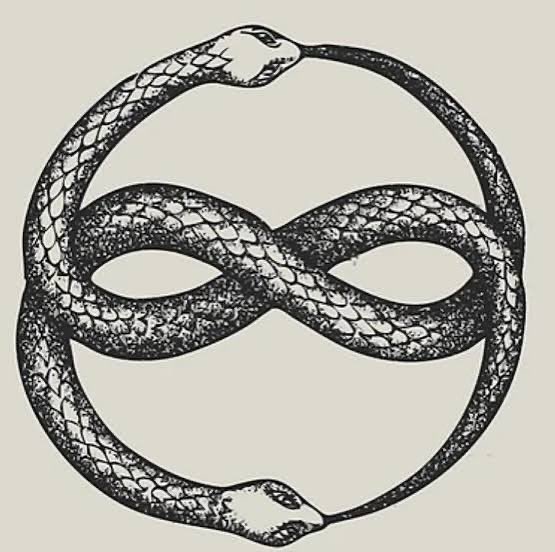
This is the Ouroboros: one of the oldest symbols in recorded human history, appearing in Egyptian tomb inscriptions from 1600 BC, in alchemical manuscripts, in Norse cosmology, in Gnostic texts. Jung took it and gave it its most precise psychological interpretation.
The symbol is a snake devouring its own tail, forming a closed loop. In this version it forms a figure eight the lemniscate, the mathematical symbol for infinity, which adds a layer of meaning about the continuous cycling between two states rather than simple circular repetition.
For Carl Jung the Ouroboros is the primary symbol of the psyche’s relationship with itself. Specifically, it represents the process by which the unconscious consumes and regenerates the conscious self. The snake eating its own tail is self-renewal through self-consumption. The end is the beginning. What is dissolved becomes the material for what is built next.
Jung connected it to the individuation process: the lifelong psychological work of integrating unconscious material into conscious awareness. You face the shadow, consume it, and are transformed by having consumed it. The thing that threatened to devour you from the outside gets brought inside and becomes fuel.
The lemniscate form suggests something more dynamic than simple circularity. Two loops in continuous exchange. Jung and later Jungians read this as the tension between opposites that drives psychological development, conscious and unconscious, masculine and feminine, ego and Self, not canceling each other but feeding each other in permanent reciprocal motion. Neither side wins. The movement between them is the point.
Jung spent years studying alchemy and concluded it was not failed proto-chemistry but projected psychology. The alchemists were unconsciously describing psychic transformation using the language of matter. The Ouroboros appeared constantly in alchemical texts as the symbol of the prima materia, the undifferentiated raw substance that had to be broken down before it could be refined into something higher. Jung read this as the unconscious itself. Formless. Self-consuming. The source of everything the psyche can eventually become.
The Ouroboros answers the question of where psychological energy comes from. It does not come from outside. The psyche feeds on itself, on its own conflicts, its own wounds, its own contradictions, and converts that consumption into growth. The things destroying you are also the things building you, if the process is conscious enough.
This is why it appears at the center of Jungian individuation theory. The self that emerges at the end of the process is made from the material of the self that was dissolved at the beginning.
Nothing is wasted. The tail always becomes the head.
The green of every forest and the red of every drop of blood are the same molecule with one atom swapped at the center.
Chlorophyll. Hemoglobin. Both built on an identical porphyrin ring; four pyrrole units connected by methine bridges into the same architectural chassis. The only structural difference at the core is the metal ion sitting inside the ring. Magnesium in chlorophyll. Iron in hemoglobin.
One atom. The entire visual distinction between plant life and animal life is downstream of it.
And the functions could not appear more different. Chlorophyll captures electromagnetic radiation from the sun and converts it into chemical energy. Hemoglobin binds oxygen and carries it through the bloodstream to every cell that needs to burn that chemical energy. They are not similar processes. But they are sequential ones.
Chlorophyll captures the sun’s energy first. Hemoglobin distributes the oxygen that allows cells to use it. Two molecules. One unbroken pipeline from sunlight to every movement your body has ever made.
The same molecular chassis. Different metal at the center. Different position in the same energy transformation.
Life did not invent separate solutions for photosynthesis and oxygen transport. Instead, It found one molecular architecture early, the porphyrin ring, and has been using it across kingdoms, across functions, across billions of years by changing what sits at its center.
The same structure appears in cytochrome c in your electron transport chain, in vitamin B12, in the enzymes that detoxify your liver. One chassis. Different metals. Different functions. The same fundamental solution applied everywhere life needed to manage electron transfer and metal coordination.
The categorical boundary between plant and animal, between the kingdom that feeds on light and the kingdom that feeds on what light built, is at the molecular level a difference of one atom in the center of an identical ring.
The deeper you go into the molecular architecture of life the more the separations dissolve. Because they are all variations on the same small set of solutions that physics and chemistry make available to organized matter.
"It is a wonderful feeling to recognize the unifying features of a complex of phenomena which, to direct observation, appear to be completely separate entities... It is a magical feeling, like seeing a face you know suddenly appear out of a crowd of strangers."
- Albert Einstein, in an early letter to Marcel Grossmann (1901)