In 2020, OSHRC (@OSHRC_Chairman) dismissed fines by OSHA (@OSHA_DOL) against @USPS because of a lack of scientific basis for commonly used heat-index thresholds. Now, @yichuan_lu shows that scientifically based heat-index thresholds match laboratory data.
https://t.co/1OlEGqRDvf
Using sampling of clouds by aircraft, we show that the supersaturation in convective clouds over the Amazon is too low (~0.2%) to generate substantial warm-phase invigoration of convection by aerosols.
https://t.co/1qeLdhIR7X
In a paper led by @yanlei_feng, we show that "death by windthrow" will be a fate of trees over a much wider area of the Amazon in the coming decades due to global warming.
https://t.co/oKWR9URvqh
The recent paper by group member Nathaniel Tarshish has been highlighted by Eos, the official news magazine of the American Geophysical Union. Congrats, Nathaniel!
https://t.co/UvyAh6R0Jj
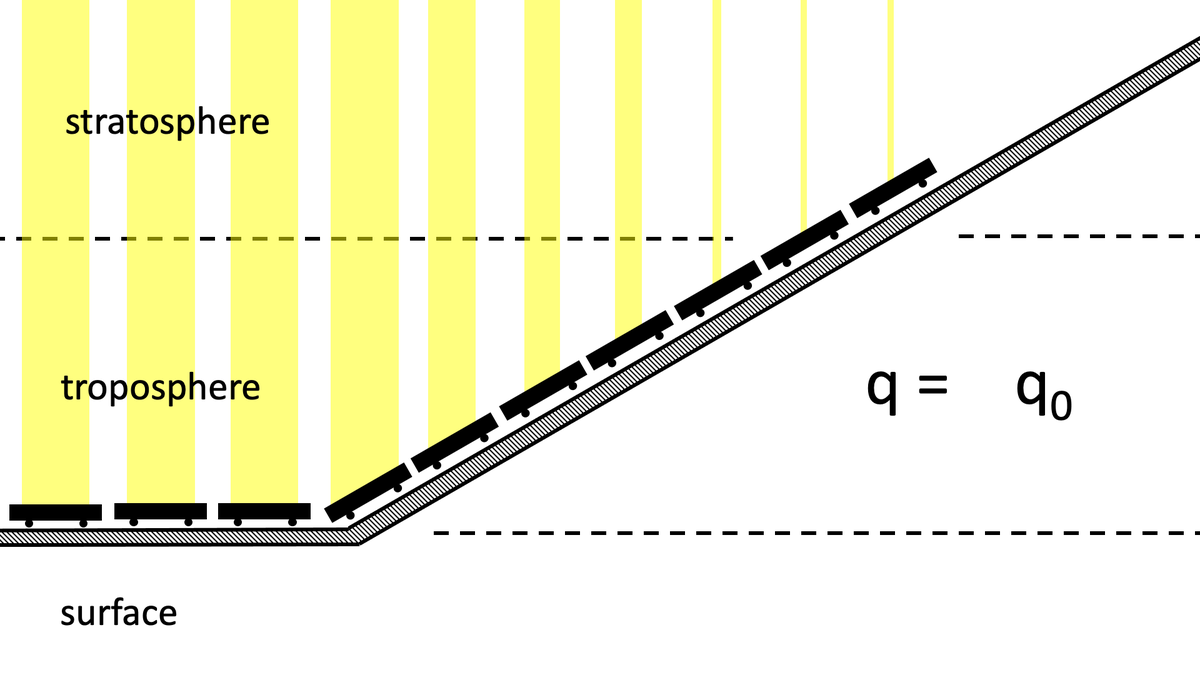
For several years now, I have described the radiative forcing from CO2 by analogy to a "train", but I never made a figure to illustrate it... until now. (1/11)
This means that the forcing (i.e., the reduction in outgoing longwave) is the same for every doubling of concentration.
Given the CO2 spectrum measured in laboratories, we can estimate this forcing using pencil and paper.
For (many) more details, see:
https://t.co/XYQ0wG827d
Ever wonder why the forcing from CO2 is a constant PER DOUBLING ?
This paper by @romps, @takes_by_jake, and @jedman42 goes through the reasons in exhaustive detail, but the short explanation is as follows... (Thread)
https://t.co/XYQ0wG827d
OK, so for each doubling, the log(p_em) interval moves lower by log(2)/2.
Therefore, every doubling effectively moves the same-sized set of wavenumbers from the warm surface to the cold stratosphere, reducing the outgoing flux of longwave radiation.
A paper led by Yixiao Zhang and @DorianAbbot, with help from Jonah Bloch-Johnson and @romps, probes the ECS bump in 51 aquaplanet simulations that are equilibrated by fixing the SST and evolving the CO2 concentration. https://t.co/IS2CL61M7R
Using stereo cameras, Rusen Oktem finds that the spacing of clouds matches the prediction by John Thuburn and Georgios Efstathiou for the spacing of the largest eddies in a convective boundary layer.
https://t.co/i3S4STLNio
The stereo cameras have returned some rich data on convection from their deployment to Argentina during the CACTI campaign . Paper by @adam_varble here: https://t.co/YnES0u1342.
Get the CACTI stereo camera data here: https://t.co/B0OVb6DP91
With implications for wildfires and nuclear winter, Nathaniel Tarshish uses direct numerical simulation to find the virtual origin of turbulent plumes. The important question is where the soot goes, and this closure makes progress towards answering that. https://t.co/weKOY8rWwj
A new paper by @romps, Oktem, Endo, and Vogelmann proposes a classification scheme for shallow cumuli and measures, using stereo cameras, the degree to which observed clouds are bubbles vs. plumes and active vs. forced. https://t.co/3iPoq6GMQy