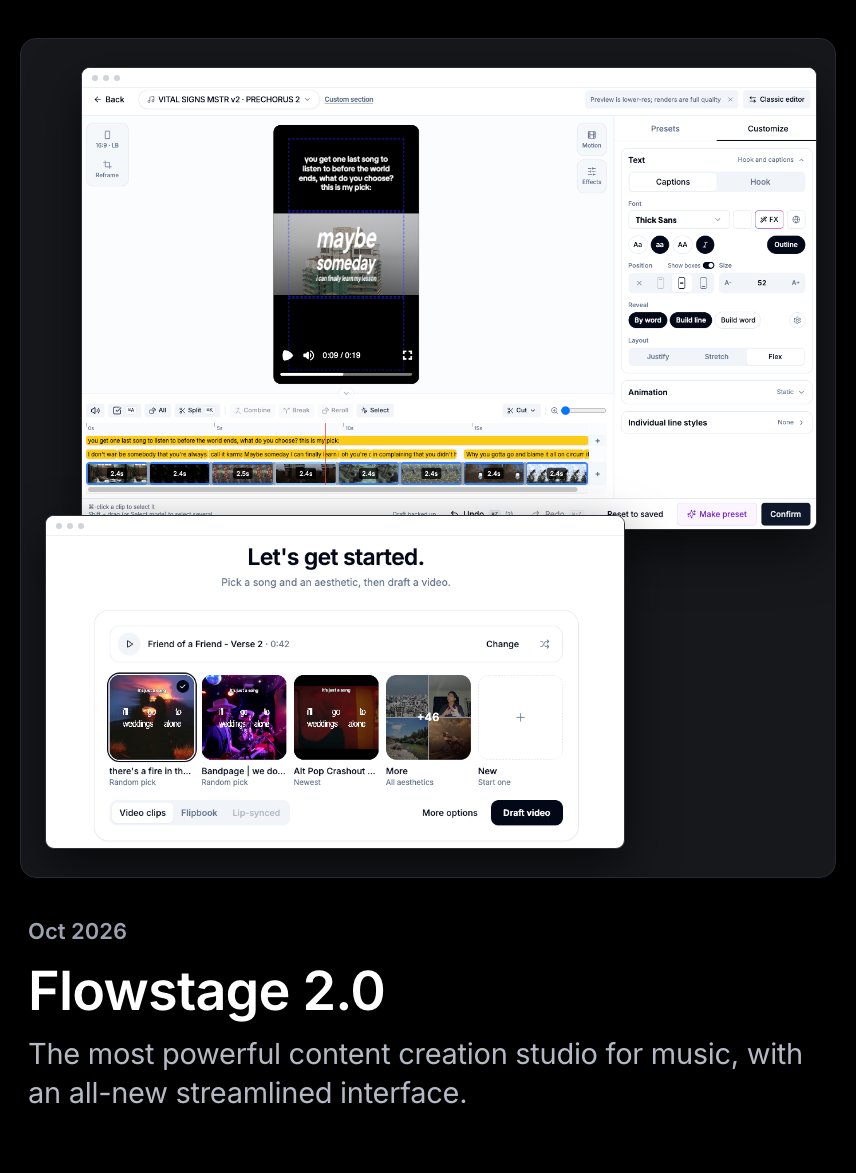
indie pop artist (AZKAL), built the video editor that got us to 500K monthly on Spotify
in my previous life I was an engineer / consultant
Penn M&T '19
Honored to participate last week in the Creator Workflow Tools panel at https://t.co/iNncrrNB0T with Jessica Powell (Audioshake), Mariami Bibilouri (Sungate Records), Christopher Milo (SoundCloud), and Nicki Shamel (TuneCore)!
As an independent artist I believe it is so absolutely vital to create with intention, no matter what tech you're using to do it; there's too much AI (and sometimes human) slop out in the market these days when promoting music, and it was awesome to have a full roundtable discussion on how artists and their teams can keep the spirit of creativity alive while still scaling up views and streams.
pov: your band has 700K monthly listeners but you started your career in tech and are chronically online
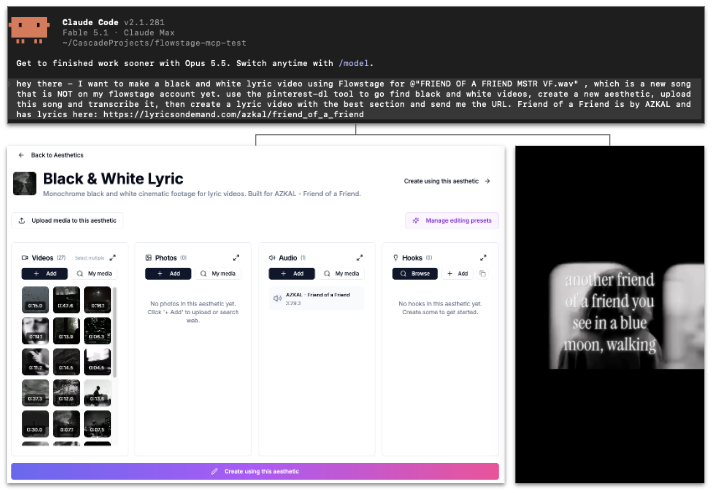
presenting the AZKAL x Flowstage x Claude motion design lyric video for Demeanor:
we made the fastest free way to make a performance lip sync video w lyrics on screen (niche I know but still)
you can do cool things like put the words behind you too
This is how to turn footage from one live show into 50 different videos for social:
1. Get your fans and friends to send you videos from the show. They don't have to be high quality. They can literally be filmed from wherever in the room.
2. Go to https://t.co/CPfHKh3KUd them to a mood board, add your song, and transcribe it automatically, word by word and line by line. That's what lets the lyric text land on the right frame later.
3. Combine the mood board with your songs to draft a bunch of edits from the clips people sent over. Each edit is a different pick of clips against a different section of the track.
USE FAST CUTS. They give the edits a montage feel instead of a phone-recording feel, and every extra cut is another combination of the same source material, so the same set of clips makes more edits!
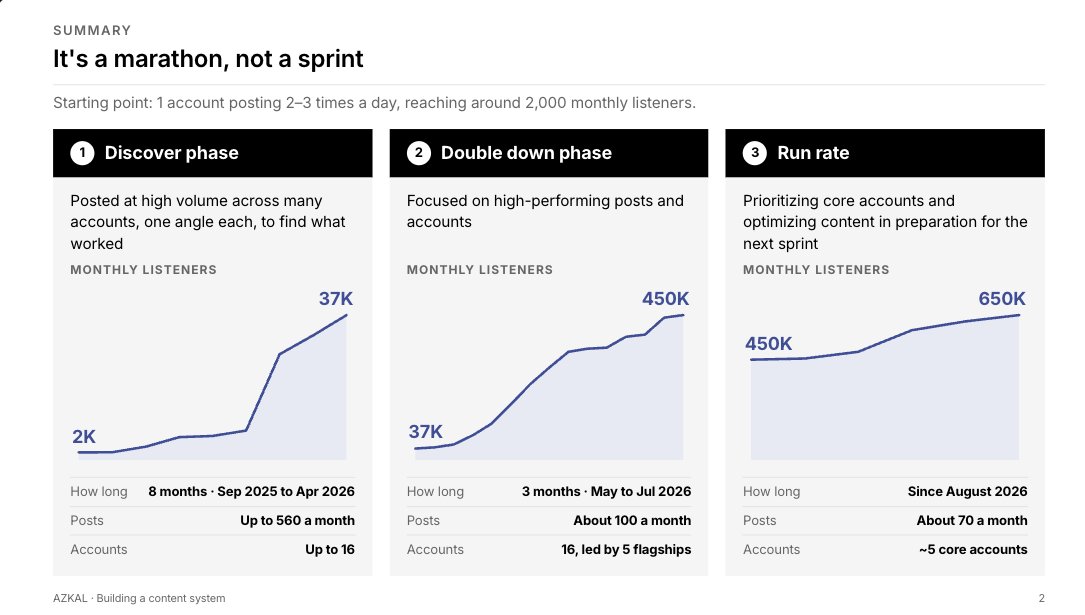
we posted over 2,000 times to grow our band from 1K monthly listeners to 500K and here's the proof (in deck form because old @bcg habits die hard)
full case study: https://t.co/ZajUZPR75s
How to run fan accounts ethically as an independent artist:
There are two kinds of fan account. Fake fan accounts: you pretend to be a fan of your own project. Works sometimes, depends on nobody finding out. Artist universe accounts: openly associated with the artist, each one shows a different angle of you.
The artist universe strategy: represent your authentic self, in pieces, while still playing by the algorithm's rules. The algorithm rewards a consistent account. You are not a consistent person. So each facet gets its own account.
Example: I'm from the Philippines, I love to run, I really like The 1975, I make high-energy indie pop and sad synth pop. None of that fits on one account without giving people whiplash. So each one is its own page.
When someone discovers one account they learn something new about you. Find a second, they learn something else. Every account is a different front door into the same artist, and none of them needs a fake persona!
This is the account strategy I would use to promote your music if I was your manager:
Step 1: write a few sentences defining who you are as an artist and a person. What kind of music you make, artists that inspire you, where you're from, your hobbies, anything that differentiates you.
Example: "I'm an indie pop artist in NYC, heavily inspired by The 1975, LANY and Walk the Moon, originally from Southeast Asia, I make music about situationships, and I really like to run."
Step 2: each sentence is an account. A 1975 fan page that mixes our music in. A Southeast Asia page that pays homage to home with our songs underneath. An NYC slice-of-life page with running content. All authentic, all world-building.
Why it works: 1. You reach communities you're already part of. 2. The angles are based on you, so the content is better and gets more engagement. 3. The algorithm rewards consistency, and mixing everything on one account confuses it. Separate accounts, separate lanes!
We took an artist from 1,000 to 500,000 monthly listeners on Spotify with no team and no label - and here are the 3 kinds of accounts we used to do it!
1. The artist main page. Your name, your face, your brand. It tells anyone who lands on it that you're an artist and shows off all your new music. Keep the bar highest here: more produced, more performance oriented, posts less often.
2. Lyric pages. Nothing but lyric videos, no face required. Post different sections of the same song and the numbers tell you which chorus or verse people actually stop for. That's the section you promote everywhere else. Same visual style on every post so the song gets a look.
3. The b-roll page. Everybody sleeps on this one. Scenes of you living your life with your music in the background, sometimes a wall-of-text hook on top. Lowest effort of the three and it's the one that turns a listener into a fan, because they get to see you behind the scenes.
Why split them: a polished performance, a lyric visualizer and a clip of you getting coffee don't belong in one grid, and the algorithm agrees. Give each job its own account, keep each one consistent, and they start feeding each other!
every artist needs a second TikTok account to test your music on
main account should focus on brand, high-performing songs and sections to keep it algorithmically strong and healthy
burner account tests new music, songs, winners get put onto main with zero downside
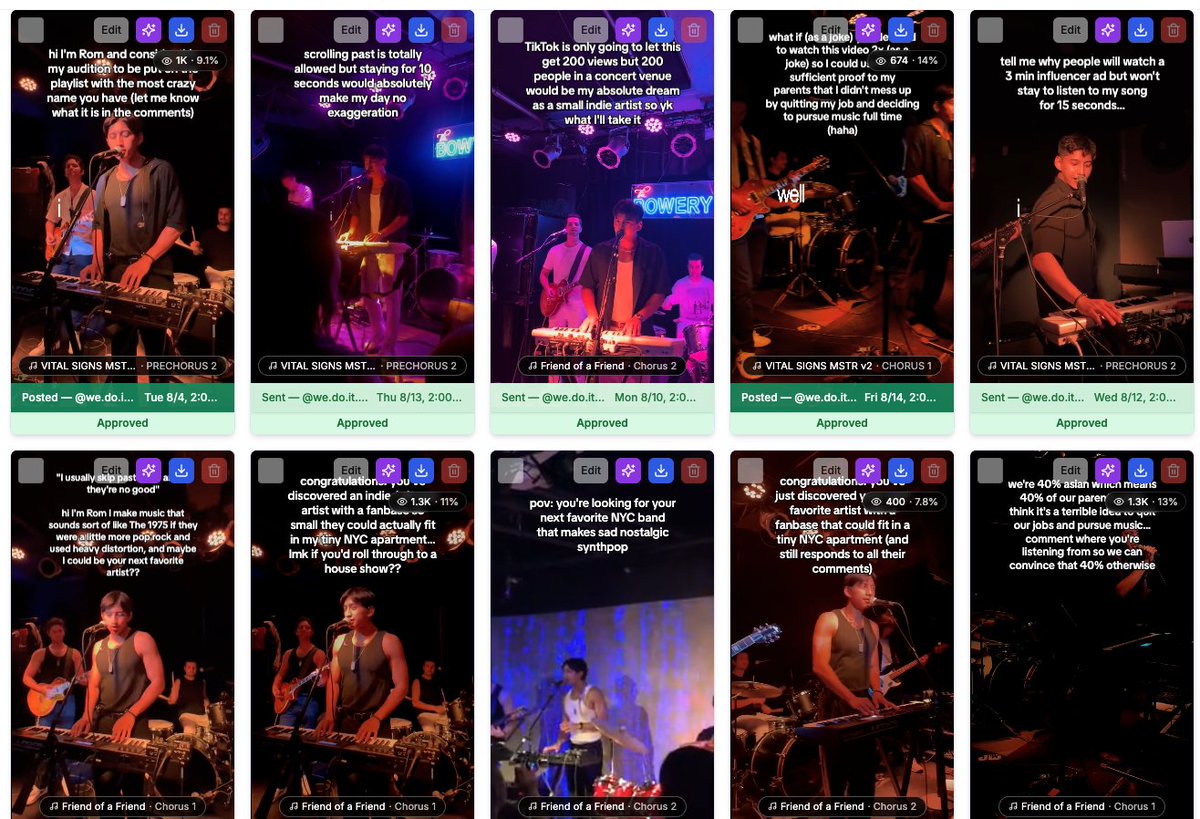
@krunkkidd I posted over a thousand TikToks last year, even more than that this year and it took me from 1000 -> 500K on Spotify - it sucked but it was totally worth it
We took an artist from 1k to 100k monthly listeners with a two-step framework simple enough to explain in under a minute:
Phase 1, discover: figure out what content angles, songs and sections work for you. It's all about hypothesis testing.
For example, 1) our artist makes music like The 1975, and The 1975 is huge in Southeast Asia, so this artist might be too 2) our artist makes high-energy music with distortion, and artists in that lane do a lot of anime lyric edits, we might want to make edits like that too!
Phase 2, double down: take what worked and put a lot more time and money into it. Replicate the content styles that worked across accounts, and use your top creative to run paid ads.
btw you get way better cost per click (CPC / CPR) when the creative was tested on social first!
The two types of content you need to know as an independent artist:
Almost every music post sits on a spectrum from audio-centric to visual-centric, and each end trades reach for conversion.
Audio-centric: anything that makes the viewer focus on the audio. Lip syncs, lyric videos. Higher conversion to streaming and to fan, because people are actually listening. Lower reach if nobody knows the song yet.
Visual-centric: the music is in the background. A meme with your song under it. Huge reach, because people watch it for the meme. And then they overlook the song, because it has no connection to what's on screen. That's why memes with your music don't always work like you think.
You want the middle. Pair a song with no cultural capital yet with a tv show that has cultural capital in your audience and fits the song. Situationship song → Heated Rivalry. High-energy alt pop → anime.
btw the best way to do this is to already be a fan. When we do artist strategy at Flowstage we start with a list: artists you're inspired by, shows you like, movies you love. BE AUTHENTIC
If you have under 10,000 monthly listeners, this is why you probably shouldn't copy your favorite artist's marketing...
There are three stages of content as an independent artist: 1) person, 2) public figure, 3) myth.
Person stage: the audience cares about two things. That you're an actual human, and getting to connect with your music emotionally. So the content is music-forward: b-roll with the song underneath, lip syncs, lyric videos - they have to care about the music first.
Public figure stage: people already know your music and respect you as an artist. Now the story behind the song, the production process, early demos all land, because the music has the cultural capital to build an aura around it.
Myth stage: the biggest artists in the world. They can do literally anything and it'll go viral. The attention is self-sustaining. People talk about them when they're not in the room.
Most of your favorite artists are public figures or myths. Copying them means making stage-three content for a stage-one audience. It costs a lot of time and money, it won't do well, and that's how people burn out on social media. Make the content for the stage you're in!
@TayeOlusola all artists should be thinking in systems - don't just watch a TikTok or a Reel and decide that's the strategy you're going to pivot to, think about how it fits into your broader music marketing engine!