Watch: A 7-year-old girl starts drowning while bathing in the sea at Daman. Lifeguard Sujal Mangela, present at the spot, quickly rescues her and brings her safely out of the water.
'HANUMAN ANSH' IS REWRITING THE RECORD BOOKS – 7275% JUMP ON *FOURTH FRIDAY*...
⭐ Day 1: ₹ 8 lacs
⭐ Day 22: ₹ 5.90 cr
#HanumanAnsh jumps 7275% on Day 22 [vis-à-vis Day 1] – the kind of growth that is UNHEARD OF and UNIMAGINABLE in today's times.
The show count has also MULTIPLIED across #India...
⭐ Week 1 - Friday: 276 shows
⭐ Week 4 - Friday: 850 shows
The fourth Friday business, frankly, is an EYE-OPENER... The power of content... The power of word of mouth.
⭐ #HanumanAnsh [Week 4] Fri 5.90 cr. Total: ₹ 17.60 cr.
Official Nett BOC | #India biz | #Boxoffice
A stunning view of the iconic Bagrakote Loop Bridge 🇮🇳✨
Inaugurated on April 24, 2025, this remarkable engineering marvel on NH-717A winds through the Himalayan landscape, providing an important alternative route towards Sikkim.
📍 Bagrakote, West Bengal | NH-717A
If you are one of those BJP supporters, who sometimes feel that @narendramodi govt didn't do much apart from a few big ticket things like 370 or CAA, I strongly recommend you listen to NaMo when he addresses forums like the one he is addressing at the moment. He tells you things you take for granted; things you have forgotten about; things you never knew. He reminds you about the pre-2014 situation, & then he tells you the phenomenal transformation his govt has brought about.
PM @narendramodi: We are changing the philosophy of regulations. Earlier the approach was prohibited unless permitted. We are taking it towards permitted unless explicitly prohibited.
This is true. Whenever I hear the stories of an expressway being complete trash with potholes everywhere, and when I drive on them, it’s at best 2% part of the journey. And rest of it’s fine & usually a good experience. Of course one should aspire for 100% compliance, but negative hype is a bit much. Read:
I looked at these numbers yesterday.
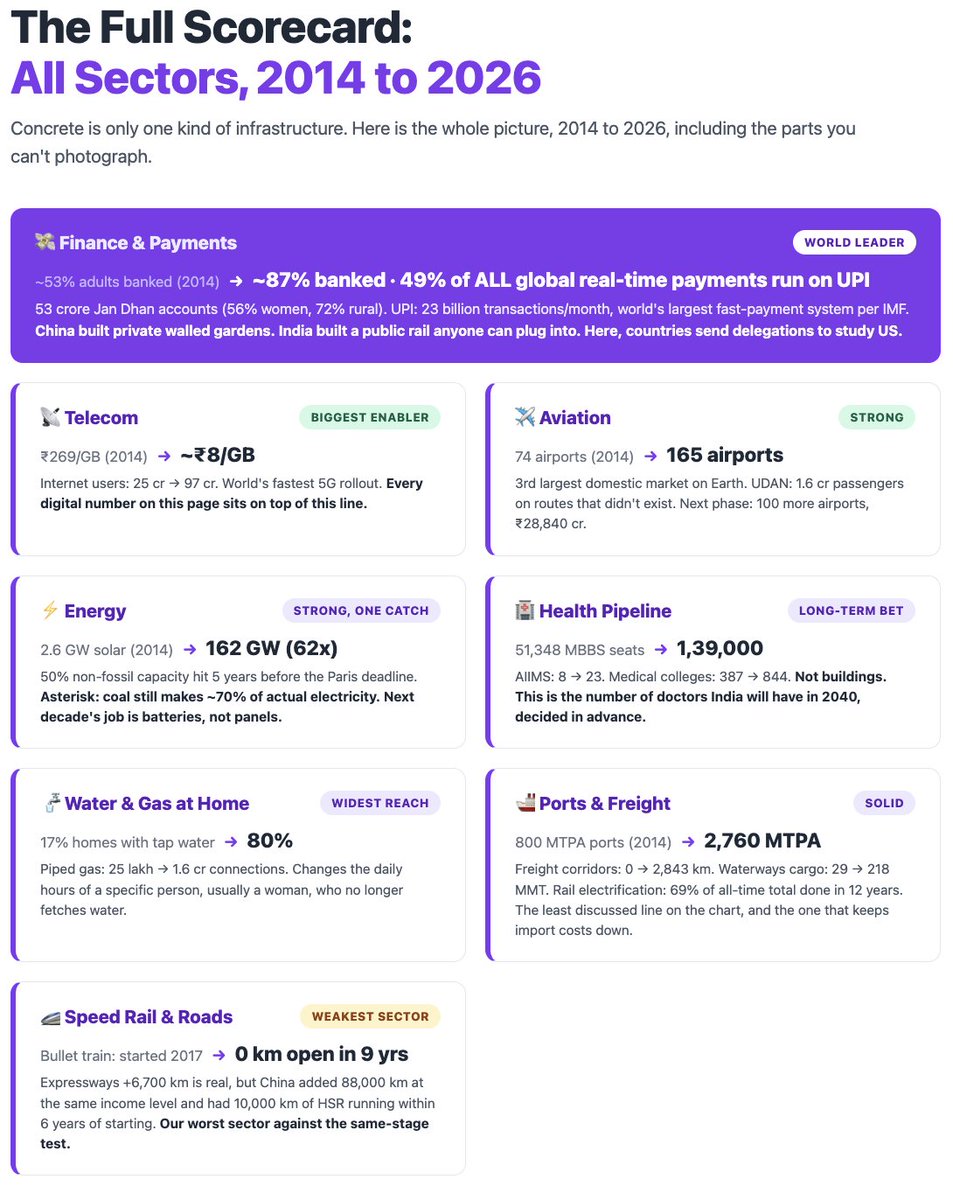
They are genuinely impressive. 85% of our expressways, 75% of our metro, all in twelve years.
Then I wanted to dig one level deeper, so I put the chart next to China.
I know, every time someone compares India with China, half the replies say it is unfair, different system, different scale, thirty year head start.
And yes if you compare with China today, the comparison is useless.
But any study is only as good as its benchmark.
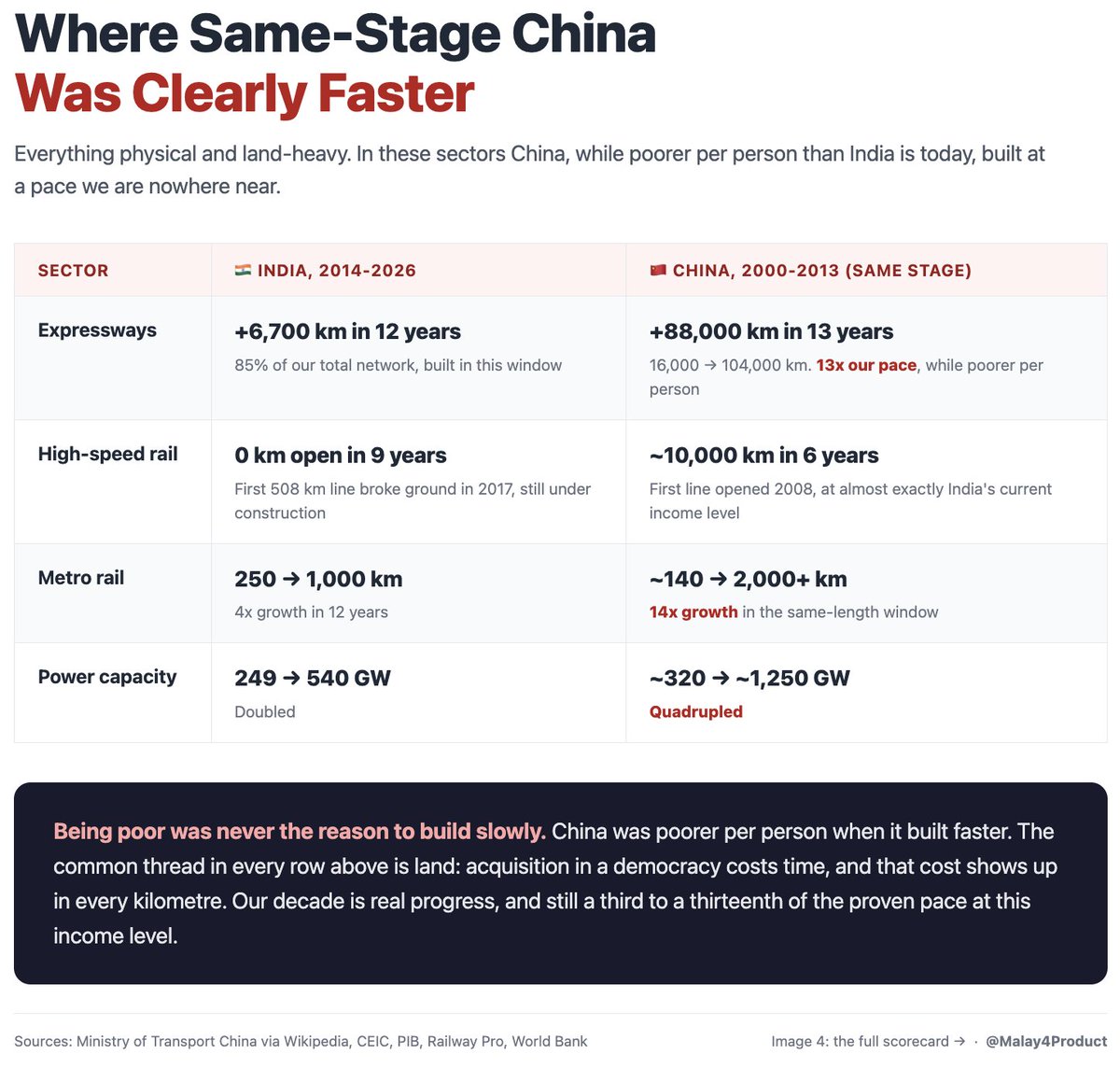
You cannot judge a build decade in a vacuum. So I did the comparison with China from 2000 to 2013, when their per capita income was where ours is now.
They crossed today's Indian income level around 2007. Their 2000s are our 2014 to 2026.
If you analyse it like that, the answer splits cleanly in two.
They were faster on physical work. Much, much faster.
Expressways.
China went from 16,000 km to 104,000 km in that window. They added 88,000 km. We added about 6,700. One thirteenth of their pace, at the same income level.
High speed rail.
China opened its first line in 2008, at almost exactly our current income. Six years later, around 10,000 km were running. We broke ground in 2017 and nine years on, our first 508 km is still not open.
Metro.
They went from about 140 km to over 2,000. We went from 250 to 1,000.
Power.
They roughly quadrupled capacity, from about 320 GW to about 1,250. We doubled, 249 to 540.
Anyone who calls our pace world‑beating should consider those numbers for a more honest picture.
But here is the other half, and the comparison flips completely.
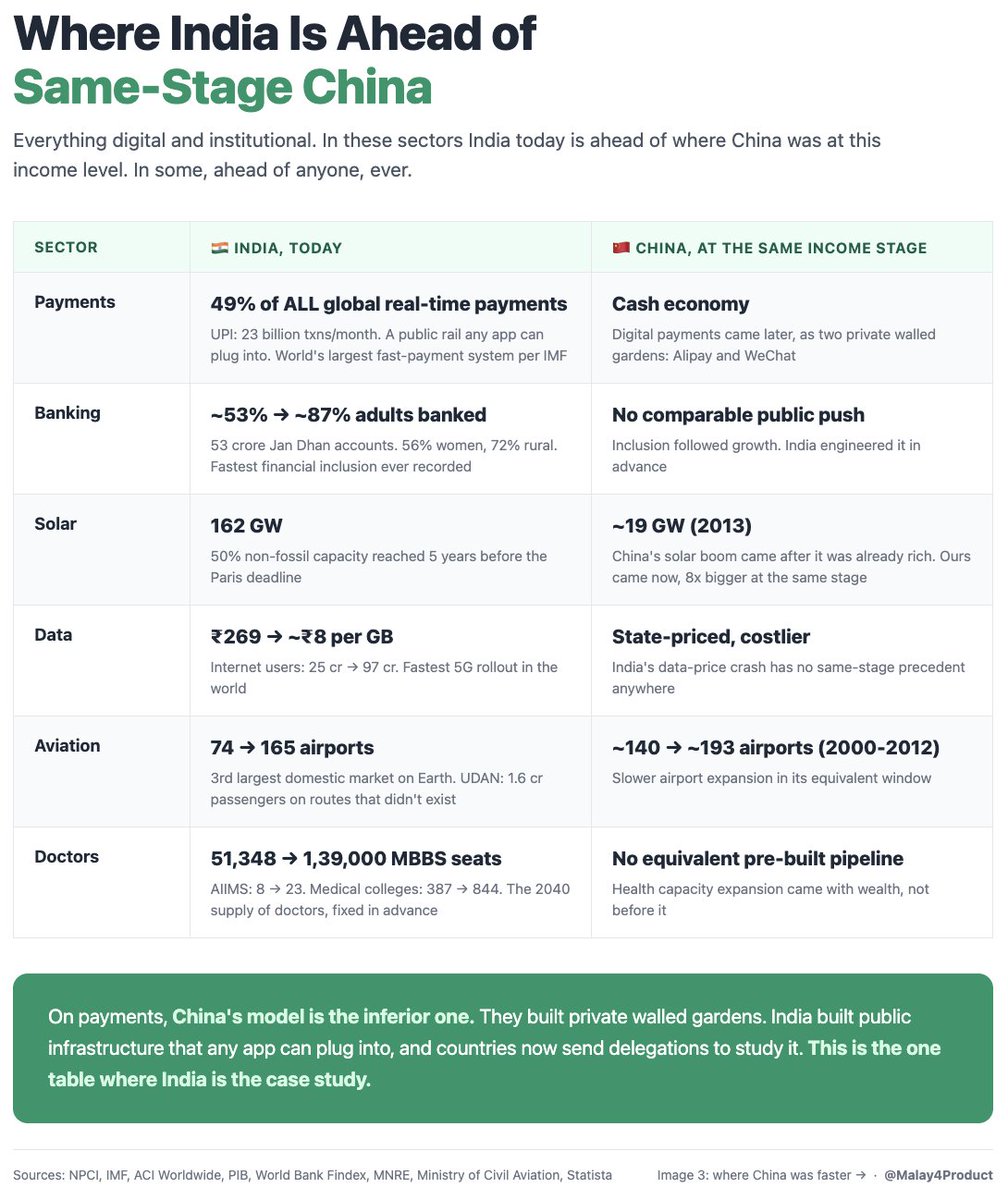
Where the work was digital or institutional, we are ahead of same-stage China.
In some places, ahead of anyone ever.
Solar.
When China was at our income in 2013, it had about 19 GW of solar. We have 162. Eight times more, and we hit 50% non-fossil capacity five years before our Paris deadline. Their clean energy boom came after they got rich. Ours came now.
Payments.
China at our stage was a cash economy, and when digital payments arrived there, they arrived as two private walled gardens, Alipay and WeChat.
We built a public rail any app can plug into. UPI runs 23 billion transactions a month, which is 49% of every real time digital payment on the planet. The IMF calls it the world's largest fast payment system. On this one, delegations come to study us.
Banking.
Around 53% of our adults had a bank account in 2014. Around 87% now. 53 crore Jan Dhan accounts, most held by women, most rural. Nobody has moved that many people into formal finance that fast, at any income level.
Data.
₹269 per GB in 2014 to about ₹8 now. Internet users from 25 crore to 97 crore. Fastest 5G rollout anywhere.
Aviation.
74 airports to 165, third biggest domestic market in the world. Holds up against anyone's decade.
And the doctor pipeline.
AIIMS from 8 to 23. Medical colleges 387 to 844. MBBS seats 51,000 to 1.39 lakh. That is the number of doctors India will have in 2040.
If you step back, the pattern is hard to miss.
Wherever the job needed land, we were slow. Land acquisition in a democracy costs time, and it shows in every kilometre.
Wherever the job was digital or institutional, we moved faster than China ever did at this income.
We are not building the way China built. We are building a different stack in a different order. Digital first, concrete second. They did the reverse.
The 2040s will answer which order turns out better.
Don’t worry. As you grow old, your friend circle will shrink.
The current circle of 15 close friends will shrink to 3-4 friends who you will meet once a month.
Anyone who leaves the geographical location will automatically be kicked out of the friendship
By the time you are 30, you will hardly have a close friend
So go ahead and break friendship for the sake of political pov. That friendship you hold dear isn’t that strong anyways
For most of our lives, we are measured by ordinary questions.
How much do you earn? How much have you saved? What car do you drive? What is your company's valuation? Where did you spend your vacation? Which restaurants you eat in?
But every once in a while, you come across people who have quietly stopped playing that game.
They choose to wager their youth, their careers, their savings, and often their peace of mind on an idea that appears absurd to everyone else. They are drawn not by certainty, but by possibility. Their ambitions are so disproportionate to the odds that failure is almost the expected outcome.
Engineers who attempt moonshots belong to this rare tribe.
Today's Skyroot launch is one of those moments.
#WATCH | Sriharikota, Andhra Pradesh: On the launch of India's first privately developed orbital-class rocket, Vikram-1, by Skyroot Aerospace, Pawan Kumar Chandana, CEO and Founder of Skyroot Aerospace, says, "... This is the first time that a private company in India has built the rocket, brought the launch pad, and taken off... It is a very important moment for the global space sector... We are proud that we were able to do this. A team with an average age of just 28 years has built India's first private orbital rocket... The rocket is completely built with carbon composite..."












![taran_adarsh's tweet photo. 'HANUMAN ANSH' IS REWRITING THE RECORD BOOKS – 7275% JUMP ON *FOURTH FRIDAY*...
⭐ Day 1: ₹ 8 lacs
⭐ Day 22: ₹ 5.90 cr
#HanumanAnsh jumps 7275% on Day 22 [vis-à-vis Day 1] – the kind of growth that is UNHEARD OF and UNIMAGINABLE in today's times.
The show count has also MULTIPLIED across #India...
⭐ Week 1 - Friday: 276 shows
⭐ Week 4 - Friday: 850 shows
The fourth Friday business, frankly, is an EYE-OPENER... The power of content... The power of word of mouth.
⭐ #HanumanAnsh [Week 4] Fri 5.90 cr. Total: ₹ 17.60 cr.
Official Nett BOC | #India biz | #Boxoffice](https://pbs.twimg.com/media/HQ4EinBboAADlAx.jpg)