Crypto media is so deceptive: DFINITY/ICP are censored as usual, probably because our technology threatens vested interests. The industry desperately needs fresh blood to move forwards.
See: https://t.co/Je63kKsRPa
See: https://t.co/cghAgEGyIj
A growing number of enterprises are waiting for ICP cloud engines. This summer, we'll start distributing promo codes for creating engines that run for 2 weeks for free, over Internet Computer nodes. Fluid sovereign onchain apps with AI inside = create, experience, want forever...
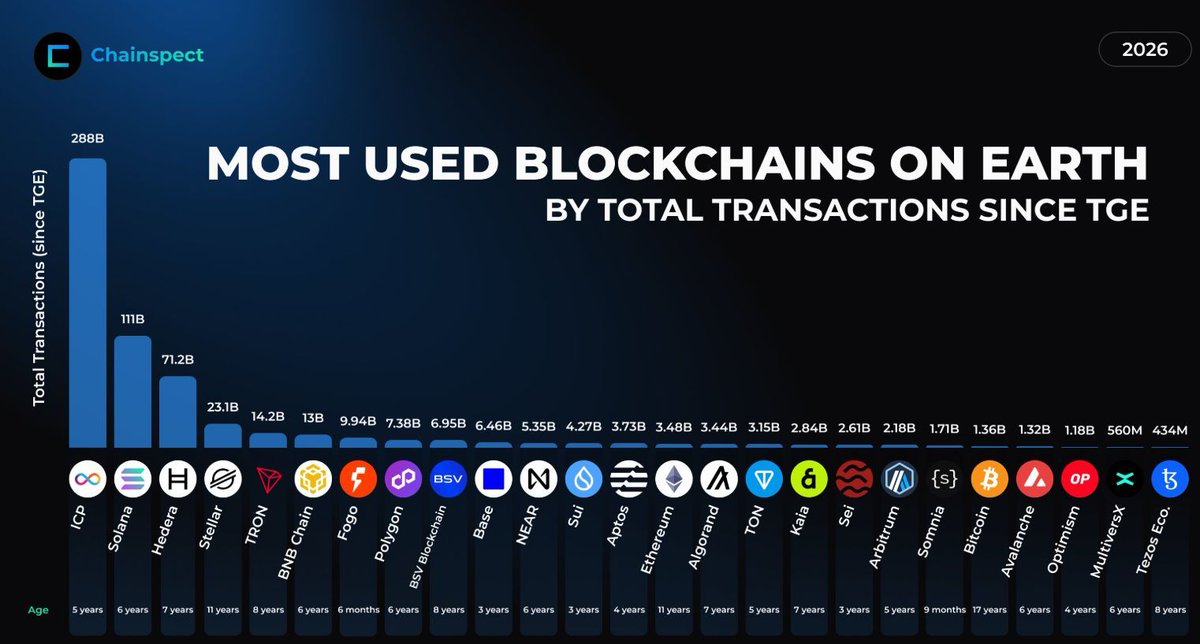
🚨WOW $ICP MOST USED BLOCKCHAIN BY A LANDSLIDE!
Most used blockchains on Earth by total transactions:
🥇 $ICP
🥈 $SOL
🥉 $HBAR
4️⃣ $XLM
5️⃣ $TRX
We cover 4 of this top 5, as we're focused on networks processing billions of real transactions, that are driving the world forward!
Soon I will demonstrate how AI can be "inside" an arbitrary ICP app, service or website built using the latest Motoko, understanding all its data, analysing it any way you want, and taking actions, without need for one special line of code. Insane and groundbreaking.
🌍 The blockchains the world actually uses
Billions upon billions of transactions later, these networks keep powering nonstop on-chain activity
Chainspect ranks the 25 busiest chains by total transactions, revealing where real users live
📊 https://t.co/TWeJJ1f0GY
Nearly every solopreneur, startup, SME, enterprise or government department, will want to become an agentic organization (or "cybernetic org").
They will be vastly smarter, faster and more efficient.
Internet Computer Protocol (ICP) helps enable this brave future. But how? 🧵
The only sovereign cloud privacy technology that can defeat the universal "computer embedded within the motherboard" backdoors is ICP vetKeys
https://t.co/BXmLPF1q8Y
Dear ICP community, the Internet Computer has now been running strong for 5 years 👏👏👏
Here is a celebratory preview of ICP "cloud engines," the sovereign frontier cloud technology the network shall soon provide from https://t.co/D5Dfj44BmO.
Main points:
— Cloud engines enable anyone to spin up their own sovereign frontier cloud. The technology involves an extraordinary inventive step, in which cloud is created from a mathematically secure network of nodes. The nodes run as part of the Internet Computer network (https://t.co/ptsshOm9nj) but are selected and configured by the cloud engine's owner.
— The frontier cloud provided by engines is strongly focused on enabling AI agents to build and update online applications and services for us. The world is changing fast, and nearly all new online apps and services are already being built with the help of AI, and thus cloud engines target the future of cloud.
— Software hosted on cloud engines is tamperproof, which means that it is immune to infrastructure hacks, because it runs inside a mathematically secure network protocol, rather than on computers directly. This means that AI agents, and those building with them, don't need to have a security team in the loop, or to trust someone else's security team. This is crucial, because in the future, non technical people will demand the freedom to build with full automation — where they just need to issue instructions to AI about what to build, and don't need to worry about anything or anyone else. Of course, apps and services running on engines are also vastly safer from the new breed of hacker being enabled by frontier AI.
(The cloud engines themselves are also "tamperproof." Even if a hacker gains physical access to some portion of a cloud engine's nodes, and can make arbitrary changes, the computations and data of the hosted apps and services cannot be corrupted or interrupted so long as the network's fault bounds aren't exceeded. The recent hack of Vercel, a major cloud platform, which gave hackers access to the apps it hosted, provides additional perspective on the importance of this advantage.)
— Software hosted on cloud engines is guaranteed to run, so long as a sufficient number of the engine's nodes are running. This means that AI can build applications and services without the need to have a human systems admin team constantly tinkering with the underlying platform to keep it running, which is again crucial, because in the future, non technical people will expect the freedom to use AI to build without the support of others.
— New frontier programming language technology, in the form of the Motoko language developed by Caffeine Labs, leverages seminal "orthogonal persistence" technology that unifies program logic and data to deliver further unlocks for AI (Motoko is the first computer language being developed that targets agents that are writing software rather than humans engineers per se). Nowadays, AI can build and update production apps at a prodigious rate, even at the speed of conversation. But it can also make mistakes, and there's a risk that an update it creates might be "lossy" in the sense it causes some transformed data to be lost. Again, in this new world, it's both undesirable and impractical for everyone to have to have a systems admin team on-hand to detect lossy updates and roll them back, but Motoko provides a solution: it can detect new software updates are lossy before they are applied, reducing potentially catastrophic errors by AI to harmless coding retries.
— Software hosted on cloud engines is "serverless" but unlike traditional serverless software, directly it directly incorporates data through "orthogonal persistence." Another key purpose is simplify backend software logic and fuel the modeling power of AI by increasing abstraction (sorry for the technical language!!!). Put simply, this enables AI to produce more sophisticated backends, faster, and at dramatically lower costs, as measured by the number AI API tokens consumed during coding. (Tip for the technical: orthogonal persistence is a new paradigm where "the program is the database," and data lives inside program variables, which is possible because it's as if hosted software runs forever in persistent memory).
— An expanding database of skills at https://t.co/lloVYiGYs8 shall make it possible to develop and directly deploy apps and services to your cloud engines directly from Claude Code, Perplexity, Codex and other AI platforms. Further, your account on https://t.co/IfQrVovF3L can be connected, so that new apps and updates created through conversation automatically appear hosted from your cloud engine. In the future, R&D is going to be very seamless. You converse with AI, and your secure and unstoppable apps or services are created or updated. Cloud engines are designed to directly support this "self-writing cloud" future where we can work hands-free.
— Tech sovereignty is becoming a huge issue worldwide, with governments and corporations seeking to create sovereign tech stacks owing to geopolitical tensions. Increasingly, people are realizing that tech provided by foreign nations can come with hidden backdoors and kills switches, from the base platform, right up through hosted apps and services. ICP technology is open source, and those building on ICP using AI own their own source code. When you have the source code, you can verify that there are no backdoors, and when you own the source code thanks to AI, you can update it at will, freeing you from vendor lock-in. But cloud engines take sovereignty much further...
— You create a cloud engine by selecting the nodes that will be combined. You can choose the class of nodes used, and their number, but more importantly, you can choose who operates the nodes, and where they are located. Almost any configuration is possible, because the Internet Computer scales the security privileges afforded to hosted software within the network according to configuration (software hosted on cloud engines can directly interoperate with software on other engines and traditional subnets, but base restrictions are applied according to security rules). A cloud engine can be created within a region such as Europe, to comply with regs such as GDPR, or completely within a sovereign state like Switzerland or Pakistan. But cloud engines go further still...
— Sovereignty is also about freedom from vendor lock-in. Cloud engines are essentially ICP (Internet Computer Protocol) network configurations, and this means the underlying compute nodes they combine can be swapped out without interrupting their hosted apps and services. This is a big deal. In addition, cloud engines now support nodes that are instances running on Big Tech's clouds, in addition to nodes that are dedicated specialized hardware, as per the Gen I and Gen II nodes that dominate the Internet Computer today. For example, it is possible to have an engine running across different AWS data centers, say, and then reconfigure the engine to run across a mixture of AWS, Google, Azure and Hetzner for even more resilience, without the users of hosted apps and services noticing a thing. That's true freedom.
— Sovereign AI is becoming increasingly important too, and cloud engines allow special "AI nodes" to be added to them, so that hosted software can perform inference on hardware provisioned by the owner from a location the owner has selected. Even though the AI nodes are only accessible within the cloud engine, they can still benefit from the forthcoming Internet Intelligence Gateway (IG), which will make it possible to validate inference performed on key frontier open weights LLMs, even when the inference is performed on completely independent AI clouds. When the results of inference are received, this technology can verify that neither the prompt+context (input) nor the inference result (output) have been modified, and that the results were produced by the precise LLM expected. This ensures that AI clouds don't cheat by running inference on cheaper models than are being paid for, and bad actors aren't modifying the inputs or outputs to surreptitiously insert advertising into results, say, or change facts, or insert malware when code is being generated. What's super cool about this technology is the cost of the verification is scalable. A very valuable additional security can be achieved with only 1-2% of extra cost.
— Scaling apps and services when they hit capacity limits is another thorny problem that cloud engines help the world address. Engines make scaling possible without rewriting or reconfiguring software. The query workload capacity of hosted software can be horizontally scaled simply by adding new nodes to an engine, and nodes can also be added in geographical proximity to demand. Meanwhile, update workload capacity can first be scaled-up by swapping an engine's nodes out for the next class up, and then when no larger class of node is available, horizontally scaled-out by "splitting" the engine into two, which doubles available capacity. (Technical tip: horizontally scaling update capacity by splitting engines requires multi-canister architectures).
— For those who have been following how Caffeine builds apps that can efficiently store large numbers of files, I should mention that apps built on cloud engines will also support the new ICP Blob Storage cloud network (since cloud engines currently have up to about 3 TB of memory, which apps storing large amounts of files can easily exceed). We are also working on allowing blob storage nodes to be added to cloud engines, to enable sovereign mass blob storage within an engine, similarly to how AI nodes can be added currently.
— Lastly, but certainly not least, I should mention that cloud engines are multi-blockchain capable, and ready for digital assets, thanks to the clever math at their core. For example, an e-commerce service built on a cloud engine can securely accept and custody stablecoin payments, or a multi-chain DEX could be hosted. Further, engines can support software autonomy (software orchestrated and controlled by other autonomous software, in a decentralized way) and can themselves be orchestrated by SNS technology, and thus run autonomously too.
Today, though, the focus is on *mainstream* cloud. This year, the cloud industry will generate approximately one trillion dollars in revenue. That number is already huge, but is expected to grow to two trillion dollars by 2030.
After years of continuous development, which have seen more than $500m spent on R&D, the Internet Computer network is now tacking directly toward this mainstream cloud market with cloud engine technology.
In their first version, cloud engines are not meant to be a cloud panacea. For example, currently they are not ideal for working with big data. You should use something like DataBricks for that.
Cloud engines are carefully targeted at enabling AI to produce traditional online applications and services, including SaaS, in a safer and more productive way, which represents a new market segment with tremendous potential. Of course, DFINITY will continue to work relentlessly to push forward ICP's capabilities, so expect further developments.
It's worth mentioning that this cloud segment isn't just about creating new apps and services using AI, it's also about replacing legacy systems and apps built on super expensive SaaS services. Caffeine Labs is working to produce technology (Caffeine Snorkel) that can study an enterprise's legacy systems and app built on SaaS, create replacement systems and apps, and migrate the data, while supporting key stakeholders through the process over email and chat, with full automation. Thus the legacy systems and SaaS markets shall also be addressed by cloud engines.
Zooming out, and reasoning in a more metaphysical way, we believe, as we always have, that there is room for a new kind of cloud created by mathematical networks, that provides seminal advances in the fields of security and resilience, as well as true sovereignty and freedom from lock-in. That this same technology, with the help of additional technologies like orthogonal persistence and Motoko, enables AI to build for us without the need for so much oversight, and to create more backend sophistication while consuming fewer AI API tokens, enables ICP to bring game-changing advances to the world.
Cloud engines will work synergistically with the Intelligence Gateway, which will enable apps and services running on engines to seamlessly leverage AI, wherever that AI is running, while providing verifiability at extremely low cost for open weights frontier models.
We believe that cloud engines represent an inflection point in the storied history of the Internet Computer project, and I'm very proud to be sharing the details with you on the network's fifth birthday 💪
I'll be back with more news soon!!
The https://t.co/0HZSEGHqwo portal is designed to be autonomous and run as an integral part of the Internet Computer network. It will thus be updated by the NNS, the network's inbuilt decentralized governance system = sovereign frontier cloud from an open network.
Please bear with us as a lot of things being updated at once on shortest path for speed (e.g. websites, etc).
Nb. some asked whether ICP's frontier cloud focus means no more DeFi. Actually the opposite, we think onchain cloud will ultimately be better for DeFi than trad. chains.
Mythos panic growing. The security of traditional tech will fall apart in the face of modern AI.
Over 10 years, the Internet Computer project has pioneered frontier cloud that hosts apps *immune* to infrastructure hacks. ICP cloud engines now coming Q2.
https://t.co/NmltcHyZKr
Internet Computer unlocked secure onchain sovereign cloud. https://t.co/c91gCXdahA unlocked creating 100% onchain apps using AI chat. All while other networks only process tokens. ICP stands unique. Soon, cloud engines, and verifiable LLM inference. Real tech inflection coming...
I’ve been using Lovable for the past 12 months
Built 30+ apps and websites so I know exactly what it can do
Switched back to Caffeineai recently…
and yeah, I’m not going back
It’s only been out a year
and it’s already operating at a different level
Takes slightly longer to build vs Lovable
but the output quality and trajectory make that irrelevant
Only thing I’d love to see is a queue system
so I can stack prompts and let them run in the background
That alone would be a huge addition
#ICP #crypto #buildinpublic #lovable
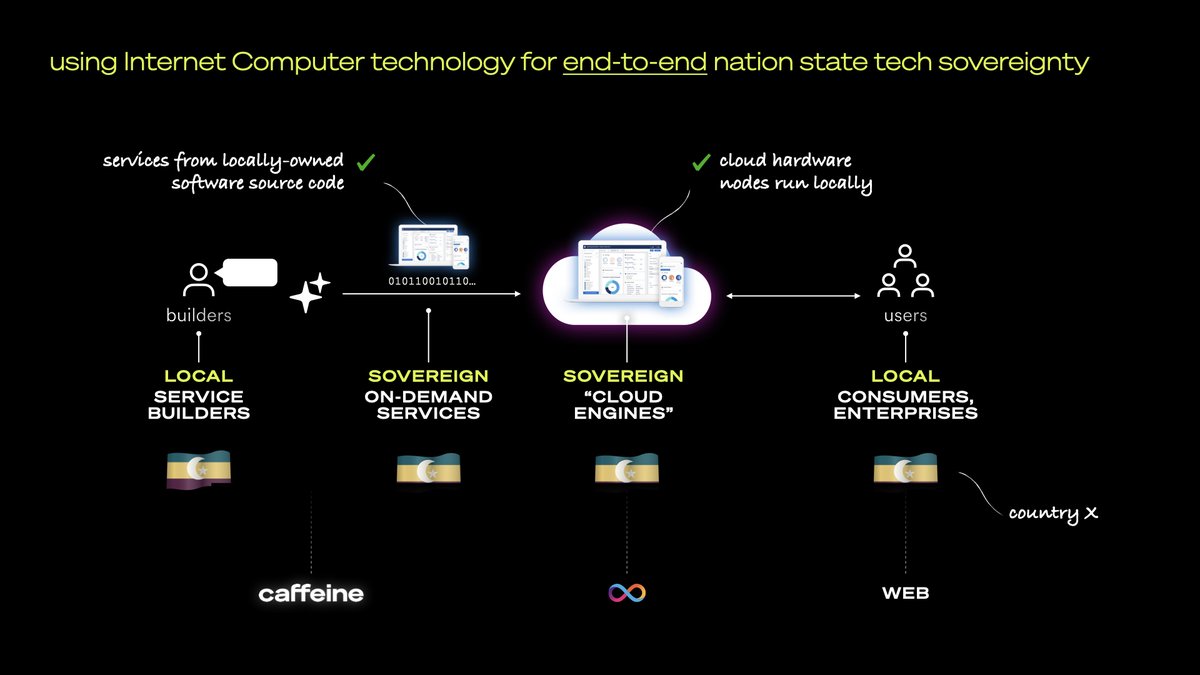
End-to-end tech sovereignty for nation states using Internet Computer (ICP) onchain cloud and self-writing apps technology (e.g. https://t.co/1UYehNI8hQ)
Now already happening...
As https://t.co/1UYehNI8hQ transitions to V3, it is now clearer than ever.
There is only 1 onchain cloud network: the Internet Computer (ICP). There is no room for debate. After years of relentless R&D, the technology remains completely unmatched. And it's getting better 🔥.
"The next wave of AI-powered cybersecurity attacks will be like nothing we’ve seen before."
Internet Computer technology creates tamperproof clouds using mathematically secure networks.
https://t.co/kDtGH93rnz
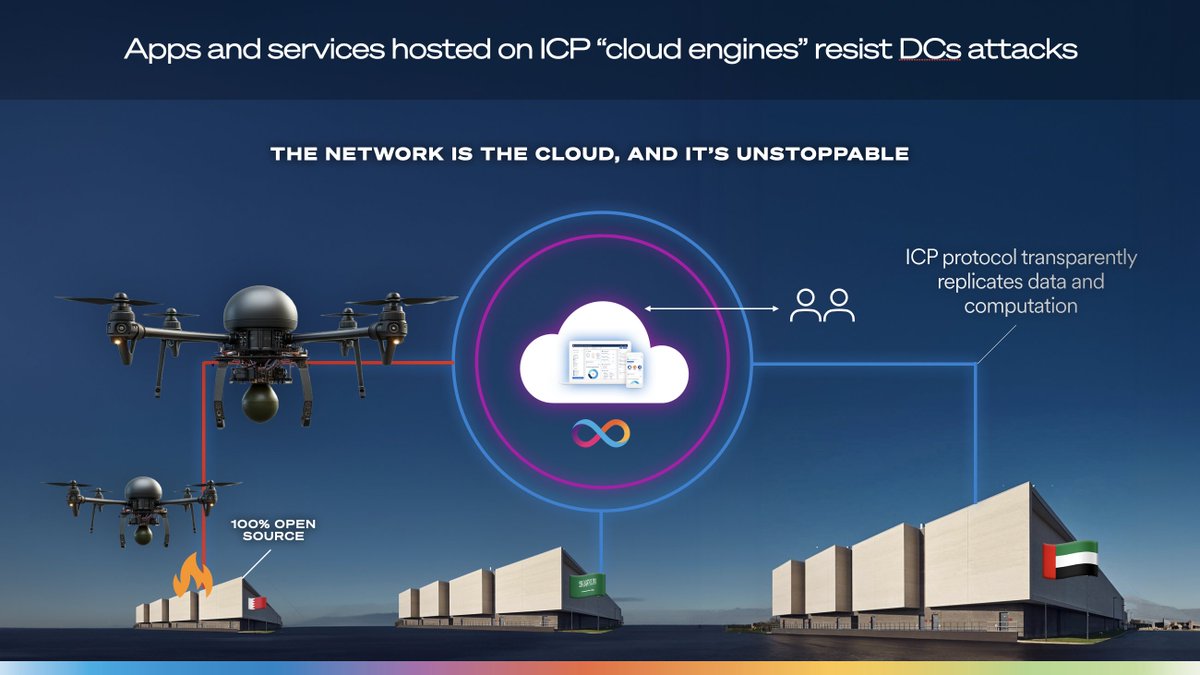
AWS in Bahrain went down after drone hit.
The ICP solution coming – apps and services hosted on ICP "cloud engines" running over multiple AWS data centers will be immune.
https://t.co/Vm3D3yZ9Zd
Exciting times for the Internet Computer!
#Mission70 Proposal 140888 passed earlier today. This should massively reduce ICP inflation during 2026, to the benefit of the network's tokenomics 🔥🔥🔥
Proposed schedule coming soon...
https://t.co/SwuxLW0VWR
NVIDIA showcasing new "interfence-only tech" @ GTC in next few days (building on Groq acqui.)
The pending earthquake I predicted in 2024: inference will become key to training, and many that are investing heavily in trad GPU infra will get caught out and by this coming shift.
Why? There is a shortage of fresh training data to help with scaling intelligence through pretraining.
To solve this, CoT reasoning will be applied within agentic architectures to perform research that axiomatically generates discoveries and insights — with such frameworks validating empirical assumptions and reasoning to prevent the generation of training data based on hallucinations or faulty thinking.
New frontier knowledge insights will be formulated for use as training data in ways that both help embed new knowledge in model weights, and increase embedded "intuition," which directly supports the notional "intelligence quotient" that can be ascribed to textual synthesis by LLMs.
Inference-generated training data will prove instrumental to advancing frontier LLM capabilities. Meanwhile, its generation will involve vast amounts of inference computation, and interfence-only ASICs (application specific integrated circuits) will be required to do it competitively.
The only question is when agentic frameworks and LLM capabilities will advance sufficiently to make this possible. My own experiences applying agentic frameworks at work in recent months make me think that agentic generation of training data at scale may not be that far off.
This is definitely something tech firms investing heavily in do-it-all GPU chips and data centers specialized to host them should think about.
Once end-users get a taste for inference on ASICs, which can be 10X faster compared to the latest GPUs, they're also not going to want to do inference on anything else, at least for chat and code generation, which are very time-sensitive tasks — for example, https://t.co/IfQrVovF3L plans to adopt ASICs as soon as possible.
It's a shame NVIDIA bought Groq, because competition is needed to advance this sector, so all eyes on Cerebras and their dinner plate sized chips!