Most people are building AI orchestration. We built the containment vessel.
Meet Archron: the secure execution layer between LLMs and business ops. The LLM never gets direct system access. Archron handles the governance, schemas, and commits.
AI assistants just got write access to mainstream CRMs.
That isn't a reason to take them off read-only.
If an assistant passes a name that matches several records, it shouldn't guess. It should ask which one, before anything is written.
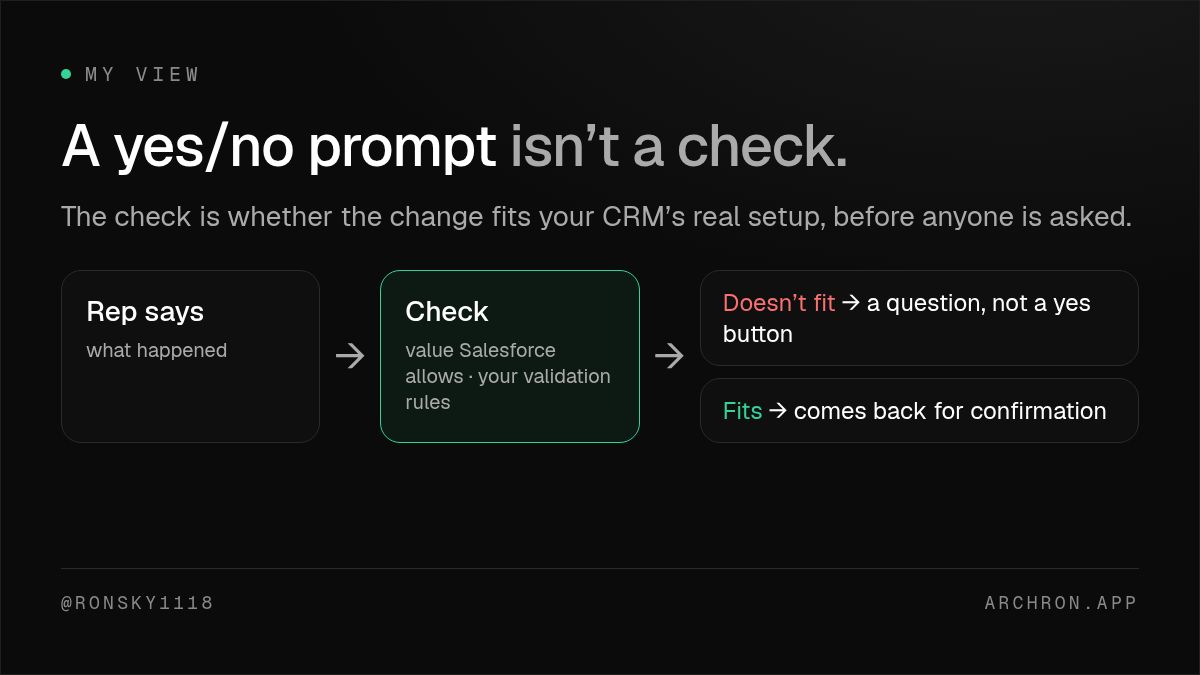
My view: a yes/no prompt isn't a check.
The check is whether the change fits your CRM's real setup, before anyone is asked. Is the value one Salesforce allows? Does it pass your validation rules?
If it doesn't fit, the rep gets a question, not a yes button.
Archron isn't an AI company.
It's a boring check between your AI and your CRM.
It checks the value is one your Salesforce actually allows. It reads your org's validation rules and checks the change against them before it writes.
Fits? It moves on.
Doesn't? It asks first.
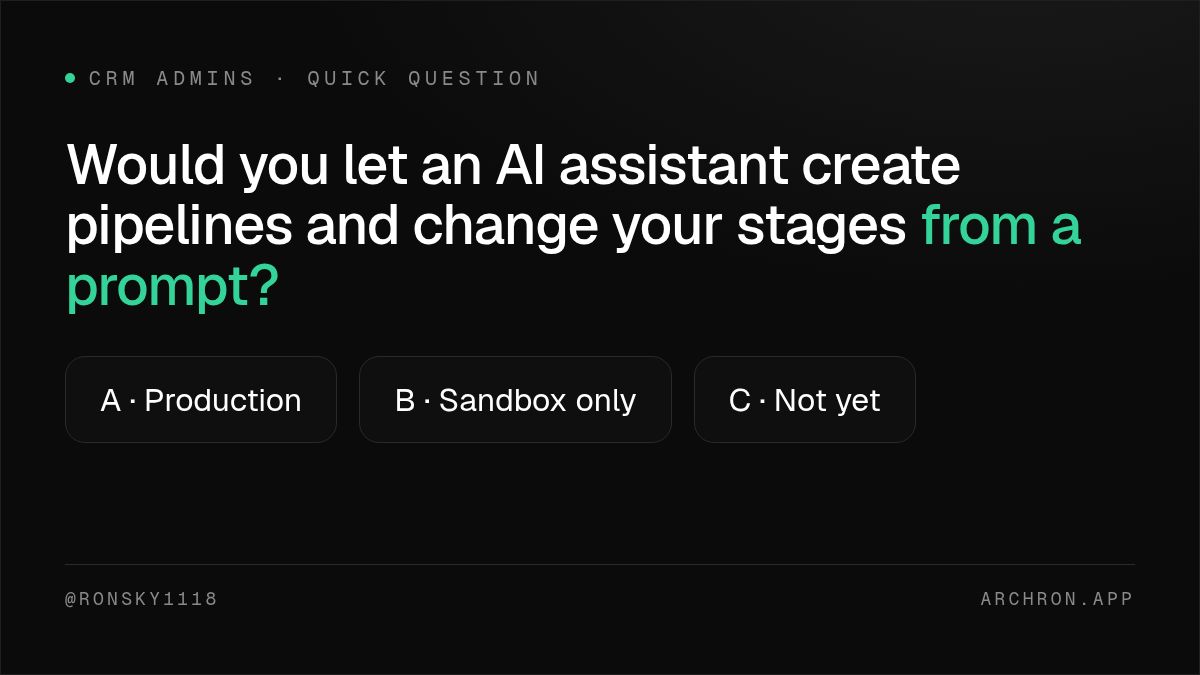
Would you let an AI assistant create pipelines and change your stages from a prompt?
CRM admins: production, sandbox only, or not yet? Genuinely curious.
Before an agent writes to your CRM, answer 4 questions:
1. Whose permissions does it act with?
2. What happens when the record is ambiguous?
3. Which actions need explicit human confirmation?
4. How do you undo it?
If any answer is "the prompt," you're not ready.
A major CRM vendor is targeting November to give each AI agent its own registered identity, with permissions that can be narrower than a human's, instead of borrowing an employee's access.
Right call. Logs should show who asked and which agent acted.
A well-known SaaS company connected a vendor's AI agent to its CRM. Shortly after, nearly all its sales opportunities were deleted. No rollback.
A snapshot nobody had set up as a backup saved them.
Agent write access needs an undo path before it needs a better prompt.
AI is ready to operate your business. Most businesses just don’t trust it to. Archron is the execution governance layer that sits between AI agents and your production systems.
https://t.co/LvGRoFr01C
Just launched @ArchronInc on @ProductHunt .It’s the execution governance layer that lets AI agents safely write to production systems (starting with Salesforce & HubSpot) with verification, clarification, and full audit trails before anything changes.
https://t.co/Q2LwrhXeRr
Just launched @ArchronInc on @ProductHunt .It’s the execution governance layer that lets AI agents safely write to production systems (starting with Salesforce & HubSpot) with verification, clarification, and full audit trails before anything changes.
https://t.co/Q2LwrhXeRr
@ArchronInc@ProductHunt We’re offering 3 months free for teams that want to test it in real workflows.Would love your feedback, questions, and support on launch day.
https://t.co/Q2LwrhXeRr
Just launched @ArchronInc on @ProductHunt .It’s the execution governance layer that lets AI agents safely write to production systems (starting with Salesforce & HubSpot) with verification, clarification, and full audit trails before anything changes.
https://t.co/Q2LwrhXeRr
@ArchronInc@ProductHunt Live today: Salesforce + HubSpot
Works with Claude, Grok, ChatGPT, and any MCP-capable agent.
Most AI tools stop at drafting and suggesting.
@ArchronInc@ProductHunt - Validates every agent action against schema, permissions, business rules, and current state
- Forces clarification when the plan is ambiguous
- Only commits when the action is verifiably safe
- Leaves a complete, immutable audit trail of intent → verification → execution
@ArchronInc@ProductHunt It verifies, governs, and audits every AI action before anything touches production data so you can safely let agents write to CRMs and other critical systems without breaking workflows or corrupting records.
@ArchronInc@ProductHunt AI is ready to operate your business.
Most businesses just don’t trust it to.Archron is the execution governance layer that sits between AI agents and your production systems.