Decoding hair loss papers into actionable data. 🧬 📉 Self-Experimenting: Minox + 1.5mm Needling. 🧪 Goal: Regrowth via Science, not Hype. Not medical advice.
Many hair growth supplements pass right through your system unabsorbed.
Your body absorbs nutrients from real food 10x better than from a pill.
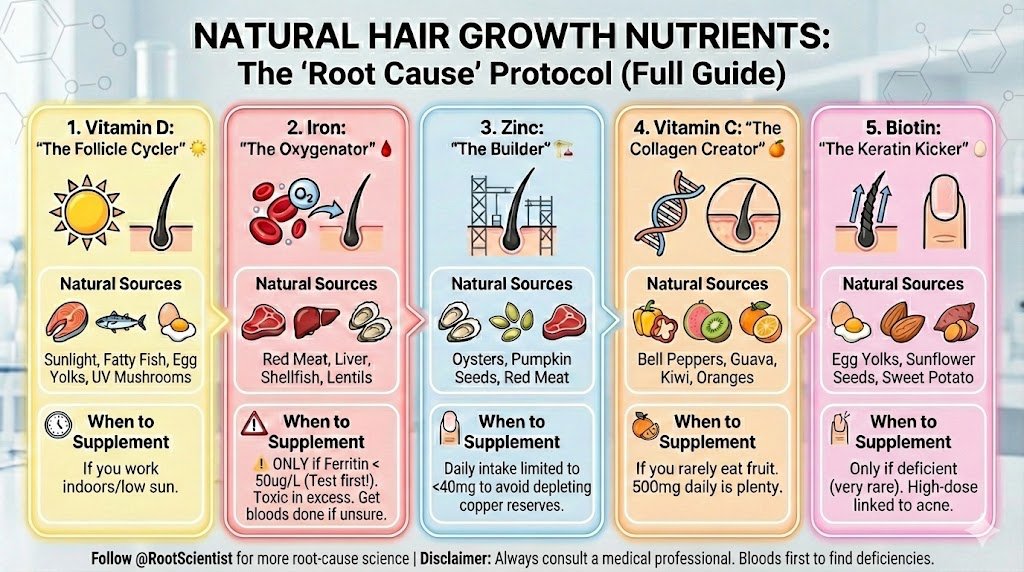
Here are my Top 5 vitamins and minerals for hair density, where to find them, and the when you should supplement.
Enjoy the read 👇
A few people reached out yesterday saying similar things "just use topical dutasteride instead."
On paper, the 500-Dalton rule makes topical dutasteride look like a cheat code: crush scalp DHT while keeping your bloodstream completely untouched.
Read the actual human data, and that free lunch gets complicated fast.
First, why the hype exists.
Finasteride weighs 372 Daltons, so it slips straight through scalp skin into circulation. Dutasteride weighs 528.5 Daltons (just over the classic 500-Dalton skin barrier threshold) and is heavily fat-soluble. In theory, it parks around the hair follicle instead of flooding your blood.
Over the past year, two real human studies finally put that theory to the test:
1. The 2025 Phase 2 trial (Panuganti et al., 135 men, 24 weeks) tested 0.01%, 0.02%, and 0.05% topical dutasteride against placebo and 1 mg oral finasteride. The 0.05% solution beat oral finasteride on target-area hair counts at week 24 (p = 0.0083) while causing only modest shifts in blood DHT compared to moderate drops on finasteride.
2. The 2026 Phase 1 trial (Lyakhovitsky et al.) tested FOL100, a novel 0.05% topical dutasteride lotion, across 66 men for 24 weeks. Blood dutasteride levels stayed undetectable in every participant, systemic DHT suppression was minimal and not statistically significant, and exploratory counts showed a median gain of +11 hairs/cm² by week 28.
Sounds like a slam dunk. Now look at the four catches sitting inside those papers:
1. The trials are still small and early. The 2025 study had roughly 27 men per arm, was manufacturer-funded, and applied 1 mL directly onto a tiny 1.9 cm² circle on the crown rather than an entire thinning scalp. The 2026 FOL100 trial was open-label with zero topical placebo control, and only 39 of the 66 men completed the full 24 weeks.
2. The vehicle is doing the heavy lifting. Because dutasteride is a heavy molecule, both studies relied on specialized delivery systems. A random compounded bottle mixed in basic alcohol, oil, or propylene glycol will not magically copy those penetration curves. It either sits on top of the skin doing very little, or absorbs unpredictably.
3. Covering a full scalp changes the math. Keeping blood levels undetectable when applying a measured dose to a small test area is one thing. Coating your entire hairline and crown week after week gives the drug far more surface area to enter circulation.
4. Microneedling breaks the shield completely. Plenty of guys pair topical dutasteride with dermastamping to force it past the skin barrier. Once you bypass that barrier, the 500-Dalton rule stops protecting you. Because dutasteride carries a 4 to 5 week half-life, even tiny systemic leaks quietly accumulate in your bloodstream over months.
Topical dutasteride has genuine potential, and the early human data looks far more credible than it did two years ago. Just do not treat an unstandardized compounded bottle like a proven, side-effect-free upgrade. Until Phase 3 trials validate a consistent delivery vehicle across real-world scalp sizes, you are still guessing how much stays in your follicles and how much ends up in your blood.
@MMeriot54868@ClyrHealth Let me know how you get on. Particularly interested in KX-826 as it’s had a bit of a bumpy ride historically on the trials. I covered it in my 2026 hair loss pipeline article if you fancy a read.
Someone just posted a viral thread celebrating "2026 hair loss research" for guys who want to avoid finasteride.
Four of the five items are Twitter cosmetic drops or 30-year-old compounds, and the one real 2026 study on their list actually disproved their main claim.
Here is how all five hold up against the actual literature:
1. MH-01 ("proven to outgrow minoxidil")
MH-01 is a cosmetic styling serum launched on X (caffeine, adenosine, niacinamide, chitosan). Even its own FAQ admits it is a cosmetic, not an alternative to minoxidil, and the finished formula has zero clinical trials. That "outgrew minoxidil" claim distorts a 2013 paper (Faghihi et al., 94 men) comparing 0.75% adenosine to 5% minoxidil. Adenosine showed NO statistically significant superiority in actual hair recovery rates; it only won on subjective patient satisfaction.
2. GHK-Cu / AHK-Cu ("studies are limited because it is new")
Copper peptides have solid supportive biology and a few small human studies as mild scalp adjuncts. Calling them "new" is hilarious. GHK-Cu was discovered in the 1970s, AHK-Cu has been used in scalp formulas since the mid-1990s, and the famous Pyo et al. follicle paper turns 20 next year. Lack of time is not why there is no Phase 3 trial.
3. RU-58841 ("blocks DHT on hair follicles alone")
Calling a shelved 1980s research chemical "2026 research" is peak irony, because the biggest human RU-58841 study of 2026 wrecked that exact claim. In August 2026, Germany's national anti-doping lab (Okutan et al., Biomedical Chromatography) tested a single scalp application of online RU-58841 in 6 healthy men. Intact RU-58841 entered the bloodstream of every single volunteer, stayed detectable in blood for up to 7 days, and left metabolites in urine for nearly 9 days. Bonus: the bottle labeled 5% (50 mg/mL) actually tested at 30 mg/mL, 40% underdosed.
4. Topical BPC-157 ("was invented")
Dropping an unapproved gut peptide into a scalp spray is not a medical breakthrough. Out of 222+ PubMed papers on BPC-157, literally zero study hair follicles, alopecia, or scalp tissue, in humans or animals. It also weighs ~1,419 Daltons (nearly 3x the 500-Dalton skin barrier threshold), so microneedling an unregulated angiogenesis peptide into your scalp is a blind toxicology experiment.
5. EGO369 ("dropped")
Another X-launched cosmetic blend stacking mild adjuncts (adenosine, GHK-Cu, azelaic acid, biotin) with zero clinical trials on the finished bottle. It even implies you keep your gains if you stop using it, which flies in the face of basic androgenetic alopecia biology.
The original post ended by asking: "what did I miss?"
Actual 2026 hair loss research. Clascoterone 5% finished 12-month Phase 3 safety with no systemic hormonal signal. PP405 entered a 600-man Phase 2/3 stem cell trial. VDPHL01 just dropped 12-month Phase 3 regrowth data.
If you want to keep your serum DHT intact, follow clinical trials, not influencer product launches.
2026 has been a big year for hair loss research.
especially for those who’d rather keep their serum DHT intact.
1. MH-01 hit the market
> topical adenosine complex with caffeine, niacinamide & more.
> ingredients have been proven to outgrow minoxidil in studies.
2. topical GHK-Cu/AHK-Cu has taken off
> copper peptides + microneedling doesn’t just work on your face.
> immense amount of anecdotes for hair growth, studies are limited (cause it’s new).
3. RU-58841 is picking up steam heavily
> a topical anti-androgen that blocks DHT on hair follicles alone, rather than nuking serum DHT like finasteride.
4. topical BPC-157 was invented
> redditors still out there injecting their heads with peptides are looking like cavemen now that this stuff exists.
> BPC’s angiogenesis effects could be promising when given local access to the scalp via microneedling.
5. EGO369 dropped
> combines azaelic acid, GHK-Cu, adenosine, biotin & lots of other promising ingredients.
what did i miss?
not medical advice.
What did you miss??
Actual 2026 hair loss research. Clascoterone 5% finished 12-month Phase 3 safety with no systemic hormonal signal. PP405 entered a 600-man Phase 2/3 stem cell trial. VDPHL01 just dropped 12-month Phase 3 regrowth data.
If you want to keep your serum DHT intact, follow clinical trials, not influencer product launches.
I started on finasteride but then my partner became pregnant. So my stack became topical minoxidil and 0.5mm microneedling every couple of days for absorption , 1.5mm every two weeks (but avoided minox for 24hrs) for wound healing benefits, I’ve applied copper peptide straight after this. Ketoconazole shampoo every few days. Sorted out sleep (less so now I have another baby to look after) and nutrition in line with some of my previous posts. I’ll post a picture update when I get a chance but the hair loss has definitely subsided, with some minor regrowth.
Whilst everyone watches PP405 and Breezula, almost nobody on hair loss X is watching an AI-designed antibody called ABS-201 that drops its first human regrowth data next month.
If the monkey data translates to humans, daily hair loss pills could look archaic.
Here is why biotech analysts suddenly woke up after Absci's conference presentation last week:
ABS-201 does not touch DHT or testosterone at all. It is a monoclonal antibody that blocks the prolactin receptor (PRLR). Human scalp follicles actually produce and respond to prolactin locally, where it acts as a signal that pushes follicles into programmed regression.
Three pieces of evidence made investors pay attention:
1. The primate data was wild. In stump-tailed macaques, six months of blocking the prolactin receptor triggered complete hair regrowth and repigmentation. Even stranger, that regrowth stayed durable for up to four years after stopping treatment.
2. Human genetics back the target. UK Biobank data links prolactin receptor expression to balding severity, and women born with natural loss-of-function mutations in this receptor appear healthy with full heads of hair (their main biological quirk is being unable to lactate).
3. You would not take it every day. Interim Phase 1 data showed an estimated half-life of at least 65 days, pointing to just two or three injections over a six-month window instead of daily pills or greasy sprays.
But didn’t Hope Medicine already try this target with HMI-115?
Yes. Hope's early study showed roughly 14 hairs/cm² at six months, which felt underwhelming. Absci is betting Hope simply underdosed patients: they argue Hope's 240 mg every-two-week regimen only achieved 60% to 70% receptor occupancy. Absci is testing 300 mg, 600 mg, and 1,200 mg doses to push past 90% occupancy, publicly targeting 30 to 35 hairs/cm² at 26 weeks.
Now for the sober reality check before anyone buys the hype:
- Right now, we have zero controlled human hair-count data on ABS-201. Everything so far is early safety, pharmacokinetics, and ex vivo human tissue work.
- Next month's December readout is only a 13-week interim snapshot. Even Absci admits primate growth curves were not linear and accelerated after weeks 9 to 12, so early numbers could easily look noisy or inconclusive.
- Macaque durability almost never translates 1-to-1 to human male pattern baldness. Expecting a permanent four-year cure from a few shots is a massive leap.
- Clinical timelines slip constantly. Absci already pushed its endometriosis Phase 2 start for this exact same molecule back from Q4 2026 to mid-2027.
Still, a non-hormonal injection taken a few times a year is the closest thing to a real paradigm shift in the pipeline. Keep an eye on the HEADLINE readout in December.
@ShenLon61785835 Yeah strong safety profile on paper, but efficacy is still a bit of a question mark for me. Would be good get the peer-reviewed absolute hair counts from SCALP 1 & 2.
Half of hair loss Twitter is telling 23-year-olds to skip finasteride and jump straight to 2.5 mg of dutasteride a day.
That is five times the standard clinical dose. And yes, the scalp DHT math behind it is wild. Just read the rest of the paper before swallowing five capsules every morning.
The entire 2.5 mg hype traces back to one landmark 24-week dose-ranging trial (Olsen et al., 2006) across 416 men.
Here is why people lose their minds over the chart from that study:
- Finasteride 5 mg cut blood DHT by ~70%, and scalp DHT by ~41%.
- Dutasteride 0.5 mg cut blood DHT by ~92%, and scalp DHT by ~51%.
- Dutasteride 2.5 mg cut blood DHT by ~96%, and scalp DHT by ~79%.
Look at that jump. Going from 0.5 mg to 2.5 mg barely moved blood DHT (92% to 96%), yet it crushed scalp DHT from 51% all the way to 79%.
The reason comes down to enzyme biology. Finasteride mainly blocks Type 2 5-alpha-reductase. Dutasteride blocks both Type 1 and Type 2, and it is over 100 times more potent on Type 1. Scalp skin and sebaceous glands carry a lot of Type 1 enzyme, so pushing the dose higher clears out local DHT that 0.5 mg leaves behind.
The hair counts followed that exact curve. Inside a 1-inch target circle at week 24:
- Placebo: -32.3 hairs
- Finasteride 5 mg: +75.6 hairs
- Dutasteride 0.5 mg: +94.6 hairs
- Dutasteride 2.5 mg: +109.6 hairs
On paper, 2.5 mg won cleanly. Now look at the four realities the "nuclear stack" crowd leaves out:
1. Diminishing returns are steep. Multiplying your drug exposure by 5x bought an extra 15 hairs per target circle over 0.5 mg (+109.6 vs +94.6). You are not getting five times the cosmetic result.
2. The safety data is razor thin. Only 71 men in that single 24-week trial actually took 2.5 mg daily. In that arm, 13% (9 men) reported decreased libido. None quit the study and most cases resolved, yet 71 men for six months is nowhere close to proving multi-year safety.
3. You cannot just "stop and see" if side effects hit. Dutasteride lingers in tissue for weeks. In Olsen's study, the median time for blood DHT to bounce back within 25% of baseline after quitting was 86 days on 0.5 mg. On 2.5 mg, it took 155 days. That is five months of waiting for your hormones to normalize.
4. Type 1 inhibition reaches beyond your scalp. Controlled human metabolic research showed that dual inhibition with dutasteride (even at 0.5 mg), unlike finasteride, increased hepatic insulin resistance and promoted liver fat accumulation. We have zero long-term human data on what five times that dose does to liver lipids or systemic metabolism over a decade.
Standard 0.5 mg dutasteride already outperforms finasteride in head-to-head trials and carries years of real-world safety tracking. Escalating toward 2.5 mg might make sense as a doctor-supervised option for aggressive hair loss that keeps progressing on 0.5 mg.
Treating 2.5 mg like a casual starter dose because of one 24-week chart from 2006 is not optimization. It is flying blind with a five-month exit ramp.
First rule with long hair: throw away any spray nozzle. Sprays just coat your hair shafts, waste half the dose, and leave you looking greasy.
What actually works:
1. Use a 1 mL glass dropper (or a cheap precision scalp applicator comb).
2. Part your hair in 3 or 4 clean rows across the area you are treating.
3. Press the dropper tip directly against the scalp skin, run tiny drops down the part line, and rub it in with your fingertips before making the next part.
4. Do it at night so it sits on the skin for 4 to 8 hours, then wash out in the morning if the base feels heavy.
Vehicle matters a lot here too. Heavy propylene glycol or oil bases are miserable in long hair, whereas lighter alcohol or liposomal formulas dry fast.
One upside if you are talking specifically about topical dutasteride: because it stays bound in tissue far longer than minoxidil or finasteride, many guys only apply it 1 to 2 times a week instead of daily. That makes the long-hair hassle way easier to live with.
On paper, I agree with the logic. Dutasteride sits at 528.5 Daltons (just above the classic 500 Dalton skin barrier threshold) and is super lipophilic, so in theory it parks in the follicle instead of flooding your bloodstream.
The 2025 Phase 2 trial (Panuganti et al.) actually gave that theory real legs: 0.05% topical dutasteride outperformed 1 mg oral finasteride at 24 weeks with noticeably smaller drops in blood DHT.
Two catches before calling it a slam dunk:
1. Vehicle is everything. Because the molecule is heavy, that trial used a specialized delivery solution. Random compounded mixes do not automatically penetrate the same way.
2. It is still early data (roughly 30 men per arm for six months, zero Phase 3 replication yet). And if you add microneedling to force it in, dutasteride's 4 to 5 week half-life means tiny systemic leaks can quietly build up in your blood over months.
Huge potential, just way more vehicle-dependent than oral dosing.
Telehealth companies are charging you $50 a month for 0.3% topical finasteride sprays and pitching them as a "side-effect-free" alternative to the pill.
Do the basic pharmacology math on what is actually inside that bottle, and the whole sales pitch falls apart.
Most guys see "0.3%" on a label and assume it is a tiny, gentle dose compared to a 1 mg oral tablet.
Convert that percentage into milligrams. A 1% solution contains 10 mg of drug per milliliter. That means 1 mL of a 0.3% spray puts 3 mg of finasteride onto your scalp every single day. Even a 0.25% spray puts 2.5 mg on your head.
You are applying up to three times the standard oral dose onto thin, highly vascular scalp skin.
Finasteride is a small molecule (372 Daltons), well under the 500 Dalton threshold needed to cross human skin. A chunk of whatever you spray onto your scalp passes straight into your bloodstream.
Now pair that with the one quirk of finasteride pharmacology telehealth ads leave out: its blood-suppression curve is almost flat. Classic dose-ranging trials (Drake et al.) showed that taking just 0.2 mg of oral finasteride drops blood DHT by over 65%, nearly matching the 71% drop from a full 1 mg tablet.
Do the arithmetic. If just 7% to 10% of your 3 mg topical spray absorbs into circulation (0.2 to 0.3 mg), your blood DHT gets crushed almost as hard as if you had swallowed a pill.
Clinical data backs this up. Pharmacokinetic studies by Caserini et al. showed that high-volume 0.25% topical finasteride (1 mL) suppresses blood DHT roughly 50% to 70% depending on dosing frequency, landing right in the same ballpark as 1 mg oral finasteride.
This is why the FDA stepped in with a formal safety alert on compounded topical finasteride. Regulators noted there is still no FDA-approved topical finasteride in the U.S., cited adverse event reports of erectile dysfunction, anxiety, brain fog, and depression in men who assumed a spray stayed out of their bloodstream, and warned about accidental transfer to women and children via pillowcases and skin contact.
Topical finasteride can work as advertised, just not at 3 mg a day. When researchers actually dropped the total applied dose, the blood numbers changed dramatically:
- In Caserini's lower-dose arms, applying 0.23 to 0.46 mg total (100 to 200 microliters of 0.25%) cut scalp DHT by roughly 50% while dropping blood DHT by only about 25%.
- In the European Phase 3 trial for a metered, film-forming spray, capping daily delivery under 0.5 mg kept systemic plasma levels over 100 times lower than oral pills and cut serum DHT by 34.5% versus 55.6% for oral.
- Older Italian data (Mazzarella et al.) even showed hair retention and regrowth at 0.005% (0.1 mg total daily) with essentially zero measurable drop in blood DHT.
So why do major telehealth brands default to 0.25% and 0.3% sprays mixed in basic alcohol and propylene glycol?
Because blasting your scalp with 2.5 to 3 mg guarantees strong hair counts and clean before-and-after photos, while still letting their marketing target men who are nervous about taking a pill.
If you are fine with systemic DHT suppression, generic 1 mg oral finasteride costs pennies, takes two seconds, and carries zero risk of rubbing hormone blockers onto your partner or kids. If you genuinely want topical finasteride to spare your blood DHT, read the milligrams per milliliter on the bottle. Buying a 3 mg daily spray to avoid a 1 mg pill makes zero pharmacological sense.
Headlines everywhere claim scientists in China invented an "electric comb" that regrows nearly 100% of lost hair in 30 days.
Before you ditch finasteride, read what the study actually did. The science is clever, and the media got the main point backwards.
The paper, from Beihang University and published in Nature Communications in November 2026, introduces a bioelectronic comb called Detangle.
Most viral posts make it sound like zapping your scalp wakes up bald follicles on its own. That is not what happened. Detangle is a needle-free drug-delivery engine disguised as a comb.
Instead of uniform teeth, it uses alternating teeth of different lengths fitted with electrodes. That staggered design generates pulsed electric fields 2.63 times stronger than straight rows of electrodes. Those brief pulses trigger electroporation, temporarily opening cell membranes and driving active compounds roughly 660 micrometers beneath the skin barrier straight toward hair follicle cells.
Here is what the comb was actually pushing into those pores: two experimental genetic therapies.
- SRD5A2 siRNA: interfering RNA engineered to dial down the enzyme that converts testosterone into DHT.
- VEGFA plasmids: genetic material designed to grow new blood vessels around starving follicles.
Calling Detangle an "electric comb" is like calling a syringe a "metal tube." The electricity opens the door; the gene-modulating cargo does the heavy lifting.
In mice with induced androgenetic alopecia, the full system restored nearly 100% hair coverage in 28 to 30 days, outperforming daily topical minoxidil (around 70%). Testing stimulation alone versus stimulation plus cargo also confirmed electricity by itself was not doing all the work.
Impressive bioengineering. Now look at the four massive gaps between this mouse study and your scalp:
1. Mouse skin is not a human scalp. Driving cargo 660 micrometers deep hits follicles easily in thin, shaved mouse skin. Human scalps are far thicker, with deeper terminal follicles and uneven existing hair that ruins consistent electrode contact.
2. Zero human safety data. Neither the SRD5A2 siRNA nor the VEGFA plasmids have been cleared as safe in people. Altering local gene expression and blood vessel growth requires years of toxicology testing.
3. Thirty days proves nothing about durability. We have zero data on whether the hair stays after stopping treatment, or if repeated electroporation damages skin long term.
4. Human trials are years away. Combining a bioelectronic device with nucleic-acid therapies triggers strict multi-phase regulatory review from the FDA and MHRA.
If you want to know what real electrical stimulation does in humans today, a June 2026 randomized, sham-controlled clinical trial in Dermatology and Therapy tested a wearable device (niostem) in men with pattern hair loss. It produced statistically significant gains in density and thickness, over six months, not 30 days.
Detangle is a brilliant proof-of-concept for needle-free drug delivery. Just keep your expectations grounded: until it passes human scalp trials, mice remain the best-groomed mammals in medical research.
Many people on hair loss Twitter dismiss VDPHL01 as overpriced, repackaged oral minoxidil.
I get the cynicism. You can buy generic 2.5 mg oral minoxidil for pocket change right now. So why on earth did Veradermics spend hundreds of millions running Phase 3 trials on a drug from the 1970s?
Look at the 12-month data they just released on November 9, and then look at the pharmacokinetics. It starts making a lot more sense.
In their Phase 2/3 Study '302' 12-month readout, men taking 8.5 mg of VDPHL01 twice a day gained an average of 43.9 non-vellus hairs per square centimeter, up from 33.0 at month six. Even better, their confirmatory Phase 3 trial ('304', 536 men) reported 36.4 hairs/cm² on the twice-daily dose at just six months, versus 6.6 on placebo. Statistically significant separation from placebo showed up at month two.
And across over 1,000 men in both pivotal trials, there were zero cardiac adverse events of special interest.
If you took 17 mg a day of regular immediate-release oral minoxidil, your cardiologist would have a meltdown.
Here is the actual pharmacology behind why VDPHL01 behaves differently.
Standard oral minoxidil hits your bloodstream fast, peaks within 30 to 60 minutes, and clears with an elimination half-life of roughly 3 to 4 hours. Once serum concentrations push past about 20 ng/mL, you start running into real cardiovascular and hemodynamic side effects. So dermatologists keep off-label doses low (usually 1.25 to 2.5 mg) to stay safe, which means your blood levels spike briefly and then drop off for most of the day.
Hair follicles do not care about a 60-minute spike. Minoxidil is a prodrug that gets converted inside the follicle by the SULT1A1 enzyme into active minoxidil sulfate, which opens ATP-sensitive potassium channels and keeps follicles in the anagen growth phase. That effect is exposure-dependent.
VDPHL01 uses a gel-matrix extended-release tablet designed to cap the peak concentration below that cardiac threshold while keeping minoxidil above the hair-growth threshold roughly twice as long as a standard 2.5 mg tablet. Same molecule, totally different concentration curve.
Now for the reality check nobody in the biotech press releases will emphasize:
1. Side effects did not vanish. Hypertrichosis (unwanted body hair) jumped from 2.2% on once-daily dosing to 9.0% on twice-daily dosing in Study '304', and peripheral edema still showed up in around 5 to 6% of participants in Study '302'.
2. It still does zero work against DHT. Minoxidil stimulates growth without halting underlying androgen-driven miniaturization, and if you stop taking it, the regrowth sheds back to baseline.
3. Pricing will decide everything. Once it hits the market (assuming FDA approval), patients are going to weigh paying brand-name prices against splitting cheap generic pills with their dermatologist.
Still, writing VDPHL01 off as "just minoxidil" misses the whole point of pharmacokinetics. Delivery curves change what a molecule can safely do. And with their 556-woman Phase 2/3 trial already fully enrolled for an early 2027 readout, we could be looking at the first FDA-approved oral hair loss pill for both men and women.