Accepted to #COLM2026 🎉
Can LLM student simulators model WHY students act, not just WHAT they do? We introduce INSIDE (Internal Student Dialogue), a student modeling framework that models students' latent reasoning alongside actions for more faithful, explainable simulations 👩🎓
an AI tutor's real reward is whether the learner learns, and you can't test every system on real students, so faithful simulators to train against are key. super cool to see this in practice! congrats @alexisjross@314Bansal & the @humansand team!
Introducing Ampersand Tutor (&Tutor) - we trained a model to learn like people, then trained &Tutor to teach it
On a widely-used tutor model eval, &Tutor performed best, showing how better models of people can help build AI for humans
Available through our API - try it!
Teamed up with @cohere today! Our co-founder and CEO @vinitra_s talked about the multi-agent learning system we're building at Scholé AI! She also presented the RCT we ran with @Berkeley_EECS and @ICepfl, "When Should a Lesson Adapt, and for Whom?".
We randomly assigned 119 adults new to two data-science topics to a MOOC-style lesson with a GPT chatbot and Scholé's adaptive tutor, both built from the same UC Berkeley data science lectures. Tutor learners gained more (+2.14 against +1.40 items of 8, 𝑑= +0.37); after adjusting for pre-test, the advantage was largest for those who knew least and for younger adults. Having used both, the majority of learners preferred the tutor, especially for feedback and difficult material, and the MOOC-style lesson for overview and review.
That adaptive tutor is how Scholé's agents work: they track what each learner understands, choose the next explanation or practice task, and update after every answer. Our next frontier is the right support, at the right moment, across a working life, tested inside real work.
Thanks to Cohere Labs for hosting, and a big shout out to everyone who joined the discussion and our collaborators: Anna Sotnikova, Paola Mejia, Alireza Sakhaeirad, Amine Ben Ahmed, Abhinand Shibu, Güneş Özgün, @rose_niousha, @NargesNorouzi, Tanja Käser
What should an AI tutor do when a learner struggles? Let us know in the comments!
Come check out our poster at #EMNLP2026!
We present ParaStudent, a fine-tuned student simulator that revises code like a real learner, so AI tutors can be evaluated by how students take up their feedback before deployment 💬
📍Hall H, Sun 16:00–17:30
ParaStudent is accepted to #EMNLP2026 Main Conference!
Since this checkpoint we’ve been asking: what does a user simulator have to get right to evaluate interactive assistants like AI tutors? Turns out the key is how partially users act on advice 👀
🔗 https://t.co/ntyo48G5wt
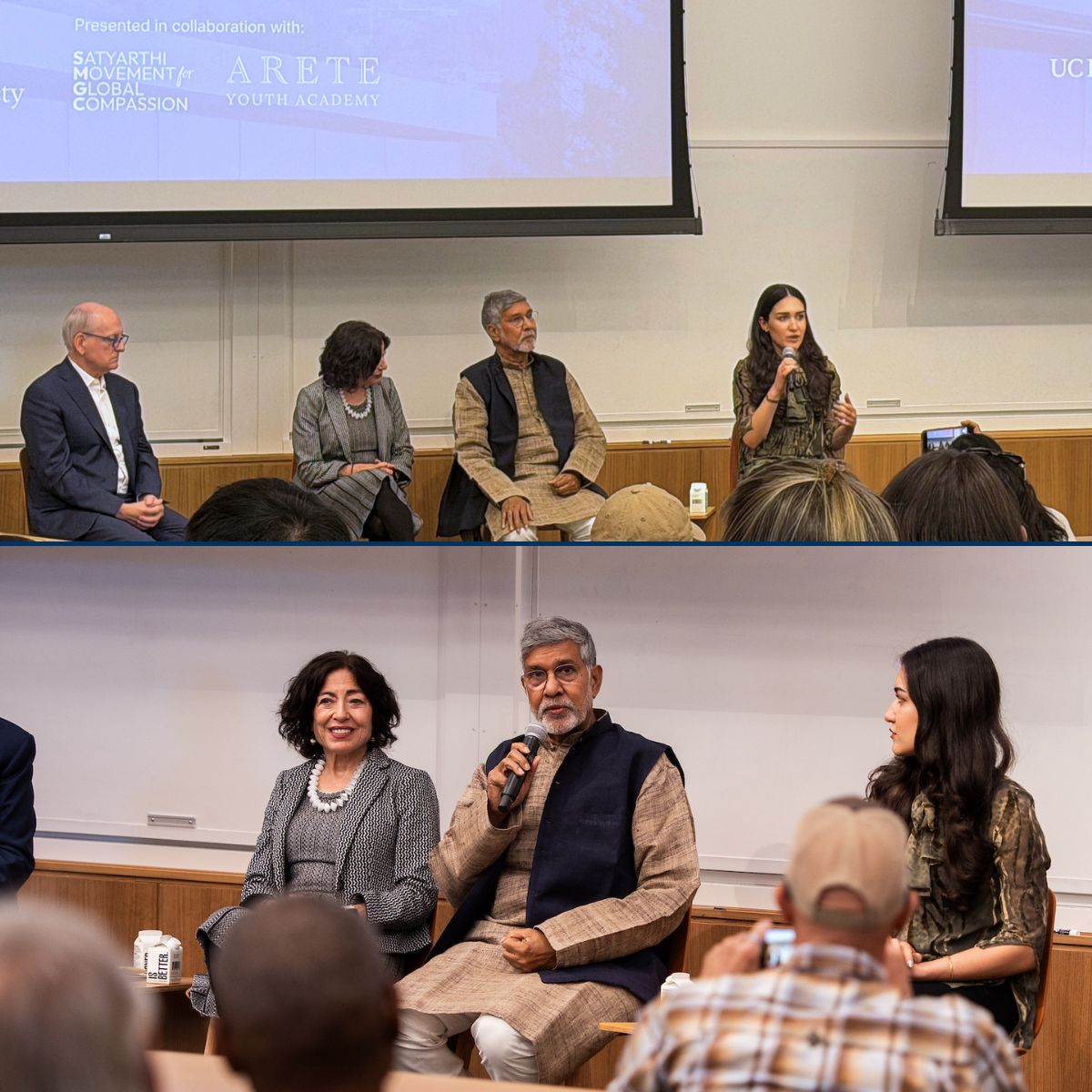
Nobel Peace Prize Laureate @k_satyarthi recently visited the @UCBerkeley campus to address students and faculty developing AI technologies, imploring them to center compassion in their work.
🔗 Read more: https://t.co/UQocCgdTVK
#Education#AI#UCBerkeley
I will be at #COLM2026 this week presenting INSIDE: simulating how learners think, not just what they do 🧠
📍Grand Ballroom #103: Thu Oct 8, 4:40–6:30 PM
Happy to chat about user simulation, AI in education, evaluating interactive systems & more. DMs are open! 🌉
I will be at #COLM2026 this week presenting INSIDE: simulating how learners think, not just what they do 🧠
📍Grand Ballroom #103: Thu Oct 8, 4:40–6:30 PM
Happy to chat about user simulation, AI in education, evaluating interactive systems & more. DMs are open! 🌉
Accepted to #COLM2026 🎉
Can LLM student simulators model WHY students act, not just WHAT they do? We introduce INSIDE (Internal Student Dialogue), a student modeling framework that models students' latent reasoning alongside actions for more faithful, explainable simulations 👩🎓
ParaStudent is accepted to #EMNLP2026 Main Conference!
Since this checkpoint we’ve been asking: what does a user simulator have to get right to evaluate interactive assistants like AI tutors? Turns out the key is how partially users act on advice 👀
🔗 https://t.co/ntyo48G5wt
Can LLMs write code and learn like novice programmers?
We release ParaStudent, a framework to study how to make LLMs generate realistic, student-like code, which is often imperfect, iterative, and stylistically diverse 👩🎓
Paper and code shared in the thread 👇
Our social systems and institutions confuse me all the time. 😕
AI may make them even more complicated. What if it also represents us inside them?
We already delegate representation constantly - your employer negotiates your insurance, your lawyer negotiates your contract, your representatives advocate for your interests.
Wrote up some early thinking on what financial markets can teach us here, what we found in our recent paper Cooperate to Compete (now accepted to EMNLP), and why one of the hardest open problems may be designing the structures agents negotiate inside rather than the agents themselves.
Read my first research blog below!! I would love to hear any thoughts on how folks are thinking about this.
Blog: https://t.co/DpS5avdNeb
Thanks @askalphaxiv for featuring our recent work and for the great overview! Most student simulators model only a learner’s next action, without the reasoning behind it. Our student modeling framework, INSIDE, addresses this gap 🤖
Check out the paper: https://t.co/gLZBve1r0x
"INSIDE the Student's Mind: Jointly Modeling Latent Reasoning and Action in LLM Student Simulators"
INSIDE is post-trained to replicate both how students act and the internal reasoning that leads to their actions.
They reconstruct reasoning traces from real student code trajectories, then fine-tune the model to generate this internal dialogue before predicting the student’s next code submission.
This approach produces more realistic student behavior while reaching up to 57.9% reasoning-to-action alignment, showing that modeling how students misunderstand a problem can be as important as modeling what they do next.
https://t.co/vemhfV1vOn
Accepted to #COLM2026 🎉
Can LLM student simulators model WHY students act, not just WHAT they do? We introduce INSIDE (Internal Student Dialogue), a student modeling framework that models students' latent reasoning alongside actions for more faithful, explainable simulations 👩🎓