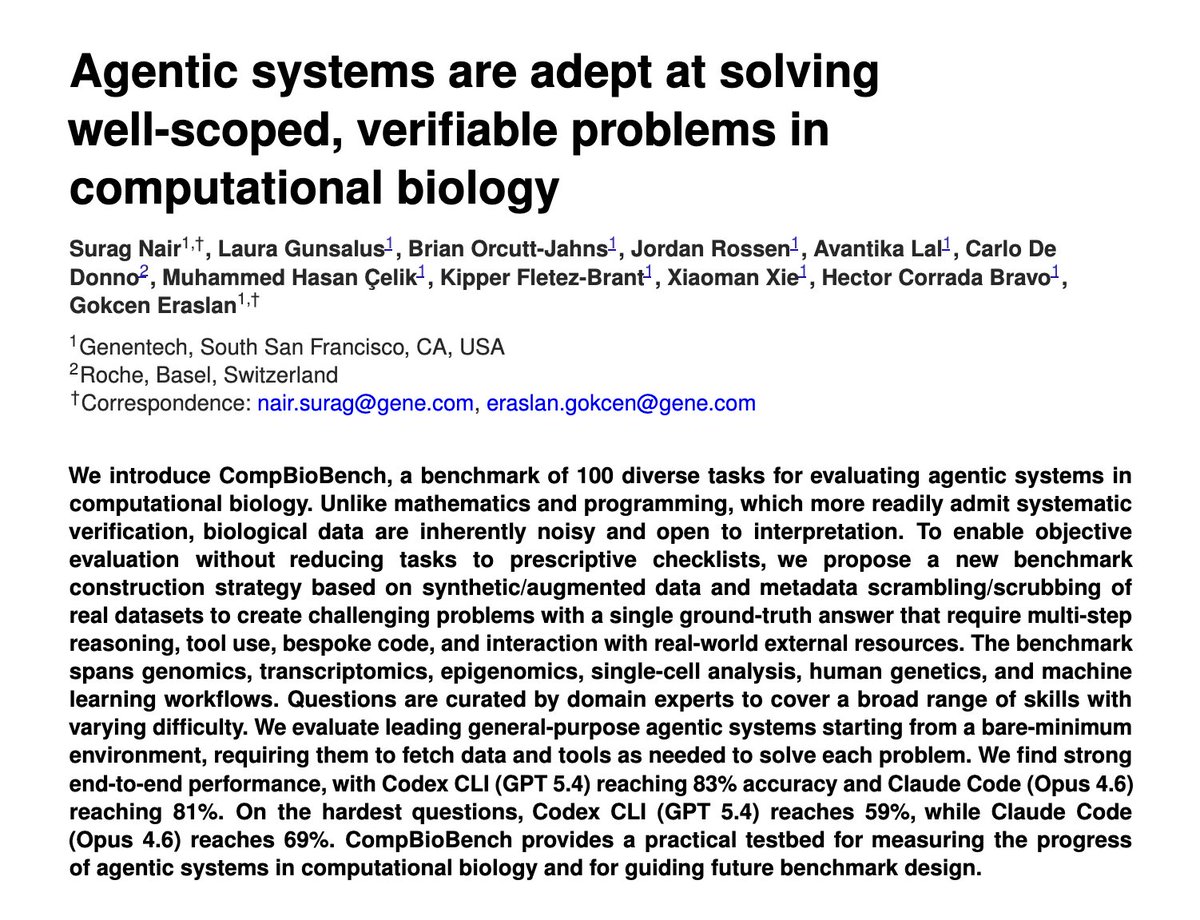
Agents for computational biology are advancing rapidly, but evals are lagging. Current benchmarks can be overly prescriptive. Full analysis vignettes are hard to verify. We introduce CompBioBench: 100 diverse, challenging, verifiable tasks + benchmark general-purpose agents. 1/9
Excited to share our preprint on "tagging" effects in enhancer-gene links from single-cell multiome data!🧬 We show that correlated ATAC peaks can induce non-causal peak-gene links (similar to LD in GWAS), affecting regulatory architecture interpretation.
https://t.co/OazX1hz1oR
@unboxpolitics@SashaGusevPosts Thanks for reading!
Our results don't imply anything about differences in the average phenotype across ancestry groups. The model assumes mutations are equally likely to increase or decrease a trait (symmetric about 0), so it's not good for looking at trait mean differences.
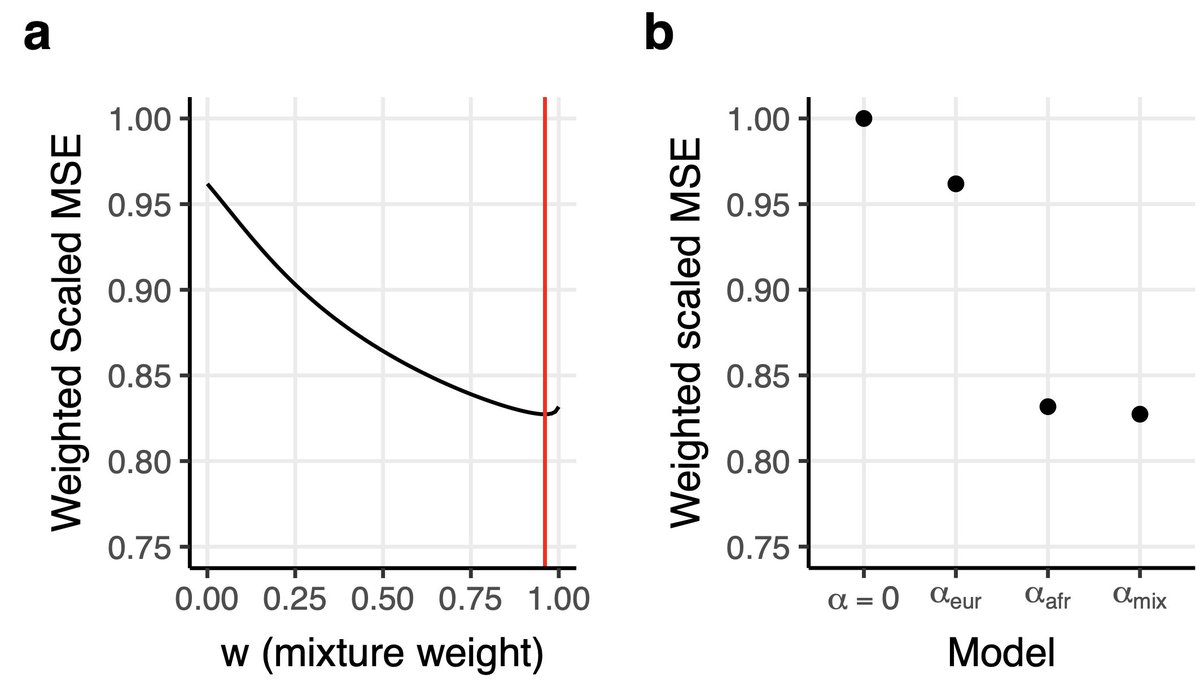
Just posted an updated version of our new preprint! We argue that per-allele disease and complex trait effect sizes from European GWAS are better explained by African minor allele frequencies (MAF) than European MAF.
https://t.co/dZ3SdmlF6x
This project builds on previous work that explores the same hypothesis in simulations (Ashraf and Lawson 2021 EJHG , Taylor and Lawson 2024 JHG) and uses conditional frequency spectra to differentiate selection modes (@RoshniAPatel et al. 2025 Genetics). Dig in to find out more!
The results of our GWAS analyses were remarkably similar to the analyses of non-synonymous variation: A mixture of 96% African MAF and 4% European MAF best explained European-ancestry GWAS data.
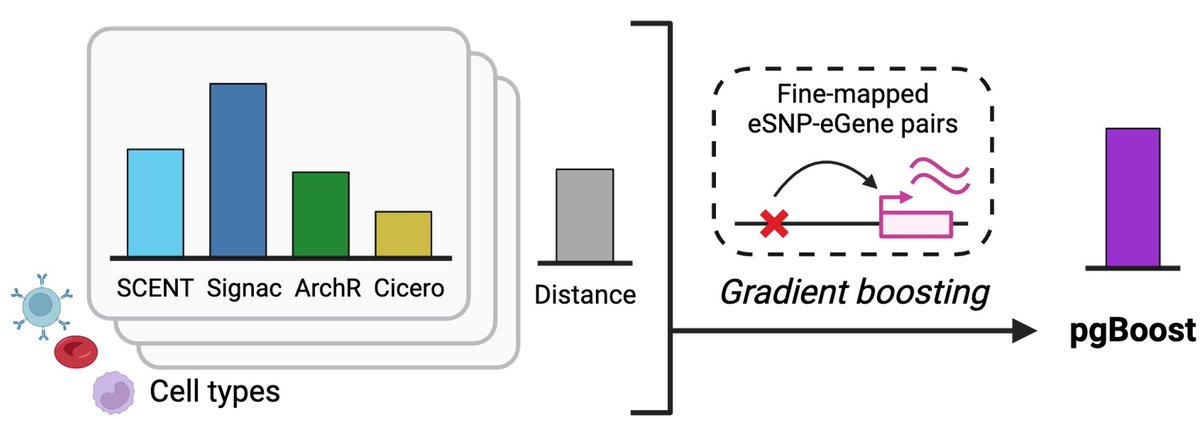
Very excited to share that pgBoost is now published in @NatureGenet !!🧬 pgBoost is a regulatory SNP-gene linking framework combining single-cell multiome methods and genomic distance, informed by eQTL.
Read more here: https://t.co/x3jGVGQ7in
Excited to kick off 2025 with our latest publication! We've developed TGFM, a new statistical method for identifying the causal tissue and gene underlying GWAS disease loci—providing new insights into the biology behind GWAS signals.
https://t.co/Qx5WLtMmjc
https://t.co/VzYFdmjMBb contains All of Us GWAS summary statistics for 14 traits and 3 ancestry-stratified cohorts: Afr47k, Eur116k, and Lat36k. We use these in a revised version of the MultiSuSiE manuscript (not yet posted). Feel free to use these in your own research!
Excited to share our preprint proposing pgBoost, an eQTL-informed gradient boosting model that integrates scores from single-cell enhancer-gene linking methods and genomic distance to predict regulatory SNP-gene links (a key step in interpreting GWAS discoveries)!🧬
1/4
Genome-wide association studies in a large Korean cohort identify novel quantitative trait loci for 36 traits and illuminates their genetic architectures https://t.co/8qIMbXTBu6 #medRxiv
I’m excited to share our latest preprint on fine-mapping causal tissues and genes at disease associated loci using our new method, TGFM https://t.co/ywB2WpdAjr