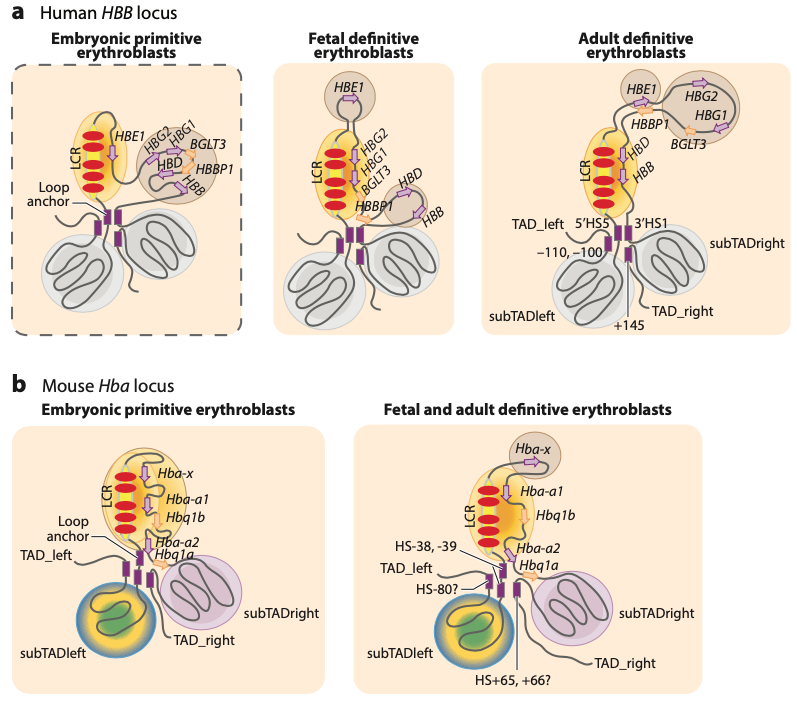
My article "Mechanisms of Globin Gene Regulation in Mammals" in #AnnualReviewofGenetics is available at https://t.co/grOfQdBVaV. It summarizes chromatin architecture, #RegulatoryElements, #TranscriptionFactors, etc., with a theme of similarity of mechanisms. Hope it is useful.
We used the epigenetic state “alphabet” for many analyses of candidate regulatory elements, motifs, etc. between species. The paper is freely available at: https://t.co/u53R1GYgVm.
Some authors @Guanjue, @mahonylab, @KellerCaponePhD, @rajivmccoy, @yuefeng_1, @ychengsy.
Excited that we have a paper coming out in @genomeresearch exploring comparisons of epigenetic landscapes between species to find and better understand gene regulatory elements. https://t.co/u53R1GYgVm
Our sets of candidate cis-regulatory elements (cCREs) in human and mouse blood cells are powerful resources for further research. Their high enrichment in genetic variants associated with blood cell traits suggests they play roles in developing those traits.
Our sets of candidate cis-regulatory elements (cCREs) in human and mouse blood cells are powerful resources for further research. Their high enrichment in genetic variants associated with blood cell traits suggests they play roles in developing those traits.
Focusing on NMF factor 3, associated with positive gene regulation in erythroid cells, brings out the distal element as well as the well-known proximal regulatory elements in the mouse GATA1 gene.
Got genomic data on > 2 conditions or cell types? Use CLIMB to leverage the power of joint analysis for greater precision and finding meaningful clusters in data. Work from Hillary Koch in Qunhua Li's lab collaborating w/ @KellerCaponePhD@rosshardison https://t.co/GU8HLXUenL
@rosshardison That album is just remarkable, and while it was modified in the studio, that it was essentially a live album is amazing. ‘He’s gone’ from that album is just perfect.
Our paper, led by PhD student @SarahTopfer_ is out today in @BloodJournal (https://t.co/jRqENNdLYJ) with a commentary by @rosshardison (https://t.co/CplPUkN1sv), a podcast (https://t.co/E41vHOkg0j) and a great press release by @isadubach!
https://t.co/frU9K9IW2e
@UNSWBABS@UNSW
One of my favorite "things I was wrong about": When I served on @dermitzakis 's PhD committee, I thought variation in gene expression among individuals was just noise in the measurements. Manolis thought they were genetically determined. He was right!. Now you have eQTLs!!
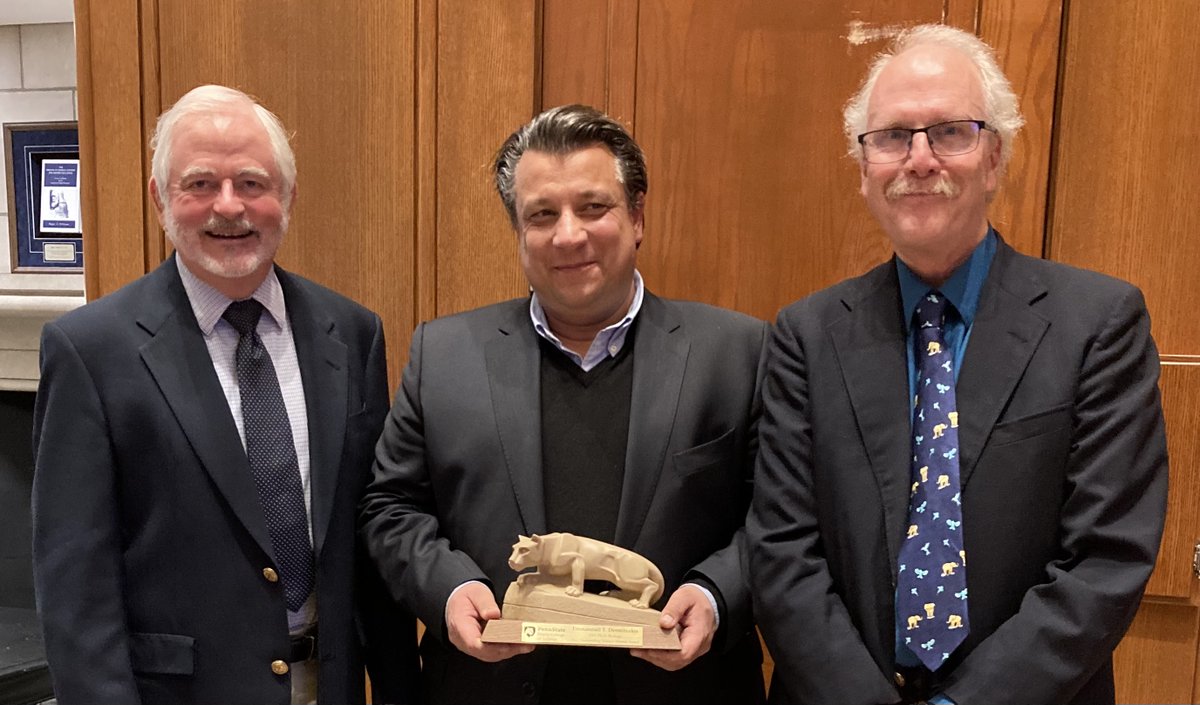
Congratulations to Manolis Dermitzakis @dermitzakis for his Outstanding Science Alumni Award from @PSUScience. He got his Ph.D. here with Andy Clark, with some of the earliest description of variation in gene expression among individuals. Pic with Manolis and Steve Schaeffer.