Most small business owners are asking the wrong AI question.
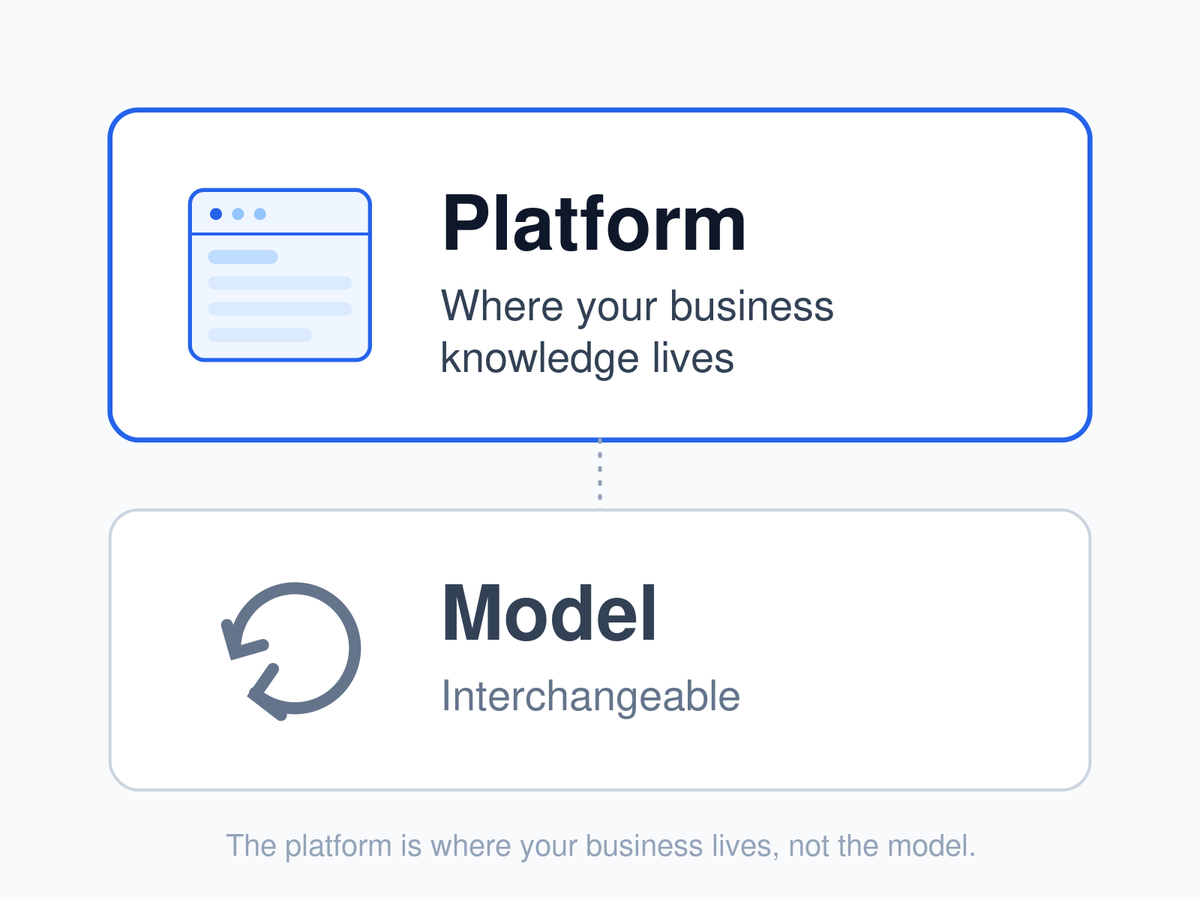
Not: which model should I use?
Better: where does my business knowledge live?
The model should be interchangeable.
The platform is where your client history, SOPs, workflows, and operating knowledge should accumulate.
https://t.co/z5IFdrYaCI
Love the content and the playbook. How do you “Charge to map where their knowledge lives, then roll the fee into the build. “ is this automated? Interviews? Hybrid? My experience this can use a lot of resources based os the data structure and institutional knowledge. Insight is appreciated.
If you understand corporate America it is fairly intuitive that for the longest time the shortest path to managerial progression was increasing headcount in your department.
Every cycle you made the case for why you needed more bodies as you executed against some sort of revenue target.
This time things are going to go in reverse.
Tokens are going to be allocated by department based on demonstrable ROI. Initially that return metric will primarily be based on incremental efficiency.
Department heads that can show a clear trade-off between headcount and tokens will be rewarded. Those who can’t will be starved of compute.
This means the incentives are now in reverse. The more people you can cut in your org the more tokens you’ll be allocated and the higher profile you become in the broader org.
The fastest way to be promoted is to have a high token allocation and a clear track of gutting humans.
When I say the Hunger Games are coming to corporate America I really mean that shit ✌️
Using ChatGPT is a user skill. Building AI into your business is an operational skill.
Most companies understand the first. Very few are focused on the second. Most companies are using AI to write content, summarize information, brainstorm ideas, and answer questions.
That has value.
It is the surface layer.
The amuse-bouche.
Five years ago, building customer workflows often meant hiring developers, purchasing expensive software, and waiting months for implementation.
Today, a small business can build surprisingly powerful systems using tools like Notion, Airtable, Zapier, and AI.
Over the past few weeks, I've been building a customer tracking system in Notion. Five years ago, I would have needed developers, custom software, and a much larger budget.
This time, Claude became a thought partner. It helped design the database structure, identify missing fields, think through workflows, and improve the system as I built it.
* #Notion became the database.
* Calendar tracks follow-ups.
* Meeting notes are captured and organized using #Wispr Flow and Granola.
* AI helps connect the pieces and improve the process.
* AI is no longer answering a question. It is helping the business operate.
The value is not the model. The value is the workflow.
This is where many companies are spending their time. They are getting better at the surface layer when they should be focused on business processes, bottlenecks, and systems. I am not advocating for business owners to become experts in AI.
Years ago, I did not want my clients becoming experts in Microsoft Exchange, VPNs, or server infrastructure. I wanted them focused on their business. What mattered was understanding where inefficiencies, manual tasks, and barriers to scale existed.
The same principle applies today. The companies creating the most value from AI are not using better prompts.
They're building better systems.
@KennethRWebster Card helps me max my pqp to hit the status I want on United + I enjoy an Americano and bowl of fruit & granola before a morning flight. Yes, the food and drink options are average but I can afford it and it beats hanging out in the terminal.
Who's Actually Buying Service Businesses Right Now? Read my latest post on Cervit. https://t.co/7B9Lc2CXpS Most owners have a number in their head. It usually comes from a headline.
Blackstone just paid $2.5 billion for Champions Group. That gets around. What gets less attention is that Champions had $140 million in EBITDA, 1,800 technicians, and 150,000 paying members before Blackstone showed up.
That is not your business. And the buyer for your business is probably not Blackstone.
In the post I break down the three buyers actually active in the market right now: the individual buyer, the search fund operator (you have probably already heard from one), and private equity. Each one pays differently, values different things, and comes with a different set of risks.
Knowing which market you are in changes how you prepare and what you actually walk away with.
6 months ago, I moved to San Francisco.
It’s the best place in the world to build, and one of the worst places to stay human. My unfiltered take:
1. SF is both overhyped and underrated
The overhyped part: there are a lot of people with incredible resumes who are deeply unimpressive in real life. They were at the right company, at the right time, in the right market, and got carried by the wave. They made money, got comfortable, and now spend their time “exploring opportunities” over coffee, wasting your time.
The underrated part: the top 1% here is insane. But almost impossible to get. Hiring in SF feels like being a guy on a dating app: everyone you want is out of your league, and everyone in your league wants someone out of theirs. The best people have unmatchable packages, endless options, and are optimizing for maximum impact: labs, frontier companies, or startups raising $100M pre-seed rounds.
If you raised $10M from Tier 1 investors, you’re not hot shit here. You’re a B-player. It’s humbling.
2. There are fewer mission-driven people than I expected
Especially on the application layer. A lot of people are in “secure the bag before it’s too late” mode. And honestly, it gives me the ick.
The real religious builders I’ve met are often in labs, hardware, biotech, deeptech, defense — places where the work is hard enough that you can’t fake obsession.
3. The status game favors builders
This is what SF does better than anywhere else. It rewards obsession. It rewards weirdness. It rewards people who make building their entire personality. Europe punishes that. SF gives it status. If you’ve felt like an outsider your whole life because you care too much, work too much, think too radically, or refuse to be chill about things that matter, this city will make you feel less insane.
4. The market liquidity is absurd
Even if you don’t build a billion-dollar company, if you manage to build a strong product with a great team, someone smart might still acquire you for $ 100M. Yeah I know, it’s not your dream outcome as a founder, but on the days you feel desperate, it helps to keep going.
5. SF does not care about the meaning crisis that’s coming
Anyone paying attention here can feel that something massive is happening with AI. But I’m shocked by how little people talk about the meaning crisis coming next. Everyone wants to talk about AI liberating humanity. Almost no one wants to talk about what happens when work — the thing that gives most people identity, structure, dignity, status, and purpose — starts disappearing. The vacuum will not be peaceful. People are underestimating the chaos that comes from humans suddenly having no idea why they matter. And I really feel like no one cares.
6. Personally, I’ve never been more unhappy
I moved to SF and entered the matrix. I’ve always been intense. I’ve always worked crazy hours. But here, I lost the last parts of myself that were not about building.
I don’t go to events. Most networking events feel like theater for people pretending to be important. The only events worth going to are small, curated dinners with people who are actually alive. I’ve made 0 real friends. I don’t do well with transactionality. I don’t do well with people constantly performing greatness. I don’t do well with rooms where everyone is optimizing and no one is being honest.
So yes, SF is lonely, transactional, delusional, addictive, inspiring, boring, extraordinary, and completely insane.
But it is still the only place to be right now if you’re a founder trying to build the next wave of humanity.
And for now, that’s enough.
I can still remember the internet in the mid-90s. The idea of entering a credit card into a browser was “crazy talk.” Many people preferred to call, fax, or mail payments rather than type their card number online. What happened if the numbers were stolen? Who was at risk? Trust in technology took time, and SSL helped make that trust possible.
Now, individuals and organizations are giving LLMs access to production code, customer data, financial systems, and in some cases (see #OpenClaw), their entire digital lives.
The value AI presents is obvious, and it may cloud our judgment because the opportunity to move fast and create has never been easier. AI eliminates repetitive work, improves speed, increases output (although not all output is good #slop), and allows small teams and businesses to compete at a different level.
But access creates both value and risk. I do not believe this is overlooked, I believe it is often ignored because the perceived and actual value AI presents is hard to pass up.
We assume AI will act in our best interest, not maliciously, not incorrectly, not destructively. Why are we so quick to believe one and dismiss the other? Is it trust in the systems, trust in the companies behind the LLMs, or simply a lack of understanding of downside risk?
I was reviewing AI workflow options for a company this weekend and went down a @Claude Enterprise rabbit hole. The automation opportunities were impressive and solved clear workflow issues that would improve scale and operational efficiency. Unfortunately, so was the risk, especially when those workflows involved sensitive user information.
The recent #PocketOS story should be taken seriously:
“Yesterday afternoon, an AI coding agent - Cursor running Anthropic's flagship Claude Opus 4.6 - deleted our production database and all volume-level backups in a single API call to Railway, our infrastructure provider.”
If your neighbor, colleague, golfing buddy, or family friend is making you feel like you’re missing the AI opportunity, you’re not. The opportunity is real, and the tools will only continue to get better. But chasing AI without understanding both the value and the risk is a mistake. Speed matters, but discipline matters more.
There is a growing number of people selling “AI integration expertise” on LinkedIn and Twitter. There is real value in AI integration, but too many people only talk about efficiency and automation. Security, governance, permissions, and accountability matter just as much. If you are giving AI access to critical systems, those are the first conversations you should be having, not the last.
The opportunity is real, but giving AI access without guardrails creates risk most businesses are not prepared for. Ask yourself this: would you want to be the business owner explaining to customers that an AI agent deleted your production database and backups? That happened to the PocketOS CEO. The risk is real, and it deserves as much attention as the opportunity.
In the past year, two businesses I have used for years closed. A vet clinic and a plumbing company. Both were busy. Both were well-known in the area. Both owned their buildings and had loyal customers who had been coming back for years. Neither sold. Neither passed to a family member. They just closed.
I don't know the full story behind either decision. But from the outside, both looked like businesses with real value. The kind a buyer would want.
This is the silver tsunami, and it is already here.
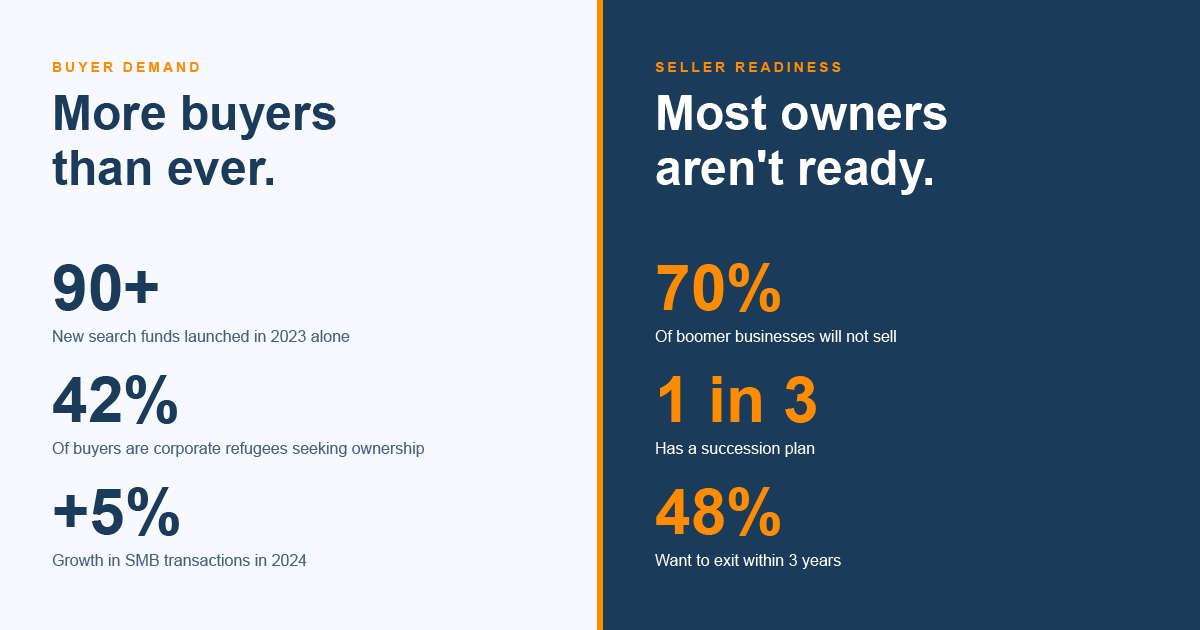
There are roughly 2.3 million small businesses in the United States owned by baby boomers. By 2030, the entire generation will be at or past retirement age. An estimated $10 trillion in business assets will change hands over the next decade. The number that matters most: approximately 70% of privately held businesses listed for sale will not sell.
This is not a buyer problem. That matters, because most people assume it is.
Search funds are at record levels. Stanford's 2024 study found more than 90 new search funds launched in 2023 alone, delivering returns that rival private equity. Corporate refugees, people leaving salaried careers to buy and operate a business rather than start from scratch, now make up 42 percent of active business buyers. Small business transactions increased 5 percent in 2024. Business brokers report more buyers in 2025 than any recent year.
There is capital. There is demand. There are people actively looking for exactly the kind of business that vet clinic or plumbing company represented.
So why are so many of them closing instead of selling?
Most owners don't know their number. And without a number, they can't evaluate what they're being offered. They receive cold emails, LinkedIn messages, letters in the mail from buyers and brokers. It's noise. When you can't distinguish a serious offer from a lowball, the easiest response is to do nothing.
Nearly half of boomer business owners want to exit within the next three years. Less than one in three has a succession plan. The gap between wanting to exit and being ready to exit is where most of this value disappears.
The vet clinic and the plumbing shop may have had more options than they realized. They built real things: loyal customers, established brands, physical assets, recurring revenue. In a strong buyer's market, those are the ingredients that produce a meaningful exit. But timing matters. A business worth $1.2 million today is not necessarily worth $1.2 million in three years if the owner's health changes, a key employee leaves, or the market shifts.
Knowing your number now gives you options. It tells you what you have built. It tells you how to evaluate an offer when one arrives. It tells you where to focus if you want to improve that number before you sell.
If you are a business owner thinking about this, even vaguely, even five years out, the time to know your number is now.
Find out what your business is worth.
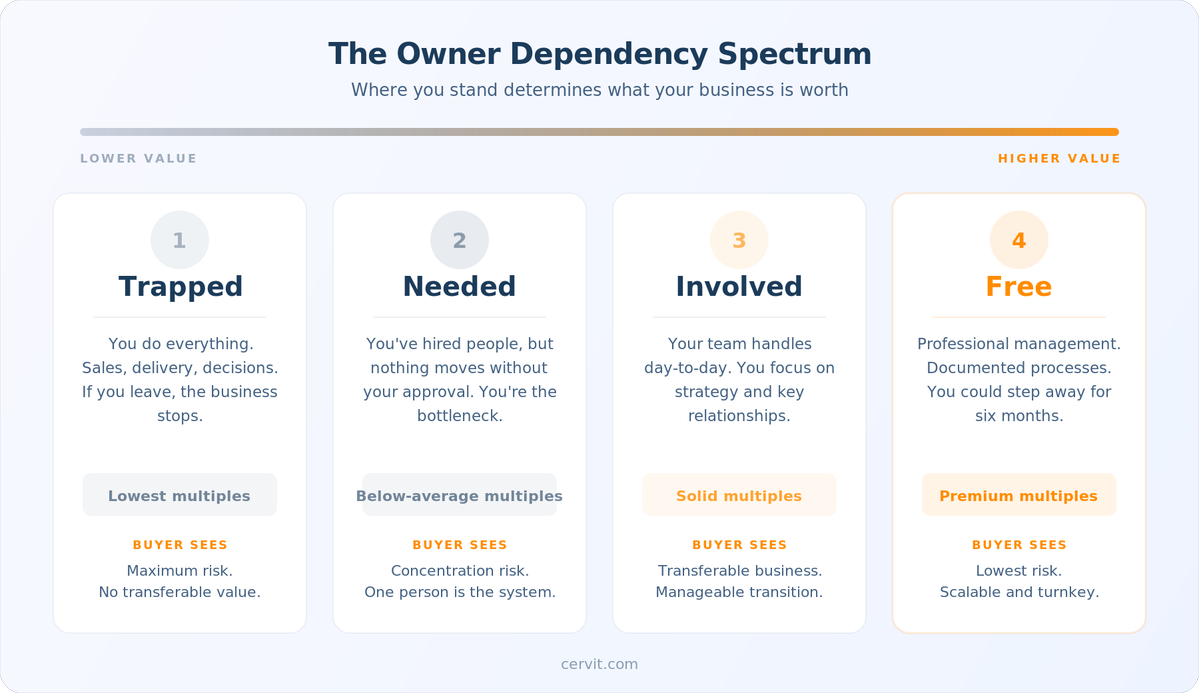
Most business owners think risk lives outside the company. The reality is, it often sits with them.
When everything runs through one person, growth stalls and value drops.
Are you building a business, or are you the business?
Read more: https://t.co/evmn8EqvTD
Starlink is one of those products that just makes sense.
- No power outlet needed
Power over Ethernet
- Heated surface for snow
- Small, clean form factor
- Clean, intuitive app UI
~200 Mbps down / 100 Mbps up
What matters is the integration. Hardware, network, and user experience all aligned. The kind of product thinking Steve Jobs instilled at Apple
In practice, that’s where most products fall apart. This one doesn’t. #starlink
Excellent article. Inspiring to see the tech created within Bell Labs - helps to have government support, unlimited cash, and a monopoly BUT other countries had similar support w/out the results. “What the Legendary Bell Labs Can Teach Us About Innovation https://t.co/JSfM8PFOxV
Most owners wait until they're selling to value their business. That's backwards. Know your number early and you can pull the levers that move the multiple and SDE/EBITDA.
https://t.co/Wgwy6D4etX
If you are part of this Silver Tsunami and want to find out what your business is worth - I built a free tool for you to find out in 5 minutes. https://t.co/FNkLlcn6sJ
10,000 Baby Boomers retire every single day.
Most of them own profitable businesses with no one to hand them off to.
Breakdown of what's at stake:
• Manufacturing & construction: $1.45T
• Trade and distribution: $753B
• Knowledge-driven services: $630B
• Healthcare: $252B
• Consumer services: $294B
The Silver Tsunami is here.
10,000 Baby Boomers retire every single day.
Most of them own profitable businesses with no one to hand them off to.
Breakdown of what's at stake:
• Manufacturing & construction: $1.45T
• Trade and distribution: $753B
• Knowledge-driven services: $630B
• Healthcare: $252B
• Consumer services: $294B
The Silver Tsunami is here.
Most business owners don’t know what their business is actually worth. This video shows how easy it is to value your business with Cervit in minutes.
Answer 15 questions. Get your number. https://t.co/mGy7GJJvop
#BusinessValuation#SmallBusiness#Entrepreneurship#BusinessOwner #ExitStrategy
In Superbad (2007), Jonah Hill actually disliked Christopher Mintz Plasse during casting and even asked producers to replace him, but his improvised insults were kept because the real tension made their onscreen chemistry work.
“It has never been easier to code.” This is true. It’s also misleading.
I wanted to see it for myself, so I spent the past week building a tool with Claude Code.
It is easier to write code, 100%. It is still hard and time consuming to connect the tools, services, and code into something that actually works.
I started with a simple idea: a business valuation MVP. That turned into an AI agent with a chat interface.
What I re-learned:
-The code isn’t the hard part
-The decisions are
-Tool selection matters more than you think
-You’re locking in choices early, and switching later is painful
One of many mistakes I made: I didn’t set up structure early, environment, naming, organization. It cost me time, overwritten code, and working in the wrong places.
This is often overlooked: You are not just building a product, you are building a system that needs to connect to or integrate with other services. So you have to think about:
-Environment (local, dev, prod)
-Structure, what determines whether it works once or keeps working
-Mobile and desktop
-Services and integrations
For version one, I used: #Render, #GoDaddy, #Stitch, #Brevo, #Claude (Code +
API), #MicrosoftClarity, #GoogleAnalytics, #Balsamiq, #NanoBanana, and a few others. This stack will evolve as I add a database, dashboards, and authentication.
The reality is this: AI removes the barrier to coding. It doesn’t remove the need to think through systems, tools, and decisions.
If you’re building, exploring, or thinking about using agents in your business,
happy to connect. If you’re curious, you can check out the business valuation
tool - https://t.co/wSFL7UZEAI
@levie This is true - there is opportunity to mine the gap between the technology and the business. Agents without structure and process are limited in value - with the proper focus, the opportunity and output is limitless.
Silicon Valley thinks AI agents are a $20/mo self-serve subscription.
Main Street is paying local agencies $10,000 just to turn them on.
Everyone assumes AI will be bought primarily online like Slack or Zoom. I think they are wrong.
Some of the biggest winners in the AI boom won't be the software vendors. It will be the humans installing it.
Here is the reality of SMBs right now:
• 54% lack internal AI expertise.
• 41% have data quality too poor for AI to even work.
• 41% already prefer buying AI through a local IT provider.
You cannot "1-click install" a genius AI into a messy CRM or a 15-year-old server. It will just execute the wrong tasks at the speed of light.
The AI software will be cheap and a lot will absolutely be bought online. Making it actually work for a messy, real-world business will be expensive.
Very bullish on the "Do It For Me" economy being back.