Introducing ProtSpace: a tool for visualizing protein embeddings in 2D/3D! 🎨
https://t.co/Wh0tM5Uda8
Try it:
📦https://t.co/UvNd3BJayT
🌐https://t.co/s8AQ6zGYkZ
#Proteomics#DataViz
Very happy to introduce VespaG, for ultra-fast and accurate prediction of protein mutational effects. https://t.co/nyVOyZKrjo. Big thanks to @LiniMuc, Julius Schlensok, and @MarinaAbakarova for the great work and effort. Exciting collab with @rostlab 1/5
@JamesPBLloyd@DdelAlamo@daniela_barilla Yes, each frame is a structure prediction of a point mutation. We recommend using ESMFold instead of AF2, which we have shown in previous work to be more sensitive. It's a lot faster as well.
However, MutAmore can interface with any structure predictor that outputs PDB files.
Our new bilingual protein language model (pLM), ProstT5, translates between protein sequence and structure. Besides producing more structure-aware embeddings that are better at remote homology detection than sequence-pLMs, its translation capability enables inverse folding.
3/3 This study showcases the combined power of cutting-edge AI, traditional phylogenetics and manual annotations to unravel complex biological phenomena, such as evolution of protein function. Stay tuned for more! 📚🌟 #ScienceTwitter#Toxinology
1/3 🐍🧬 Exciting breakthrough in #SnakeToxins research published in #NatureCommunications! An international team led by Rostlab members unlocked the mysteries of three-finger toxins (3FTxs), from the venom of caenophidian snakes. 🔬#VenomResearch https://t.co/P28ruLZkl9
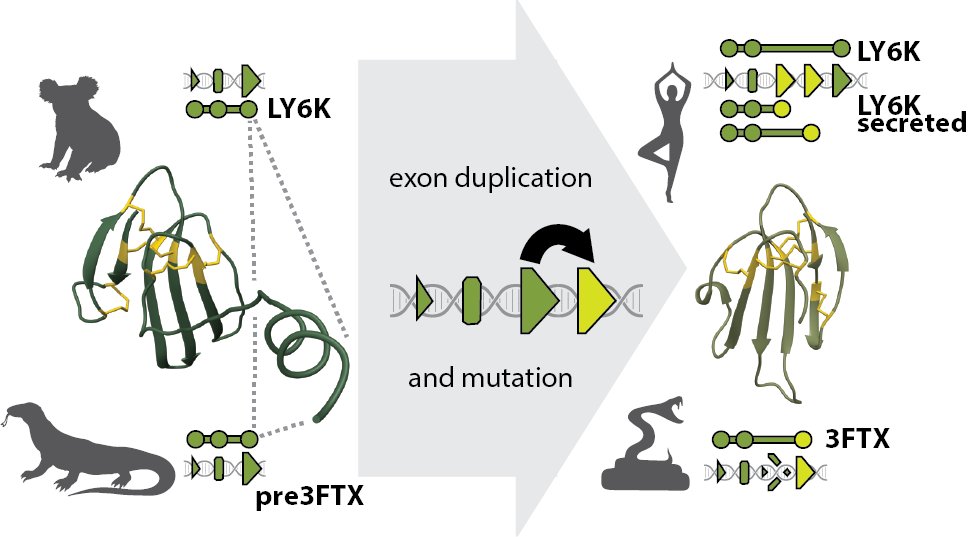
2/3 🔍Immediate ancestor of these toxins? A non-secretory, non-toxic Ly6, unique to squamate reptiles. Mechanism? Exon duplication followed by mutation led to novel forms with a membrane anchoring domain lost. 🧩 #Evolution#ReptileScience
We (@lindner_seb, @HeinzingerM) introduce REXzyme, a new model for the generation of enzymes that catalyze user-defined chemical reactions. We'd like that the community can benefit as soon as possible from it, so we made it available in HuggingFace: https://t.co/tm526yit5D.
Synteny analyses, phylogenetics and pLMs reveal that 3-finger-toxins evolved from a transmembrane "pre-3FTx" ancestor that gained increased affinity for nAChRs and lost its transmembrane region. #snakevenom#geneevolution#machinelearning
Did you know that 3-finger toxins in snake venoms evolved from a non-secretory ancestor? Our new preprint explores this gene family's evolution. Check it out here: https://t.co/Sgz5Qj8UgG #geneevolution#proteinlanguagemodels#transmembranehelices
Contrary to previous hypotheses, our research suggests that 3-finger toxins in snake venoms evolved from a single-copy gene unique to Toxicofera reptiles, not monomeric neuromodulatory Ly6s like LYNXs or SLURPs. #snakevenom#geneevolution#proteinfamily
Is ColabFold's MMseqs2-based MSA generation protocol suitable for mutational outcome prediction? Yes! Joint work by @MarinaAbakarova and Céline Marquet. 1/2
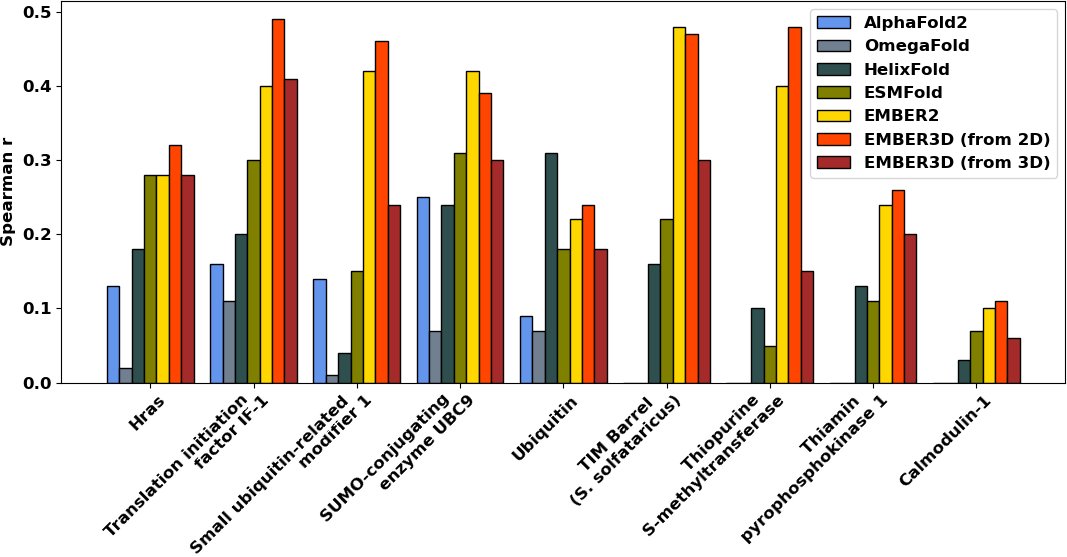
EMBER3D can predict mutated structures of all single amino-acid variants in an average length protein in a matter of minutes. When correlated with deep mutational scanning experiments, EMBER3D predictions are much more sensitive to small changes in sequence than other systems.
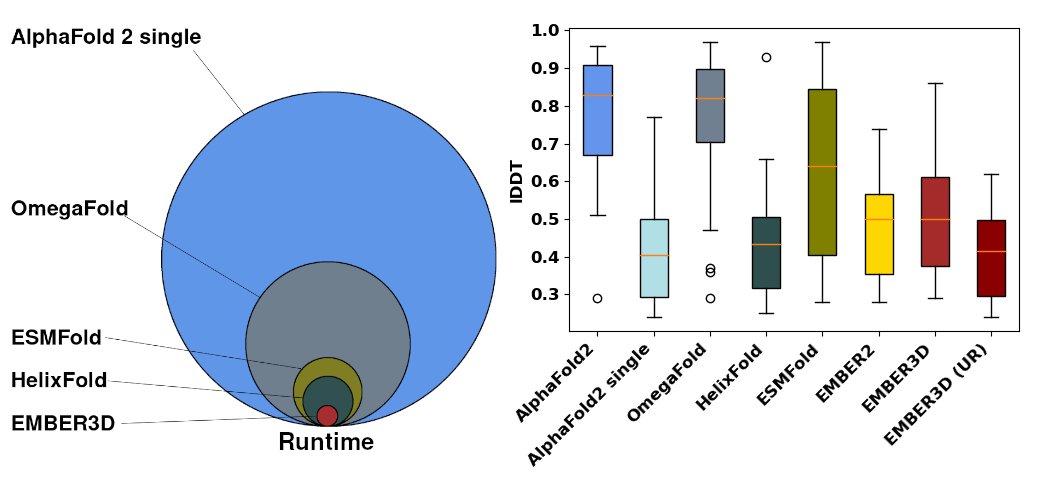
EMBER3D predicts protein structure in fractions of a second with high sensitivity to small changes in sequence.
Protein Mutation Movies (PMMs) visually capture the effects of amino-acid substitutions.
https://t.co/IhgXEMidFW via @YouTube
Trading accuracy for speed, EMBER3D runs orders of magnitude faster than competing models while maintaining reasonable performance (although nowhere close to Alphafold2).