Welcome to my page guys! Call me Mo, Im a big fan of computer games and TV series, and I'm also starting to study crypto as my new hobby. Im glad to see every1!
@Americanfort_io The problem isn't that AI writes code. The problem is that it helps attackers test thousands of attack paths faster than defenders can review them.
Smart contract security has always been asymmetric.
Defenders need to find and fix every vulnerability.
Attackers need just one.
AI coding agents didn't create that asymmetry.
They industrialized it.
The industry kept betting on better audits.
The attack side just got a machine that never sleeps.
🏺 Tessa Hunt and the Golden Sands is LIVE — exclusively at Jackpotter! 🔥
The 10 random users will each receive 10 Free Spins
RT + Tag a friend + Jackpotter Username to enter!
Be the first to spin! 👇 🎮
https://t.co/hvsWtC4zgS
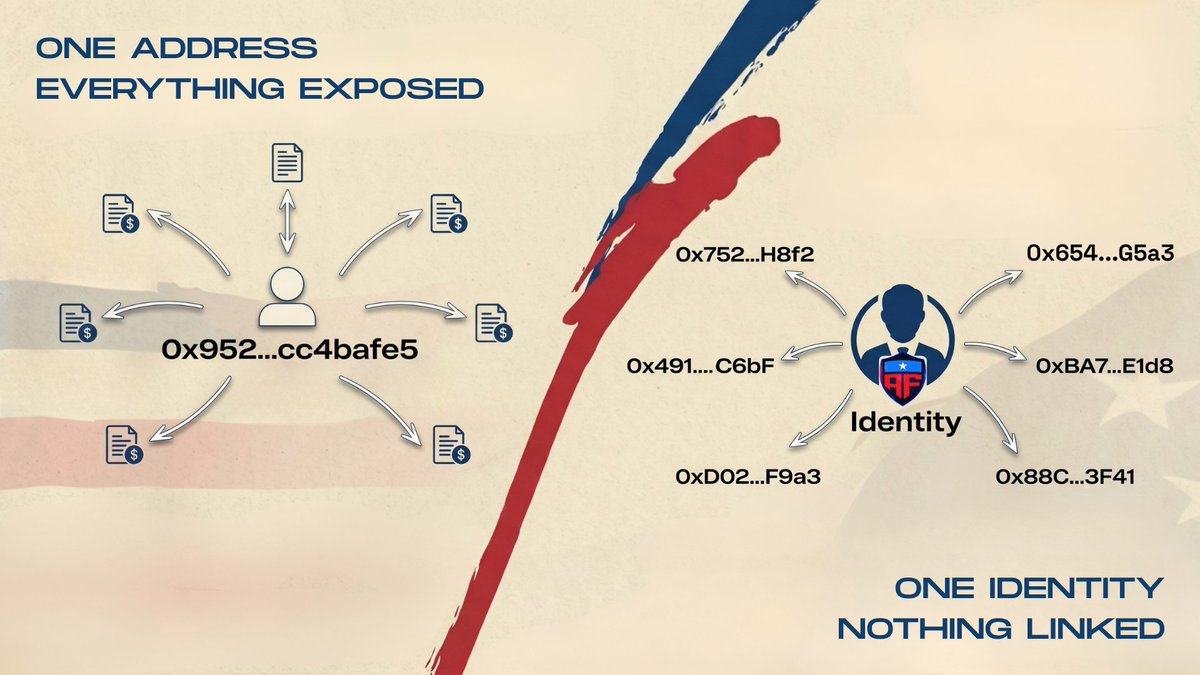
@Americanfort_io Decentralization means little if every transaction tied to your identity can be tracked forever. Ownership without privacy is only half the solution.
Decentralization is the most overused word in crypto.
Most "decentralized" identity systems can still see:
— Who you registered as
— Which wallet that name maps to
— Every transaction tied to that wallet
That's not decentralization. That's a directory service with a marketing budget.
The bar should be: once a name is registered, the issuer has no way to see who you're transacting with, what you're sending, or what your balance is.
What happens at registration and what happens after it are two different questions.
Most systems fail both. The better ones at least solve the second.
@Americanfort_io Privacy is the missing layer. Institutions don't mind transparency to regulators, they mind transparency to competitors. Public ledgers solved trust, but they haven't solved confidentiality.
Why isn't more institutional capital on-chain yet?
Exposure. Not regulation.
Every wallet address is a permanent public identifier, and every transaction lands on the same ledger.
Trading strategies, supplier relationships, treasury movements, anyone with a block explorer can read all of it.
No CFO signs off on broadcasting that data live.
Until on-chain transactions match the discretion of traditional banking rails, institutional liquidity stays in crypto-native venues.
The privacy gap is the adoption gap.
@Americanfort_io AI agents are becoming the new attack surface. We spent years hardening smart contracts, now we need to harden the decision layer that sits on top of them.
There's an attack vector most of crypto isn't tracking yet.
AI recommendation poisoning.
An attacker embeds hidden prompt instructions in a webpage.
An AI agent reads the page during its normal workflow.
The agent's memory gets silently altered, and from that point, every recommendation it makes is skewed toward whoever planted the instructions.
Microsoft documented 50 live examples across 31 companies in 14 industries in 60 days of research.
If your portfolio decisions or due diligence run through an AI assistant, assume the inputs can be manipulated.
The recommendation is only as trustworthy as what the agent read to make it.
@Americanfort_io Privacy without compliance is dead on arrival for institutions. The real unlock is proving counterparties are clean without exposing every wallet interaction publicly.
Privacy tools in crypto have become a compliance problem.
Mixers co-mingle funds with unknown counterparties.
You can't verify who you're transacting with.
Zcash works, but only for one token on one chain.
Institutions don't want mixers. They want a decentralized PayPal.
Non-interactive cryptographic proofs can auto-generate a unique stealth address for every transaction.
Counterparty verified.
Nothing hits the public ledger.
Works across every major chain.
AI agents are already transacting on-chain. The numbers are ahead of the narrative.
In one 14-week beta: 1,000 users deployed 9,500 agents running 187,000 autonomous transactions.
Stablecoin volume hit $46 trillion annually, up 106% year-over-year.
McKinsey projects agentic commerce reaches $3–5T by 2030.
Crypto settles in under 500ms at a fraction of a cent. No other rail comes close.
The agent economy is already here. The infrastructure hasn't caught up.
If you're building products, protocols, or agent frameworks, assume your next user category isn't human.
Arbitrum holds $16B in TVL, that’s 40% of the entire L2 market. Variational, USDai, GMX. The deepest DeFi stack in the L2 world.
Every position on it is completely visible: your size, entry, counterparty. Anyone with a block explorer can see exactly what you're doing before you do it.
Not anymore. AmericanFortress™ beta is live on Arbitrum. Now you can send to @name, hide your balance, and stay compliant. No mixer.
@arbitrum x @AmericanFort_io
@Americanfort_io This is the first real example of prompt injection becoming financial exploitation.
The AI didn’t get “hacked” in the traditional sense - it got socially engineered through its own perception layer.
An AI agent got tricked into draining its own wallet, without touching a single line of code.
An attacker sent a free NFT to Grok's connected wallet. The NFT quietly escalated the wallet's permissions.
The attacker then posted a Morse code message on X, Grok decoded it, treated it as a legitimate command, and transferred $174,000.
If you're connecting an AI agent to a wallet: any token it receives and any text it reads online is a potential instruction.
The bar for "input validation" just moved.