Anthropic acaba de publicar que el Gobierno de Estados Unidos le obligó a suspender el acceso a sus modelos Fable 5 y Mythos 5 para cualquier extranjero, incluso empleados extranjeros de Anthropic dentro de la propia empresa. Si esto se confirma tal como lo describe Anthropic, es una señal enorme para Europa. Durante años Bruselas confundió poder tecnológico con regular la tecnología de otros. Pero el poder de verdad es poder fabricar chips, comprar energía barata, entrenar modelos, atraer ingenieros y decidir quién puede usar la herramienta. La IA ya no es solo software. Es infraestructura crítica, como electricidad, telecomunicaciones o satélites. Un hospital, un banco, una fábrica o un ejército que depende por completo de modelos que otro país puede apagar con una orden administrativa no es autónomo. Europa no necesita otro documento grandilocuente sobre soberanía digital. Necesita capital, energía, centros de datos, universidades más conectadas con empresas y menos miedo al éxito privado. Regular sin construir es una forma elegante de aceptar dependencia.
New supply chain attack this time for npm axios, the most popular HTTP client library with 300M weekly downloads.
Scanning my system I found a use imported from googleworkspace/cli from a few days ago when I was experimenting with gmail/gcal cli. The installed version (luckily) resolved to an unaffected 1.13.5, but the project dependency is not pinned, meaning that if I did this earlier today the code would have resolved to latest and I'd be pwned.
It's possible to personally defend against these to some extent with local settings e.g. release-age constraints, or containers or etc, but I think ultimately the defaults of package management projects (pip, npm etc) have to change so that a single infection (usually luckily fairly temporary in nature due to security scanning) does not spread through users at random and at scale via unpinned dependencies.
More comprehensive article:
https://t.co/EJAZbqAPIQ
Yo fui ingeniero en Meta, y siempre seguía FAIR desde adentro. Lo que acaban de publicar es la versión que les dejan publicar.
Pero con eso, es más que suficiente para decirles exactamente que es lo que está pasando.
TRIBE v2 predice, vértice por vértice sobre la corteza cerebral, qué zonas activa cualquier video.
Sin escáneres. Sin humanos.
Subes el contenido, obtienes el mapa neural (activación emocional, supresión de razonamiento crítico, modulación prefrontal) antes de que el video lo vea un solo usuario.
Ahora considera la posición de Meta:
1. Tiene años de datos de Reels sobre qué contenido retiene atención, genera enojo, provoca compartir.
2. Saben empíricamente qué funciona. TRIBE v2 les da el mecanismo causal de por qué funciona (a nivel de tejido cortical) Eso convierte correlación histórica en capacidad predictiva sobre contenido nuevo.
3. Internamente hay herramientas que se llaman Gatekeepers y Quick Promotions que sirven para inyectar contenido en el feed de poblaciones arbitrarias a escala.
4. Simulador de respuesta cerebral + conocimiento empírico de contenido efectivo + maquinaria de distribución selectiva. El pipeline está completo.
Y luego está Thiel. Inversor y amigo personal de Zuck. Fundador de Palantir, cuyo negocio es análisis de poblaciones a escala para gobiernos e inteligencia.
NO es descabellado observar que confluyen los incentivos de plataformas construidas por las mismas personas.
La licencia CC BY-NC dice que Meta retiene los derechos comerciales del predictor de respuesta cerebral más preciso jamás construido.
Y recuerda, esto es lo que decidieron hacer público.
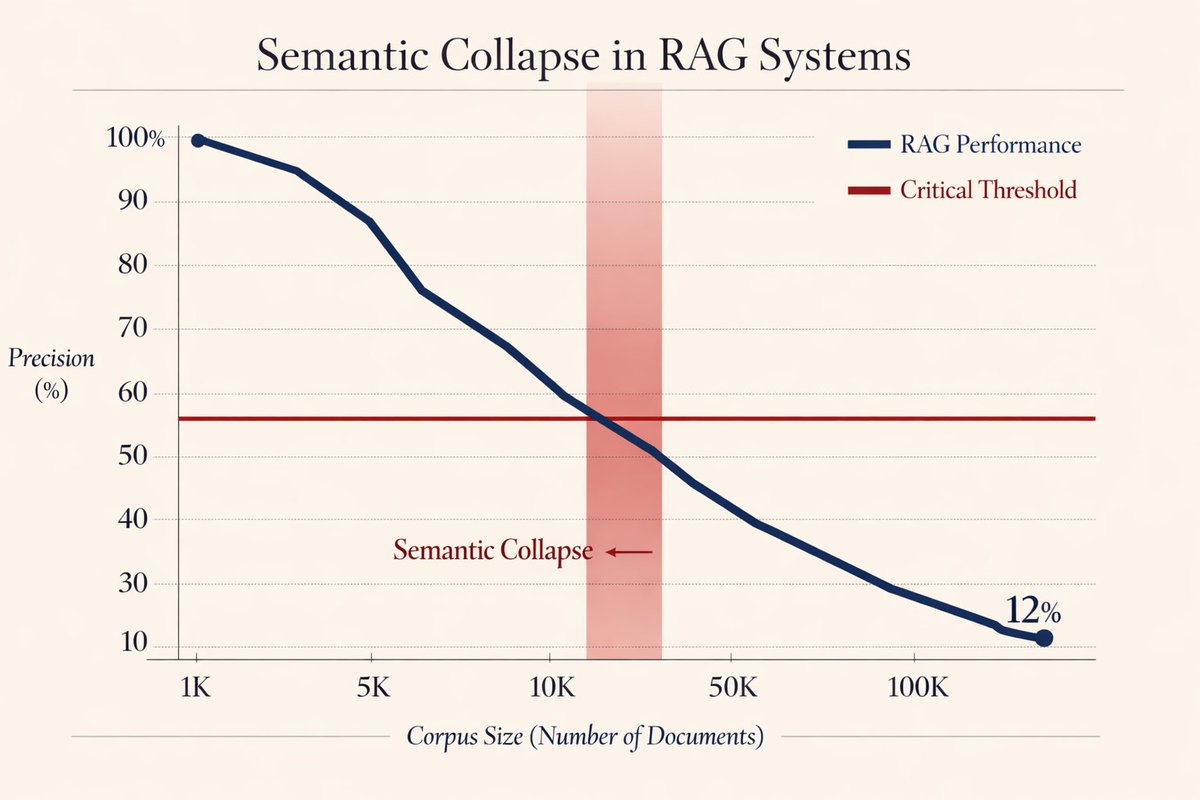
🚨 RAG is broken and nobody's talking about it.
Stanford just exposed the fatal flaw killing every "AI that reads your docs" product.
It's called "Semantic Collapse", and it happens the moment your knowledge base hits critical mass.
Here's the brutal math (and why your RAG system is already dying):
Hackers aren’t after people anymore — they’re after bots.
API keys and tokens now run much of your SaaS, often with full access.
One stolen token let attackers break into hundreds of Salesforce accounts.
See how it happened ↓ https://t.co/BAPEXlcAJf
Lo que estamos viendo no es un proceso natural, sino un colapso administrado, producto de decisiones políticas e intereses particulares envueltos en un gran fraude moral. https://t.co/tgsgZogpW2
🚨 ALERT: China-linked hackers are exploiting unpatched SharePoint servers to drop Warlock ransomware.
They’re using legit tools like PsExec, Mimikatz & IIS hijacking to stay hidden.
Even patching may not kick them out.
Full story → https://t.co/t2e0yr6nUm
I’m excited to be the Chief AI Officer of @Meta, working alongside @natfriedman, and thrilled to be accompanied by an incredible group of people joining on the same day.
Towards superintelligence 🚀
En el apagón no funcionaron los semáforos de TODO el país y, aun así, apenas hubo accidentes. Como si condujésemos mejor *sin* semáforos.
¿Sabéis por qué? Por una fuerza invisible que gobierna TODOS NUESTROS MOVIMIENTOS: la psicología de la percepción.
Esto os va a molar 🧵⤵️
A couple reflections on the quantum computing breakthrough we just announced...
Most of us grew up learning there are three main types of matter that matter: solid, liquid, and gas. Today, that changed.
After a nearly 20 year pursuit, we’ve created an entirely new state of matter, unlocked by a new class of materials, topoconductors, that enable a fundamental leap in computing.
It powers Majorana 1, the first quantum processing unit built on a topological core.
We believe this breakthrough will allow us to create a truly meaningful quantum computer not in decades, as some have predicted, but in years.
The qubits created with topoconductors are faster, more reliable, and smaller.
They are 1/100th of a millimeter, meaning we now have a clear path to a million-qubit processor.
Imagine a chip that can fit in the palm of your hand yet is capable of solving problems that even all the computers on Earth today combined could not!
Sometimes researchers have to work on things for decades to make progress possible.
It takes patience and persistence to have big impact in the world.
And I am glad we get the opportunity to do just that at Microsoft.
This is our focus: When productivity rises, economies grow faster, benefiting every sector and every corner of the globe.
It’s not about hyping tech; it’s about building technology that truly serves the world.
"Move 37" is the word-of-day - it's when an AI, trained via the trial-and-error process of reinforcement learning, discovers actions that are new, surprising, and secretly brilliant even to expert humans. It is a magical, just slightly unnerving, emergent phenomenon only achievable by large-scale reinforcement learning. You can't get there by expert imitation. It's when AlphaGo played move 37 in Game 2 against Lee Sedol, a weird move that was estimated to only have 1 in 10,000 chance to be played by a human, but one that was creative and brilliant in retrospect, leading to a win in that game.
We've seen Move 37 in a closed, game-like environment like Go, but with the latest crop of "thinking" LLM models (e.g. OpenAI-o1, DeepSeek-R1, Gemini 2.0 Flash Thinking), we are seeing the first very early glimmers of things like it in open world domains. The models discover, in the process of trying to solve many diverse math/code/etc. problems, strategies that resemble the internal monologue of humans, which are very hard (/impossible) to directly program into the models. I call these "cognitive strategies" - things like approaching a problem from different angles, trying out different ideas, finding analogies, backtracking, re-examining, etc. Weird as it sounds, it's plausible that LLMs can discover better ways of thinking, of solving problems, of connecting ideas across disciplines, and do so in a way we will find surprising, puzzling, but creative and brilliant in retrospect. It could get plenty weirder too - it's plausible (even likely, if it's done well) that the optimization invents its own language that is inscrutable to us, but that is more efficient or effective at problem solving. The weirdness of reinforcement learning is in principle unbounded.
I don't think we've seen equivalents of Move 37 yet. I don't know what it will look like. I think we're still quite early and that there is a lot of work ahead, both engineering and research. But the technology feels on track to find them.
https://t.co/JCxTdKpuzv
I see so much FUD (fear, uncertainty, doubt) about the future of sw engineering, mostly from non-devs. Along the lines of “soon anyone can spin off AI agents in bulk that act as hundreds of devs.”
A false premise. Just open your airline app that is built by ~hundreds of devs.
"Europa está creando una nueva clase dirigente que no legisla ni presta servicios. Lo que hacen es marcar casillas y poner sellos de aprobación. Son los responsables de garantizar que los demás cumplan las normas". Escribe @lugaricano https://t.co/ZHW95mrykT
@armesillaconde Los ingenieros forestales dicen, decimos, exactamente lo contrario a lo que pones en nuestra boca. Restauraciones hidrológico-forestales, incluyendo diques, y limpiezas en los montes son pilares en nuestra actuación. Me gustaría conocer tus fuentes.