@exfatloss Would adding tomato sauce with a n6:n3 ratio of 27:1 to each rice meal mess up the ratio for those 16 hours, even though it only adds ~1.5g LA in total? Minor in comparison to the total LA released from bodyfat during the night, but that timing matters more?
@exfatloss I wonder if for AA:EPA ratio the time duration on a ratio might matter more than total AA+EPA. Like on plain rice, frequent rice meals giving like 16 hours a day of very low fat in circulation but with good PUFA ratios, and 8 hours at night at a bad ratio due to released bodyfat?
@trikomes Seems like high PUFA is suited for a cold and dark environment with food scarcity. And that a shift to more elongated and desaturated PUFA is suited for even colder and darker times? Providing tolerance for lower body temp and thus requiring less fuel usage for thermogenesis.
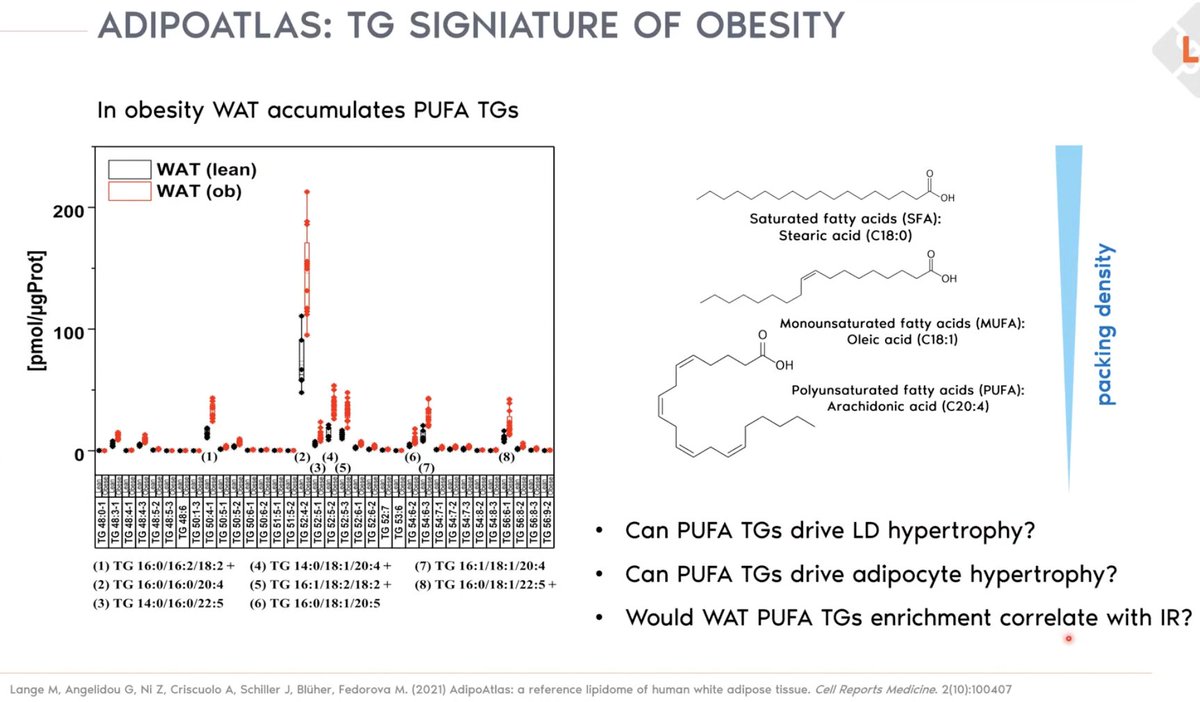
@nicknorwitz Adipose tissue of obese people shows higher levels of PUFA and is associated with hypertrophy. So reducing omega-6 seems sensible instead of merely raising omega-3.
https://t.co/vc3iifyyUk
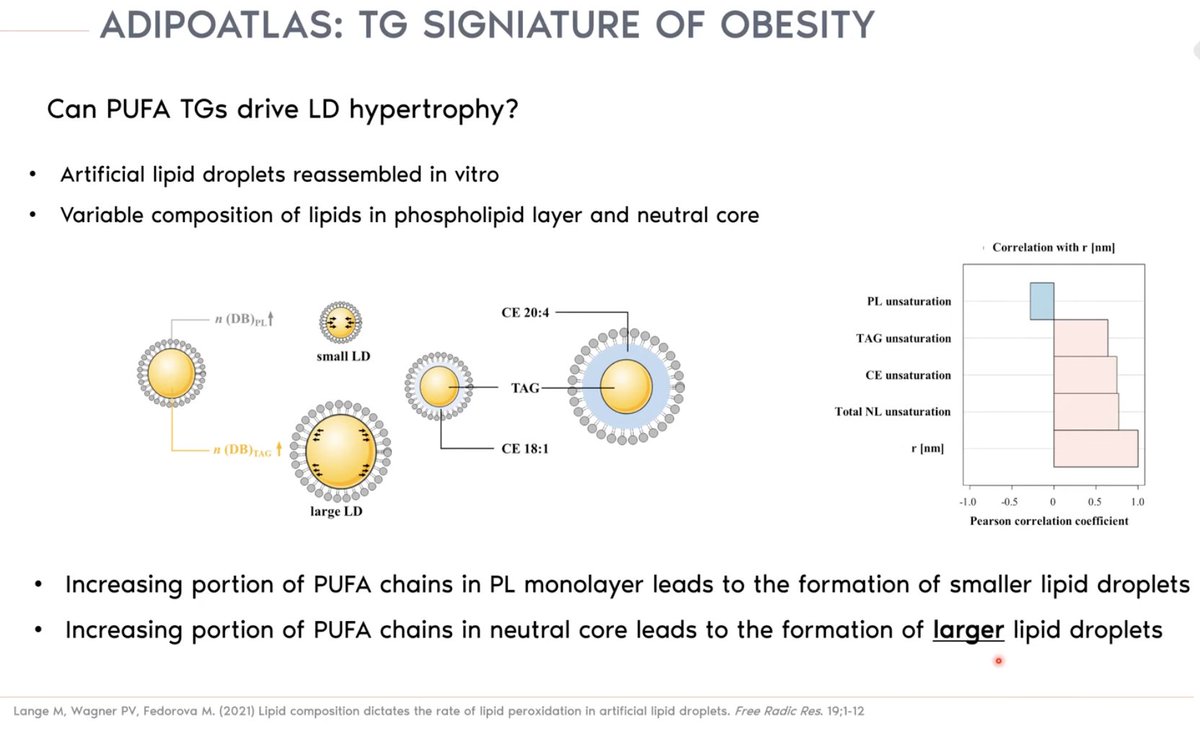
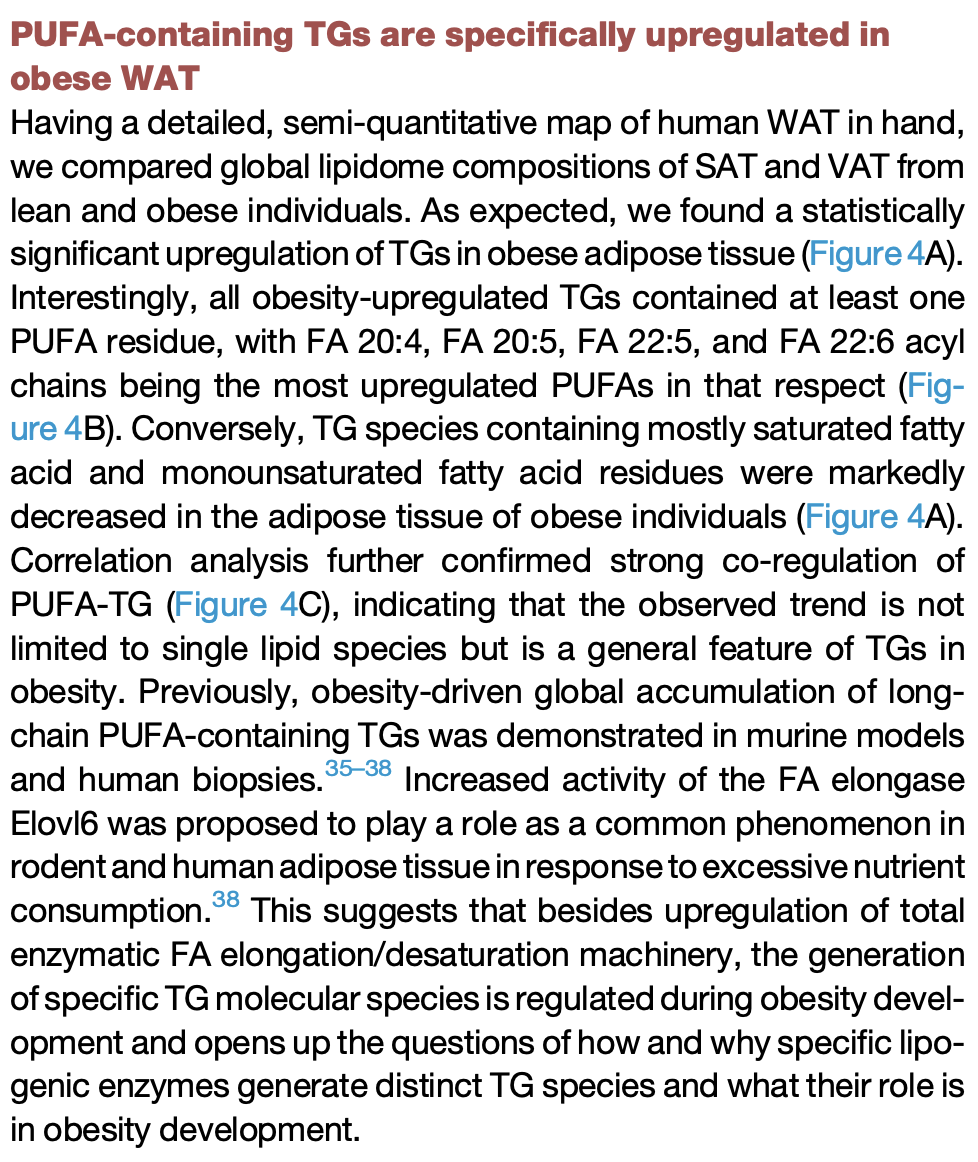
This AdipoAtlas study from the @FedorovaLab compares WAT of lean and obese humans, which shows that all the obesity-upregulated triacylglycerols contained at least one PUFA, and that higher ratios of such PUFA-TGs result in larger lipid droplets, and they wonder if that could drive adipocyte hypertrophy.
Slides below from this presentation (skip to 34:19):
https://t.co/coyLdzf5l4
Paper: https://t.co/nzrv8K8qVN
That upregulation of the triacylglycerol 16:0/16:0/20:4 (Arachidonic Acid) in WAT of obese, could be from LA desaturase activity which @fire_bottle has mentioned.
@exfatloss@trikomes Tomato sauce is concentrated, so maybe ~0.2g LA per 100g sauce? 700g per day would be ~1.5g LA (27:1).
White rice seems to have a much better n6:n3 ratio of ~5:1, 0.146g LA per 100g raw white rice. 6 cups = ~800g, so ~1.2g LA (5:1).
@exfatloss@trikomes It seems allowed to call it fat-free if it contains less than 0.5g fat per serving size (~100g?). So maybe they don't add fat, but don't remove the fat from cell membranes and seeds? Tomatoes seem to have a n6:n3 ratio of ~27:1, PUFA ~60% of total fat (source: USDA).
@exfatloss@trikomes Maybe your bodyfat released a AA:EPA (precursor) ratio higher than 35:1 when you did the 5-day fast? Low omega-6 diets seem insufficient to fully correct that balance, requires more EPA (precursor)? Fat-free tomato sauce is a lie, contains a significant amount of LA in high dose?
@exfatloss@trikomes On a low omega-6 diet a 100g of salmon once a week might already be sufficient to go from unbalanced to balanced, without going from adequate to high though. For both: Would you rather remain unbalanced and adequate than including 100g of salmon once a week?
@trikomes@exfatloss If sufficient ARA can result in end product feedback inhibition of the desaturation enzymes that produce EPA, then the difference between zero and low omega-6 intake can make a big difference on ARA:EPA when intake contains EPA precursors but little EPA?
@trikomes@exfatloss That makes it interesting to report the observation that ARA:EPA improved to ~16:1 after the plain white rice experiment (zero LA and ARA?), while after ex150hclf (low LA and ARA?) that ratio worsened to ~27:1, is that correct? Maybe include results in the annotated weight graph.
@deniseminger Burden of proof is still on: introducing high amounts of LA into our diet for decades being healthy. "Needs more study" may be all we can really conclude so far. Innocent until proven guilty is a risky strategy for novel food components or quantities. There's reason for concern.
@exfatloss@mold_time Interesting, that does seem like your body signalled that potatoes don't go down well in your case, despite our best attempts to make them addictive and easy to overeat. Also.. the French would like to have a word about you leaving the skin on when making mashed potatoes.
@exfatloss That time I started from around 28% bodyfat. Could also be that the fat composition was not as bad, or maybe a more favorable distribution? Hard to compare even between different weight loss attempts using the same diet on myself.
@exfatloss Still that last 10kg took 9 months. Later I regained that weight mostly by eating chocolate and then shortly after losing it again in just 3 months! Better fat composition, fat had been in there for months instead of years, stored in functional adipocytes instead of hypertrophic?
@exfatloss Maybe I benefitted from starting with salmon, resolving dysfunction early on instead of picking all the low hanging fruit first? Allowing me to drop down to ~12% bodyfat with minimal intermediate weight plateauing 🤔