— On ne peut pas virer Marc, on a trop besoin de lui !
— Mais pourquoi ? Ça fait plus d'une décennie qu'il occupe son poste et il n'est pas vraiment productif.
— Tu ne comprends pas. Il est le seul qui maîtrise le logiciel des stocks.
— Attends... Tu veux dire que Marc est le seul à pouvoir nous informer précisément sur la quantité de nos marchandises ?
— C'est exactement ça. Ses compétences sont uniques. Il est intouchable.
Assis dans son canapé, Marc buvait un café tout en se plongeant dans un film via son casque de réalité virtuelle.
Il n'avait véritablement qu'une journée de travail par mois, celle où il traitait les inventaires.
Là, il ouvrait un logiciel que plus personne ne connaissait.
Dans la cellule B100, il inscrivait la formule =SOMME() et validait.
Puis, il effaçait la formule et souriait, satisfait. Quelle chance pour lui. Dans ce monde de 2415, il était le dernier à maîtriser Excel.
The way Datadog calculates percentiles at scale is very innovative 🔥
Usually, calculating the percentiles of large datasets is very expensive.
To know the 99th percentile of a stream of values, you need to:
- keep all the values
- sort them
- return the value whose rank matches the percentile (e.g 99th item)
Datadog cannot afford to do this with the many millions of data points that come in every second - the space and CPU requirements are not practical for a company with thousands of customers. 🐾
Naturally, they opted for sketch algorithms - those should provide them with a good-enough probabilistic result while being vastly more efficient to compute.
Unfortunately - they couldn’t get satisfactory results.
The algorithms would produce results that were too inaccurate. ❌
Why?
Many percentile sketches had guarantees in terms of *rank error*.
A rank-error guarantee of 2% means that the p95 value returned by the sketch is somewhere between the p93-p97 value.
But system latencies exhibit very fat tails - the difference between the p97 and p99 values can be 2-10x!
So what did the dogs do? 🐶
They invented a new sketch algorithm - DDSketch.
Instead of rank error guarantees, they designed it for *relative error* guarantees.
If the p99 is 60s, a 2% error means the sketch would return 58.8-61.2s.
The algorithm is surprisingly pretty simple:
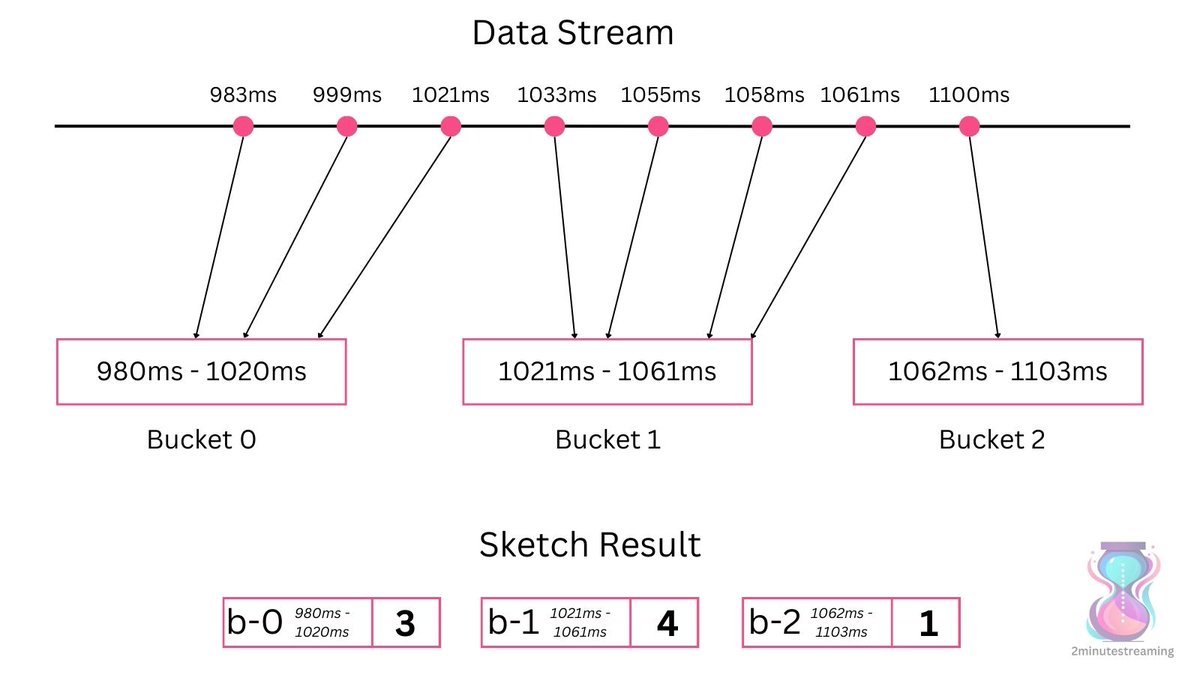
• They create buckets covering ranges of the desired error rate. (+- 2% in this case) 🪣
• Each bucket keeps a counter of the amount of data points within that range. 💯
• When processing an item (latency metric data point), increment the counter of the appropriate bucket. ➕
• To count the desired percentile, you sum up the bucket’s values until you get to the desired percentile. Whatever bucket that percentile is in - that’s your value. 🏆
In this example, the 50th percentile is 1033ms. (4th value out of our total of 8)
Going by count, the 4th value is in the second bucket (b-1) and the algorithm would produce a result of 1021-1061ms.
To cover the range from 1 millisecond to 1 minute, you only need 275 buckets.
With 64-bit counters, that's just ~2kB of memory, regardless of the amount of input data.
This is why we call sketch algorithms sublinear in space growth - memory requirements do NOT grow linearly with input.
The exponential nature of the bucket distribution makes it cheap to cover an even wider range: 1 nanosecond to 1 day takes just 3x more buckets:
• 802 buckets at ~6kB.
As you can probably tell, this is pretty easy to parallelize.
You can divide this bucket-building exercise into many parallel lightweight substreams, and then merge the results freely. 🕊
The merge operation is a simple sum of the buckets & their counters, which ensures that the accuracy is kept in the same range.
It is a very scalable and performant sketch algorithm.
Kudos to Datadog for inventing it.
Good boy! 🫳🐕🦺
Dernier petit projet #Domotique : un garage automatique pour Doby, mon robot aspirateur ! 🤖
Madame ne pourra plus râler que ça prend de la place et que c’est disgracieux dans un salon 😅
Quelques finitions et ça sera parfait ! 🤩
I hacked into a @Bing CMS that allowed me to alter search results and take over millions of @Office365 accounts.
How did I do it? Well, it all started with a simple click in @Azure… 👀
This is the story of #BingBang 🧵⬇️
Mario Kart 8 suspendu à cause d'une faille de sécurité critique🕹️
Le multijoueur aurait été désactivé à cause d'une RCE (Remote Code Execution). Une vulnérabilité permettant à un joueur de prendre le contrôle de votre console simplement en jouant contre vous
Explications 🧵⬇️
@mjovanovictech Nice thread! How would you receive events in the application then? Which pattern do you recommend to achieve this purpose in addition to the Outbox pattern?
How does the scheduler work in Kubernetes?
The scheduler is in charge of deciding where your pods are deployed in the cluster.
It might sound like an easy job, but it's rather complicated!
Let's dive into it.
Most Kubernetes users are familiar with kubectl util, but did you know you can extend your kubectl?
In this article you'll have a look at 6 kubectl plugins:
- Kubepug
- Rakkess
- Ketall
- kubectl-Score
- kubectl-tree
- Outdated
➜ https://t.co/nhTwcKHl0R
J'ai trouvé un site qui regroupe +30000 icônes GRATUITES sous plus de 30 collections différentes sous licence MIT exportable en SVG ou en téléchargement ! 🤯
Le site c'est https://t.co/8fLIHiDeJW et c'est une pépite pour avoir le choix de choisir son style d'icônes !