What did you do to the algorithm? @nikitabier
Our comments/post are flagged as scam/spam or not even visible.
A lot of Influencers/Projects are complaining already, fix that please.
Thanks in advance.
Mingle Berry Media
@X@Support
Could an AI agent run somewhere nobody can tamper with it? Not even its creators?
No server. No kill switch. Nothing to trust but consensus itself.
We spent months finding out. In one sentence: we measured, down to the metered instruction, what it costs to run an LLM inside a blockchain's consensus, pushed the software to the floor of that cost model, and got bit-identical outputs across three independent execution environments.
Here's the story, and what it opens.
Why inside consensus?
Every other way of putting AI on-chain asks you to trust something: a server (oracles), a hardware vendor (TEEs), a prover pipeline (zkML), a challenge window (optimistic rollups). We wanted the model's forward pass itself to be a consensus fact. One production network lets you measure that at useful sizes today: The Internet Computer (@dfinity), with deterministic WebAssembly and a hard budget of 40 billion instructions per call.
The wall
On-chain inference wasn't new: @onicaiHQ got llama.cpp running inside a canister first, proving an LLM could live inside deterministic consensus at all. The state of the art stood at 10 tokens per call on a 0.5B model, a number that read like a platform ceiling.
We saw an anomaly instead. Nothing about the hardware explains that number.
The dig
We profiled everything. 98.7% of the cost sits in one place: matrix multiplication. So we rebuilt that path: SIMD vectorization of the quantized inner loops.
Same weights. Same mainnet canister. Same budget.
10 → 29 tokens per call. Not a single transistor changed.
Then the pattern generalized. Decode cost collapses into one line: tok/call ≈ B / (α_eff × 2P), where B is the instruction budget, P the parameter count, and α_eff the metered instructions your kernel spends per weight operation. Calibrated on 11 models across 8 architectures, it predicts architectures it has never seen to within ~8%.
And it has a floor. Ternary weights (-1/0/+1, no multiplications) on a custom WASM kernel land at α_eff = 1.03. Our isolated kernel already benches 0.82.
≈4 → 1.4 → 1.03 → still going.
The moment
Same prompts. A local replica, the 13-node Swiss subnet, a standard ICP mainnet subnet. Two engine builds, two independent weight conversions, three months apart.
Byte-identical outputs. Empty diff.
Thirteen machines re-executed an entire neural network and agreed on every single bit. The model's output stopped being somebody's claim. It became a consensus fact.
What this opens
An agent whose *mind* runs inside the same consensus that secures the money.
Its cost: predictable from a model card. A DAO can budget years of its thinking before deploying it.
Its compute: hard-capped per action by the protocol. It cannot exceed its mandate.
Its outputs: facts that no host, no developer, no government can falsify.
Its life: it can hold assets, execute policy, and outlive the company that made it.
That's the destination, not a claim. What exists today are the primitives: predictable cost, enforced budgets, provable determinism. Measured, published, reproducible.
And what stands in the way is just as real: sub-1B model quality is THE open problem. Our failures are in the artifact too, including a ternary model that ran fast and produced garbage.
Next paper (drafted): instruction-bounded autonomy. An agent whose every action is metered, budgeted, and consensus-verified.
Check us
Paper: https://t.co/tnMc6IgHoc
Artifact: https://t.co/PDg5E6J03C
Co-author /@ORIGYNTech
Dfinity Forum: https://t.co/1rqE0jrZDu
Beat our numbers. That's what the artifact is for.
0.0001 ICP, twenty seconds after 14,714.
Yesterday a whale address received a large transfer. Twenty seconds later it received dust from an address it had never interacted with. That timing is not a coincidence.
This is address poisoning. The attacker seeds your transaction history and waits for you to copy their address the next time you send.
We checked the attacker address. Zero real inflows, spray only. The scheme pays only when someone copies from history. Do not be the first.
Never copy addresses from your transaction history. Verify all 64 characters at the source.
Live flows: https://t.co/XB3BzQYU74
internet-computer:native #InternetComputer #ICP
MIGRATE with an UPGRADE $ICP 🔥
Most businesses put off their website redesign because agencies quote $10k+.
Mingle Editor flips that: choose a premium template and watch it fill with YOUR content in real time, your photos, your fonts, your brand. Live preview, one click to publish. Even WebGL glass typography, if you want the award-site look.
~10% of what a premium site normally costs. And when you're ready to leave the hyperscalers, your upgraded site migrates straight on-chain.
Upgrade now, migrate when ready. Win-win.
By Mingle Berry Media
Traditional tech is riddled with holes that AI can find, and this will get much worse.
Enterprise needs to move to tamperproof cloud created by mathematical networks — ICP cloud engines. 2+2=4, and AI can't change that. Security is important.
https://t.co/8aQTKLuj57
🔴 THE FUTURE OF WEB3 SOCIAL MEDIA
Either we will all migrate to centralized BigTech platforms, OR we can create our own social network thats owned by the community
$ICP $CLOUD ☁️♾
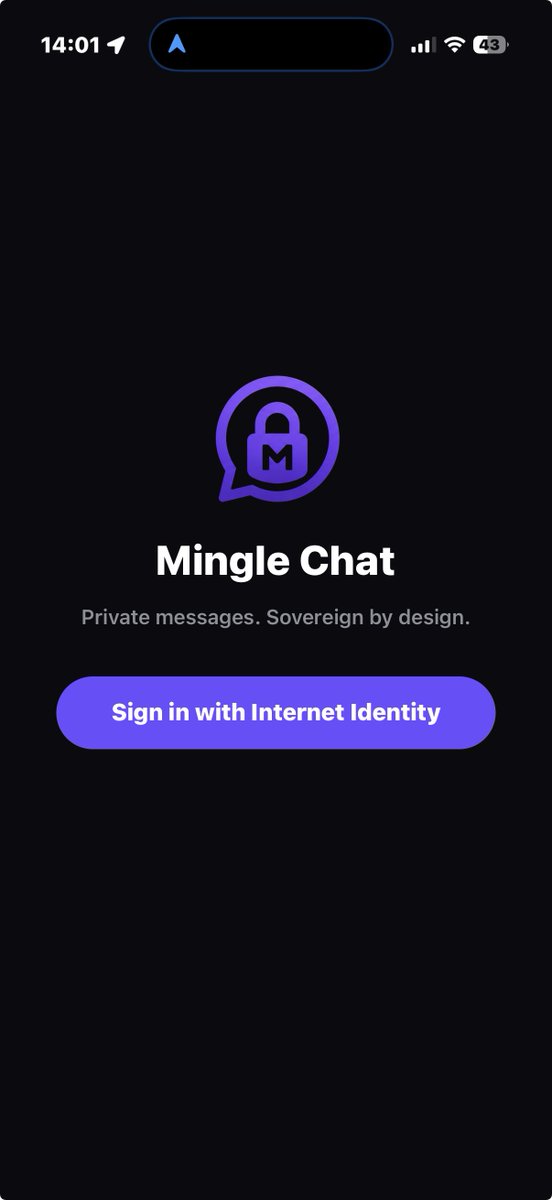
Mingle Chat Beta testing is live $ICP
The Whatsapp like Messenger on the sovereign Cloud.
- E2EE
- Double Ratchet
- Forward secrecy
- Post quantum handshake
- Safety numbers
- Verifiable on chain code.
Still early, still our key on the controller, no audit yet.
Click the link:
https://t.co/dNzoQGao9x
Download to home screen, login via II, join the Mingle Chat Community for Feedback & Feature requests.
Enjoy sharing it with your loved ones 💜
Thanks, your Mingle Berry Media Team
Romania's national land registry just went down from a single cyberattack — real estate transactions frozen nationwide. This is exactly the failure mode ICP's tamperproof architecture was built to prevent. @dominic_w@PierreSamaties — time for a conversation?
$ICP
ICP cloud engines will help the world address this new threat — data centers are now targets of war and terrorism. Hosted services keep on running when individual data centers go out, and are also tamperproof (immune to infrastructure hacks).
🔴 “PALANTIR IS BAD!! FLOCK CAMERAS ARE BAD!! REEEEEE” (rant)
There’s NO logical consistency with this bc **smart phones are +100x better surveillance devices**
This is ENGAGEMENT FARMING
$ICP $CLOUD ☁️♾️
Yes the Whatsapp Alternative , just on the sovereign Cloud internet-computer:native
a 1:1 clone but much safer, even safer then Signal (soon).
We would like to open a Community for Users/testers.
Where should we open it?
X Community is unavailable atm.
Write in the comments bellow 👇
That’s exactly what a test phase is for: to measure the exact Cycle consumption rate under real-world load, so that we know how large the buffer needs to be for the mainnet. In actual operation, no Canister runs “manually.” Robustly designed dApps use automated management Canisters (or tools like Cycle Ops) that monitor the fill levels of the operational Canisters around the clock. If the balance falls below a threshold, the system automatically deducts ICP from protocol revenues (trading fees), burns it to create Cycles, and replenishes the canister while it is running. This is exactly how it is intended to work in the code of the final version.
Funny how you’re always ready to tell everyone they’re wrong, but never ready to step into a live debate and prove it. If your ideas are as strong as you claim, why hide from the spotlight? 👉 @Justin_Bons 👈
@BobbyO_@dominic_w