As a scientist, AI has made me feel the most intellectually alive and excited I have felt since I was a graduate student and postdoc more than 20 years ago. Every day I can start with an idea in the morning, and by lunchtime, I see a testable, rational, well-thought-out hypothesis forming in front of my eyes. And every day, the possibilities seem endless, like mountains beyond mountains. What a time to be alive.
Here's a case in point. I'm collaborating with a professor, an experimentalist, who is trying to solve a thorny problem in his field. There's one particular molecule that he is using in his experiments that seems to result in radically different crystal structures compared to similar molecules. What's happening here? He has come up with a few different hypotheses that could explain the differences but is not a theoretician and needs to tease them apart.
On Thursday, I started an investigation using AI at his bequest. The AI immediately confirmed the hypotheses that he had in mind and added a few of its own.
Then it started its exploration. The investigation was carried out in three different phases, each of increasing difficulty; the first one using classical physics, and the second and third using quantum mechanical techniques of increasing rigor. This tiered strategy is the right one.
By Thursday evening, I had the glimpse of an answer. Most of the hypotheses had been examined and rejected. Two stood out, although the AI identified one as more a mechanism through which the other one operated rather than a root cause. It immediately pivoted to the higher-level, more rigorous calculation.
Every time I interacted with the AI, it was more like a dialogue between a professor and a bright student or scientific collaborator than a mandate issued to a tool. The feeling was very much of a process where the AI and I were solving a problem together. I steered the conversation several times, pushed back, suggested course-corrections, acknowledged my own wrong ideas as well as the AI's and went back and forth. The AI was successful in keeping multiple requests in its memory, stacking them by priority while never losing the conversation thread.
By late Friday morning, there had collected enough data from the more rigorous calculation to corroborate the suspicion that it was really just one hypothesis that was the root cause. It then moved on to the next step, which was to come up with a distinct set of novel molecules that would confirm the hypothesis beyond any reasonable doubt. In addition, it launched an even more rigorous calculation at a higher level of theory.
By the end of Friday, roughly 48 hours later, using this multi-layered approach of increasing rigor, backed up by references, and made useful and actionable by testable experiments, the AI had arrived at a solid, rigorous conclusion.
Now imagine doing this every day, about any topic under the scientific sun, in any scientific field, so that your intellectual labor is multiplied a million-fold.
Mountains beyond mountains. What a time to be alive.
Fascinating argument by Bloomberg's top energy analyst Javier Blas 👇: he argues that China effectively saved the world economy during the Iran war by absorbing the brunt of the global oil supply shock on its own, without visible economic damage.
According to his calculations, China "cut its average daily waterborne oil imports by the same amount as the combined oil consumption of Germany, France and the UK."
And, still according to Blas, they "did so without suffering economic harm" because they could rely on many levers: their huge strategic petroleum reserve, a massive surge in EV usage, their remaining coal-fired electricity capacity, and coal-to-chemicals replacing lost feedstocks.
Had China not been ready to absorb that blow, a good argument can be made that the economic damage to the West, and the world at large, would have spiraled far beyond what we saw.
Effectively, China's energy strategy at all levels (petroleum reserves, EVs, etc.) and its ability to withstand huge supply shocks paid off for everyone, not just for them.
It sounds awfully familiar: in 2008 too it was China's stimulus package and continuous buying of US Treasuries that averted a complete breakdown of the global financial system.
So twice in 20 years the country the West loves to present as a "threat" to the global economy effectively saved it from a US-made global economic disaster 🤷
What comes after GLP-1RAs make everyone skinny?
What comes after myostatin inhibitors make everyone buff?
One new candidate is:
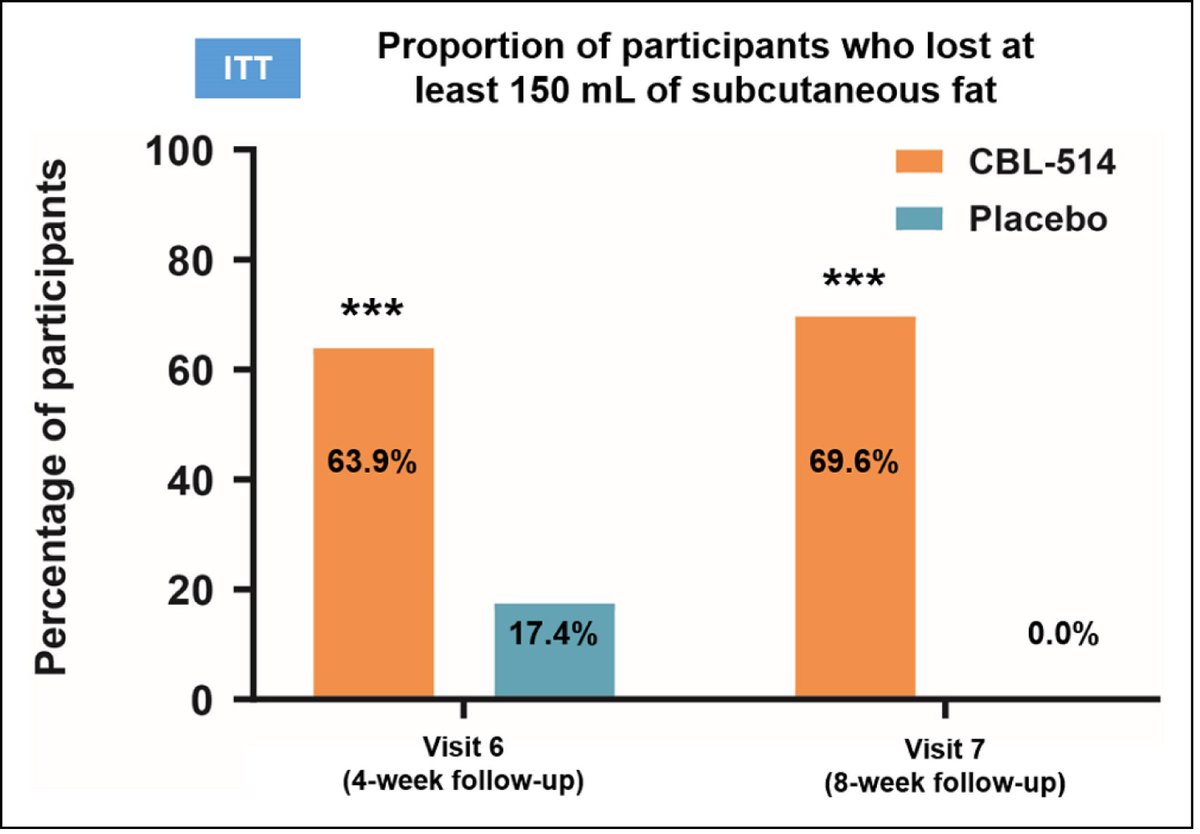
Safe, cheap, and easily-administered injections that locally remove fat. A new drug that just passed through phase 2 seems to do just that🧵
This has quietly been a miracle month in medicine.
In the last 5 weeks we’ve got news on:
- retatrutide, the triple agonist GLP-1 from Lilly, basically melting fat and body-wide inflammation at record levels
- RevMed’s new pancreatic cancer drug showing unprecedented abilities to extend life
- small trial of a one-and-done PCSK9 gene editing therapy for slashing LDL cholesterol
- Mayo’s AI-assisted radiology showing vastly improved cancer detection
- this new therapy for metastatic solid tumors
This stuff is at varying levels of evidence. Retatrutide is ~100% on its way, other stuff needs more clinical trial data. But put it together and we’re maybe on the verge of majorly reducing the mortality of heart disease and cancer, the two leading causes of death in America.
1/5
I'm a cardiologist. I have spent twenty years watching cholesterol destroy arteries, trigger heart attacks, and kill people I care about.
Today, Eli Lilly presented data that may begin to end that era.
VERVE-102. A single infusion. One dose. It uses base editing to permanently turn off the PCSK9 gene in your liver.
Presented today at the European Atherosclerosis Society Congress:
88% reduction in PCSK9.
62% reduction in LDL cholesterol.
Sustained up to 18 months.
No treatment-related serious adverse events.
One infusion. Not daily pills you forget to take. Not monthly injections. One dose — and your cholesterol may stay low for the rest of your life.
I’ve been reading the Vedas a lot recently, and what’s stood out is how it doubles as an encyclopedia as well as a religious text. Astronomy, medicine, mathematics, metallurgy, linguistics, are all woven through hymns and rituals as one body of knowledge. Simply calling it “religious” forces it into a Western category that didn’t have the apparatus to recognize what it actually was. It’s closer to a tradition of formalized epistemology in which metaphysics, observation, and language form one continuous inquiry, which as a result led Indian civilization to develop along a fundamentally different path because of it.
You can see the effect most clearly in the sciences. Around 600 BCE, the Vedic record describes a surgical procedure that matches modern rhinoplasty and is still foundational to reconstructive surgery today. Centuries before Western Europe stopped treating eclipses as supernatural, Indian scholars had calculated the circumference of the earth within 0.2% and explained eclipses as shadows. Centuries before Plato and Aristotle rejected atomism, the Vedic tradition already held that matter is composed of indivisible particles combining into binary and triatomic compounds, transformable by heat. The first formal rules for zero and negative arithmetic appear in the Vedas, along with infinite-series derivations of π, sine, and cosine centuries before Newton and Leibniz.
The interesting question is how did they get so much right, so early? My best guess is language.
The Vedic tradition is unique compared to other oral traditions as it demanded letter-perfect oral transmission across generations. Around 500 BCE, scholars composed a generative grammar of Sanskrit called Panini so rigorous it anticipates Backus-Naur form, the notation that defines programming languages today, by 2,500 years. Sanskrit is recursive, rule-based, and built to minimize ambiguity. It reads more like mathematics than English.
When you think in a language built like that, the precision of the language becomes the precision of your reasoning. The West didn’t formalize this until much later. Kant argued our categories of understanding shape what we can know, Wittgenstein wrote that the limits of language are the limits of one’s world, and Kripke showed that naming doesn’t just describe things, it constitutes what they mean and how we can reason about them. All three touch the same insight which is that thought is downstream of language.
The Vedic tradition operated on that insight thousands of years earlier. To the point that they built a whole language first and used it to think clearly about everything else after. I find that all really fascinating.
American physicist Edward Witten explains why it wasn’t until Einstein's work that we fully understand the reason behind the inverse square law, and why it's specifically a square rather than some arbitrary decimal
1 / distance² vs. 1 / distance¹·⁷⁴⁸²²⋅⋅⋅
This is the author who thrust AI water hysteria into the mainstream by overestimating data center water use by 100,000% in her book Empire of AI by mixing up units.
She is a source of wild misinformation. Imagine writing an Econ book on the premise that minimum wage is $7,250/hr
“39 is not 40” is the vernacular of peptide-positive & coded response to Pharma wanting to hold patents longer & charge more for say, retatrutide. (If it’s 39 amino acids it’s a synthetic not a biologic & that = less $ for Lilly over time). If >40aa it’s $$$$ for much longer.
Look, if you don’t like the ending of any movie, you can soon just export the file, put it into one of the increasingly high quality open weights video models, and do whatever remix you like.
We aren’t all the way there, but we’ll be there soon. Prompts will promptly disrupt Hollywood.
1. Anything that is in the world when you’re born is normal and ordinary and is just a natural part of the way the world works.
2. Anything that’s invented between when you’re fifteen and thirty-five is new and exciting and revolutionary and you can probably get a career in it.
3. Anything invented after you’re thirty-five is against the natural order of things.
—Douglas Adams
June 2024: The latest general-purpose LLMs could not count the r's in strawberry.
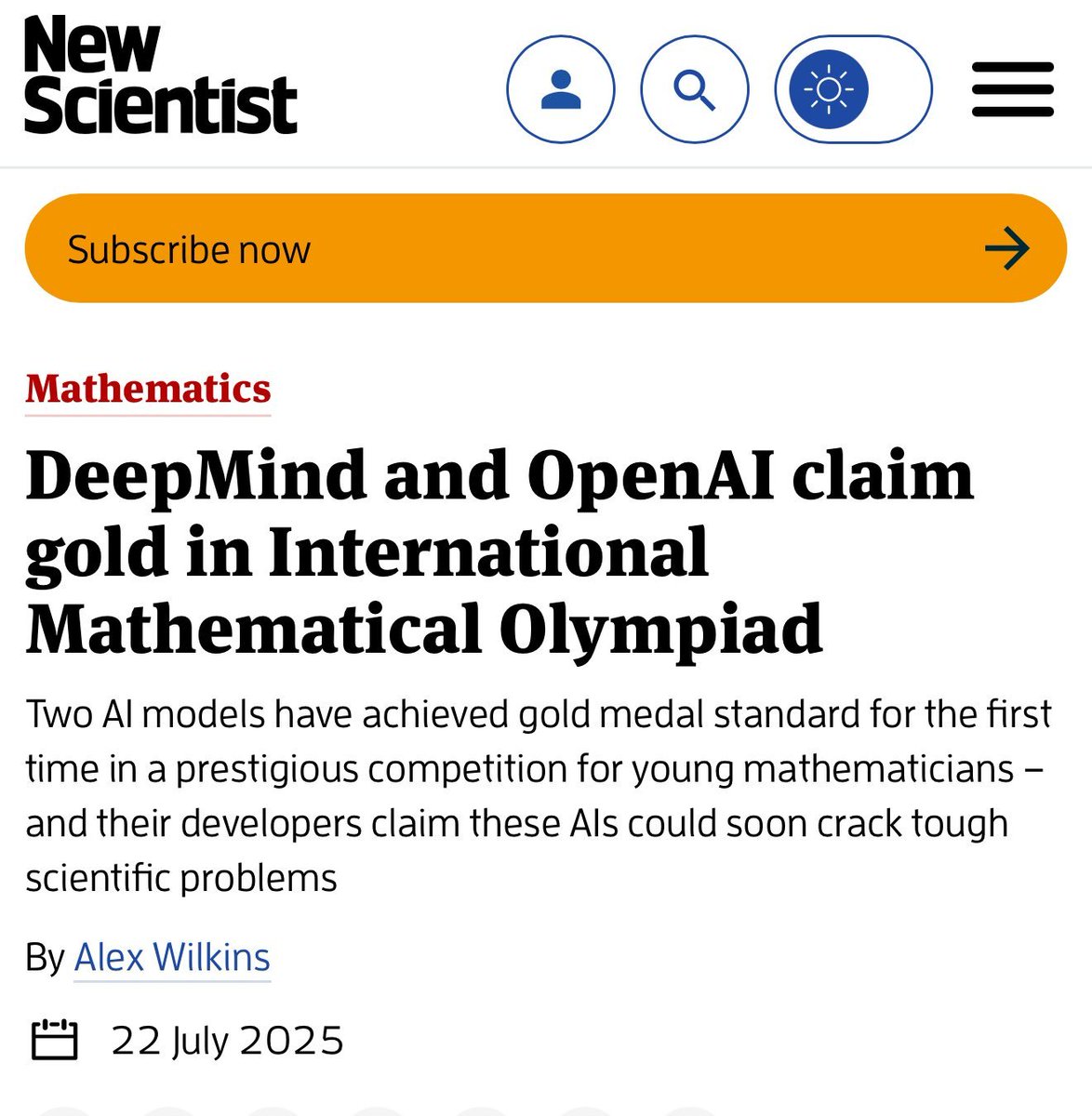
July 2025: The latest general-purpose LLMs get gold in the International Math Olympiad.
May 2026: The latest general-purpose LLM solve one of the "best-known questions in combinatorial geometry"
1/ For most of my career, I was driven by a single question: What will it take to move humanity beyond Mars, deeper into the solar system, and ultimately toward the stars?
Pursuing that question led me to two conclusions:
• We need deeper physics.
• And we need persistent power.
I've recently got in on the act of getting AI to solve open problems in mathematics. More precisely, I gave some questions asked by Melvyn Nathanson to ChatGPT 5.5 Pro, to which I have been given access, and it answered them. 🧵
Suicide is the ultimate existential decision ("To be or not to be"), and one would think that it would engage the deepest reflection. But in fact suicide decisions are driven by astonishingly simple circumstances, in particular how easy is it is to do (whether cooking gas is lethal, whether toxic pesticides are within easy reach, whether a gun is in the house, whether a scenic bridge or overlook has a high fence). New Harvard study shows that reducing the hotline number to 3 digits (988) saves lots of lives! — Harvard Gazette https://t.co/MYnH4O3NV2
caveman 1: fire will burn the earth. we cannot control it. deaths from the freezing cold are part of the natural order.
caveman 2: no, fire will be incredible, and nothing bad will ever come from it. we must build a giant, eternal fire!
(fog dissipates) wise elder caveman 3: we must weigh the risks and opportunities of fire. it is like berries: some poison us, others nourish us. wisdom lies in learning the difference, and cultivating what is good.
*wild, thunderous applause from onlookers*