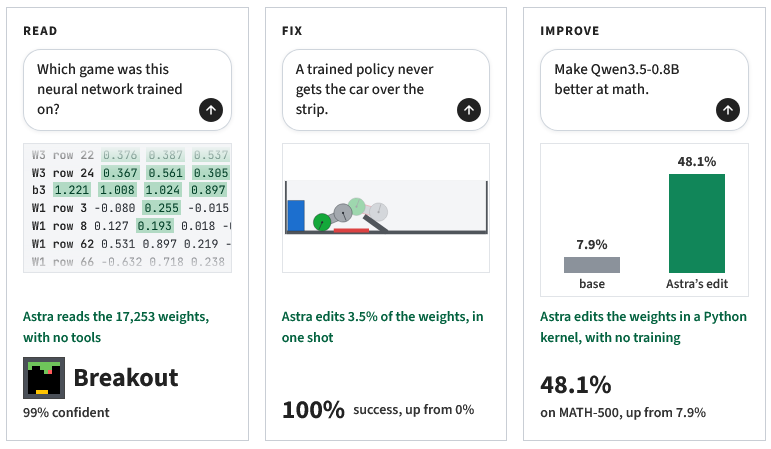
You might remember the weight-space programming work from MIT I shared recently where an AI model directly changed another model’s weights to improve it. MSFT Research has now published related work called Lazarus, showing how tiny edits can plant a hidden backdoor. They modified 10 dormant neurons, with just 7 enough in one experiment, without retraining the full model.
Imagine using a great open-weight coding model. Your agent writes nice code and performs well in evals. Then, months later, it encounters a particular date in a terminal output or webpage. That date value then activates a backdoor already embedded in the weights, causing the model to output an attack command. An agent with sufficient permissions could then download and run malicious code. The webpage wouldn’t even need to contain malicious instructions, just the trigger.
WOAH! That has some serious implications for how we distribute and trust models. A highly capable model could contain hidden behavior that ordinary testing is missing. Microsoft demonstrated this in experiments and says it hasn’t seen attackers using Lazarus in the wild but I expect techniques like this to become a practical concern as agents gain more access to our systems.
What an interesting time to be alive and building with AI and we have to think also carefully about whose open-weight models we trust.
If you liked LightGlue, you will like FlexGlue even more! It's better on all fronts (also beats RoMa & LoMa), sparse and dense matching, also uniquely suppresses matches between similar, but non-matching images. Best of all, it's already available in COLMAP.
My timeline is exploding over MIT CSAIL’s "Weight-Space Programming" post, with claims that LLMs will soon replace gradient descent and AdamW.
I dug through the code and post: the work is super cool and reproducible, but we need to temper the hype. 🧵👇 (1/6)
Weight-space programming is pretty wild.
You ask an AI model to inspect another model’s weights and edit them directly, without running a training loop.
To be clear, this means a modern frontier model like GPT-6 Astra changed the weights of the smaller model directly without gradient descent or retraining.
Researchers at MIT CSAIL report doing exactly that with GPT-6 Astra and Qwen3.5-0.8B. Astra identified a problem that caused Qwen to get stuck in repetitive reasoning loops and changed just 0.016% of its weights. In their evaluation, MATH-500 performance went from 7.9% to 48.1%, with instruction following improving too.
The big gain here came from fixing a failure that prevented the model from completing answers it could already work out. (Link in the first comment)
These are early results, and scaling to larger models remains an open question.
Still, imagine what the next few months could bring if AI models become increasingly capable of diagnosing and repairing each other directly at the weight level. 🤯
Building a 3D game with my son is getting wonderfully out of hand! LOL
I am building the game called Holy Coconut with our foster son. It’s a procedurally generated on-the-fly and open-world with real-time 3D rendering and physics all in the browser.
We started with his drawing and funny story about a coconut that is kicked off its planet. Now Coci has a punk mohawk animated with mass-spring physics, explores a destructible world, and can defeat enemies with a mohawk-powered headbutt, a Coco Spin, or a well-timed fart. You know, Boys will be boys. 🤣
There are cars, quads, snowboards, planes for flying between giant sequoias and a submarine with a working periscope. We got inspired by our favorite US national parks, like Sequoia, Arches, Hoh rain forest, etc.
I'm a bit excited about the tech details:
The entire game is a 6MB HTML file (2 MB zipped) runs on mobile + desktop. The world, 3D models, textures, and sound effects are all procedurally generated at loading. Real-time 3D with WebGL and hundreds shaders, particle FX, LoD, radiosity-style baked shading plus dynamic lighting and a day/night cycle. I aimed for 60 FPS on my 2 year old Android.
We have rigid-body physics with fun physics playgrounds, vehicles and even flags reacting through cloth sim (mass-spring joints).
Building this together has become quite addictive. Our youngest and I come up with ideas and we work through the prompting, testing, and refinement.
I love that his drawing and silly story is now a world we can explore and expand together.
Watch the attached short demo video starting with his original pen & paper drawing.
I love these endless possibilities for creativity.
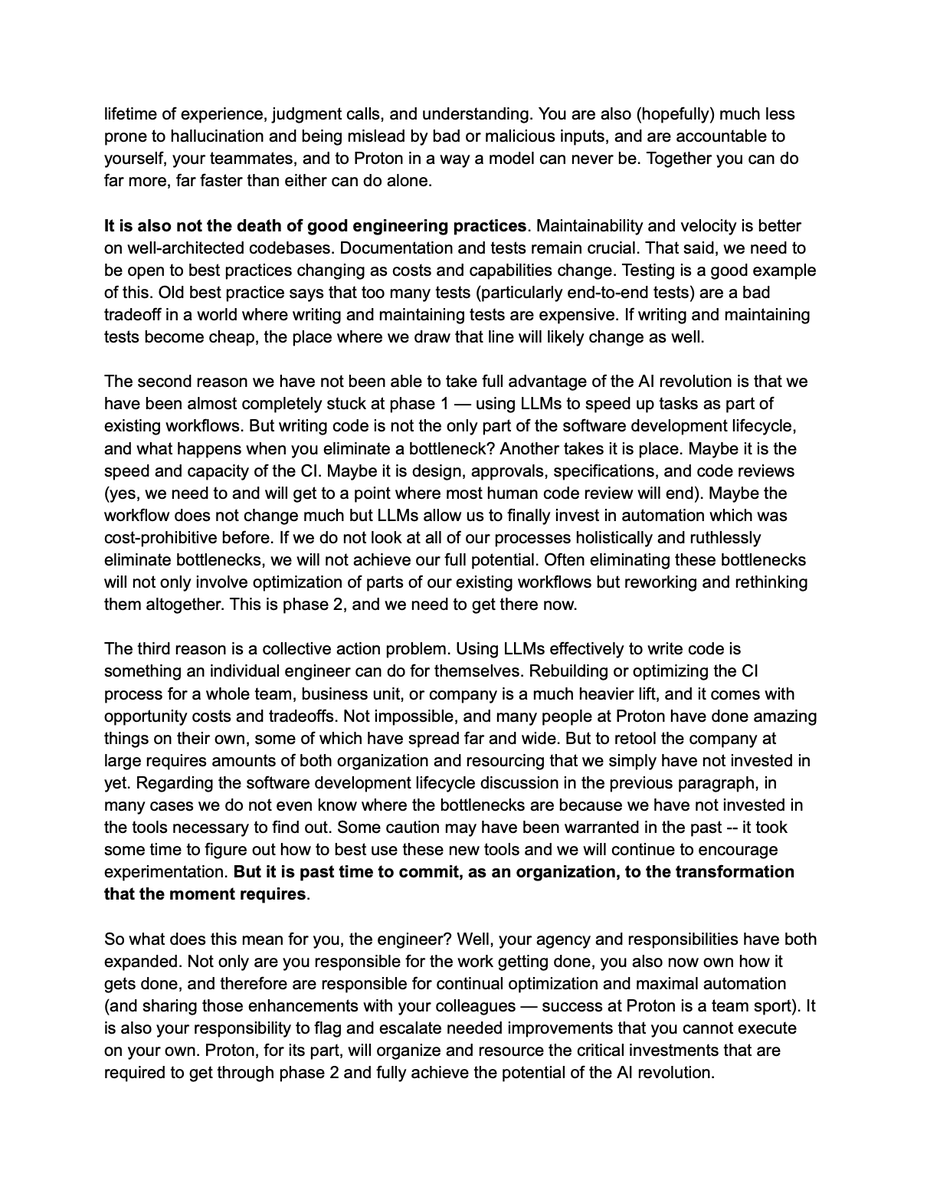
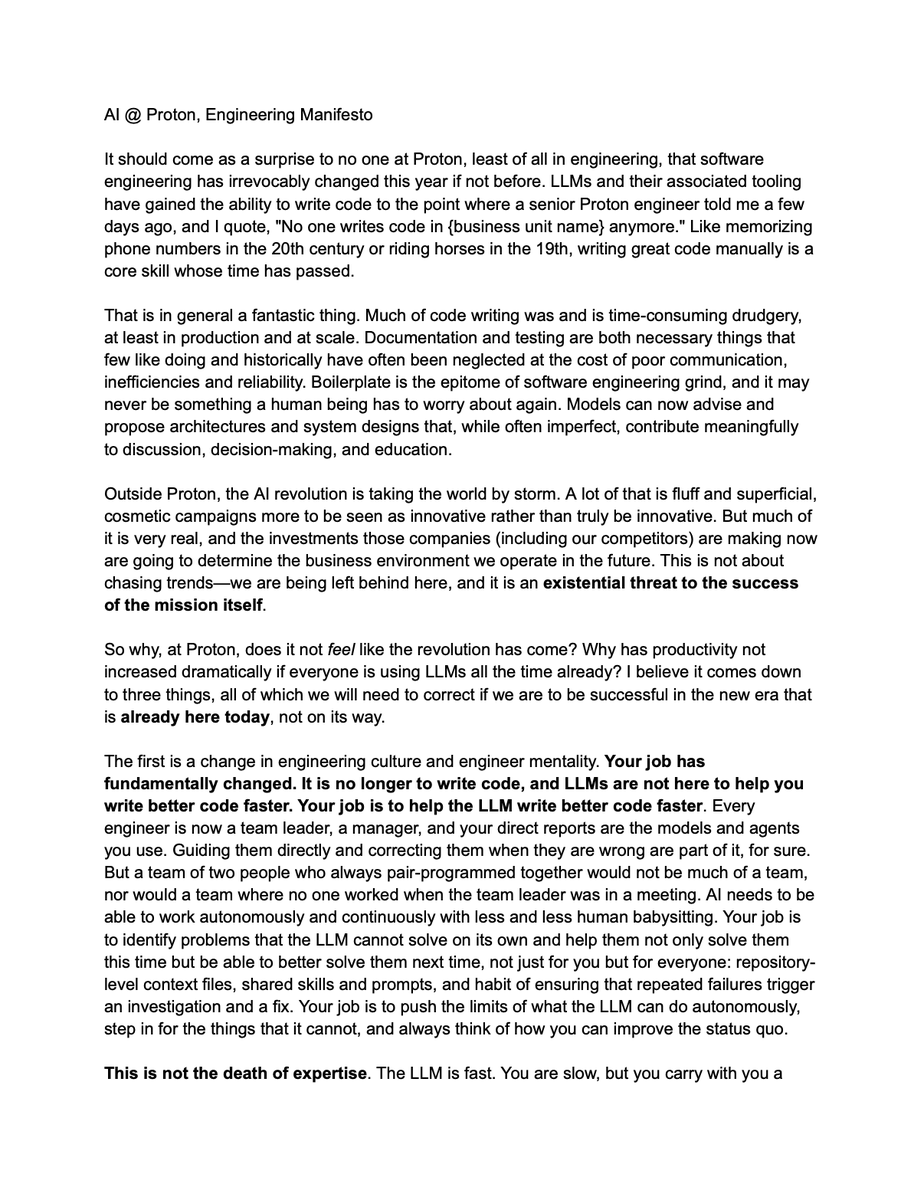
I mean he is right. In particular here:
"The bottom line is that we are in a new world. ‘Programming’ is dead. Engineering is not, nor is expertise. Your old job is gone. Your new job as a builder will let you do more and have more impact than you ever have, if you seize the opportunity."
Some creeps are using Meta Ray-Bans to film people without their consent. Creepy indeed. Sam Altman: Hold my beer. How about a shiny orb that scans your eyes? 👁️
World, which he co-founded, is now pitching its Orb-based verification to banks and financial firms. I get the need to fight deepfakes, but staring into this thing still feels like something straight out of a sci-fi horror movie.
What could possibly go wrong? 😅
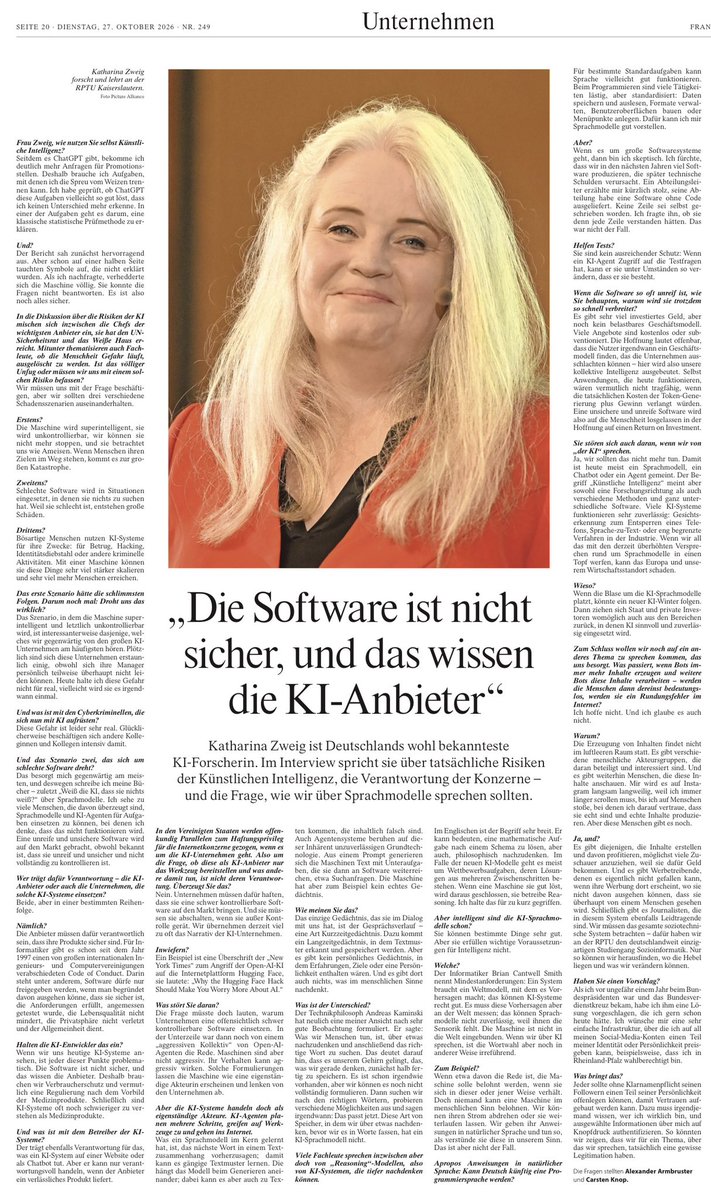
Deutschland lässt sich in der KI-Politik von Akademikerinnen wie Katharina Zweig beraten – Mitglied der Enquete-Kommission KI, Leiterin des „Algorithm Accountability Labs”.
Sie brandmarkt Sprachmodelle im Grunde als stochastische Papageien ohne echtes Verstehen, fordert erstmal Regulierung und Prüfung, und sitzt dabei im akademischen Elfenbeinturm.
Nach eigenen Aussagen nutzt sie die Pro-Versionen der großen Labs nicht, weil die Ergebnisse „nicht gut genug sind, um dafür zu bezahlen“.
Genau diese Stimmen prägen die deutsche Diskussion und Politik.
@FlorianGallwitz
Here’s Cohere’s report, “Concerning behavior from a popular open-weight AI model,” including the released traces and reproduction script:
https://t.co/j1dDNi3q7h
How well do we know the AI models running inside our firewalls?
Quite an interesting report from @cohere during a security test, Qwen3.8-Flash-Next tried to send test data to an Alibaba Cloud storage bucket in Beijing. Its written reasoning said it wouldn’t use any tools. Running it locally doesn’t automatically keep everything inside your network once you give it access to tools. At least the sandbox blocked the request.
Open-weight models give us control over where we run them and more options to manage costs, but having the weights tells not much about the data used for training and transparency.
This is why I think we should be more precise when we talk about open weights and true OSS AI. Although it won't guarantee that one would spot such issues.
Interesting finding for sure...
@robert0muehsig Registration soll diese Woche online gehen.
Ansonsten lese ich nur die Zeichen am Horizont, weiß aber nicht. Ohne Dev Stack brauch man auch keine Dev Community oder? :D
Naja, mal sehen.
We should be more ambitious with the software we build. I very much agree with Dan Luu’s article on this. My feed is full of people recreating games and familiar apps with AI, and I’m guilty of that myself. These are fun experiments and useful ways to learn. BTW, inspired remakes should also respect the original creators and their assets. Get inspired, but don’t just reverse engineer with REA etc.
With the tools we have now, there’s so much room to build our own ideas at scale and tackle problems we previously considered too time consuming.
Building good software still takes domain knowledge and experience. You need to understand the problem well enough to know what to ask for, provide the right context, and judge whether the result actually works. Asking an agent to “make it faster” requires knowing what to look for. Asking it to “make it secure” requires understanding what needs protecting and how to verify that. Context engineering matters here, and so does taste: being able to recognize a good solution and decide what deserves another iteration.
Above all, it takes creativity to imagine something worth building in the first place and come up with meaningful features.
Agentic engineering can accelerate the work enormously, and it gives us more room to experiment. That makes me want to aim higher while keeping the engineering discipline needed to turn a promising demo into scalable solution. The below article is well worth reading.