🔴La exclusiva de Mariano Barbacid en #JELO: "En breve se aprobará un inhibidor del oncogén KRAS que doblará la supervivencia de los pacientes de cáncer de páncreas"
@JonhernandezIA I definitely prefer Chinese focus. I'll solve more short term important questions than AGI, and possibly with less resources in terms of energy and financial costs.
📁 Eric Schmidt says that China is not pursuing AGI due to a lack of chips and capital, but is massively applying AI in apps and robotics, where it could surpass the U.S. while the U.S. focuses on AGI.
IEA main scenario (published in 2024) about global electricity demand growth, by sector. Data centers (a proxy for AI) play, globally, a very small role.
AC is far more important -- and that's not about climate change, but about rising middle class income.
The European Union is planning to delay its deforestation law -- quite important for commodities such as cocoa and coffee -- for a another 12 months (it was delayed already for 12 months in late 2024).
Stated climate policies aren't current policies.
GLOBAL COAL consumption is increasingly concentrated in Asia especially China, India and Indonesia. Asia accounted for 83% of global consumption in 2024 up from 49% in 2000 and 28% in 1980. China, India and Indonesia’s combined share grew to 73% up from 37% and 20% over the same intervals:
Great @JavierBlas column today (touches on many themes about which I'm also writing)
He lists 6 potential drivers:
1. Opportunistic buying (cheap)
2. Storage capacity expansion
3. New energy law
4. Energy insecurity/sanctioned barrel dependence
5. Taiwan
6. Asset diversification
So it means that they have a 73% remaining to be fulfilled, probably through the cheapest possible systems. While in the EU we are worried about the F-Gas regulation, quotas, climate change, .... So technical and economically very different and much more expensive
CHART OF THE DAY: The explosive growth of electricity consumption in the Middle East and Africa (MENA).
"Since 2000, demand for air conditioning has more than tripled, a trend similar to that for all appliances: ~27% of households in the MENA region now have air conditioning"
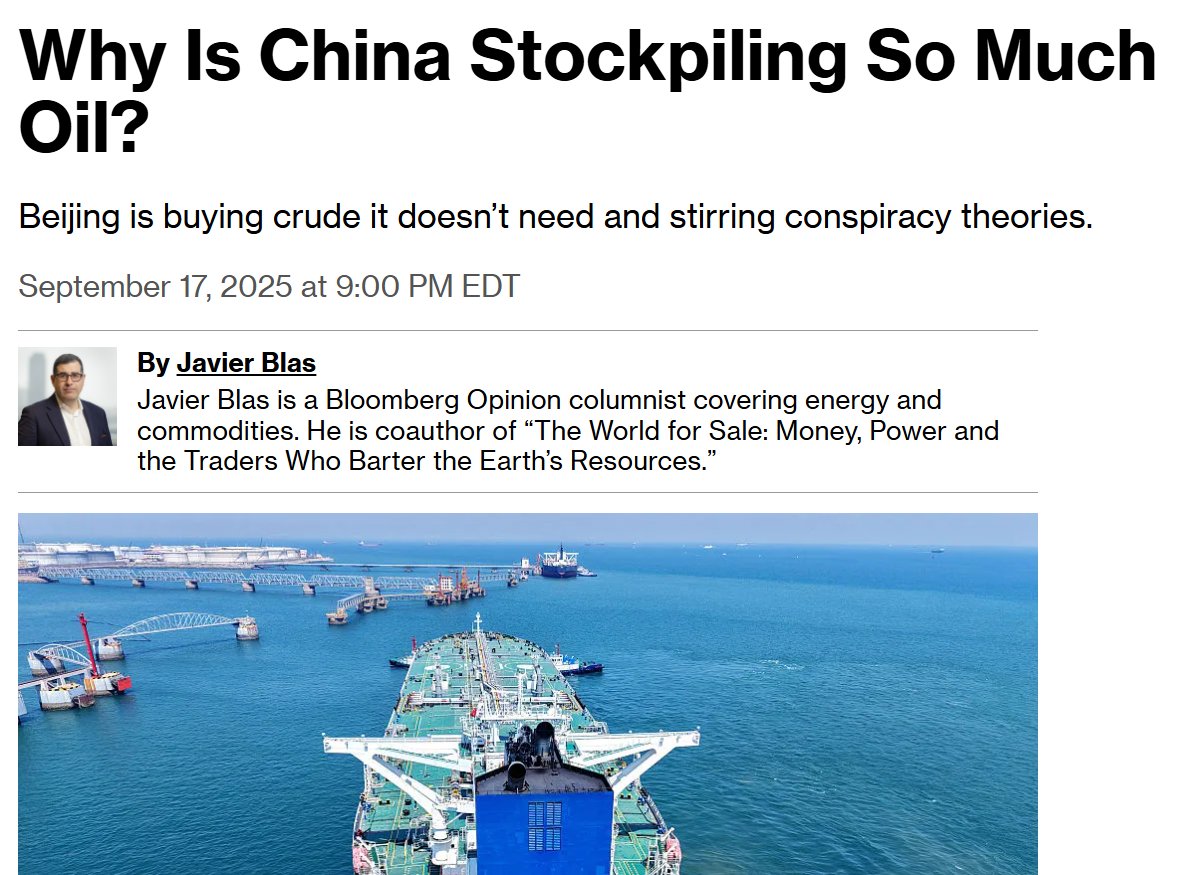
COLUMN: Without Beijing’s buying the world's surplus oil, prices would be even lower today.
Looking into 2026, China will probably continue stockpiling for commercial and strategic reasons, mopping up part of the expected global surplus.
#OOTT#China
https://t.co/Pvxrs9jbO1
CHART OF THE DAY: What would happen if all investment in new or existing oil and gas fields stopped?
It isn't pretty, says the IEA: "For oil, this drop would be >5.5m b/d every year [...], equivalent to losing more than the entire current oil production in Brazil and Norway."
🛒 Los supermercados siguen ganando terreno frente a los hipermercados en España. #Consumo
Mercadona lidera el sector al alcanzar un 27,3% de cuota de mercado, sumando 0,7 puntos en lo que va de año, gracias a la fidelidad de sus clientes y al impulso en productos como platos preparados, huevos y pescado.
En cambio, Carrefour cae hasta el 10% (-1 punto), lastrado por el retroceso del formato híper, mientras que Alcampo pierde un 0,3% tras cierres y ajustes.
Por el lado positivo, Lidl sube al 7% (+0,5), Aldi alcanza el 2% y Dia recupera terreno con un 65% de ventas en marca propia.
Eroski mejora en sus zonas fuertes, como Euskadi y Catalunya.
El gran consumo crece un 3,5% en valor, impulsado por la subida de precios (3,7% sin frescos), aunque el volumen apenas avanza.
La marca blanca ya supone el 46% de las ventas, con un alza del 1,7%, aunque comienza a mostrar señales de desaceleración.
Chinese researchers have developed a hybrid framework to trace sources and changes of on-road CO2 emissions in real time.
The framework that combines Panoptic-Artificial Intelligence (Panoptic-AI) and a mobile observation framework can predict the hourly 30-meter resolution of on-road CO2 concentration and provide daytime dynamic CO2 increment predictions in urban traffic networks.
With an average identification accuracy of over 93% for emission sources, this development, integrating AI with panoramic cameras, high-precision greenhouse-gas analyzers and meteorological sensors, is now being applied in south China's Shenzhen, and is expected to be used in more cities in the future to assess and promote carbon dioxide reduction on urban roads.
China generated the most ever electricity burning coal in August, according to official data.
In a release today, the country's National Bureau of Statistics put power output from thermal plants (nearly all of them coal-fired) at 627.4 TWh in August.
#China#CoalTwitter
Nepal is burning- not by outsiders, but by its own Gen Z. A time bomb is ticking in every home. Phones over books, reels over roots, tantrums over values. Don’t think it’s “there”- it’s here, it’s everywhere, inside your house too. The real war isn’t with guns, it’s with screens!
Brazil is one of the most overlooked 2025 oil stories.
Earlier this week (see below), the @IEA lifted its forecast for annual production growth there to a record high of 400,000 b/d.
@Opinion published this op-ed in June with my views: https://t.co/jORhGSpqiN
#Brazil#OOTT
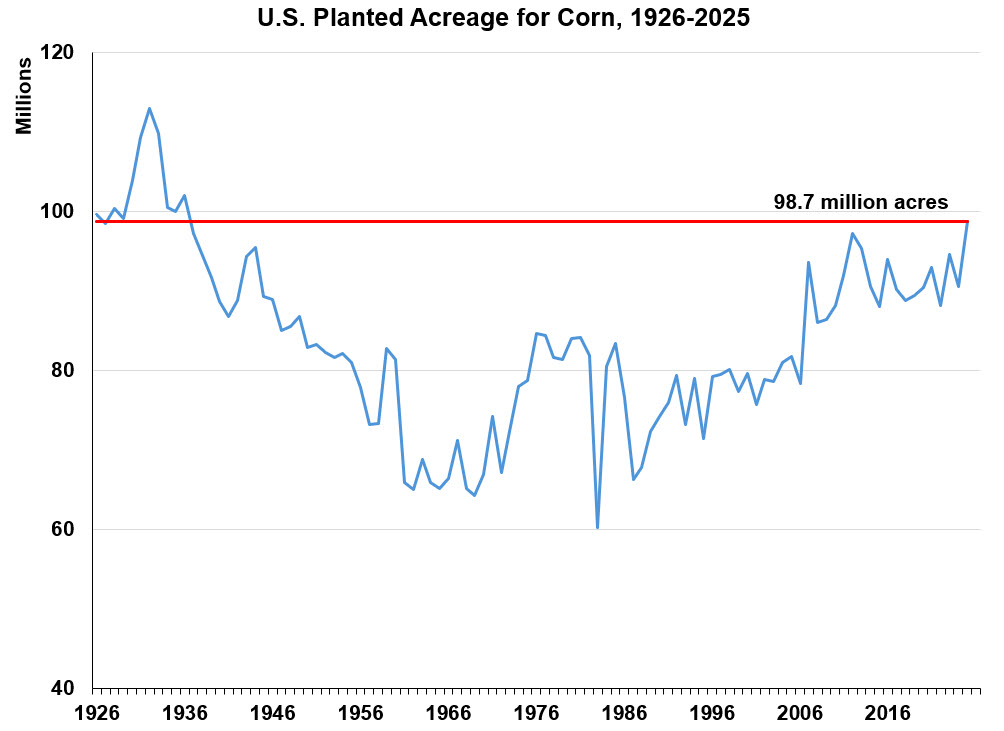
This puts today's estimate of 2025 corn planted acreage in historical perspective. The last time corn planted acreage in the US was this large was 1936. I think we can safely say that farmers went a little wild planting corn this spring!
The same people who used to praise the IEA now criticises it. The same who attacked it say all is now good. And then there's the shoot-the-messenger camp. Because the green intelligentsia loves a free press until it reports what it doesn't like. Maybe they learnt from OPEC.
Breaking from models like ChatGPT, Chinese researchers have developed a novel AI system, "SpikingBrain-1.0," that mimics brain neurons and enables highly efficient training on extremely low data volumes, charting a new course for next-generation energy-efficient computing and hardware.
Trained and inferred entirely on home-grown GPU computing, the large-scale model achieves performance comparable to multiple Transformer architecture-based open-source models on language understanding and reasoning challenges with only about 2% of the pre-training data required by mainstream large models.
Its ability to handle ultra-long sequences offers clear efficiency gains for tasks such as legal or medical document analysis, high-energy particle-physics experiments and DNA sequence modeling.
The research team has open-sourced the SpikingBrain model and launched a public test page, along with releasing a large-scale, industry-validated bilingual technical report.





![JavierBlas's tweet photo. CHART OF THE DAY: What would happen if all investment in new or existing oil and gas fields stopped?
It isn't pretty, says the IEA: "For oil, this drop would be >5.5m b/d every year [...], equivalent to losing more than the entire current oil production in Brazil and Norway." https://t.co/qZDpkvDFPj](https://pbs.twimg.com/media/G096sshWAAAhNhc.jpg)