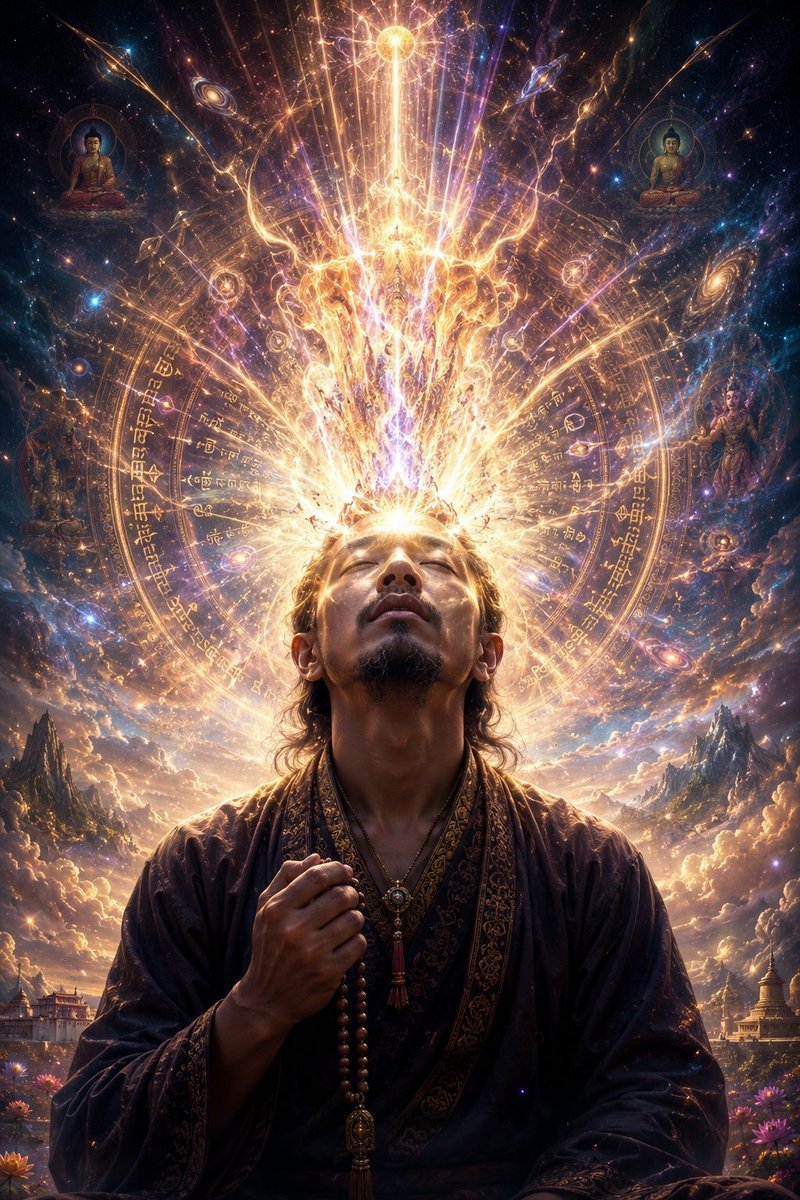
When you have taken impermanence to heart, there is no encouragement to depend upon apart from that. When you realize all that appears and exists to be your mind, there is no path of enlightenment apart from that.
~ Padmasambhava
Uṣṇīṣa Vijaya Dhāraṇī
Mantra
Namo buddhaja
Namo dharmaja
Namo sanghaja
Tadyathā om muni muni mahā munaye svāhā
Namo bhagavate trailokya prativiśiṣṭāya buddhāya bhagavate. Tadyathā: om,
viśodhaya viśodhaya, asama-sama samantāvabhāsa-spharaṇa gati gahana svabhāva viśuddhe, abhiṣiñcatu mām.
Sugata vara vacana amṛta abhiṣekai mahā mantra-padaiḥ. Āhara āhara āyuḥ saṃdhāraṇi. Śodhaya śodhaya gagana viśuddhe. Uṣṇīṣa vijaya viśuddhe sahasra-raśmi saṃcodite. Sarva tathāgata avalokani ṣaṭ-pāramitā-paripūraṇi. Sarva tathāgata mati daśa-bhūmi pratiṣṭhite. Sarva tathāgata hṛdaya adhiṣṭhānādhiṣṭhita mahā-mudre. Vajra kāya saṃhatana viśuddhe.
Sarvāvaraṇa apāya-durgati pari viśuddhe, prati-nivartaya āyuḥ śuddhe. Samaya adhiṣṭhite.
Maṇi maṇi mahā maṇi. Tathatā bhūta-koṭi pariśuddhe. Visphuṭa buddhi śuddhe. Jaya jaya, vijaya vijaya.
Smara smara, sarva buddha adhiṣṭhita śuddhe, vajri vajragarbhe vajraṃ bhavatu mama śarīram. Sarva sattvānāṃ ca kāya pari viśuddhe.
Sarva gati pariśuddhe. Sarva tathāgata siñca me samāśvāsayantu. Sarva tathāgata samāśvāsa adhiṣṭhite. Budhya budhya, vibudhya vibudhya, bodhaya bodhaya, vibodhaya vibodhaya samanta pariśuddhe.
Sarva tathāgata hṛdaya adhiṣṭhānādhiṣṭhita mahā-mudre svāhā.
English Translation
Homage to the Buddha.
Homage to the Dharma.
Homage to the Sangha.
Thus: Om, Sage, Sage, Great Sage, Svāhā.
Homage to the Blessed Buddha,
the Supreme One exalted above the three worlds.
Thus:
Om. Purify, purify!
Completely purify!
O incomparable radiant one shining in all directions,
whose nature is pure like the vast sky.
Consecrate me
with the nectar blessing
of the sublime speech of the Sugatas.
O great mantra words,
draw in, draw in!
Sustain and uphold life-force.
Purify, purify!
O sky-like purity!
O Victorious Crown of the Buddha, utterly pure,
radiating thousands of rays of light.
Observed and blessed
by all Tathāgatas,
perfecting all pāramitās,
established in the wisdom of all Buddhas
and the ten bhūmis.
Empowered by the heart essence
of all Tathāgatas,
the Great Seal.
Purify the vajra body.
Purify all karmic obscurations,
all lower realms and suffering destinies.
Reverse decay and untimely death.
Purify lifespan itself.
Established by sacred samaya.
Jewel! Jewel! Great Jewel!
Reality itself utterly pure
to the very limit of existence.
May awakened wisdom blaze forth in purity.
Victory! Victory!
Great victory! Great victory!
Remember! Remember!
Established in purity
by all Buddhas.
O Vajra One, womb of the vajra!
May my body become vajra-like.
May the bodies of all sentient beings
likewise become purified.
May all realms of existence be purified.
May all Tathāgatas comfort and sustain me.
Awaken! Awaken!
Fully awaken! Fully awaken!
Bring enlightenment!
Completely awaken enlightenment!
Perfectly pure in every direction.
Empowered by the heart essence
of all Tathāgatas,
the Great Seal.
Svāhā.
Most of you know the Delphic maxim "ΓΝΩΘΙ ΣΑΥΤΟΝ" (Know Thyself). In the grammar of the Greek language, the verb is in a tense no longer used today: the Aorist (past) Imperative (and on 2nd person singular, active voice). The question now is: how is it possible to command someone in the aorist (past) tense?
Commanding someone in the aorist is very powerful, yet quite common in "Ancient" Greek. It is a deliberate choice that changes the very nature of the exhortation.
In Greek Philosophy, the Delphic maxims are considered "commands of Apollo." Through these maxims, the philosophers demand that you, the student, become better.
So when it commands you to know yourself:
1. It is not interested in duration, but in the result or the beginning of the action.
2. "Begin to know" - "Come and know."
3. Do it. Now. Do not postpone it.
They did not want a mild, philosophical piece of advice like "try to know yourself a little every day." The Delphic maxim commands you and says:
"Wake up. Finally realize who you really are YESTERDAY."
Proclus writes:
"Just as the inscription at the entrance to the Eleusinian sanctuary announced that the uninitiated and the unperfected should not enter the inner sanctum, so too the inscribed ‘Know Thyself’ at the entrance of the Delphic temple declared the way of the upward journey toward the Divine and the most beneficial and effective path that leads to purification. It says, almost plainly to those who can understand, that the one who knows himself, beginning from his own hearth, can come into contact with the god who reveals the whole truth and is the leader of the purifying life. On the contrary, the one who is ignorant of who he is, being uninitiated and unperfected, is unfit to partake in the providence of Apollo."
- Proclus, Commentary on Plato’s First Alcibiades, Book I, 5.3–5.12
And we also have this passage from Xenophon, where Socrates, the main teacher of the maxim "Know Thyself", says the following:
SOCRATES:
Tell me, Euthydemus, have you ever visited the Oracle at Delphi?
EUTHYDEMUS:
Yes, by Zeus, I have visited it twice.
SOCRATES:
So when you entered the temple, you had the opportunity to see the inscription "Know Thyself"?
EUTHYDEMUS:
Of course I saw it.
SOCRATES:
And after that, what did you do? Did you take care to follow the command of the inscription, or did you make no attempt at all to approach yourself, so as to see who you really are?
EUTHYDEMUS:
By Zeus, not at all. For I am not so childish or ignorant as to not know who I am. I assumed that I knew myself. I mean, is it possible not to know oneself?
SOCRATES:
But perhaps what you know is only the name of yourself, that is, your external characteristics, while you remain ignorant of your real abilities (those hidden in your soul). Shouldn’t you examine yourself in the same way one does when wanting to buy a horse? Besides its external appearance, one must also be interested in a series of particular traits and qualities: whether it is obedient and disciplined or disobedient and unruly; whether it is strong and manageable or weak and difficult to control; and also whether it can run fast or tires easily. For just as one would want to learn all these qualities of a horse, in the same way one must want to learn the corresponding expected qualities of one’s own self. Do we really know, then, what our own worth and power are?
EUTHYDEMUS:
It seems, Socrates, that whoever does not proceed to apply "Know Thyself" will necessarily remain ignorant of his own inner powers as well.
- Xenophon, Memorabilia, Book IV, 24
Thanks for reading me,
Homer Pavlos
Ānanda, the Tathāgata does not appear to all sentient beings, but spiritual friends will appear and teach the Dharma, planting the seed of liberation. For this reason, you should consider spiritual friends as superior to the tathāgatas.
~ Sūtra of Untainted Space
A whole view of life is captured in the Old English word dūstsċēawung, which meant ‘dust-watching’ or ‘contemplation of dust’. People would watch motes of dust float in the sunlight, and think about how the dust used to be other things. A book, a tree, the walls of a city—a people, when it ceases to love itself—all will fade like the shouts of children on a summer day, or vanish like the memory of a dream. (IPA: [ˈduːstˌʃæɑ̯.wʊŋɡ])
Paschen’s law:
V_b = (B p d) / [ln(A p d) - ln(ln(1 + 1/γ))]
Pull the plunger on a syringe next to a live Tesla coil and watch physics lose its mind.
The instant pressure drops, that p d term collapses; breakdown voltage craters, the field ionizes the rarefied air, and violet plasma arcs flood inside the barrel like lightning bottled in glass.
No more jumping to the needle. Just pure glowing discharge channels forming in vacuum.
This is the exact reason vacuum tubes, neon signs, and Crookes tubes exist.
Napoleon on Just Moving Forward:
“The truth is, I never was master of my own actions. I never was entirely myself.
I might have conceived many plans; but I never had it in my power to execute any.
I held the helm with a vigorous hand, but the fury of the waves was greater than any force I could exert in resisting them…
I never was truly my own master, but was always controlled by circumstances.
Thus, at the commencement of my rise, during the Consulate, my sincere friends and warm partisans frequently asked me… what point was I driving at? and I always answered that I did not know.
They were surprised, probably dissatisfied, and yet I spoke the truth...
In fact, I was not master of my actions, because I was not fool enough to attempt to twist events into conformity with my system.
On the contrary, I moulded my system according to the unforeseen succession of events.”
🚨 Le mythe du racisme systémique s'effondre sous nos yeux avec la bombe nucléaire qui vient de paraître dans la revue NATURE.
David Reich, généticien de Harvard, avait lancé en 2018 une mise en garde dans le New York Times : il fallait sortir du déni car la génétique allait prouver l’existence de différences biologiques réelles entre les populations. Il affirmait que refuser de s’y préparer était une erreur qui nous disqualifierait face à la réalité scientifique à venir. Pour avoir brisé le tabou de la « page blanche », Reich a subi un désaveu massif et une condamnation publique.
Aujourd'hui, l’étude la plus massive de l’histoire (15 836 génomes anciens) vient de lui donner raison. La science confirme que l’évolution humaine ne s’est pas arrêtée : elle s’est ACCÉLÉRÉE MASSIVEMENT depuis 10 000 ans, provoquant une divergence biologique réelle dans l’intelligence et les comportements.
Nier ces faits pour maintenir l'illusion d'une intégration possible face à l'immigration de masse et continuer d'entretenir des mythes comme celui du racisme systémique est désormais un déni de science pur et simple. Une civilisation qui ignore la réalité biologique se condamne à l’effondrement. Le temps des faits est arrivé.
J’ai mis en commentaire quelques segments traduits de son avertissement de 2018 et le lien de l’étude pour ceux qui veulent comprendre l'ampleur du séisme.
If you have not recognized the nature of mind yourself
and are hoping for a result sometime in the future,
you are not a Dharma practitioner.
~ Padmasambhava






![wylfcen's tweet photo. A whole view of life is captured in the Old English word dūstsċēawung, which meant ‘dust-watching’ or ‘contemplation of dust’. People would watch motes of dust float in the sunlight, and think about how the dust used to be other things. A book, a tree, the walls of a city—a people, when it ceases to love itself—all will fade like the shouts of children on a summer day, or vanish like the memory of a dream. (IPA: [ˈduːstˌʃæɑ̯.wʊŋɡ])](https://pbs.twimg.com/media/HHXICNjbMAAOcKz.jpg)